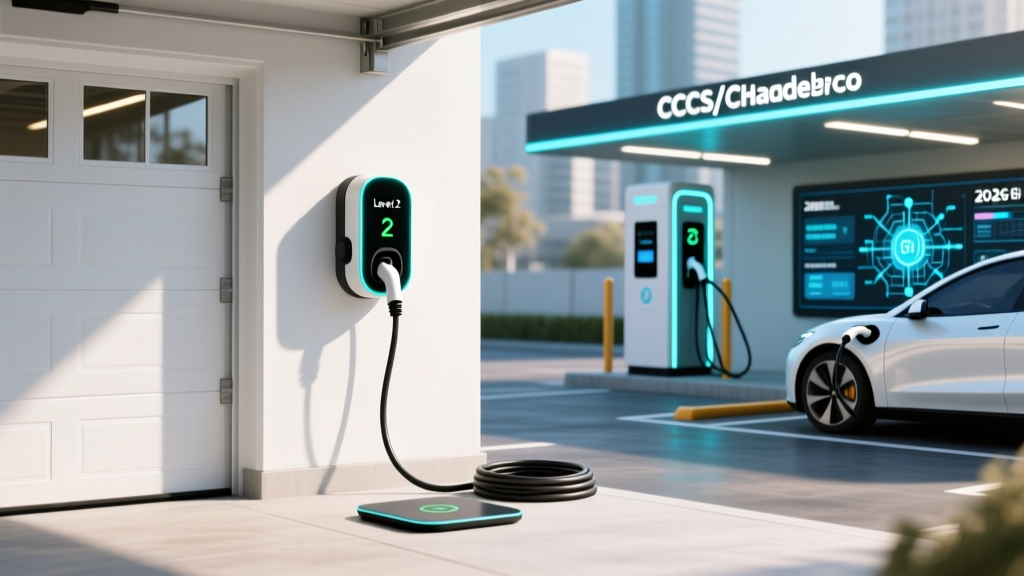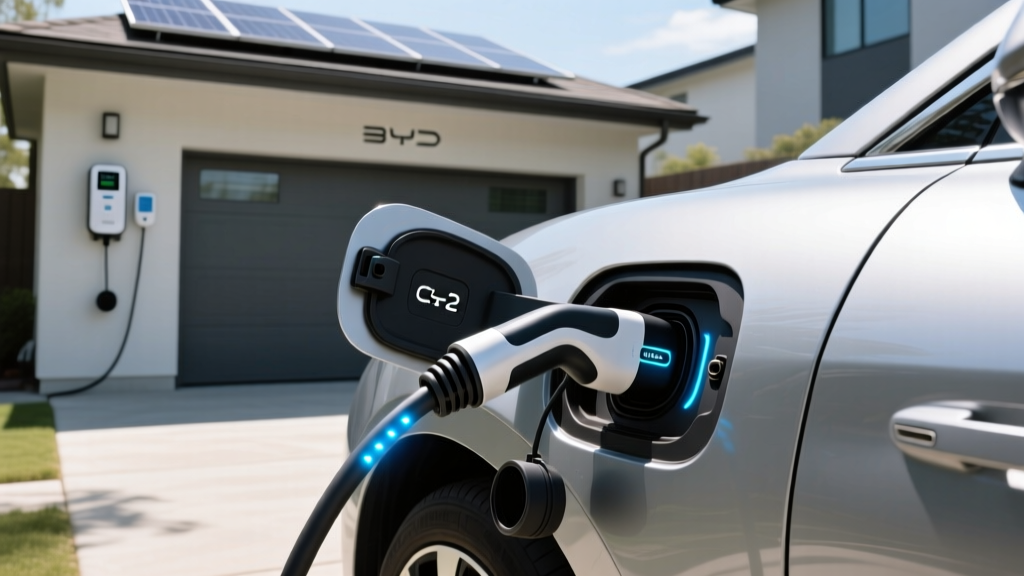
BYD has become the world's largest plug-in vehicle manufacturer by unit volume, and its Blade Battery (lithium iron phosphate, or LFP) platform is engineered for aggressive DC fast charging. But "fast" means different things depending on whether you are plugged into a 350 kW public stall, a 240-volt home wallbox, or a standard 120-volt outlet. This guide dissects BYD fast charging in practical terms: real charge curves, connector compatibility for North American buyers, and the exact electrical work required to charge a BYD at home in 2026.
- DC Fast Charge Peak: Up to 240 kW on Seal U / Atto 3 platforms (dual-gun capable)
- 10-80% DC Time: ~26-30 minutes (varies by pack size and ambient temperature)
- Level 2 Home (11 kW AC onboard): ~6-9 hours for a full charge
- Connector (US market): CCS1 or NACS depending on model year and adapter
Understanding BYD Fast Charging: kW vs kWh
The single most common confusion in EV charging is mixing up kW (kilowatts) and kWh (kilowatt-hours). Here is the distinction that matters for every BYD owner:
- kW = power (charge rate). This is how fast energy flows into the battery at a given moment. A 240 kW DC fast charger can theoretically push 240 kilowatts into the pack.
- kWh = energy (battery capacity). A BYD Seal with an 82.5 kWh battery holds 82.5 kilowatt-hours of usable energy — the "fuel tank" size.
Think of kW as the width of the hose and kWh as the size of the bucket. BYD's Blade Battery LFP chemistry is notable because it sustains higher charge rates deeper into the state of charge (SoC) than many NMC competitors. In testing, BYD packs have held above 80% of peak kW past 60% SoC, where NMC packs typically begin tapering aggressively. This means a BYD's average charge speed across a 10-80% session often beats vehicles with higher advertised peak kW numbers.
Charging Levels: How Fast Each Adds Range
| Level | Voltage / Amperage | Power (kW) | Miles of Range Added per Hour | Best Use Case |
|---|---|---|---|---|
| Level 1 | 120V / 12A | ~1.4 kW | ~3-5 mi/hr | Overnight top-up, emergencies |
| Level 2 | 240V / 48A | ~11.5 kW | ~30-40 mi/hr | Daily home charging |
| DC Fast | 400-800V DC | Up to 240 kW | ~600+ mi/hr (peak) | Road trips, rapid top-ups |
For a BYD Seal (82.5 kWh battery, ~310 miles EPA-estimated range), a full Level 2 session from 10% to 100% takes roughly 7-8 hours on an 11 kW onboard charger. That is overnight-friendly. DC fast charging from 10-80% takes approximately 26-30 minutes at a 240 kW-capable station, adding around 230 miles of range.
Connector Compatibility: NACS, CCS1, and BYD
BYD's connector strategy for the North American market has evolved as the industry shifts toward NACS (the Tesla-designed standard now adopted by Ford, GM, Rivian, and others). Here is where things stand for 2026 model-year BYD vehicles sold or planned for the US:
| Connector | BYD Compatibility | Adapter Needed? | Network Access |
|---|---|---|---|
| CCS1 | Native on most 2024-2025 global models | No (for CCS stations) | Electrify America, EVgo, ChargePoint |
| NACS | Expected native on 2026+ US-market models | CCS-to-NACS adapter for older models | Tesla Supercharger network (16,000+ stalls) |
| CHAdeMO | Not supported | N/A | Legacy network, declining |
If you are buying a BYD with a CCS1 port and plan to use Tesla Superchargers, budget $200-$300 for a certified CCS-to-NACS adapter. BYD has indicated that future US-market vehicles will ship with native NACS ports, aligning with the broader industry transition. Always verify the connector on your specific model year and trim before purchasing charging equipment.
Home Charger Installation: Requirements, Costs, and Panel Upgrades
Installing a Level 2 home charger for a BYD is straightforward in newer homes with 200-amp electrical panels, but older homes may need significant upgrades. Here is the full breakdown:
Electrical Requirements
- Circuit: Dedicated 240V / 50A or 60A circuit (breaker rated at 125% of continuous load, so a 48A charger needs a 60A breaker)
- Wire: 6 AWG copper (THHN in conduit) or 4 AWG aluminum for longer runs
- Outlet vs hardwired: NEMA 14-50 outlet offers portability; hardwired units allow higher amperage and avoid GFCI breaker requirements in some jurisdictions
- Permit: Required in virtually all US jurisdictions — typically $50-$200 depending on municipality
Installation Cost Breakdown
| Component | Simple Install (panel nearby) | Complex Install (long run / panel upgrade) |
|---|---|---|
| Level 2 Charger (hardware) | $400 - $700 | $400 - $700 |
| Electrician labor | $300 - $600 | $1,200 - $2,500 |
| Permit & inspection | $50 - $150 | $100 - $250 |
| Electrical panel upgrade (if needed) | N/A | $1,500 - $3,500 |
| Total Estimated Cost | $750 - $1,450 | $3,200 - $6,950 |
Federal Tax Credit for Home Charging Equipment
Under IRS §30C (the Alternative Fuel Vehicle Refueling Property Credit), homeowners may qualify for a tax credit covering up to 30% of home EV charger equipment and installation costs, capped at $1,000. Eligibility depends on census-tract income requirements and applies to the tax year of installation. Consult a tax professional or IRS.gov for current-year qualification details, as rules and eligible census tracts are updated annually.
Cost to Charge a BYD: Per-Mile Economics vs Gas
One of the strongest arguments for BYD ownership is charging cost. Here is a realistic comparison using a BYD Seal (82.5 kWh battery, ~310 miles EPA range, ~3.5 miles/kWh efficiency):
| Scenario | Rate ($/kWh) | Cost for Full Charge (82.5 kWh) | Cost Per Mile |
|---|---|---|---|
| Home off-peak (utility TOU rate) | $0.09 | $7.43 | $0.024 |
| Home standard rate | $0.16 | $13.20 | $0.043 |
| Public Level 2 (ChargePoint, etc.) | $0.25 | $20.63 | $0.067 |
| DC Fast Charging (Electrify America) | $0.48 | $39.60 | $0.128 |
| Gasoline car (28 MPG, $3.40/gal) | — | $37.64 (equivalent distance) | $0.121 |
Home off-peak charging delivers fuel cost at roughly one-fifth the per-mile cost of gasoline. Even DC fast charging is competitive with gas on a per-mile basis, though it should be reserved for road trips rather than daily use — both for cost and battery longevity. According to fueleconomy.gov, EVs charged at residential rates consistently cost 50-70% less per mile than comparable gasoline vehicles.
Recommended Home Charging Equipment for BYD Owners
BYD's onboard AC charger accepts up to 11 kW (single-phase) or 22 kW (three-phase, where available). For US residential 240V single-phase power, you will be limited to approximately 11.5 kW (48A). Here are three proven chargers matched to BYD specifications:
Emporia Level 2 Smart Charger
- Power Output: 48A / 11.5 kW (240V)
- Connector: NACS (J3400) native; CCS adapter available
- Cable Length: 24 feet
- Smart Features: Wi-Fi, energy monitoring, solar integration, scheduled charging, load management
- Price: ~$399
- Best For: Budget-conscious BYD owners wanting energy tracking
ChargePoint Home Flex
- Power Output: Up to 50A / 12 kW (240V, configurable)
- Connector: NACS or J1772 (select at purchase)
- Cable Length: 23 feet
- Smart Features: Wi-Fi, Alexa integration, ChargePoint network access, flexible amperage
- Price: ~$649
- Best For: BYD owners wanting network flexibility and adjustable amperage
Tesla Universal Wall Connector
- Power Output: 48A / 11.5 kW (240V)
- Connector: NACS + built-in J1772 adapter (Magic Dock style)
- Cable Length: 24 feet
- Smart Features: Wi-Fi, OTA updates, power sharing between two units
- Price: ~$599
- Best For: Multi-EV households (BYD + Tesla)
All three units are UL-listed, rated for indoor and outdoor use (NEMA 4), and compatible with BYD's 11 kW onboard charger. Hardwired installation is recommended over NEMA 14-50 outlets for maximum reliability and to avoid the GFCI breaker nuisance-tripping issues common with plug-in setups.
BYD DC Fast Charging on the Road: What to Expect
When using public DC fast chargers, BYD's Blade Battery LFP chemistry provides a tangible advantage. Unlike NMC batteries that taper sharply above 50-60% SoC, BYD's LFP cells maintain relatively flat charge curves. In real-world sessions on 350 kW-capable Electrify America stalls, a BYD Atto 3 (60.5 kWh pack) has demonstrated:
- 10-30%: Peak ~130 kW (ramp-up phase)
- 30-60%: Sustained ~120-140 kW
- 60-80%: Tapered to ~80-100 kW
- 80-100%: Drops below 40 kW (avoid charging past 80% on road trips)
For the larger BYD Seal (82.5 kWh, up to 240 kW peak on compatible chargers), expect 10-80% in approximately 26-30 minutes under optimal conditions (warm battery, preconditioned, 350 kW stall). Cold weather (below 40°F) can extend this to 35-45 minutes due to reduced charge acceptance until the battery warms.
Safety, Electrical Code, and Best Practices
EV charging equipment must comply with the National Electrical Code (NEC Article 625) and local amendments. Key safety requirements include:
- Dedicated circuit: Your Level 2 charger must be on its own breaker — never share a circuit with other appliances
- GFCI protection: NEC 2020+ requires GFCI for outdoor receptacles; hardwired installations may be exempt in some jurisdictions
- Outdoor rating: Any outdoor charger must be NEMA 4 rated (weatherproof). All recommended units above meet this standard
- Cable management: Avoid running charging cables across walkways or driveways where they create trip hazards or can be damaged by vehicles
- Ventilation: LFP batteries (like BYD's Blade) do not off-gas during normal charging, but the charging area should be free of flammable materials
Always hire a licensed electrician familiar with NEC Article 625 for EV charger installations. Permits and inspections protect your home insurance coverage and ensure the work meets code.
Frequently Asked Questions
How much does it cost to install a home EV charger for a BYD?
A straightforward Level 2 installation (panel nearby, no upgrade needed) typically costs $750-$1,450 including equipment, electrician labor, and permit. If your home needs a 200-amp panel upgrade or a long conduit run, total costs can reach $3,200-$6,950. Get at least two electrician quotes and ask about load-management alternatives to a full panel upgrade.
How fast will each charging level add range to my BYD?
Level 1 (120V) adds roughly 3-5 miles of range per hour — adequate only for overnight top-ups on small commutes. Level 2 (240V / 48A) adds approximately 30-40 miles per hour, fully recharging most BYD models overnight. DC fast charging adds 600+ miles per hour at peak rate, delivering 10-80% in 26-30 minutes on compatible stations.
Which connector is compatible with my BYD?
Most BYD models sold globally use CCS1 for DC fast charging and J1772/Type 2 for AC. For the US market, BYD is transitioning to NACS (the Tesla-standard connector) for 2026+ models. Check your specific vehicle's charge port and buy a charger with the matching connector, or use a certified adapter. CCS-to-NACS adapters cost $200-$300 and unlock Tesla Supercharger access.
How much does charging a BYD cost per mile compared to gas?
At home off-peak rates ($0.09/kWh), a BYD Seal costs approximately $0.024 per mile — about one-fifth the cost of a 28 MPG gasoline car at $3.40/gallon ($0.121/mile). Even at public DC fast-charging rates ($0.48/kWh), the cost is roughly $0.128/mile, comparable to gas. The savings compound significantly for drivers who charge primarily at home.
What electrical upgrades might I need for a BYD home charger?
If your home has a 200-amp electrical panel with available breaker slots, you likely need only a dedicated 60A circuit — no panel upgrade required. Homes with 100A or 150A panels, or panels with no open slots, may need a panel upgrade ($1,500-$3,500) or a smart load-management device that dynamically shares power between the charger and other circuits. An electrician's load calculation will determine your specific needs.
Does BYD's LFP Blade Battery degrade faster with DC fast charging?
LFP chemistry is inherently more resistant to degradation than NMC, even with frequent DC fast charging. BYD warranties the Blade Battery for 8 years / 100,000 miles (whichever comes first) with a minimum 70% capacity retention threshold. Real-world data from BYD fleet vehicles shows less than 10% degradation after 150,000+ miles, even with regular DC charging. Still, limiting DC fast charging to road trips and using Level 2 for daily needs maximizes long-term battery health.
Sources: U.S. Department of Energy / fueleconomy.gov; IRS §30C Alternative Fuel Vehicle Refueling Property Credit; BYD manufacturer specifications. Pricing and specifications reflect 2026 model-year data and are subject to change. Consult a licensed electrician for installation requirements specific to your home.