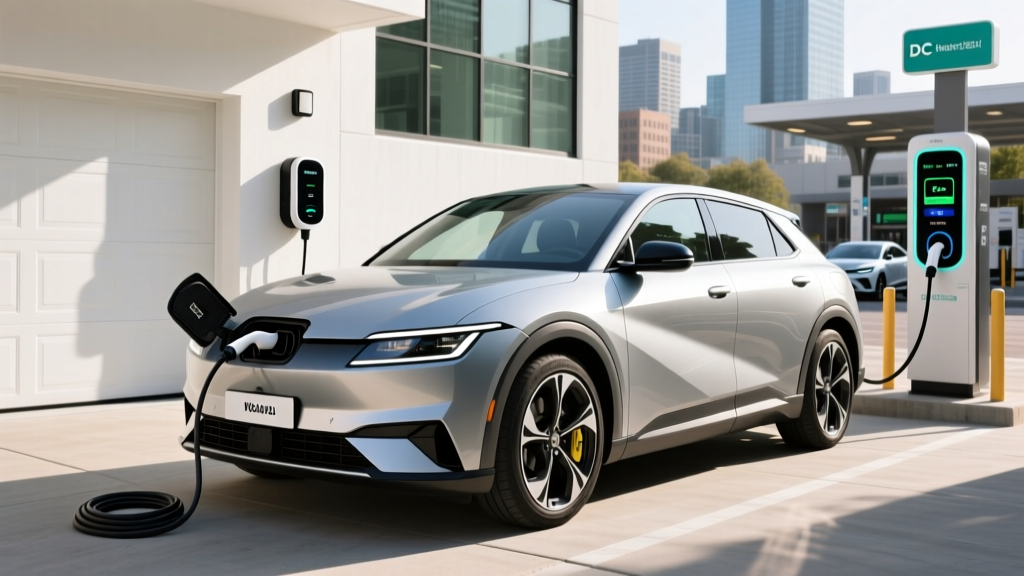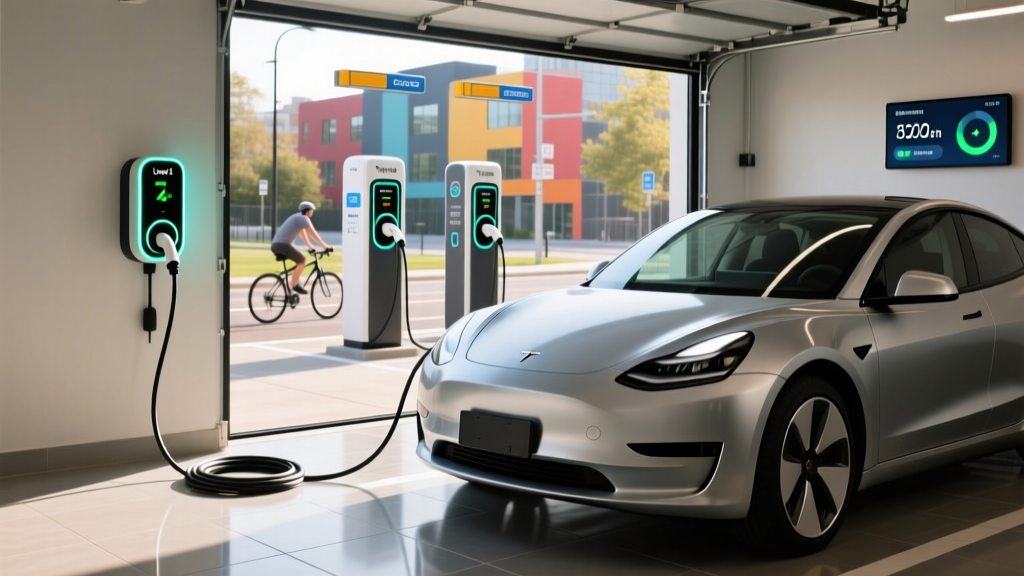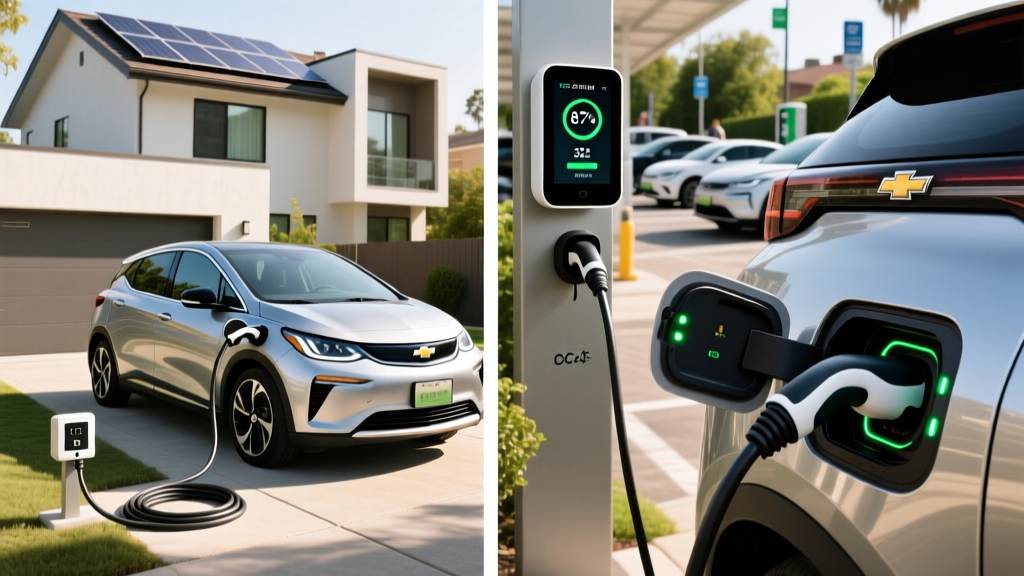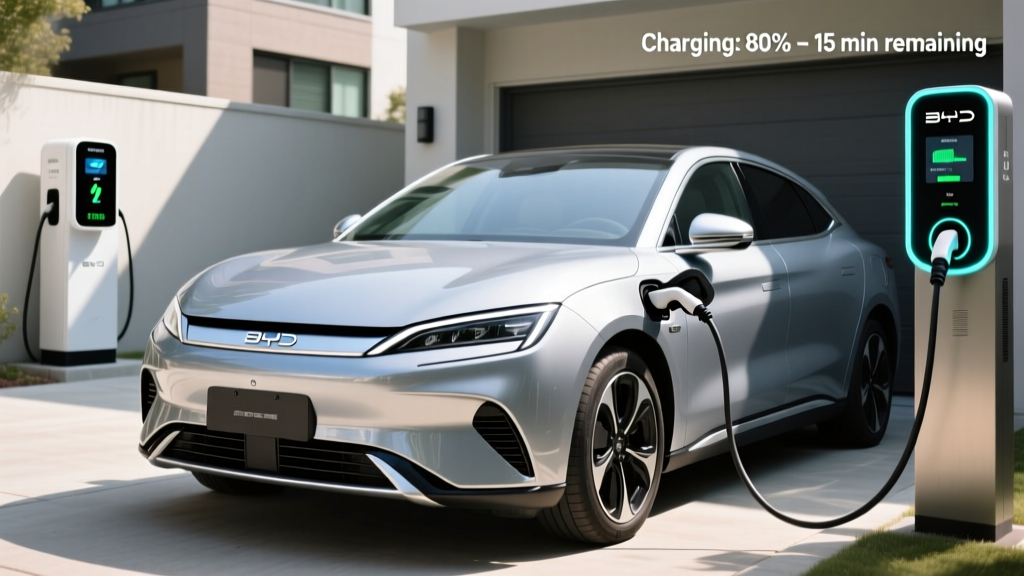
BYD's global expansion has put models like the Atto 3 (Yuan Plus), Seal, Dolphin, and Han EV on the radar of drivers worldwide. But before you plug in, you need to know exactly how long each model takes to charge, what equipment you need, and what it costs. This guide breaks down BYD charge time across every charging level, with real-world numbers for common BYD battery sizes and practical advice for setting up home charging.
kW (kilowatts) measures charging power — how fast energy flows into your car. kWh (kilowatt-hours) measures battery energy capacity — how much the battery holds. A 60 kWh battery charged at 7 kW takes roughly 8.5 hours from empty. Confusing these two is the most common EV mistake.
BYD Charge Time by Charging Level
Every BYD model supports three charging tiers, but the speed varies dramatically depending on the onboard charger rating and battery chemistry. BYD uses its proprietary Blade Battery (LFP — lithium iron phosphate) across most models, which accepts DC fast charging well but has slightly lower energy density than NMC packs.
| Level | Voltage / Amperage | Power (kW) | Miles of Range Added/Hour | Best Use Case |
|---|---|---|---|---|
| Level 1 | 120V / 12A | 1.4 kW | 3–5 mi/hr | Overnight top-off, emergencies |
| Level 2 | 240V / 32–48A | 7.7–11.5 kW | 22–38 mi/hr | Daily home charging, workplace |
| DC Fast Charge | 400–800V DC | 50–150+ kW | 150–400+ mi/hr (peak) | Road trips, rapid top-ups |
Most BYD models — including the Atto 3, Dolphin, and Seal — come with an onboard AC charger rated at 7 kW (single-phase) or 11 kW (three-phase, market-dependent). This means even if your Level 2 wallbox outputs 11.5 kW, a 7 kW-limited BYD will only draw 7 kW. Always check your specific model's AC charge acceptance rate.
BYD Model-by-Model Charge Time: 10–80% and Full Charge
Below are charge time estimates for popular BYD models based on their usable battery capacity and maximum charge rates. DC fast-charge times reflect the 10–80% state-of-charge window, where charging is fastest. Above 80%, the charge curve tapers significantly to protect battery health — a full 80–100% top-off can add another 20–40 minutes.
| Model | Battery (kWh usable) | Max DC kW | 10–80% DC Time | Max AC kW | Full Level 2 Time |
|---|---|---|---|---|---|
| BYD Dolphin (Standard) | 44.9 kWh (LFP Blade) | 60 kW | ~34 min | 7 kW | ~6.5 hrs |
| BYD Atto 3 (Yuan Plus) | 58.6 kWh (LFP Blade) | 80 kW | ~29 min | 7 kW | ~8.5 hrs |
| BYD Seal (Design/RWD) | 82.5 kWh (LFP Blade) | 150 kW | ~26 min | 11 kW | ~7.5 hrs |
| BYD Han EV | 85.4 kWh (LFP Blade) | 120 kW | ~30 min | 7 kW | ~12 hrs |
Home Charger Installation: Electrical Requirements, Costs & Panel Upgrades
Installing a Level 2 home charger is the single best investment for BYD ownership. It transforms your daily routine: plug in at night, wake up to a full battery every morning. But installation involves real electrical work, and costs vary widely depending on your home's panel capacity.
Electrical Requirements for a BYD Level 2 Charger
For a 7 kW charger (matching most BYD models' AC acceptance), you need a 240V circuit rated at 32–40 amps. The National Electrical Code (NEC) requires that continuous loads (like EV charging) use no more than 80% of a circuit's rated capacity. So a 40-amp circuit safely delivers 32 amps (7.7 kW), and a 50-amp circuit delivers 40 amps (9.6 kW).
- Minimum for 7 kW BYD charging: 240V / 40A dedicated circuit (NEMA 14-50 outlet or hardwired)
- Optimal for 11 kW-capable BYD models (Seal): 240V / 50–60A dedicated circuit
- Wire gauge: 6 AWG copper (40A) or 4 AWG copper (50–60A) — your electrician will specify
- GFCI protection: Required by NEC 2020+ for outdoor outlets; hardwired units may not require a GFCI breaker depending on local code
Home Charger Installation Cost Breakdown
| Item | Low End | High End | Notes |
|---|---|---|---|
| Level 2 Charger (Equipment) | $350 | $700 | Smart Wi-Fi chargers; basic units from $250 |
| Electrician Labor | $400 | $1,200 | Depends on run length from panel to garage |
| Electrical Permit | $50 | $200 | Required in most jurisdictions |
| Panel Upgrade (if needed) | $1,500 | $3,500 | 100A → 200A service upgrade for older homes |
| Total (No Panel Upgrade) | $800 | $2,100 | Typical for modern homes with 200A service |
| Total (With Panel Upgrade) | $2,300 | $5,600 | Homes with 100A or older panels |
The panel-upgrade question matters. If your home has a 100-amp electrical panel (common in homes built before the 1990s), adding a 40-amp EV circuit may overload your service. An electrician will perform a load calculation per NEC Article 220 to determine if an upgrade is needed. Homes with 200-amp service rarely need a panel upgrade for a single Level 2 charger.
Always hire a licensed electrician and pull a permit. Unpermitted EV charger installations can void home insurance claims and create fire hazards. Some utilities offer rebates of $250–$500 for Level 2 charger installation — check with your local provider before scheduling work.
Connector Compatibility: Which Plug Fits a BYD?
BYD's connector strategy depends heavily on your market. This is one area where BYD ownership requires careful attention, especially as the industry transitions from CCS to NACS (Tesla's North American Charging Standard).
| Connector | AC Charging | DC Fast Charging | BYD Models | Market |
|---|---|---|---|---|
| Type 2 (Mennekes) | ✓ Standard | — | All BYD models | Europe, Australia, most global |
| CCS2 | — | ✓ Standard | All BYD models | Europe, Australia, most global |
| GB/T | ✓ Standard | ✓ Standard | All BYD models | China (domestic) |
| CCS1 / NACS | TBD | TBD | Expected for US-bound models | North America (if BYD enters) |
As of 2026, BYD has not officially launched passenger EVs in the United States, so US-spec CCS1/NACS compatibility remains speculative. In Europe and Australia, BYD vehicles ship with Type 2 AC and CCS2 DC connectors as standard. If you're importing a BYD or buying in a market where CCS2 is standard, you'll need a CCS2-compatible home wallbox and CCS2 public chargers.
Adapter needs: In markets with mixed infrastructure (e.g., older CHAdeMO chargers alongside CCS2), a CCS2-to-CHAdeMO adapter is technically available but expensive ($500–$1,000) and not recommended for daily use. Stick to CCS2 or Type 2 infrastructure for reliability.
Cost to Charge a BYD: Home vs Public vs Gas
One of the strongest arguments for BYD ownership is fuel cost savings. LFP Blade Batteries are efficient, and electricity is cheaper than gasoline in most markets. Here's what charging actually costs.
| Scenario | Rate | Cost for 60 kWh (BYD Atto 3) | Cost Per Mile (Atto 3, 3.5 mi/kWh) |
|---|---|---|---|
| Home Off-Peak (US avg) | $0.13/kWh | $7.80 | $0.037 |
| Home Peak (US avg) | $0.22/kWh | $13.20 | $0.063 |
| Public Level 2 (avg) | $0.25/kWh | $15.00 | $0.071 |
| DC Fast Charge (avg) | $0.40/kWh | $24.00 | $0.114 |
| Gas Sedan (30 MPG, $3.40/gal) | $3.40/gallon | — | $0.113 |
Home off-peak charging delivers the best economics — roughly 3.7 cents per mile for a BYD Atto 3, compared to 11.3 cents per mile for a 30 MPG gas sedan at $3.40/gallon. That's a 67% reduction in per-mile fuel cost. Even DC fast charging at public stations is cost-competitive with gasoline, though it's not where you save the most.
Time-of-use (TOU) rates matter. Many utilities offer off-peak rates between 10 PM and 6 AM that are 30–50% cheaper than peak rates. A smart charger (see recommendations below) can automatically schedule charging during these windows. According to EIA electricity rate data, the US average residential rate is approximately $0.16/kWh, but TOU plans can push off-peak rates to $0.08–$0.12/kWh.
Recommended Level 2 Chargers for BYD Vehicles
Since most BYD models accept 7 kW AC (with the Seal supporting up to 11 kW), you want a charger that matches or slightly exceeds your car's onboard charger capacity. Here are top picks for BYD-compatible Level 2 chargers, based on reliability, smart features, and value.
ChargePoint Home Flex
- Power Output: Up to 12 kW (50A) — configurable to 16–50A
- Connector: Type 2 (EU/AU) or J1772 (NA) with CCS adapter
- Cable Length: 23 ft (7 m)
- Smart Features: Wi-Fi, app scheduling, Alexa integration, TOU optimization
- Price: ~$550–$650
- Best For: BYD Seal owners wanting max 11 kW AC; flexible amperage for panel-limited homes
Wallbox Pulsar Plus
- Power Output: Up to 9.6 kW (40A)
- Connector: Type 2 tethered (EU/AU)
- Cable Length: 13 ft or 23 ft options
- Smart Features: Wi-Fi + Bluetooth, Power Sharing (two chargers on one circuit), Eco-Smart mode
- Price: ~$450–$550
- Best For: BYD Atto 3 and Dolphin owners (7 kW AC limit); compact form factor
Tesla Universal Wall Connector
- Power Output: Up to 11.5 kW (48A)
- Connector: NACS built-in + integrated J1772/Type 2 adapter (Magic Dock)
- Cable Length: 24 ft (7.3 m)
- Smart Features: Wi-Fi, OTA updates, load sharing, Power-Share with two units
- Price: ~$600
- Best For: Multi-EV households (BYD + Tesla); future-proof NACS ecosystem
All three chargers are hardwired or plug into a NEMA 14-50 outlet. Hardwired installations are preferred for outdoor use because they avoid the GFCI breaker requirement that applies to outdoor receptacles under current NEC rules, and they allow higher amperage without a plug rating limitation.
Safety, Code & Best Practices for BYD Home Charging
EV charging is a high-draw, continuous electrical load — it runs for hours at maximum current. Proper installation and usage practices protect your home and your BYD's battery.
- Dedicated circuit: Your EV charger must be on its own dedicated breaker — never share a circuit with appliances, outlets, or lighting. This prevents overloads and nuisance tripping.
- GFCI protection: If you install a NEMA 14-50 outlet (rather than hardwiring), NEC 2020 and later requires a GFCI breaker for outdoor receptacles. GFCI breakers for 50A circuits cost $80–$150 and can occasionally nuisance-trip with certain chargers — hardwiring avoids this entirely.
- Outdoor rating: If your charger is mounted outside, ensure it carries a NEMA 4 or IP65 rating. All three recommended chargers above are outdoor-rated.
- Cable management: Use a holster or cable organizer to keep the charging cable off the ground. Tripping hazards and cable damage from vehicles running over cords are common installation oversights.
- Surge protection: A whole-home surge protector ($150–$300 installed) is good insurance for any smart charger with sensitive electronics, especially in areas with frequent lightning or grid instability.
- Permit and inspection: Your local building department will require an electrical permit and a post-installation inspection. This protects you legally and ensures the work meets code. An unpermitted installation can cause problems during a home sale or insurance claim.
BYD Blade Battery: Charging Tips for LFP Longevity
BYD's Blade Battery uses lithium iron phosphate (LFP) chemistry, which has different charging characteristics than the NMC (nickel manganese cobalt) batteries used in many competitors' EVs.
LFP advantages for charging:
- Can be charged to 100% regularly without significant degradation (BYD recommends 100% at least once per week for cell balancing)
- Superior thermal stability — less risk of thermal runaway during fast charging
- Longer cycle life: 3,000–5,000+ full charge cycles before reaching 80% capacity retention
LFP charging considerations:
- State-of-charge (SoC) estimation is less precise with LFP's flat voltage curve — your BYD's range display may be less accurate between 20–80% SoC. Periodic 100% charges recalibrate the BMS.
- Cold-weather DC fast charging is slower with LFP. If possible, precondition the battery (most BYD models do this automatically when a DC charger is set as the navigation destination).
- BYD's battery warranty typically covers 8 years / 160,000 km (or market equivalent) with a minimum 70% capacity retention threshold, per BYD's global warranty terms.
Frequently Asked Questions
How much does it cost to install a home EV charger for a BYD?
Expect $800–$2,100 for a standard Level 2 installation (equipment + electrician + permit) in a home with a modern 200-amp electrical panel. If your home has an older 100-amp panel that needs upgrading, total costs can reach $2,300–$5,600. Get at least two quotes from licensed electricians, and check with your utility for installation rebates before scheduling work.
How fast will each charging level add range to my BYD?
Level 1 (120V) adds roughly 3–5 miles of range per hour — essentially a trickle charge suitable only for overnight top-offs. Level 2 (240V, 7 kW) adds approximately 22–25 miles per hour for most BYD models, fully recharging an Atto 3 overnight in about 8.5 hours. DC fast charging at 80 kW (Atto 3) or 150 kW (Seal) can restore 10–80% in 26–34 minutes under optimal conditions.
Which connector and charger is compatible with my BYD?
In Europe, Australia, and most global markets, BYD vehicles use Type 2 for AC charging and CCS2 for DC fast charging. In China, the GB/T standard is used. BYD has not entered the US passenger EV market as of 2026, so CCS1/NACS compatibility for US models remains unconfirmed. Match your home wallbox connector to your vehicle's AC inlet — Type 2 in most non-US markets.
How much does charging a BYD cost per mile compared to gas?
Charging a BYD Atto 3 at home off-peak rates ($0.13/kWh) costs approximately $0.037 per mile. A comparable 30 MPG gas sedan at $3.40/gallon costs $0.113 per mile — roughly three times more. Even DC fast charging at $0.40/kWh ($0.114/mile) is competitive with gasoline. Home charging is where the savings are maximized.
What electrical upgrades might I need for a BYD home charger?
If your home has a 200-amp electrical panel (standard in most homes built after 2000), you likely need only a dedicated 40-amp circuit — no panel upgrade required. Homes with 100-amp panels, older wiring, or multiple high-draw appliances (electric range, heat pump, dryer) may require a panel upgrade to 200 amps, costing $1,500–$3,500. A licensed electrician will perform a load calculation to determine your specific needs. Some utilities and local programs offer rebates or low-interest financing for panel upgrades paired with EV charger installations — see ENERGY STAR incentive listings for current programs.
Can I use a Tesla Supercharger with my BYD?
Not directly. Tesla Superchargers use NACS (in North America) or CCS2 (in Europe, where some networks have opened to non-Tesla vehicles). In European markets where Tesla has opened Supercharger access to non-Tesla EVs, a BYD with a CCS2 inlet can use those stations through the Tesla app. In other markets, you'll rely on third-party DC fast-charging networks like Ionity, ChargePoint, or EVgo that support CCS2 natively.
Why does my BYD's charge speed slow down above 80%?
This is normal and intentional. DC fast charging follows a curve: peak power (e.g., 80 kW) is delivered at low state-of-charge, then tapers as the battery fills to prevent lithium plating and excessive heat. The 80–100% portion can take as long as the 10–80% portion. For road trips, plan to charge to 80% and move on — it's faster overall than waiting for 100%.