If you have been searching for a reliable home Level 2 EV charger, you may have come across the Bullit charger — a wall-mounted unit marketed toward EV owners who want straightforward, high-amperage charging without a subscription ecosystem. In this guide, we evaluate the Bullit charger alongside the broader question every new EV owner faces: how do you actually set up home charging, what does it cost, and what speeds can you expect?
Home charging is where 80% or more of EV charging happens for owners with garage or driveway access. Getting the equipment and electrical work right the first time saves thousands in avoidable upgrades and years of frustration with underpowered hardware. Below, we cover every layer — from the electrical panel to the plug in your car's charge port.
Understanding EV Charging Levels: Speeds That Actually Matter
Before evaluating any charger, including the Bullit, you need to understand the three charging levels and what they deliver in real-world terms. The most common mistake new EV buyers make is confusing kW (kilowatts — a measure of power, or how fast energy flows) with kWh (kilowatt-hours — a measure of energy capacity, or how big your battery is). Think of kW as the width of a hose and kWh as the size of the bucket.
| Level | Voltage | Power (kW) | Miles of Range Added/Hour | Typical Use Case |
|---|---|---|---|---|
| Level 1 | 120V AC | 1.0–1.4 kW | 3–5 mi/hr | Overnight top-ups, PHEVs, emergencies |
| Level 2 | 240V AC | 3.3–19.2 kW | 12–75 mi/hr | Daily home/workplace charging |
| DC Fast Charging | 400–800V DC | 50–350+ kW | 150–1,000+ mi/hr | Road trips, quick top-ups |
A Level 1 outlet (standard 120V household plug) is adequate for plug-in hybrids with small batteries — a Toyota RAV4 Prime with 18.1 kWh of usable capacity will fully recharge overnight. For a battery-electric vehicle with a 75–100 kWh battery, Level 1 is painfully slow: expect 30+ hours for a full charge. This is why Level 2 home installation is effectively mandatory for BEV owners who drive more than 30 miles daily.
DC fast charging bypasses the car's onboard charger and feeds DC current directly to the battery. Speeds here depend heavily on the vehicle's charge architecture. A Hyundai Ioniq 5 with its 800V system can peak at 240 kW and charge from 10–80% in roughly 18 minutes at a compatible station, while a 400V vehicle like the base Tesla Model Y peaks around 250 kW but sustains high rates for a shorter window. All charging tapers significantly above 80% state of charge (SoC) to protect battery health — the last 20% can take as long as the first 60%.
Bullit Charger: Hardware Specs and Real-World Performance
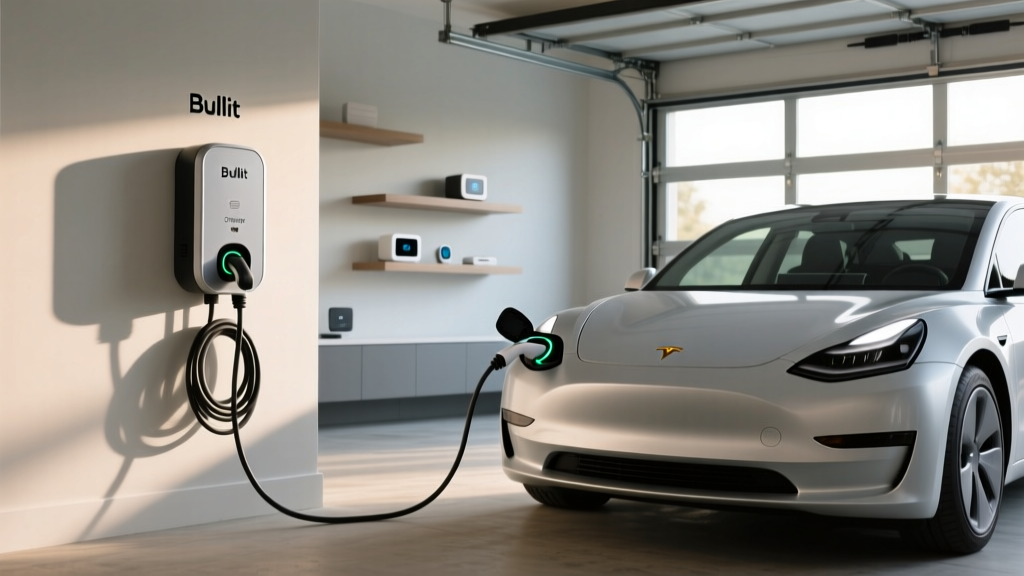
The Bullit charger is a Level 2, hardwired wall unit rated for up to 48 amps (11.5 kW on a 240V circuit). It uses a NACS (North American Charging Standard) connector natively, which as of 2025–2026 is the dominant connector adopted by Ford, GM, Rivian, Volvo, BMW, and most other major automakers alongside Tesla's existing fleet.
• Max output: 11.5 kW (48A / 240V)
• Connector: NACS (Tesla-standard plug)
• Cable length: 25 feet
• Circuit required: 60A dedicated breaker
• Smart features: Wi-Fi scheduling, energy monitoring via app
• Enclosure: NEMA 4 rated (indoor/outdoor)
• Price: ~$549 (street price, varies by retailer)
At 11.5 kW, the Bullit delivers roughly 35–44 miles of range per hour of charging for most EVs (efficiency varies from ~2.5 to 4.0 miles per kWh depending on the vehicle). A Chevrolet Equinox EV with an 85 kWh battery charging from 10–80% (about 59.5 kWh needed) would take approximately 5.5 hours — ideal for overnight charging. A Tesla Model 3 Long Range with ~75 kWh usable capacity needs roughly 52.5 kWh for a 10–80% session, taking about 4.5 hours on the Bullit.
Compared to a 32A (7.7 kW) charger like the basic ChargePoint Home Flex at lower amperage settings, the Bullit's 48A output charges roughly 50% faster. That difference matters if you drive a large-battery vehicle like an F-150 Lightning (131 kWh extended range) or if you need quick turnaround between two daily drives.
Home Installation: Electrical Requirements and Real Costs
The Bullit charger, like any 48A Level 2 unit, requires a 60-amp dedicated circuit on a 240V line. This is a hardwired installation — there is no plug to simply insert into an outlet. National Electrical Code (NEC) requires that continuous loads (like EV charging, which runs for hours) not exceed 80% of a circuit's rating, so a 48A charger needs a 60A breaker.
What Your Electrical Panel Needs to Handle
Before purchasing any charger, check your main electrical panel's total amperage. Most modern homes have 200A service. If your panel is already near capacity — running electric HVAC, an electric oven, an electric dryer, and a water heater — adding a 60A circuit may require a panel upgrade to 300A or 400A, or the installation of a secondary sub-panel. Older homes with 100A service will almost certainly need an upgrade.
Some EV owners opt for a lower-amperage charger (32A or 40A, requiring a 40A or 50A breaker respectively) to avoid panel upgrades. This is a legitimate trade-off: a 32A charger delivers 7.7 kW and roughly 25–30 miles of range per hour, which is still sufficient for overnight charging for most daily commutes under 80 miles.
Permit and Inspection Requirements
Virtually all jurisdictions require an electrical permit for a new 240V circuit. The permit ensures the work is inspected and meets NEC code — this protects your home insurance coverage in the event of an electrical fire. Permit costs typically range from $50 to $250 depending on your municipality. Skipping the permit is strongly discouraged; unpermitted electrical work can void homeowner's insurance claims and complicate a future home sale.
| Component | Typical Cost Range | Notes |
|---|---|---|
| Charger unit (Level 2, 32A–48A) | $350–$700 | Bullit ~$549; varies by brand/amperage |
| Electrician labor (standard install) | $500–$1,500 | Short run from panel to garage; longer runs cost more |
| Electrical permit | $50–$250 | Varies by municipality |
| Conduit, wiring, breaker | $150–$500 | Depends on run length and wire gauge (6 AWG for 60A) |
| Panel upgrade (if needed) | $1,500–$4,000 | 200A→300A/400A; not always required |
| Total (no panel upgrade) | $1,050–$2,950 | Most homes with 200A service |
| Total (with panel upgrade) | $2,550–$6,950 | Older homes or high-load panels |
The wide range in labor costs reflects a real variable: the distance from your electrical panel to the charger location. If the panel is in the basement and the charger goes in an attached garage on the same level, expect the lower end. If wiring must run 80+ feet through finished walls, an attic, or underground conduit to a detached garage, costs climb quickly. Get at least three quotes from licensed electricians — and confirm they have EV charger installation experience, as improper wire gauge or missing GFCI protection are common shortcuts.
Connector Compatibility: Will It Plug Into Your EV?
The EV charging connector landscape has consolidated significantly since 2024, when Ford and GM began adopting the NACS (Tesla's connector design, now standardized as SAE J3400). As of 2026, the landscape looks like this:
| Connector | Brands Using It Natively | Adapter Availability |
|---|---|---|
| NACS (J3400) | Tesla, Ford, GM, Rivian, Volvo, Polestar, BMW, Mercedes-Benz, Hyundai/Kia (select 2026 models) | CCS→NACS adapters widely available ($150–$300) |
| CCS1 | Hyundai/Kia (older models), Stellantis, VW (ID.4), some remaining 2025 models | NACS→CCS adapters available; CCS infrastructure declining |
| CHAdeMO | Nissan Leaf (legacy only — discontinued after 2025) | Adapters rare; network support minimal |
The Bullit charger ships with a NACS connector. If you drive a 2025–2026 Ford, GM, Rivian, Tesla, BMW, or Volvo EV, you can plug in directly. If you own an older CCS-equipped vehicle (such as a 2023 Hyundai Ioniq 5 or 2024 VW ID.4), you will need a NACS-to-CCS adapter — typically $150–$250 from reputable brands like Lectron or A2Z. These adapters add a small amount of resistance but do not meaningfully impact charging speed at Level 2.
Before purchasing the Bullit or any NACS charger, confirm your vehicle's charge port type. The transition period means 2024–2025 model year vehicles from the same brand may have different connectors depending on production date.
Cost to Charge: Home vs. Public vs. Gas per Mile
One of the strongest economic arguments for EV ownership is lower per-mile energy cost — but the savings depend heavily on where and when you charge. Here is a realistic comparison using national averages for 2026:
| Scenario | Cost per kWh | Cost per Mile (at 3.5 mi/kWh) | Annual Cost (12,000 mi) |
|---|---|---|---|
| Home, off-peak utility rate | $0.08–$0.14 | $0.023–$0.040 | $275–$480 |
| Home, standard residential rate | $0.14–$0.20 | $0.040–$0.057 | $480–$685 |
| Public Level 2 (ChargePoint, EVgo L2) | $0.25–$0.49 | $0.071–$0.140 | $857–$1,680 |
| DC Fast Charging (EA, Tesla Supercharger) | $0.32–$0.56 | $0.091–$0.160 | $1,097–$1,920 |
| Gasoline (28 MPG avg, $3.40/gal) | — | $0.121 | $1,457 |
Home off-peak charging delivers the largest savings — often 70–80% cheaper per mile than gasoline. Many utilities offer time-of-use (TOU) plans with rates as low as $0.06–$0.08/kWh between midnight and 6 AM. The Bullit charger's app-based scheduling feature lets you set charging windows to automatically align with these off-peak rates, which can cut your annual fuel cost below $300 for 12,000 miles of driving.
DC fast charging, however, narrows the gap significantly. At $0.48/kWh (a common Electrify America rate in 2026), your per-mile cost approaches or exceeds that of a fuel-efficient hybrid. This is why home charging infrastructure is not optional for cost-conscious EV owners — it is the primary economic driver.
Equipment Comparison: Bullit vs. Alternatives
The Bullit charger occupies a specific niche: high-amperage, NACS-native, hardwired, and competitively priced. Here is how it compares to other popular Level 2 home chargers in 2026:
• Max output: 11.5 kW (48A)
• Connector: NACS
• Cable: 24 ft
• Smart: Wi-Fi, OTA updates, power sharing
• Price: ~$475
• Best for: Tesla owners; power-sharing for multi-charger setups
• Max output: 12 kW (50A) configurable
• Connector: NACS (2025+ models); CCS (older)
• Cable: 23 ft
• Smart: App scheduling, Alexa, energy reports
• Price: ~$599
• Best for: Flexible amperage settings; detailed energy tracking
• Max output: 11.5 kW (48A)
• Connector: NACS
• Cable: 25 ft
• Smart: Wi-Fi scheduling, energy monitoring
• Price: ~$549
• Best for: Longest cable in class; straightforward no-subscription setup
• Max output: 11.5 kW (48A)
• Connector: NACS (2025+); J1772 (older)
• Cable: 24 ft
• Smart: Solar integration, whole-home energy monitoring
• Price: ~$399
• Best for: Solar homeowners wanting integrated energy management
If you prioritize cable reach — for instance, your charge port is on the opposite side of a two-car garage — the Bullit's 25-foot cable gives it a practical edge. If you want the deepest smart-home integration, ChargePoint or Emporia may serve you better. And if you own a Tesla and want multi-charger load balancing on a single circuit, the Tesla Wall Connector's power-sharing feature is unique.
Safety, Code, and Installation Best Practices
EV charging draws sustained high current for hours — this is fundamentally different from brief high-draw appliances like a microwave. Proper installation is not optional, and cutting corners creates fire risk.
- Dedicated circuit: Your Level 2 charger must be on its own dedicated breaker. Sharing a circuit with other 240V appliances (dryer, oven) is a code violation and a fire hazard.
- Wire gauge: A 60A circuit requires 6 AWG copper wire (or 4 AWG aluminum). For runs over 50 feet, your electrician may need to upsize to compensate for voltage drop.
- GFCI protection: NEC 2020 and later require GFCI protection for all EV charging receptacles. Hardwired installations like the Bullit may not require a GFCI breaker depending on local code interpretation — confirm with your inspector.
- Outdoor rating: If your charger is mounted outside (carport, exterior wall), it must carry a NEMA 4 or NEMA 4X rating for weather resistance. The Bullit is NEMA 4 rated and suitable for outdoor installation.
- Disconnect switch: Some jurisdictions require a visible disconnect switch within sight of the charger. Your electrician will know local requirements.
According to the National Fire Protection Association, EV charger installations must comply with NEC Article 625 (Electric Vehicle Charging System Equipment). Always hire a licensed electrician who pulls a permit — this protects your home, your insurance, and your resale value.
Federal and State Incentives for Home Charging
The federal Alternative Fuel Vehicle Refueling Property Credit (IRS Form 8911) offers a tax credit of up to 30% of the cost of home EV charging equipment and installation, capped at $1,000. This credit is available through 2032 but has geographic restrictions — it applies only to equipment installed in census tracts that are classified as low-income or non-urban. Check your eligibility using the IRS tool or consult a tax professional.
Many utilities also offer rebates of $200–$500 for purchasing and installing a smart Level 2 charger, and some provide free or discounted TOU rate enrollment. Check with your local utility's EV program page before purchasing — some utilities require pre-approval to qualify for rebates.
Frequently Asked Questions
How much does it cost to install a home EV charger?
Expect $1,050–$2,950 for a standard installation (charger + electrician + permit + materials) if your electrical panel has sufficient capacity. If a panel upgrade from 100A or 200A to 300A+ is needed, add $1,500–$4,000. Always get three quotes and verify the electrician will pull a permit.
How fast will each charging level add range?
Level 1 (120V) adds 3–5 miles per hour. Level 2 (240V) adds 12–75 miles per hour depending on amperage and vehicle efficiency. DC fast charging adds 150–1,000+ miles per hour but is used for quick top-ups, not daily charging. A 48A Level 2 charger like the Bullit adds roughly 35–44 miles per hour for most EVs.
Which connector/charger is compatible with my EV?
Check your vehicle's charge port. As of 2026, most new EVs from Tesla, Ford, GM, Rivian, BMW, and Volvo use NACS. Older Hyundai, Kia, VW, and Stellantis EVs use CCS1. The Nissan Leaf (now discontinued) used CHAdeMO. If your car's connector doesn't match your charger, adapters are available for $150–$300.
How much does charging cost per mile vs gas?
Home off-peak charging costs $0.02–$0.04 per mile — roughly 70–80% less than gasoline at $3.40/gal and 28 MPG. Standard home rates run $0.04–$0.06/mile. Public DC fast charging at $0.40–$0.56/kWh costs $0.09–$0.16/mile, approaching or exceeding gasoline costs.
What electrical upgrades might I need?
If your home has 200A service and moderate electrical loads, you likely need only a new 60A breaker and a wiring run. If your panel is older, already near capacity, or rated at 100A, you will need a panel upgrade to 300A or 400A — a $1,500–$4,000 job. Consider a lower-amperage charger (32A, requiring only a 40A breaker) as an alternative that may avoid the upgrade entirely.
Is the Bullit charger a good choice for my setup?
The Bullit is a strong option if you need a NACS-native, 48A hardwired charger with a longer-than-average 25-foot cable and don't want a subscription-based ecosystem. It is priced competitively at ~$549. If you need CCS compatibility, prefer a plug-in (NEMA 14-50) unit for portability, or want solar integration, other options in the comparison above may fit better.