Why EV Charging Feels Foreign After a Supercharged V6
If you've spent years listening to the Eaton M90 supercharger whine on a 2000 Buick Regal GS, the jump to an electric vehicle can feel like learning a new language. That 3.8L V6 produced 240 horsepower and sipped fuel at roughly 18 MPG city / 27 highway. You filled its 17.5-gallon tank in five minutes at any corner gas station. With an EV, "refueling" happens mostly at home while you sleep — but the vocabulary shifts to kilowatts, charge curves, and connector standards. This guide translates everything you need to know.
The single most important distinction in EV charging: kW (kilowatts) measures power — how fast energy flows, like water pressure from a hose. kWh (kilowatt-hours) measures energy — how much the battery holds, like the size of the bucket. A 75 kWh battery charged at 11 kW adds roughly 75 kWh ÷ 11 kW ≈ 6.8 hours from empty to full. Confusing the two is the #1 mistake new EV owners make.
Charging Levels Explained: Speed, Power, and Real-World Range Added
Every EV sold in the US supports three charging tiers. Here is what each actually delivers to your driveway or dashboard.
| Level | Voltage / Amps | Power (kW) | Miles of Range per Hour | Best Use Case |
|---|---|---|---|---|
| Level 1 | 120V / 12A | ~1.4 kW | 3–5 mi/hr | Overnight top-ups, PHEVs, low-mileage drivers |
| Level 2 | 240V / 32–48A | 7.7–11.5 kW | 25–44 mi/hr | Daily home charging, workplace, hotels |
| DC Fast Charge | 400–800V DC | 50–350 kW | 150–1,000+ mi/hr (peak) | Road trips, highway corridors |
A critical reality check on DC fast charging: the advertised peak kW (say, 250 kW on a Tesla V4 Supercharger) only holds for a narrow slice of the battery's state of charge — typically between 10% and 40% SoC. Above 80%, the charge curve tapers sharply to protect the battery cells. A "10–80% in 18 minutes" claim might become 80–100% in another 25 minutes. Plan your road-trip stops around 10–80% sprints, not full fills.
- Chevrolet Equinox EV (85 kWh battery, 150 kW peak DC): ~30 minutes
- Hyundai Ioniq 5 (77.4 kWh, 238 kW peak, 800V architecture): ~18 minutes
- Tesla Model Y Long Range (~75 kWh, 250 kW peak): ~25 minutes
- Ford F-150 Lightning Extended Range (131 kWh, 150 kW sustained): ~41 minutes
Home Charger Installation: What It Actually Costs
This is where most EV-curious buyers get sticker shock — or pleasant surprises. The final number depends heavily on your home's electrical panel age and the distance between that panel and your garage or driveway.
| Component | Typical Range | Notes |
|---|---|---|
| Level 2 EVSE hardware (charger unit) | $350 – $700 | 40A–48A smart chargers; Wi-Fi enabled |
| Electrician labor (240V circuit run) | $600 – $2,500 | Varies by wire distance, wall/floor penetration |
| Electrical permit | $50 – $200 | Required in most US jurisdictions |
| Panel upgrade (if needed) | $1,500 – $4,000 | Older 100A panels may need 200A service |
| Total (no panel upgrade) | $1,000 – $3,400 | Most homes built after 1990 |
| Total (with panel upgrade) | $2,500 – $7,400 | Common in pre-1980 homes |
If you're coming from a 2000 Buick Regal GS Supercharged, your home was likely built in an era with a 100-amp or 150-amp panel. A 48-amp EV charger requires a dedicated 60-amp breaker (NEC code mandates chargers run at only 80% of circuit capacity — so a 48A charger needs a 60A circuit). That dedicated circuit may push an older panel past its safe load, triggering the upgrade. Always get a licensed electrician's load calculation before committing. The US Department of Energy offers a solid pre-installation checklist.
What Electrical Upgrades Might I Need?
Beyond the panel, watch for these common gotchas:
- Service mast / meter base condition: Utility may require replacement if corroded before approving a 200A upgrade.
- Grounding electrode: Older homes may lack a modern Ufer ground or ground rod; code requires it.
- GFCI breaker requirement: NEC 2020 and later require GFCI protection on EV circuits in garages — this adds ~$50–$100 in breaker cost but is non-negotiable.
- Outdoor-rated installation: If your charger mounts outside, it must carry a NEMA 4 (weatherproof) rating, and the conduit must be rated for wet locations.
Connector Compatibility: NACS, CCS, and CHAdeMO in 2026
The connector landscape has consolidated dramatically. As of 2026, the North American Charging Standard (NACS) — originally Tesla's proprietary plug — is the dominant connector for new vehicles. Here's where each brand stands:
| Connector | Brands Using It (2026 Models) | Adapter Needed? |
|---|---|---|
| NACS (native) | Tesla, Ford, GM, Rivian, Volvo, Polestar, Mercedes, Fisker, Lucid (newer) | None for Tesla Superchargers |
| CCS1 | Hyundai, Kia, Volkswagen, BMW, Subaru, some Stellantis models | NACS-to-CCS adapter (~$100–$200) for Tesla Supercharger access |
| CHAdeMO | Nissan Leaf (legacy), Mitsubishi Outlander PHEV (older) | Limited public infrastructure; dwindling |
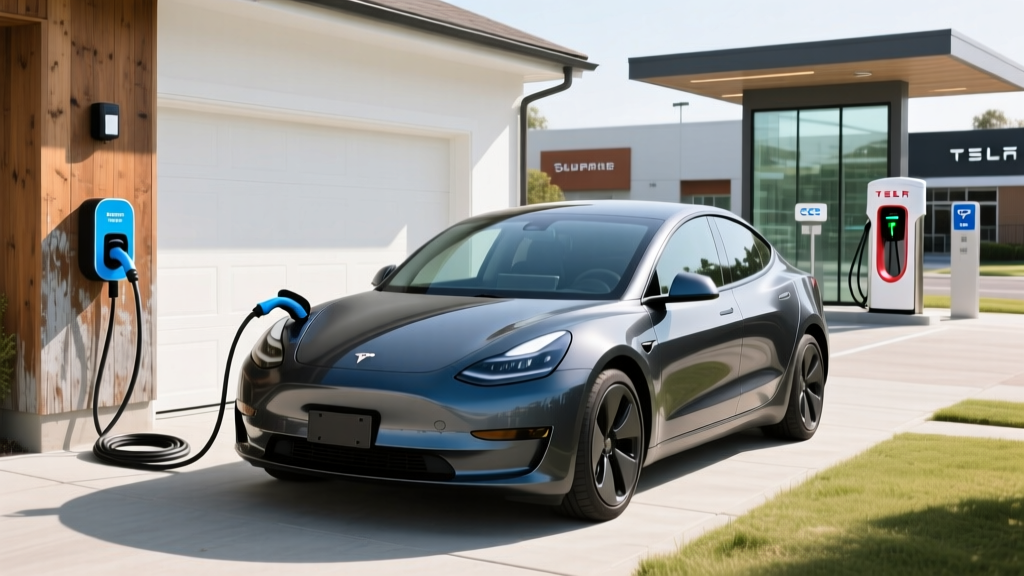
For Level 2 home charging, all EVs use the J1772 connector (or NACS, which includes J1772 signaling). Tesla ships a J1772 adapter with every vehicle, and most non-Tesla EVs now include a NACS adapter or have one available OEM. When buying a home charger, choose one with the connector that matches your vehicle natively — adapters add a failure point and slight efficiency loss.
Charging Cost Per Mile vs. Gasoline
This is where the Regal GS Supercharged's 20 MPG combined starts to sting. Let's run the numbers with real 2026 electricity and fuel prices.
| Scenario | Cost per kWh / Gallon | Vehicle Efficiency | Cost per Mile |
|---|---|---|---|
| Home charging (off-peak utility rate) | $0.13/kWh | 3.0 mi/kWh (typical EV) | $0.043 |
| Home charging (peak rate, no TOU plan) | $0.22/kWh | 3.0 mi/kWh | $0.073 |
| Public Level 2 (ChargePoint, EVgo) | $0.30/kWh | 3.0 mi/kWh | $0.10 |
| DC Fast Charging (Electrify America, Tesla) | $0.48/kWh | 3.0 mi/kWh | $0.16 |
| 2000 Buick Regal GS (gasoline) | $3.40/gallon | 20 MPG combined | $0.17 |
| 2026 gas sedan (30 MPG combined) | $3.40/gallon | 30 MPG | $0.113 |
At home off-peak rates, an EV costs roughly one-quarter what the Regal GS costs per mile. Even at DC fast-charger prices, most EVs match or beat a 20-MPG supercharged V6. Over 15,000 miles per year, the home-charging EV saves approximately $1,900 annually versus the Regal GS. Source: fueleconomy.gov EV side-by-side comparison tool.
Equipment Recommendations: Level 2 Chargers Worth Buying
ChargePoint Home Flex
- Power output: Up to 11.5 kW (48A) on a 60A circuit; configurable down to 16A
- Connector: J1772 (NACS adapter included for newer models)
- Cable length: 23 feet
- Smart features: Wi-Fi, app scheduling, utility TOU integration, Alexa
- Price: ~$549
Emporia Vue Level 2 Charger
- Power output: Up to 11.5 kW (48A)
- Connector: J1772 (NACS version available)
- Cable length: 24 feet
- Smart features: Real-time energy monitoring, solar integration, load management with Emporia panel sensors
- Price: ~$399
Tesla Wall Connector (Gen 4)
- Power output: Up to 11.5 kW (48A)
- Connector: NACS native (J1772 adapter available for non-Tesla EVs)
- Cable length: 24 feet
- Smart features: Wi-Fi updates, power sharing between two units, vehicle-charge scheduling
- Price: ~$450
Grizzl-E Smart
- Power output: Up to 10 kW (40A)
- Connector: J1772 or NACS (select at purchase)
- Cable length: 24 feet
- Smart features: OCPP-compatible, works with multiple apps, extreme cold-rated (-40°F)
- Price: ~$449
For most homeowners, the ChargePoint Home Flex or Emporia Vue offer the best balance of price, smart features, and configurability. If you drive a Tesla or a Ford/GM vehicle with native NACS, the Tesla Wall Connector eliminates the adapter hassle. Cold-climate buyers in Minnesota or Maine should consider the Grizzl-E for its rated low-temperature performance.
Safety, Code, and the Things Electricians Won't Skip
EV charging draws sustained high current for hours — more like a welder than a dryer. Shortcuts here cause fires. Non-negotiable code requirements include:
- Dedicated circuit: Your EV charger cannot share a breaker with any other outlet or appliance.
- 80% continuous-load rule: NEC Article 625 requires the charger's rated amperage to be no more than 80% of the breaker rating. A 48A charger demands a 60A breaker and 6-gauge copper wire (or 4-gauge aluminum).
- GFCI protection: Required on all garage and outdoor EV circuits since NEC 2020.
- NEMA 4 rating: Mandatory for any outdoor-mounted charger — protects against rain, ice, and hose spray.
- Permit and inspection: Skipping the permit voids your homeowner's insurance coverage for any electrical fire originating from the circuit. The National Electrical Code (NFPA 70) governs all of this.
A quality electrician will pull a permit, schedule an inspection, and provide a load calculation showing your panel can handle the added draw. If they suggest skipping the permit "to save you money," find another electrician.
Frequently Asked Questions
How much does it cost to install a home EV charger?
Most homes with a modern 200-amp panel spend $1,000–$3,400 total (charger + electrician + permit). Older homes needing a panel upgrade should budget $2,500–$7,400. Always get a licensed electrician's load calculation first.
How fast will each charging level add range?
Level 1 (120V) adds 3–5 miles per hour. Level 2 (240V) adds 25–44 miles per hour depending on amperage and vehicle efficiency. DC fast charging can add 150–1,000+ miles per hour at peak — but only for the 10–40% SoC window before tapering.
Which connector/charger is compatible with my EV?
Check your vehicle's charge port: NACS is now standard on Tesla, Ford, GM, Rivian, Volvo, and others. CCS1 is used by Hyundai, Kia, VW, BMW, and Subaru. CHAdeMO is limited to older Nissan Leafs. For home Level 2, all use J1772 signaling; buy a charger matching your car's native plug to avoid adapters.
How much does charging cost per mile vs. gas?
Home off-peak charging averages $0.04–$0.07 per mile. A 20-MPG gas car like the 2000 Buick Regal GS costs roughly $0.17/mile at $3.40/gallon. Even public DC fast charging at $0.48/kWh comes in around $0.16/mile — still competitive with gasoline.
What electrical upgrades might I need?
Homes with 100A or 150A panels often need a 200A service upgrade ($1,500–$4,000). You'll also need a dedicated 60A breaker, proper gauge wiring, GFCI protection, and possibly a new grounding electrode. The utility may require a service mast inspection before approving the upgrade.
Can I charge on a regular 120V outlet?
Yes — that's Level 1, using the mobile cord that ships with most EVs. At ~1.4 kW, you'll recover about 40 miles overnight (10 hours). It's sufficient for plug-in hybrids with small batteries or BEV owners who drive under 30 miles daily, but inadequate as a primary strategy for a 75+ kWh battery.