Why Buick's EV Lineup Demands a Charging Strategy
Buick's transition to an all-electric lineup by 2030 has produced vehicles like the 2025 Buick Electra E5 and the upcoming Electra E4, both built on GM's Ultium platform. While "supercharged Buick" might evoke the supercharged V6 engines of the Regal GS era, today's Buick owners need to think about a different kind of power delivery: kilowatts (kW) flowing into kilowatt-hours (kWh) of battery capacity.
Whether you own a Buick Electra E5 (87.9 kWh usable battery, NMC chemistry) or are planning to order one, your ownership experience hinges on your charging setup. A well-configured home Level 2 charger transforms daily driving into a plug-in-and-forget routine. A poorly planned setup means hunting for public chargers, waiting 45+ minutes at DC fast stations, or worse—discovering your home's electrical panel can't support a 48-amp charger.
This guide covers every charging decision you'll face as a Buick EV owner, from electrical panel requirements to real-world charging costs per mile.
Charging Levels Explained: Speed, Power, and Real-World Range Added
Before installing anything, understand the three charging levels and what they actually deliver. Note: kW measures power (the rate of energy flow), while kWh measures energy (the total battery capacity). A 19.2 kW Level 2 charger doesn't add 19.2 kWh per hour—it's less efficient due to onboard charger losses.
| Level | Voltage/Amps | Max Power (kW) | Miles Added/Hour | 10-80% Time (88 kWh battery) | Best Use Case |
|---|---|---|---|---|---|
| Level 1 | 120V / 12A | 1.4 kW | 3-5 mi/hr | ~45 hours | Emergency/overnight trickle |
| Level 2 | 240V / 32-48A | 7.7-11.5 kW | 22-37 mi/hr | 7-10 hours | Daily home charging |
| DC Fast | 400V+ / variable | 150-190 kW (peak) | 180-250 mi/hr (peak) | ~28 minutes | Road trips, quick top-ups |
Home Charger Installation: Electrical Requirements and Cost Breakdown
A Level 2 home charger is the single most impactful upgrade for Buick EV ownership. But installation costs vary dramatically based on your home's electrical infrastructure.
Electrical Requirements for Buick-Compatible Level 2 Chargers
Most Level 2 chargers suitable for Buick Ultium vehicles require:
- Circuit amperage: 40A (for 32A chargers) or 60A (for 48A chargers) dedicated circuit
- Voltage: 240V (standard dryer/outlet voltage)
- Wire gauge: 6 AWG copper for 40A circuits; 4 AWG for 60A circuits
- Breaker: Double-pole breaker sized 125% of continuous load (50A breaker for 40A charger)
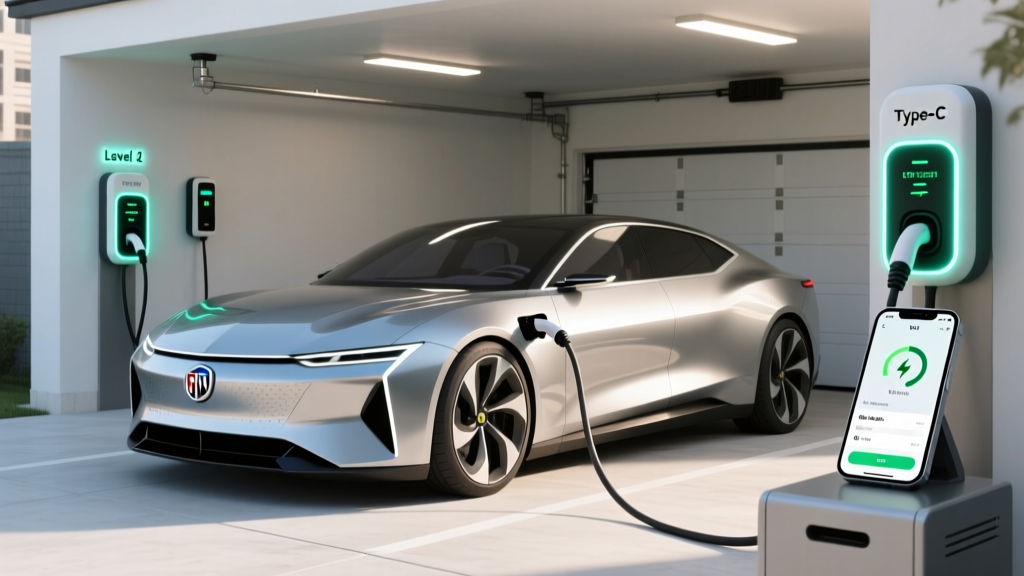
Your Buick Electra's 11.5 kW onboard charger can accept up to 48 amps. To fully utilize this, you need a 60A dedicated circuit. A 40A circuit (delivering 32A continuous) will charge at 7.7 kW—adequate for most daily needs but 33% slower than maximum capacity.
Installation Cost Breakdown
| Component | Simple Install (near panel) | Complex Install (long run/panel upgrade) |
|---|---|---|
| Level 2 Charger (hardware) | $400-$700 | $400-$700 |
| Electrician labor (2-4 hrs simple / 6-12 hrs complex) | $300-$600 | $900-$2,000 |
| Electrical permit | $50-$150 | $50-$150 |
| Conduit/wire materials (if >10 ft run) | $50-$150 | $200-$500 |
| Panel upgrade (100A to 200A service) | $0 (not needed) | $1,500-$3,000 |
| Total estimated cost | $800-$1,600 | $3,050-$6,350 |
Connector Compatibility: NACS, CCS, and the Buick Charging Ecosystem
GM's 2025 decision to adopt the North American Charging Standard (NACS) for all Ultium-based vehicles, including Buick, fundamentally changed the charging landscape for Buick owners.
| Connector Type | Physical Standard | Buick Compatibility | Network Access |
|---|---|---|---|
| NACS (Tesla-style) | SAE J3400 | Native on 2025+ Buick EVs | Tesla Supercharger (20,000+ stalls), Electrify America (partial), EVgo, others |
| CCS1 | SAE J1772 + DC pins | Requires NACS-to-CCS adapter (included with some models) | Electrify America, EVgo, ChargePoint DC stations |
| CHAdeMO | Legacy Japanese standard | Not compatible (no adapter available) | Limited relevance; being phased out |
What this means practically: A 2025 Buick Electra E5 with native NACS can access Tesla's Supercharger network directly—no adapter required. This adds approximately 20,000 DC fast charging stalls to your road-trip network. For CCS-only public chargers (still common at Electrify America locations), you'll need a NACS-to-CCS adapter, typically $150-$250 from manufacturers like Tesla or third-party suppliers.
For Level 2 home charging, all NACS-equipped Buicks still accept the J1772 connector (the NACS plug is backward-compatible with J1772 for AC charging). This means you can use any standard J1772 Level 2 charger at home without an adapter.
Level 2 Charger Equipment Recommendations for Buick EVs
Not all Level 2 chargers are equal. Here are three proven options matched to Buick's Ultium platform capabilities:
ChargePoint Home Flex (Best Overall)
- Power output: Up to 12 kW (50A adjustable down to 16A)
- Connector: J1772 (compatible with Buick NACS AC charging)
- Cable length: 23 feet
- Smart features: Wi-Fi, scheduling, energy tracking, Alexa integration
- Price: $549-$649
- Why it works for Buick: Adjustable amperage lets you match your circuit capacity (set to 48A on a 60A circuit to max out the Electra's 11.5 kW onboard charger)
Emporia Vue Level 2 (Best Budget)
- Power output: Up to 11.5 kW (48A)
- Connector: J1772
- Cable length: 24 feet
- Smart features: Wi-Fi, solar integration, load management, app control
- Price: $349-$399
- Why it works for Buick: Full 48A output matches Buick's onboard charger capacity; load management feature prevents panel overload in older homes
Grizzl-E Smart (Best for Harsh Climates)
- Power output: Up to 10 kW (40A)
- Connector: J1772
- Cable length: 24 feet
- Smart features: OCPP-compatible, extreme temp rating (-40°F to 122°F), IP67 outdoor rating
- Price: $499-$599
- Why it works for Buick: Built for unheated garages and outdoor installation in cold climates where Buick EVs lose 20-30% range in winter
Safety and code considerations: All installations must comply with NEC Article 625 (Electric Vehicle Charging System Equipment). Key requirements include a dedicated circuit (no shared loads), GFCI protection for outdoor installations (NEC 2023 update), and a disconnecting means within sight of the charger. Outdoor installations require NEMA 4-rated (weatherproof) enclosures. Always hire a licensed electrician who pulls a permit—unpermitted work can void home insurance coverage and create fire hazards.
Charging Cost Analysis: Home vs. Public vs. Gas Comparison
One of the strongest arguments for Buick EV ownership is fuel cost savings—but the math depends heavily on where and when you charge.
| Charging/Fueling Scenario | Cost per kWh/Gallon | Efficiency | Cost Per Mile | Annual Cost (12,000 mi) |
|---|---|---|---|---|
| Home Level 2 (off-peak utility rate) | $0.08-$0.12/kWh | 3.0 mi/kWh (100 MPGe) | $0.027-$0.040 | $320-$480 |
| Home Level 2 (standard utility rate) | $0.14-$0.18/kWh | 3.0 mi/kWh | $0.047-$0.060 | $560-$720 |
| Public Level 2 (network pricing) | $0.25-$0.40/kWh | 3.0 mi/kWh | $0.083-$0.133 | $1,000-$1,600 |
| DC Fast Charging (public) | $0.35-$0.55/kWh | 3.0 mi/kWh | $0.117-$0.183 | $1,400-$2,200 |
| Gasoline (25 MPG midsize SUV) | $3.40/gallon (2025 avg) | 25 MPG | $0.136 | $1,632 |
Key takeaway: Home charging at off-peak rates delivers 75-80% fuel cost savings versus gasoline. Even standard-rate home charging saves 60-70%. However, exclusive reliance on DC fast charging erases most savings and can actually cost more than gas. According to fueleconomy.gov, the Buick Electra E5 achieves approximately 100 MPGe combined (3.0 miles per kWh).
For a Buick Electra E5 with an 87.9 kWh usable battery:
- Home full charge (off-peak): $7.03-$10.55
- Home full charge (standard): $12.31-$15.82
- DC fast charge (10-80%, ~62 kWh): $21.70-$34.10
- Equivalent gas fill-up (14 gallons for ~350 miles): $47.60
Public Charging Network Access for Buick Owners
With native NACS compatibility, 2025+ Buick EVs access the largest DC fast charging network in North America: Tesla Superchargers. But network access extends well beyond Tesla.
Primary DC fast charging networks for Buick NACS-equipped vehicles:
- Tesla Supercharger: 20,000+ stalls, 150-250 kW peak speeds, $0.25-$0.40/kWh average. Buick EVs access via native NACS plug. Expect 150-190 kW peak on Buick (limited by vehicle, not station).
- Electrify America: 4,000+ stalls, up to 350 kW. NACS-equipped Buicks need NACS-to-CCS adapter for most EA stations (EA is adding NACS connectors through 2026).
- EVgo: 3,500+ stalls, adding NACS connectors. GM has a partnership providing discounted EVgo rates for Ultium EV owners.
- ChargePoint: Primarily Level 2 network; DC fast locations accept J1772/NACS.
Real-world public charging tip: Precondition your Buick's battery before arriving at a DC fast charger. Navigate to the charger in the infotainment system 15-20 minutes before arrival. This warms the battery to optimal temperature (approximately 95°F), enabling peak 190 kW charge rates. Without preconditioning, cold batteries (< 60°F) may limit charging to 80-100 kW, adding 10-15 minutes to your session.
Federal Tax Credits and Utility Rebates for Home Charging
As of 2025-2026, the IRS §30C Alternative Fuel Vehicle Refueling Property Credit offers up to $1,000 (30% of equipment + installation, capped at $1,000) for home EV charger installation. Key requirements:
- Charger must be installed at your primary residence
- Property must be located in an eligible census tract (low-income or non-urban area—check IRS eligibility tool)
- Equipment must be new and primarily for residential use
- Income limits apply: Modified AGI cannot exceed $150,000 (single) / $300,000 (married filing jointly) in the year of installation or the prior year
Many utilities offer additional rebates. Examples include $300-$500 off Level 2 charger hardware, time-of-use rate plans with off-peak charging discounts, and free or discounted panel upgrades. Contact your local utility before purchasing equipment.
Frequently Asked Questions
How much does it cost to install a home EV charger for a Buick?
Simple installations (charger near electrical panel, adequate panel capacity) cost $800-$1,600 including equipment, electrician labor, and permit. Complex installations requiring long wire runs or panel upgrades cost $3,000-$6,350. The variable is almost always electrical infrastructure, not the charger itself.
How fast will each charging level add range to my Buick Electra?
Level 1 (120V) adds 3-5 miles per hour—too slow for daily use. Level 2 (240V/48A) adds 30-37 miles per hour, fully recharging an 88 kWh battery overnight in 8-10 hours. DC fast charging adds 180-250 miles per hour at peak rates, achieving 10-80% in approximately 28 minutes on Buick's Ultium platform.
Which connector/charger is compatible with my Buick EV?
2025+ Buick EVs use the NACS (Tesla-style) connector natively. For home Level 2 charging, any J1772 charger works (NACS is backward-compatible with J1772 for AC charging). For DC fast charging at non-Tesla networks, you may need a NACS-to-CCS adapter ($150-$250). CHAdeMO is not compatible.
How much does charging a Buick cost per mile vs. gas?
Home charging at off-peak rates costs $0.027-$0.040 per mile (75-80% savings vs. gas at $0.136/mile). Standard-rate home charging costs $0.047-$0.060/mile (55-65% savings). DC fast charging costs $0.117-$0.183/mile, which can exceed gasoline costs depending on network pricing.
What electrical upgrades might I need for a Level 2 charger?
You need a dedicated 240V circuit: 40A (for 32A chargers) or 60A (for 48A chargers). Homes with 100A or 150A service panels may need a panel upgrade to 200A ($1,500-$3,000) to add this load safely. An electrician must perform a load calculation to determine if your panel has adequate capacity. Older homes (pre-1990) and homes with significant existing loads (electric heat, hot tubs, multiple EVs) are most likely to need upgrades.
For the most current Buick EV specifications, consult Buick's official EV page. Federal tax credit rules change frequently—verify eligibility at irs.gov before purchasing equipment. All installation work should be performed by a licensed electrician in compliance with local building codes.