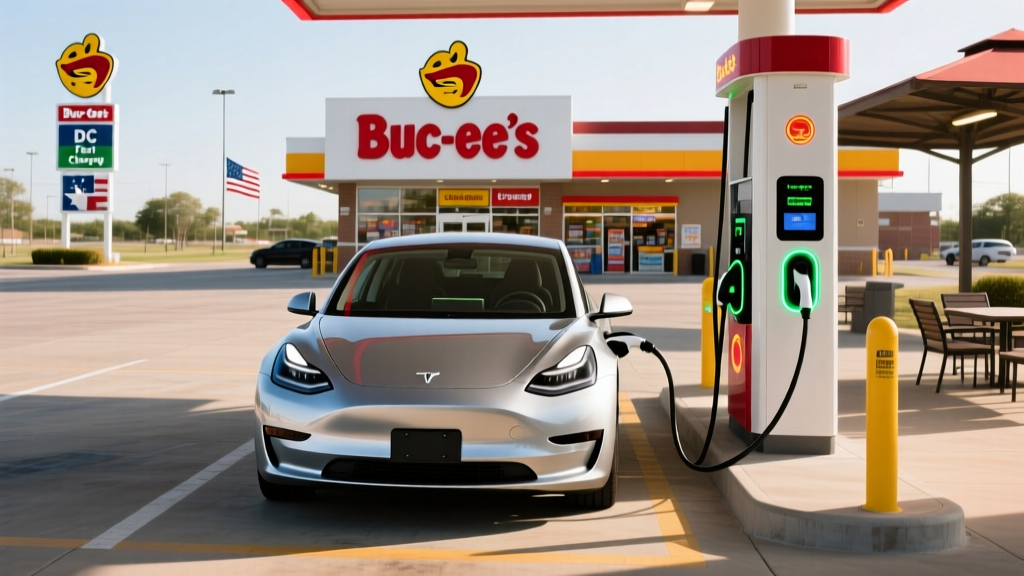
If you've ever driven through Texas, you know Buc-ee's isn't just a gas station — it's a cultural institution. Clean restrooms, brisket sandwiches, and enough beaver nuggets to fill a pickup truck bed. But for EV owners, the bigger draw in 2026 is the growing network of Buc-ee's charging station plazas equipped with DC fast chargers capable of getting you back on the road in under 25 minutes.
This guide breaks down exactly what you'll find at Buc-ee's EV charging locations: connector types, peak charge rates, real-world costs, and how to pair a Buc-ee's stop with a solid home-charging setup so road trips remain a fraction of what gas would cost you.
What Connectors and Speeds Are at a Buc-ee's Charging Station?
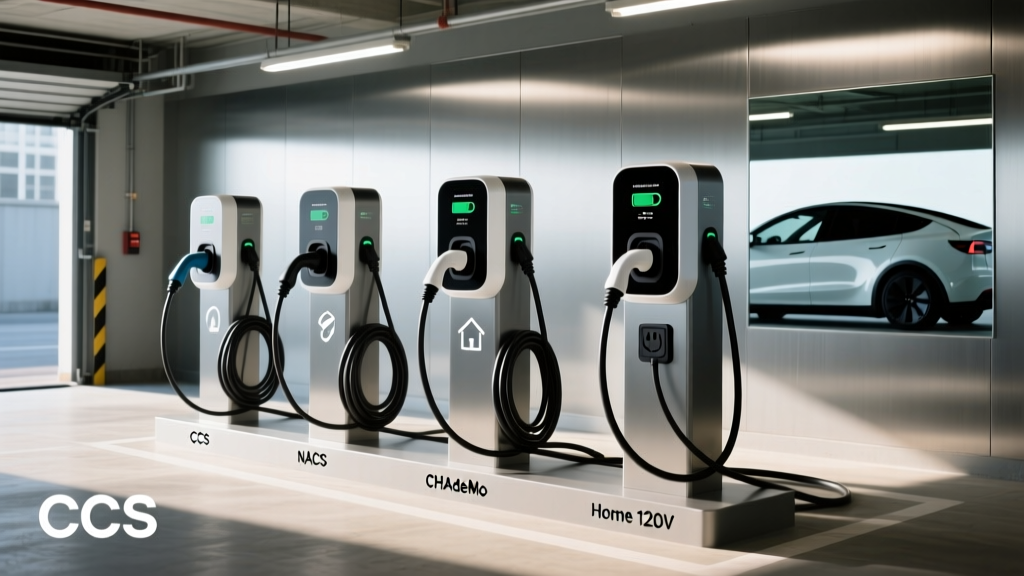
Buc-ee's has partnered with multiple charging networks over the past few years, most notably Electrify America and Tesla Superchargers. The exact hardware varies by location, but most Texas and Southeast Buc-ee's plazas now offer a mix of the following:
| Connector | Common Networks at Buc-ee's | Vehicles Supported | Adapter Needed? |
|---|---|---|---|
| NACS (Tesla) | Tesla Superchargers (V3/V4) | Tesla Model 3/Y/S/X; 2025+ Ford, GM, Rivian, Hyundai, Kia | None for native NACS; CCS vehicles need NACS-to-CCS adapter |
| CCS1 | Electrify America, EVgo | Most 2020-2024 non-Tesla EVs (VW, BMW, Kia, Hyundai) | NACS vehicles need CCS-to-NACS adapter (Magic Dock at some EA stalls) |
| CHAdeMO | Largely phased out | Nissan Leaf (older models) | No adapter available — CHAdeMO stalls are disappearing |
As of early 2026, the majority of new Buc-ee's plazas feature NACS-native Tesla Superchargers alongside Electrify America CCS/NACS dual-cable dispensers. If you drive a 2025+ model with a factory NACS port (Ford F-150 Lightning, GM Ultium vehicles, Hyundai Ioniq 5 refresh), you can plug in directly. Older CCS1 vehicles will need a Ford-approved NACS adapter or similar OEM adapter for Tesla stalls.
DC Fast Charging Speeds: What to Expect at Buc-ee's
Buc-ee's charging stations are built for throughput — you're meant to grab a snack, use the restroom, and get back on the highway. Here's what the hardware actually delivers:
| Charging Level | Power (kW) | Typical Miles Added per Hour | Where You'll Find It |
|---|---|---|---|
| Level 1 (120V) | 1.0–1.4 kW | 3–5 mi/hr | Home standard outlet — not at Buc-ee's |
| Level 2 (240V) | 7.2–19.2 kW | 20–60 mi/hr | Home wall chargers, some destination chargers |
| DC Fast (CCS/NACS) | 50–350 kW | 150–1,200+ mi/hr (peak) | Buc-ee's EA and Supercharger stalls |
At a 350 kW Electrify America stall at a newer Buc-ee's, a vehicle like the Hyundai Ioniq 5 (84 kWh battery, NMC chemistry) can accept up to 240 kW peak and charge from 10–80% in roughly 18 minutes. A Tesla Model Y at a V4 Supercharger (up to 250 kW) will do 10–80% in about 20–22 minutes.
Real-world caveat: Peak kW is not sustained kW. The charging curve tapers significantly above 80% SoC to protect battery health. If you arrive at 30% SoC, your average charge rate might be 140–160 kW, not the 350 kW the dispenser advertises. Plan your stops to arrive between 10–20% SoC for the fastest session.
How Much Does Charging at Buc-ee's Cost Per Mile vs. Gas?
Buc-ee's DC fast chargers are convenient, but convenience comes at a premium compared to home charging. Here's how the math breaks down in 2026:
| Scenario | Cost per kWh | Vehicle Efficiency | Cost per Mile |
|---|---|---|---|
| Home Level 2 (off-peak utility rate) | $0.09–$0.13 | 3.5 mi/kWh (avg EV) | $0.026–$0.037 |
| Home Level 2 (peak utility rate) | $0.18–$0.25 | 3.5 mi/kWh | $0.051–$0.071 |
| Buc-ee's EA DC Fast Charger | $0.38–$0.52 | 3.5 mi/kWh | $0.109–$0.149 |
| Tesla Supercharger at Buc-ee's | $0.28–$0.36 | 3.8 mi/kWh (Model Y) | $0.074–$0.095 |
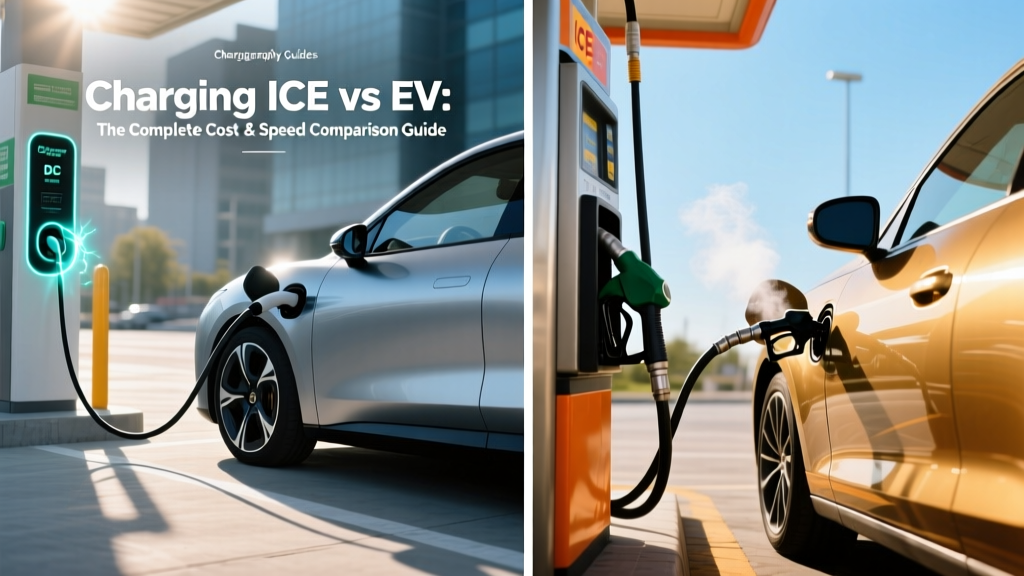
| Gas station (87 octane, $3.10/gal) | — | 28 MPG (avg ICE) | $0.111 |
Even at DC fast-charging rates, most EVs still beat or match the per-mile cost of a 28 MPG gas car. But the real savings come from home Level 2 charging, where the cost per mile drops to roughly $0.03 — a 70%+ savings over gasoline. According to fueleconomy.gov, the average EV achieves 3.0–4.0 miles per kWh depending on weight, aerodynamics, and climate conditions.
Home Charging Setup: Electrical Requirements and Install Costs
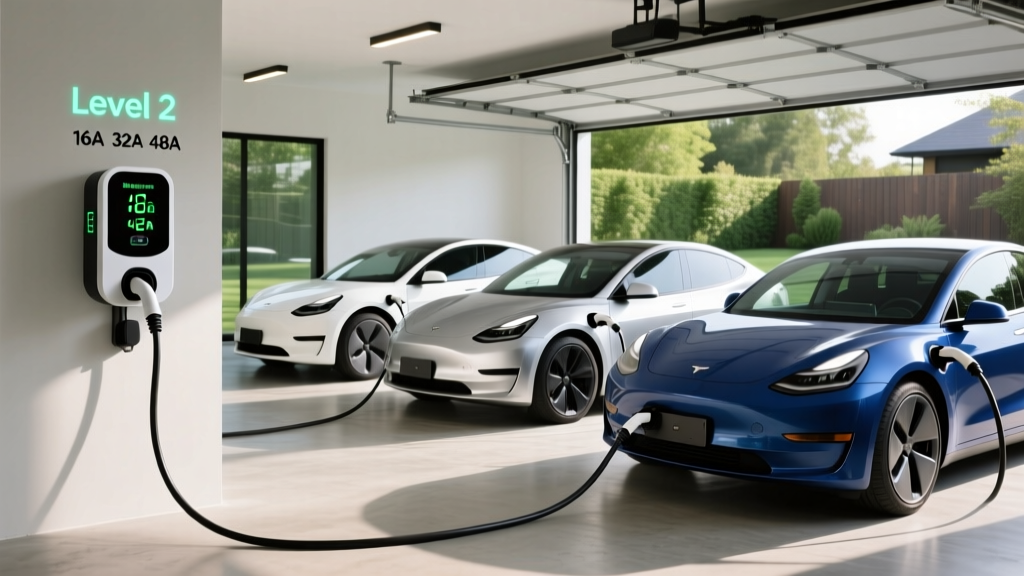
Road-trip charging at a Buc-ee's charging station is only part of the equation. Most EV owners do 80–90% of their charging at home on a Level 2 circuit. Here's what a proper home installation requires:
Electrical Requirements
- Circuit: Dedicated 240V circuit, typically 40A–60A breaker
- Continuous draw rule: NEC requires the charger to draw no more than 80% of the circuit rating (a 40A breaker supports a 32A charger; a 60A breaker supports a 48A charger)
- Wire gauge: 6 AWG copper for 40–50A circuits; 4 AWG for 60A
- GFCI protection: Required for outdoor installations per NEC 2023/2026 code
- NEMA 14-50 outlet vs. hardwired: A hardwired connection avoids GFCI nuisance tripping and supports higher amperage (48A+); a NEMA 14-50 outlet offers portability
Panel Upgrade Considerations
Many older homes have 100A electrical panels. Adding a 40–60A EV circuit may exceed your panel's capacity, especially if you already run electric range, dryer, and HVAC. A panel upgrade to 200A typically costs $1,500–$3,000 and is the single biggest variable in installation pricing.
| Component | Cost Range | Notes |
|---|---|---|
| Level 2 charger equipment | $300–$700 | Depends on power output and smart features |
| Electrician labor (no panel upgrade) | $500–$1,500 | Varies by run length from panel to garage |
| Permit fees | $50–$250 | Required in most municipalities |
| Panel upgrade (if needed) | $1,500–$3,000 | 100A to 200A service upgrade |
| Total (no panel upgrade) | $850–$2,450 | Typical scenario for newer homes |
| Total (with panel upgrade) | $2,350–$5,450 | Older homes with 100A service |
Always hire a licensed electrician and pull a permit. Unpermitted EV charger installations can void homeowner's insurance claims and create fire risk. The National Electrical Code (NEC) governs EV charging installations, and local amendments may apply.
Recommended Home Chargers for Every Budget
Before you pull up to a Buc-ee's charging station on your next road trip, make sure your home setup is dialed in. Here are three proven Level 2 chargers that pair well with daily driving:
Best Overall: ChargePoint Home Flex
- Power output: Up to 12 kW (50A, adjustable down to 16A)
- Connector: NACS or J1772 (select at purchase)
- Cable length: 23 feet
- Smart features: Wi-Fi, app scheduling, energy tracking, Alexa integration
- Price: ~$599–$649
Best Value: Emporia Level 2 EV Charger
- Power output: Up to 11.5 kW (48A)
- Connector: J1772 (NACS adapter included for newer versions)
- Cable length: 24 feet
- Smart features: Wi-Fi, app control, solar integration, energy monitoring
- Price: ~$349–$399
Premium Pick: Tesla Wall Connector
- Power output: Up to 11.5 kW (48A on 60A circuit)
- Connector: NACS native (J1772 adapter available)
- Cable length: 24 feet
- Smart features: Wi-Fi, power sharing (daisy-chain multiple units), OTA updates
- Price: ~$475
All three chargers are outdoor-rated (NEMA 4) and support hardwired or plug-in installation. For maximum charging speed, pair with a 60A breaker and hardwired connection — this delivers 48A continuous, adding roughly 35–45 miles of range per hour for most EVs.
Planning a Road Trip Around Buc-ee's Charging Stations
Buc-ee's locations are strategically placed along major Texas, Florida, Georgia, and Alabama highways — I-10, I-35, I-45, and US-59. Here's how to integrate them into a road-trip charging plan:
- Precondition your battery: Navigate to the Buc-ee's charger in your EV's built-in nav (or Tesla app) at least 20–30 minutes before arrival. This warms the battery to optimal charging temperature, preventing slow charge rates in cold or cool weather.
- Arrive at 10–20% SoC: The charging curve is fastest between 10% and 50%. Arriving at 40%+ means you'll sit through the slow taper portion of the curve.
- Charge to 80% max: Charging from 80–100% on DC fast can take as long as 10–80%. Unless you absolutely need the full battery, 80% gets you back on the road fastest.
- Check stall availability: Use the Electrify America or Tesla app to confirm open stalls before diverting. Popular Buc-ee's locations (New Braunfels, Katy, Luling) can see queues during holiday weekends.
Safety and Code Considerations for Home Charging
Whether you're charging at home between road trips or evaluating a rental property's EV readiness, these safety requirements are non-negotiable:
- Dedicated circuit: Your EV charger must have its own breaker — never share a circuit with a dryer, oven, or HVAC system.
- GFCI protection: Required for all outdoor receptacles. Hardwired chargers may be exempt in some jurisdictions, but GFCI breakers are recommended regardless.
- Outdoor rating: If your charger is mounted outside or in an unconditioned garage, it must carry a NEMA 4 or IP65 rating for water and dust resistance.
- Cable management: Use a holster or retractable reel to prevent tripping hazards and cable damage from vehicles.
- Surge protection: A whole-home surge protector ($200–$400 installed) protects your charger and vehicle from voltage spikes — especially important in Texas, where lightning is frequent.
Frequently Asked Questions
How much does it cost to install a home EV charger?
A typical Level 2 home charger installation runs $850–$2,450 if your electrical panel has capacity. If you need a panel upgrade from 100A to 200A, the total can reach $2,350–$5,450. Equipment itself costs $300–$700, with electrician labor making up the remainder. Always get at least two quotes and verify the electrician pulls a permit.
How fast will each charging level add range?
Level 1 (120V) adds 3–5 miles per hour — essentially overnight trickle charging. Level 2 (240V, 48A) adds 35–45 miles per hour, fully recharging most EVs overnight. DC fast charging at a Buc-ee's station can add 150–250 miles in 18–25 minutes depending on your vehicle's peak charge rate and battery preconditioning.
Which connector/charger is compatible with my EV?
If your EV was built in 2025 or later by Ford, GM, Rivian, Hyundai, Kia, or Tesla, it likely has a native NACS port. Earlier non-Tesla EVs typically use CCS1. CHAdeMO is limited to older Nissan Leafs and is being phased out. At Buc-ee's, you'll find both NACS (Tesla Superchargers) and CCS1/NACS dual-cable Electrify America dispensers. Carry an OEM-approved adapter if your vehicle's port doesn't match the stall natively.
How much does charging cost per mile vs. gas?
Home Level 2 charging costs roughly $0.03–$0.07 per mile depending on your utility rate. DC fast charging at Buc-ee's runs $0.07–$0.15 per mile. The average gas car at 28 MPG with $3.10/gallon fuel costs about $0.11 per mile. Even at public fast-charging rates, EVs are competitive — and at home, they're dramatically cheaper.
What electrical upgrades might I need?
The most common upgrade is a panel replacement from 100A to 200A service, which costs $1,500–$3,000. You may also need a new conduit run if your panel is far from the garage (long wire runs increase cost). Some utilities offer rebates of $250–$500 for EV charger installations — check with your local provider before scheduling work.
Buc-ee's charging stations have become a reliable anchor for EV road trips across the South, combining genuine DC fast-charging infrastructure with the kind of amenities that make a 20-minute stop feel like a break rather than a compromise. Pair that with a well-installed home Level 2 charger, and the total cost of EV ownership continues to undercut gasoline vehicles year after year.