BMW and Tesla Chargers: What Owners Actually Need to Know
If you own a BMW iX, i4, or a Tesla Model Y—or you're shopping for one—you've likely searched for the right BMW Tesla charger setup and found a maze of conflicting specs, adapter debates, and vague installation quotes. This guide cuts through that noise with exact numbers: kilowatt charge rates, real installation costs, connector compatibility, and the true cost per mile of charging at home versus fueling a comparable gas car.
Before we get into hardware, let's clear up the single most common EV confusion: kW (kilowatts) is power—how fast energy flows into your car. kWh (kilowatt-hours) is energy—the total capacity of your battery, like gallons in a tank. A 19.2 kW charger fills a 100 kWh battery in roughly 5 hours from empty. A 48 kW DC fast charger does it in roughly 2 hours. Knowing this distinction will save you from buying undersized equipment or misunderstanding charge times.
- kW = rate of charge (like water pressure from a hose)
- kWh = total battery capacity (like tank size)
- Level 1 = 120V household outlet (1.4–1.9 kW)
- Level 2 = 240V dedicated circuit (3.8–19.2 kW)
- DC Fast Charging (DCFC) = public stations, 50–350+ kW
Charging Levels Explained: Speeds, Range Added, and Real-World Times
Whether you drive a BMW i4 eDrive40 (81.5 kWh usable battery) or a Tesla Model Y Long Range (~75 kWh usable), the charging level you use determines whether you're adding 3 miles of range per hour or 300. Here's how each level performs across common BMW and Tesla battery sizes.
| Charging Level | Voltage / Power (kW) | Miles of Range Added per Hour | 10–80% Time (BMW i4, ~81.5 kWh) | 10–80% Time (Tesla Model Y LR, ~75 kWh) |
|---|---|---|---|---|
| Level 1 (120V outlet) | 120V / 1.4–1.9 kW | 3–5 mi/hr | ~42–56 hours | ~38–50 hours |
| Level 2 (240V, 32A) | 240V / 7.7 kW | 22–28 mi/hr | ~7.5 hours | ~6.8 hours |
| Level 2 (240V, 48A) | 240V / 11.5 kW | 33–42 mi/hr | ~5 hours | ~4.5 hours |
| Level 2 (240V, 80A) | 240V / 19.2 kW | 50–60 mi/hr | ~3 hours | ~2.7 hours |
| DC Fast (150 kW) | 400V+ / 150 kW | ~500+ mi/hr (peak) | ~31 min (10–80%) | ~25 min (10–80%) |
| DC Fast (250 kW, Tesla V3/V4) | 400V+ / 250 kW | ~800+ mi/hr (peak) | N/A (BMW CCS/NACS caps lower) | ~18 min (10–80%) |
Real-world caveat: DC fast charging rates are peak values, not sustained. Both BMW and Tesla batteries taper charge speed significantly above 80% State of Charge (SoC) to protect cell health. Expect a 150 kW session on a BMW i4 to average roughly 90–110 kW across the full 10–80% window. Tesla's thermal management is among the best in the industry, sustaining near-peak rates longer, but you'll still see taper above 60% SoC.
Connector Compatibility: NACS, CCS1, and What BMW and Tesla Owners Need in 2026
The connector landscape shifted dramatically between 2023 and 2026. Here's exactly where BMW and Tesla stand today.
| Vehicle | Native Connector (AC Level 2) | Native Connector (DC Fast) | Supercharger Access? | Adapter Needed? |
|---|---|---|---|---|
| Tesla Model Y / Model 3 (all years) | NACS (Tesla proprietary) | NACS | Yes, native | CCS adapter available for non-Tesla DCFC networks |
| Tesla Model S / Model X (2025+) | NACS | NACS | Yes, native | None |
| BMW i4 / iX / i7 (2025+) | J1772 (AC) / NACS (DC, 2025+ models) | NACS (2025+ models) or CCS1 (pre-2025) | Yes, with NACS or adapter | Pre-2025 BMWs: NACS adapter or CCS-native |
| BMW i4 / iX (pre-2025, CCS1) | J1772 | CCS1 | Yes, via BMW-provided NACS adapter | NACS adapter for Superchargers |
What this means practically: Starting with 2025 model-year vehicles, BMW adopted the NACS connector for DC fast charging on new models, following the industry-wide shift to Tesla's North American Charging Standard. If you own a 2022–2024 BMW i4 or iX with CCS1, BMW offers a certified NACS adapter (typically $199–$249) that enables Supercharger access. Tesla owners have native Supercharger access but may want a CCS adapter ($199 from Tesla) to access Electrify America and other CCS-only networks.
For Level 2 home charging, all EVs use either NACS (Tesla, and 2025+ BMWs) or J1772 (older BMWs). Any J1772 charger works with a Tesla using a simple J1772-to-NACS adapter (~$30–50), and any NACS charger works with a J1772 vehicle using the reverse adapter. This means you are not locked into brand-specific home chargers.
Home Charger Installation: Electrical Requirements, Costs, and Panel Upgrades
Installing a Level 2 home charger is the single biggest ownership advantage for BMW and Tesla drivers—waking up to a full battery every morning eliminates the need for routine public charging. But costs vary enormously based on your home's electrical panel.
Electrical Requirements by Charger Size
EV chargers are considered continuous loads under the National Electrical Code (NEC), meaning the circuit must be rated for 125% of the charger's maximum draw. Here's what each common charger size requires:
- 32A charger (7.7 kW): Requires a 40A dedicated 240V circuit (e.g., NEMA 14-50 outlet or hardwired)
- 40A charger (9.6 kW): Requires a 50A dedicated 240V circuit
- 48A charger (11.5 kW): Requires a 60A dedicated 240V circuit
- 80A charger (19.2 kW): Requires a 100A dedicated 240V circuit — hardwired only, no plug
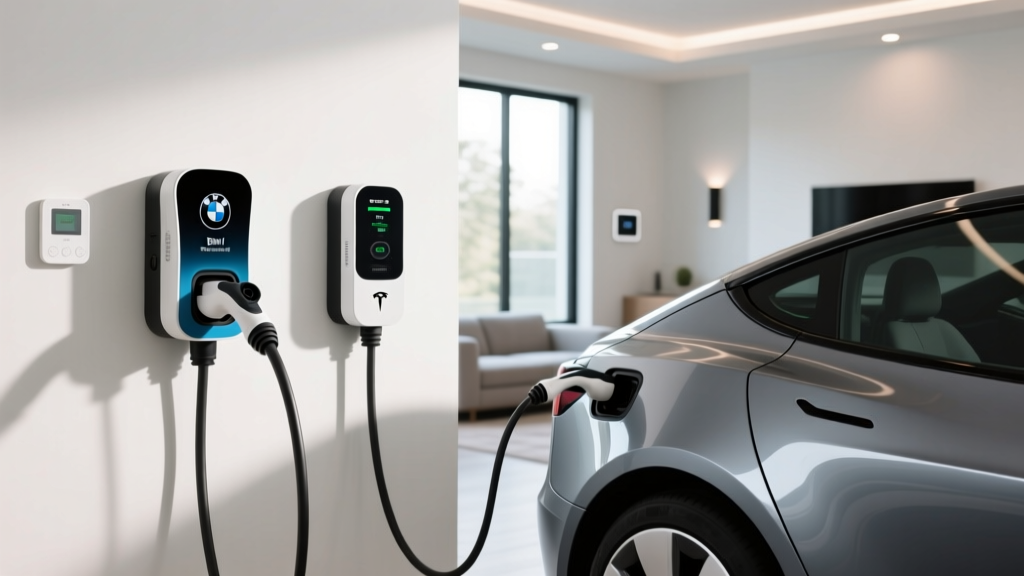
The BMW Wallbox (11.5 kW / 48A) requires a 60A circuit. The Tesla Wall Connector (up to 11.5 kW / 48A on most installations, or 19.2 kW / 80A with a 100A circuit) is configurable. Most homes with a 200A main panel can accommodate a 48A/60A circuit without an upgrade. Homes with 100A panels or existing heavy loads (electric heat, pool, workshop) may need a panel upgrade.
Installation Cost Breakdown
| Cost Component | Simple Install (Panel Nearby, No Upgrade) | Complex Install (Long Run, Sub-Panel) | Panel Upgrade Required |
|---|---|---|---|
| Charger equipment | $400–$700 | $400–$700 | $400–$700 |
| Electrician labor | $500–$1,200 | $1,500–$3,000 | $1,500–$3,000 |
| Permit & inspection | $100–$300 | $150–$400 | $200–$500 |
| Electrical panel upgrade (if needed) | $0 | $0 | $2,000–$5,000 |
| Total | $1,000–$2,200 | $2,050–$4,100 | $4,100–$9,200 |
Panel upgrade reality: If your home has a 100A main service panel and you're already running electric heat, an electric dryer, and an electric range, adding a 60A EV circuit may exceed your panel's capacity. Upgrading to a 200A panel costs $2,000–$5,000 depending on your utility's requirements and local labor rates. Some utilities offer rebates of $200–$500 for panel upgrades tied to EV adoption—check with your provider.
Smart alternative — load management: Devices like the Emporia VUE smart panel or the Tesla Wall Connector's built-in load-sharing feature can dynamically reduce charger amperage when other household loads spike, potentially avoiding a panel upgrade entirely. This is especially relevant for older homes.
Safety and Code Considerations
- Dedicated circuit: Your EV charger must have its own dedicated breaker — never share a circuit with other appliances.
- GFCI protection: NEC 2020+ requires GFCI protection for all 240V EV charging outlets. Hardwired chargers with built-in ground-fault protection may exempt the breaker from this requirement (confirm with your local inspector).
- Outdoor rating: If mounting outdoors, ensure the charger is NEMA 4 rated (rain/splash resistant). Both the Tesla Wall Connector and BMW Wallbox are outdoor-rated.
- Permit: Nearly all jurisdictions require an electrical permit for EV charger installation. Skipping this can void home insurance claims and create issues at resale.
- Hire a licensed electrician: EV circuits carry sustained high current for hours—this is not a DIY project. Use a licensed electrician familiar with NEC Article 625 (EV charging).
Recommended Chargers for BMW and Tesla Owners
Here are the best Level 2 home chargers for BMW and Tesla drivers in 2026, selected for reliability, power output, connector compatibility, and smart features.
Tesla Wall Connector (Gen 3)
- Max power: 11.5 kW (48A) on 60A circuit, or 19.2 kW (80A) on 100A circuit
- Connector: NACS (native Tesla); J1772 adapter available
- Cable length: 24 feet
- Smart features: Wi-Fi, OTA updates, load sharing between multiple units, Power-Sharing
- Price: ~$475 (48A config)
- Best for: Tesla owners; BMW owners with NACS (2025+) or J1772 adapter
BMW Wallbox (Flexible Fast Charger / Wallbox Pro)
- Max power: 11.5 kW (48A) on 60A circuit
- Connector: J1772 (pre-2025) or NACS (2025+ models)
- Cable length: 25 feet
- Smart features: Integrated cable management, LED status display, app monitoring
- Price: ~$550–$700
- Best for: BMW owners wanting OEM-matched equipment
ChargePoint Home Flex
- Max power: 12 kW (50A) on 60A circuit — adjustable down to 16A
- Connector: J1772 (NACS adapter available)
- Cable length: 23 feet
- Smart features: Wi-Fi, Alexa integration, scheduling, energy tracking, amperage configurable in-app
- Price: ~$599–$699
- Best for: Multi-EV households (BMW + Tesla with adapter), flexible amperage for panel-constrained homes
Emporia Level 2 EV Charger
- Max power: 11.5 kW (48A) on 60A circuit — adjustable
- Connector: J1772 (NACS version available 2025+)
- Cable length: 24 feet
- Smart features: Deep energy monitoring via Emporia VUE panel integration, solar-aware charging, scheduling
- Price: ~$399–$499
- Best for: Budget-conscious buyers, solar homes, energy-monitoring enthusiasts
Our recommendation: If you own a Tesla (or a 2025+ BMW with NACS), the Tesla Wall Connector offers the best power-to-price ratio and seamless integration. If you have a pre-2025 BMW with CCS1/J1772, the ChargePoint Home Flex is the most versatile because you can adjust its amperage via software to match your panel's capacity without swapping hardware.
Cost to Charge: Home vs. Public vs. Gas — The Real Numbers
Charging cost is where EVs deliver their biggest ongoing savings—but the gap narrows significantly if you rely on DC fast charging. Here's how BMW and Tesla charging costs compare to gas in 2026.
| Charging Scenario | $/kWh | Cost to Fill 75 kWh (Tesla Model Y) | Cost Per Mile (at 3.5 mi/kWh) | Gas Equivalent (30 MPG, $3.40/gal) |
|---|---|---|---|---|
| Home off-peak (utility TOU rate) | $0.08–$0.12 | $6.00–$9.00 | $0.023–$0.034 | $0.113/mile |
| Home standard rate | $0.14–$0.18 | $10.50–$13.50 | $0.040–$0.051 | $0.113/mile |
| Public Level 2 (ChargePoint, etc.) | $0.25–$0.39 | $18.75–$29.25 | $0.071–$0.111 | $0.113/mile |
| DC Fast (Tesla Supercharger, avg) | $0.28–$0.38 | $21.00–$28.50 | $0.080–$0.109 | $0.113/mile |
| DC Fast (Electrify America, peak) | $0.43–$0.56 | $32.25–$42.00 | $0.123–$0.160 | $0.113/mile |
Key takeaway: Home charging at off-peak utility rates delivers per-mile costs roughly 70–80% lower than gasoline. Even standard home rates are 55–65% cheaper per mile. However, exclusive reliance on premium-priced DC fast chargers can push EV per-mile costs close to or even above gasoline. The economics of EV ownership are overwhelmingly driven by access to affordable home or workplace charging.
According to fueleconomy.gov, the 2025 Tesla Model Y Long Range achieves 122 MPGe combined (approximately 3.5 miles per kWh), while the BMW i4 eDrive40 achieves 109 MPGe combined. These efficiency figures directly impact your per-mile cost — a more efficient vehicle saves more money at any given electricity rate.
Public Charging for BMW and Tesla: Networks, Access, and Practical Tips
Tesla's Supercharger network remains the gold standard for reliability and coverage, with over 30,000 stalls globally as of 2026. BMW owners with NACS-equipped vehicles (2025+) or a BMW-issued NACS adapter now have full Supercharger access—a major competitive advantage that was unavailable to BMW drivers before the industry-wide NACS adoption.
For CCS1-equipped BMWs (pre-2025), the primary DC fast charging networks are:
- Electrify America: Largest CCS network; rates $0.43–$0.56/kWh at peak; reliability varies by location
- EVgo: Growing network with some 350 kW stalls; membership plans reduce per-kWh cost
- ChargePoint: Primarily Level 2 but expanding DCFC; good for workplace/retail charging
- Tesla Superchargers (with adapter): Available to CCS BMWs via NACS adapter; typically $0.28–$0.38/kWh
Preconditioning tip: Both BMW and Tesla vehicles will precondition (warm) the battery when you navigate to a DC fast charger. This is critical in cold weather—arriving at a charger with a cold battery can cut your peak charge rate by 50% or more. Always enter the charger as a navigation destination so the car can begin thermal prep 15–30 minutes before arrival.
Frequently Asked Questions
How much does it cost to install a home EV charger for my BMW or Tesla?
A straightforward Level 2 installation (panel nearby, no upgrade needed) typically runs $1,000–$2,200 including the charger, electrician labor, and permit. Complex runs with long wire distances or a required panel upgrade can push costs to $4,100–$9,200. Always get 2–3 quotes from licensed electricians, and confirm they pull a permit.
Can I use a Tesla charger on a BMW, or vice versa?
Yes, with adapters. A Tesla Wall Connector has a native NACS plug. Pre-2025 BMWs with J1772 inlets can use a NACS-to-J1772 adapter (~$30–50). Conversely, BMW Wallbox chargers (J1772) can charge Teslas using a J1772-to-NACS adapter. For DC fast charging, 2025+ BMWs with native NACS can use Tesla Superchargers directly, while older CCS1 BMWs need BMW's official NACS adapter.
How fast will a Level 2 home charger add range to my BMW i4 or Tesla Model Y?
A 48A/11.5 kW Level 2 charger (the most common home setup) adds roughly 33–42 miles of range per hour to a BMW i4 and 35–44 miles per hour to a Tesla Model Y. An overnight charge (8 hours) fully replenishes either vehicle from near-empty. A smaller 32A/7.7 kW charger adds about 22–28 miles per hour—still sufficient for most daily driving needs.
Do I need an electrical panel upgrade to charge at home?
Not always. Homes with a 200A main panel and moderate existing loads can typically accommodate a 48A/60A EV circuit without issue. Homes with 100A service, electric heat, and multiple large appliances may need an upgrade ($2,000–$5,000) or can use a smart load-management device to avoid one. Have an electrician perform a load calculation before deciding.
Is it cheaper to charge my BMW or Tesla at home or at public stations?
Home charging is dramatically cheaper. At off-peak utility rates ($0.08–$0.12/kWh), you'll pay roughly $0.02–$0.03 per mile—about 75% less than gasoline. Public DC fast chargers ($0.28–$0.56/kWh) cost $0.08–$0.16 per mile, which can approach or exceed the cost of gasoline in a fuel-efficient car. Home charging is the economic foundation of EV ownership.
What size home charger should I buy for a BMW or Tesla?
For most owners, a 48A/11.5 kW charger on a 60A circuit is the sweet spot—it charges any BMW or Tesla overnight, fits most 200A panels, and doesn't require exotic wiring. If you have a 100A panel or limited capacity, a 32A/7.7 kW charger on a 40A circuit still handles daily needs. Only pursue an 80A/19.2 kW installation if you have a large battery (BMW iX xDrive50: 111.5 kWh usable) and a panel that supports a 100A circuit.