2014 Jaguar XF 5.0 Supercharged: Limited-Slip Differential Explained
The 2014 Jaguar XF 5.0 Supercharged does not come equipped with a traditional mechanical limited-slip differential (LSD). Instead, it uses Jaguar's electronic traction control system paired with an open differential. This setup relies on brake-based torque vectoring to manage wheelspin, applying brake pressure to the spinning wheel while redirecting torque to the wheel with grip.
While this electronic approach works adequately for daily driving and light performance scenarios, it lacks the predictability and responsiveness of a true mechanical LSD during aggressive cornering or track use. The system can also generate excess heat in the brake components during sustained performance driving.
For owners seeking improved traction and handling, aftermarket mechanical LSD conversions are available through specialty shops, though these modifications typically cost between $3,000-$5,000 installed and may affect warranty coverage on remaining powertrain components.
EV Charging Levels: Speed and Range Addition
Understanding the three primary charging levels is essential for planning your electric vehicle ownership experience. Each level delivers different power outputs measured in kilowatts (kW), which directly determines how quickly your battery—measured in kilowatt-hours (kWh)—recharges.
| Charging Level | Power Output | Miles Added Per Hour | Typical Use Case |
|---|---|---|---|
| Level 1 (120V) | 1.4-1.9 kW | 3-5 miles | Overnight home charging, emergency top-ups |
| Level 2 (240V) | 3.3-19.2 kW | 12-75 miles | Daily home charging, workplace, public locations |
| DC Fast Charging | 50-350 kW | 150-1,000+ miles | Road trips, rapid charging during travel |
Level 1 charging uses a standard household outlet and requires no special installation. While convenient for plug-in hybrids with smaller batteries or as a backup option, it's impractical as the primary charging method for most battery-electric vehicles with 60-100 kWh battery packs.
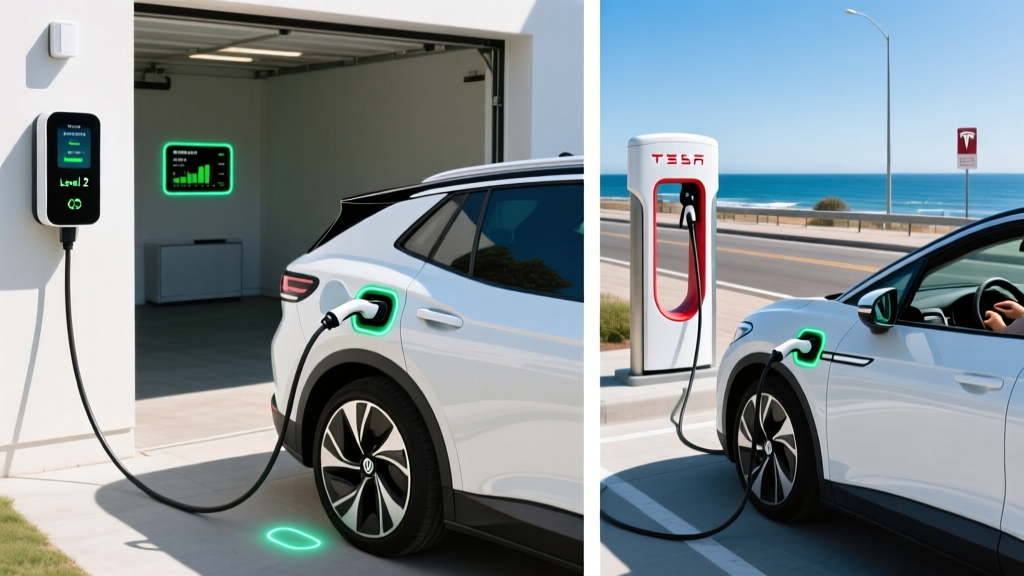
Level 2 charging represents the practical standard for daily EV ownership. Most home installations operate at 240V and 32-48 amps, delivering 7.7-11.5 kW of power. This level can fully recharge most EVs overnight while you sleep.
DC Fast Charging bypasses the vehicle's onboard charger and delivers direct current straight to the battery. Modern EVs can accept 150-350 kW peak charging rates, though sustained rates typically average 60-70% of peak due to charging curve taper above 80% state of charge. According to fueleconomy.gov, charging speeds continue improving with each model year as battery thermal management systems advance.
Home EV Charger Installation: Requirements and Costs
Installing a Level 2 home charger involves electrical work that varies significantly based on your home's existing electrical infrastructure. The total investment typically ranges from $800 for simple installations to $4,000+ for homes requiring panel upgrades.
Electrical Requirements
Most Level 2 chargers require a dedicated 240V circuit with 40-60 amp capacity. The National Electrical Code mandates that continuous loads (like EV charging) cannot exceed 80% of circuit capacity, so a 48-amp charger needs a 60-amp circuit breaker.
Your electrical panel must have sufficient spare capacity to handle the additional load. Homes with 100-amp service panels often require upgrades to 200-amp panels before adding EV charging capability, especially if you're already running electric heating, air conditioning, and other major appliances.
| Component | Cost Range | Notes |
|---|---|---|
| Level 2 Charger Equipment | $300-$800 | Smart chargers with WiFi connectivity cost more |
| Electrician Labor (simple install) | $400-$1,200 | Short run from panel, accessible location |
| Electrician Labor (complex install) | $1,000-$2,500 | Long wire runs, conduit, difficult access |
| Permit Fees | $50-$200 | Varies by municipality |
| Electrical Panel Upgrade | $1,500-$3,500 | Only if needed; 100A to 200A upgrade |
| Total (no panel upgrade) | $800-$2,200 | Most common scenario |
| Total (with panel upgrade) | $2,300-$5,700 | Older homes with limited capacity |
The federal government offers a tax credit for home charging equipment installation through IRS §30C, covering 30% of costs up to $1,000. Check current eligibility requirements at irs.gov before purchasing.
EV Connector Compatibility Guide
North American EVs use three primary connector standards, though the industry is rapidly consolidating around the North American Charging Standard (NACS) developed by Tesla.
| Connector Type | Manufacturers Using It | Adapter Availability |
|---|---|---|
| NACS (Tesla) | Tesla, Ford, GM, Rivian, Volvo, Polestar, Mercedes (2025+) | CCS-to-NACS adapters available ($200-$400) |
| CCS1 | VW, Hyundai, Kia, BMW, legacy models from Ford/GM | NACS-to-CCS adapters available for Tesla Supercharger access |
| CHAdeMO | Nissan Leaf (legacy), Mitsubishi Outlander PHEV | Limited adapter options; network declining |
As of 2026, most new EVs ship with NACS connectors, and manufacturers that previously used CCS1 are transitioning. If you're purchasing a used EV with CCS1, verify that your preferred charging networks support it or budget for an adapter.
For home charging, most Level 2 chargers come with either a J1772 connector (compatible with CCS1 and CHAdeMO vehicles) or NACS. Adapters allow cross-compatibility, but native connectors provide the most reliable connection.
Charging Cost Analysis: EV vs Gas Per Mile
One of the strongest economic arguments for EV ownership is the lower fuel cost per mile. However, actual savings depend heavily on your local electricity rates, charging habits, and whether you primarily charge at home or rely on public charging networks.
| Charging Scenario | Cost per kWh | Cost Per Mile (4 mi/kWh EV) | Annual Cost (12,000 miles) |
|---|---|---|---|
| Home (off-peak rate) | $0.12-$0.18 | $0.03-$0.045 | $360-$540 |
| Home (standard rate) | $0.18-$0.25 | $0.045-$0.063 | $540-$756 |
| Public Level 2 | $0.25-$0.40 | $0.063-$0.10 | $756-$1,200 |
| DC Fast Charging | $0.35-$0.60 | $0.088-$0.15 | $1,056-$1,800 |
| Gasoline (30 MPG, $3.50/gal) | N/A | $0.117 | $1,404 |
| Gasoline (25 MPG, $3.50/gal) | N/A | $0.14 | $1,680 |
Home charging with off-peak electricity rates delivers the best economics, typically costing 60-75% less per mile than gasoline. However, exclusive reliance on DC fast charging—common for apartment dwellers without home charging access—can narrow or eliminate this cost advantage.
Many utilities offer time-of-use rates that provide significantly cheaper electricity during overnight hours (typically 10 PM to 6 AM). Programming your charger or vehicle to charge during these windows maximizes savings.
Recommended Home EV Chargers (2026)
The home charger market offers numerous options across price points. Here are three proven performers based on reliability, features, and value:
ChargePoint Home Flex
Power Output: Up to 12 kW (50 amps) configurable
Connector: J1772 (CCS compatible)
Cable Length: 23 feet
Smart Features: WiFi connectivity, app scheduling, energy tracking, Alexa integration
Price: $699
Best For: Most EVs with CCS1 connectors, flexible amperage adjustment for older electrical systems
Tesla Wall Connector
Power Output: Up to 11.5 kW (48 amps)
Connector: NACS native
Cable Length: 24 feet
Smart Features: WiFi updates, power sharing between multiple units, load management
Price: $475
Best For: Tesla vehicles and NACS-equipped EVs, multi-EV households
Emporia Vue 2 with EV Charger
Power Output: Up to 11.5 kW (48 amps)
Connector: J1772
Cable Length: 24 feet
Smart Features: Whole-home energy monitoring integration, solar charging optimization, detailed usage analytics
Price: $599 (charger only) or $899 with energy monitor
Best For: Homes with solar panels, energy-conscious owners wanting detailed consumption data
Charging Time Examples by Battery Size
Actual charging times vary based on battery size, state of charge, battery temperature, and charging curve characteristics. Most EVs accept peak charging rates only between 10-80% state of charge, with rates tapering significantly above 80% to protect battery longevity.
For a 75 kWh battery (typical mid-size EV):
- Level 1 (1.4 kW): 54 hours for full charge (impractical for regular use)
- Level 2 (11.5 kW): 6.5 hours for full charge (overnight charging)
- DC Fast (150 kW peak): 10-80% in approximately 25-30 minutes, accounting for charging curve taper
For a 100 kWh battery (larger luxury EV or truck):
- Level 1 (1.4 kW): 71 hours for full charge
- Level 2 (11.5 kW): 8.7 hours for full charge
- DC Fast (250 kW peak): 10-80% in approximately 20-25 minutes with modern thermal management
Battery preconditioning—warming the battery before fast charging—significantly improves charging speeds in cold weather. Most modern EVs automatically precondition when you navigate to a charging station.
Safety and Electrical Code Considerations
EV charger installations must comply with National Electrical Code (NEC) Article 625 and local building codes. Key safety requirements include:
- Dedicated Circuit: EV chargers require their own dedicated circuit—no sharing with other appliances or outlets
- GFCI Protection: Ground Fault Circuit Interrupter protection is mandatory for outdoor installations and recommended for garages
- Outdoor Rating: Outdoor installations require NEMA 4-rated enclosures and weatherproof connectors
- Proper Wire Gauge: Wire size must match circuit amperage and account for voltage drop over long runs
- Permit and Inspection: Most jurisdictions require permits and inspections for EV charger installations
Never attempt DIY electrical work for EV charger installation unless you're a licensed electrician. Improper installations create fire hazards and may void home insurance coverage.
Frequently Asked Questions
How much does it cost to install a home EV charger?
Typical installations cost $800-$2,200 including equipment, electrician labor, and permits. Homes requiring electrical panel upgrades can expect $2,300-$5,700 total. The federal §30C tax credit covers 30% up to $1,000 of installation costs.
How fast will each charging level add range?
Level 1 adds 3-5 miles per hour, Level 2 adds 12-75 miles per hour depending on amperage, and DC fast charging adds 150-1,000+ miles per hour (though you'll typically charge for 20-30 minutes rather than a full hour).
Which connector/charger is compatible with my EV?
Check your vehicle's charge port: NACS (Tesla-style) is now standard on Ford, GM, Rivian, and Tesla vehicles. CCS1 is used on VW, Hyundai, Kia, and older Ford/GM models. CHAdeMO is limited to older Nissan Leaf and Mitsubishi models. Adapters are available for cross-compatibility.
How much does charging cost per mile vs gas?
Home charging typically costs $0.03-$0.06 per mile, while gasoline costs $0.12-$0.14 per mile for a 25-30 MPG vehicle. This represents 60-75% savings when charging at home with standard or off-peak rates.
What electrical upgrades might I need?
Homes with 100-amp electrical service often need panel upgrades to 200 amps before adding EV charging, especially with other electric appliances. Your electrician will perform a load calculation to determine if upgrades are necessary.