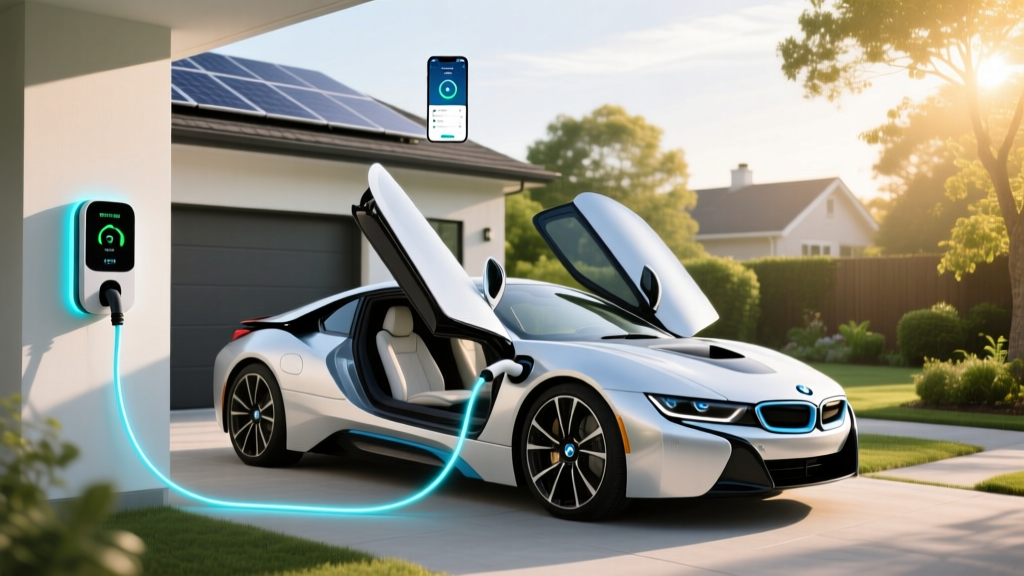
The BMW i8 ended production in 2020, but thousands remain on US roads as one of the most recognizable plug-in hybrids ever built. If you own or are shopping for a used i8, understanding its real-world electric-only range, charging limitations, and home setup requirements is essential. This guide covers the BMW i8 EV range in practical terms, breaks down what each charging level delivers for a PHEV like the i8, and walks through the exact costs and electrical requirements of installing a home charger.
BMW i8 EV Range: EPA Sticker vs Real-World Expectations
The later-model BMW i8 (2019–2020, with the 11.6 kWh battery pack) carries an EPA-rated 18 miles of electric-only range. The earlier 2015–2018 models with the 7.1 kWh pack were rated at just 15 miles. These are modest figures by 2026 PHEV standards — the Toyota RAV4 Prime delivers 42 miles, and the Chrysler Pacifica Hybrid manages 32 — but the i8 was never designed as an EV commuter. It was a performance hybrid that used its electric motor to fill torque gaps and enable silent neighborhood driving.
| Spec | 2015–2018 | 2019–2020 (Roadster/Coupe) |
|---|---|---|
| Battery (gross / usable) | 7.1 kWh / ~5.2 kWh | 11.6 kWh / ~9.4 kWh |
| EPA Electric Range | 15 miles | 18 miles |
| EPA MPGe (electric + gas) | 76 MPGe | 69 MPGe |
| Combined MPG (gas only) | 28 MPG | 27 MPG |
| Total System Output | 357 hp | 369 hp |
| 0–60 mph | 4.2 sec | 4.2 sec (Coupe) / 4.4 sec (Roadster) |
| Onboard Charger | 3.7 kW | 3.7 kW |
| Charge Port | J1772 (Level 2 AC only) | J1772 (Level 2 AC only) |
| DC Fast Charging | Not supported | Not supported |
The critical takeaway for charging: the i8's onboard charger maxes out at 3.7 kW. That means even if you plug into a 48-amp Level 2 station capable of delivering 11.5 kW, the i8 will only draw 3.7 kW. This is a hardware limitation inside the car, not the charger.
Charging Levels Explained: What Each Delivers for the BMW i8
Understanding the three charging tiers is essential for any PHEV owner. Note: kW (kilowatts) measures the rate of power delivery — think of it as how fast water flows through a hose. kWh (kilowatt-hours) measures total energy stored — the size of the bucket. Your charger's kW rating determines how quickly you fill the i8's battery (measured in kWh).
| Level | Voltage | Max Power to i8 | Miles of Range Added/Hour | 0–100% Time (i8) |
|---|---|---|---|---|
| Level 1 (Standard Outlet) | 120V / 12A | ~1.4 kW | ~3–4 mi/hr | ~7–8 hours |
| Level 2 (Home/Public AC) | 240V / 16A+ | 3.7 kW (i8 cap) | ~9–11 mi/hr | ~3–3.5 hours |
| DC Fast Charging | 400V+ DC | Not supported | N/A | N/A |
For a PHEV with a small battery like the i8, Level 2 home charging is the practical standard. A full charge in roughly 3 hours means you can top off during a work-from-home afternoon or overnight with ease. Level 1 is viable only as a backup — it will take most of the night to refill the pack, and you'll lose some energy to charging inefficiency.
DC fast charging is irrelevant for the i8. The car has no DC inlet, and most PHEVs from this era lack the capability. If you're comparing the i8 to a modern BEV like the Hyundai Ioniq 5 (which peaks at 240 kW DC and charges 10–80% in ~18 minutes), understand that the i8 was designed for overnight AC topping, not road-trip fast charging.
Home Charger Installation: Electrical Requirements, Permits & Costs
Even though the i8 can only accept 3.7 kW, installing a higher-capacity Level 2 charger at home makes sense. It future-proofs your setup for a next-generation EV and lets you charge any visiting vehicle at full speed. Here's what the installation involves.
Electrical Requirements
- Circuit: A dedicated 240V circuit is required. For a 40-amp charger (the most common home size), you need a 50-amp breaker (NEC code requires circuits rated at 125% of continuous load).
- Wire: 6 AWG copper (THHN in conduit or NM-B/Romex) for a 50-amp circuit.
- Panel capacity: Your electrical panel must have two adjacent open slots and sufficient amperage headroom. A typical 200-amp panel can usually accommodate a 50-amp EV circuit without issue. Older 100-amp panels often cannot.
- Outlet vs. hardwired: A NEMA 14-50 outlet offers portability (you can unplug the charger and take it with you). Hardwired units eliminate the outlet cost and allow higher amperage (60A+ circuits).
Do You Need a Panel Upgrade?
This is the single biggest variable in installation cost. If your home has a 200-amp service with available breaker slots, you're likely fine. If you have a 100-amp panel, or your panel is near capacity with existing loads (HVAC, electric range, dryer, water heater), you may need a panel upgrade to 200 amps — which adds $1,500–$3,500 to the project. A licensed electrician will perform a load calculation during the estimate.
Permits and Inspections
Most US jurisdictions require an electrical permit for a new 240V circuit. Permit fees typically run $50–$200. The work must pass inspection before the utility will energize the circuit (if a panel upgrade is involved). Never skip the permit — it protects your home insurance coverage and ensures code compliance.
| Component | Low End | High End | Notes |
|---|---|---|---|
| Level 2 Charger (Equipment) | $300 | $700 | 32A–48A smart chargers |
| Electrical Permit | $50 | $200 | Varies by municipality |
| Electrician Labor (standard install) | $400 | $1,200 | Short run from panel, no upgrade |
| Electrical Panel Upgrade (if needed) | $1,500 | $3,500 | 100A → 200A service upgrade |
| Conduit/Wire (long run, 50+ ft) | $200 | $800 | Distance from panel to garage |
| Total (No Panel Upgrade) | $750 | $2,100 | Most homes with 200A panels |
| Total (With Panel Upgrade) | $2,250 | $5,600 | Older homes with 100A service |
Connector Compatibility: What Plugs Into the BMW i8
The BMW i8 uses a J1772 connector for all AC charging. This is the universal standard for non-Tesla EVs and PHEVs in North America. Every public Level 2 station in the US provides a J1772 plug, and every home Level 2 charger ships with one.
| Connector | Type | Used By | i8 Compatible? |
|---|---|---|---|
| J1772 | AC Level 1 & 2 | All non-Tesla EVs/PHEVs | ✅ Yes — native |
| NACS (Tesla) | AC & DC | Tesla; Ford, GM, Rivian, others (2025+) | ❌ No (AC adapter exists but unnecessary for i8) |
| CCS1 | DC Fast | Most non-Tesla BEVs | ❌ No — i8 has no DC inlet |
| CHAdeMO | DC Fast | Nissan Leaf, older Japanese EVs | ❌ No — i8 has no DC inlet |
For i8 owners, connector compatibility is simple: any Level 2 charger with a J1772 plug works. You do not need adapters. If you later upgrade to a BEV with a NACS port (like a Tesla or a 2025+ Ford/GM model), you can either buy a new NACS charger or use a J1772-to-NACS adapter for your existing unit.
Cost to Charge: Home Electricity vs Public Stations vs Gas
One of the strongest arguments for PHEV ownership is cheap electric miles for daily commuting. Here's how the i8 stacks up.
| Scenario | Rate | Cost to Fill i8 Battery (~9.4 kWh usable) | Cost Per Mile (Electric) |
|---|---|---|---|
| Home Off-Peak (utility TOU) | $0.09/kWh | $0.85 | ~$0.05/mi |
| Home Standard Rate | $0.16/kWh | $1.50 | ~$0.08/mi |
| Public Level 2 (network) | $0.30/kWh | $2.82 | ~$0.16/mi |
| Gasoline (premium, $4.20/gal @ 27 MPG) | $4.20/gal | N/A | ~$0.16/mi |
At home off-peak rates, the i8 costs roughly 5 cents per mile on electricity — about one-third the cost of premium gasoline. Even at standard residential rates, you're at 8 cents per mile. Public Level 2 charging, however, erases the savings; at $0.30/kWh, you're paying the same per mile as gas. This is why home charging is non-negotiable for PHEV economics.
Keep in mind the i8 requires premium 91+ octane fuel when the gas engine runs, which further widens the gap between electric and gas cost per mile.
Recommended Level 2 Home Chargers for the BMW i8
Since the i8 caps at 3.7 kW, you might wonder whether a high-power charger is worth the investment. The answer: yes, if you plan to own a future EV that can accept 11.5 kW or more. Here are three solid options that serve the i8 today and your next EV tomorrow.
ChargePoint Home Flex
- Power Output: Up to 12 kW (50A) — i8 will draw 3.7 kW
- Connector: J1772 (25-foot cable)
- Smart Features: Wi-Fi, app scheduling, utility TOU integration, Alexa
- Installation: Hardwired or NEMA 14-50 plug
- Price: ~$550
- Best For: Flexible amperage settings let you match your circuit exactly
Emporia Vue Level 2 Charger
- Power Output: Up to 11.5 kW (48A)
- Connector: J1772 (24-foot cable)
- Smart Features: Wi-Fi, real-time energy monitoring, solar integration, app control
- Installation: Hardwired or NEMA 14-50
- Price: ~$400
- Best For: Budget-conscious buyers who want energy tracking and solar pairing
Grizzl-E Smart
- Power Output: Up to 10 kW (40A)
- Connector: J1772 (24-foot cable)
- Smart Features: OCPP-compatible, app scheduling, adjustable amperage
- Installation: Hardwired or NEMA 14-50
- Price: ~$450
- Best For: Cold-climate durability (rated to -40°F) and rugged outdoor installs
Any of these units will fully charge the i8 overnight in roughly 3 hours. The ChargePoint Home Flex remains our top pick for its adjustable amperage (set it from 16A to 50A to match your circuit), reliable app, and broad utility demand-response program compatibility.
Safety, Code Compliance & Installation Best Practices
EV charging involves sustained high-current draw — often 8+ hours at a time. This isn't like running a dryer for 45 minutes. The National Electrical Code (NEC) treats EV charging as a continuous load, which triggers specific requirements:
- Dedicated circuit: Your EV charger must have its own breaker — no sharing with other outlets or appliances.
- 125% rule: A 40A continuous charger requires a 50A breaker and wire rated for 50A. Never undersize the breaker.
- GFCI protection: NEC 2020 and later require GFCI protection for outdoor receptacles used for EV charging. Some jurisdictions extend this to indoor garage outlets. Hardwired chargers with built-in ground-fault protection may satisfy this without a GFCI breaker.
- Outdoor rating: If your charger is mounted outside, it must carry a NEMA 4 (weatherproof) rating. All three chargers above meet this standard.
- Cable management: Keep the charging cable off the floor where possible. Wall-mounted cable organizers prevent trip hazards and cord damage.
Always hire a licensed electrician familiar with NEC Article 625 (Electric Vehicle Charging System Equipment). Ask whether they've installed EV chargers before — the continuous-load requirements catch some general electricians off guard.
Frequently Asked Questions
How much does it cost to install a home EV charger for the BMW i8?
A standard installation with a 200-amp panel and short wire run costs $750–$2,100 including equipment, permit, and labor. If your home needs a panel upgrade from 100A to 200A, the total can reach $2,250–$5,600. The i8's low 3.7 kW draw means you could use a smaller circuit (20A/16A), which reduces wire cost slightly — but we recommend installing a 50A circuit for future-proofing.
How fast will each charging level add range to the i8?
Level 1 (120V outlet) adds roughly 3–4 miles of electric range per hour. Level 2 (240V, 3.7 kW as limited by the i8's onboard charger) adds about 9–11 miles per hour. A full Level 2 charge takes approximately 3–3.5 hours for the 2019–2020 model. DC fast charging is not supported.
Which connector and charger is compatible with my BMW i8?
The i8 uses the J1772 connector for all AC charging. Any Level 2 home charger or public station with a J1772 plug is compatible. You do not need a CCS, CHAdeMO, or NACS adapter — and the i8 cannot use DC fast charging regardless of adapter.
How much does charging the i8 cost per mile vs gas?
At home off-peak electricity rates ($0.09/kWh), the i8 costs about $0.05 per mile on electricity. At standard residential rates ($0.16/kWh), it's roughly $0.08/mile. Premium gasoline at $4.20/gallon with the i8's 27 MPG combined rating costs about $0.16 per mile. Electric miles are roughly one-third to one-half the cost of gas miles.
What electrical upgrades might I need for a home charger?
If your home has a 200-amp electrical panel with two open breaker slots, you likely need no upgrades. If your panel is 100-amp, fully loaded, or uses a legacy fuse box, you'll need a panel upgrade ($1,500–$3,500). Homes with the panel far from the garage may also face higher wire and conduit costs. A licensed electrician's load calculation will determine your exact needs.
Does the BMW i8 battery degrade, and how does that affect range?
Yes. The i8's lithium-ion pack (NMC chemistry) will lose capacity over time and charge cycles. A 2019–2020 i8 that originally delivered 18 EPA electric miles may now deliver 14–16 miles after 5–7 years of use, depending on charging habits and climate. BMW's original high-voltage battery warranty was 8 years/80,000 miles with a capacity retention threshold — check whether your vehicle's warranty remains active or has been transferred to you as a second owner.
Can I use a Tesla wall connector or Supercharger with the BMW i8?
No. Tesla Superchargers are DC fast chargers, which the i8 cannot use. The Tesla Wall Connector outputs AC with a NACS plug — you could theoretically use a NACS-to-J1772 adapter, but it adds unnecessary cost and complexity. A standard J1772 Level 2 charger is simpler and equally effective for the i8.