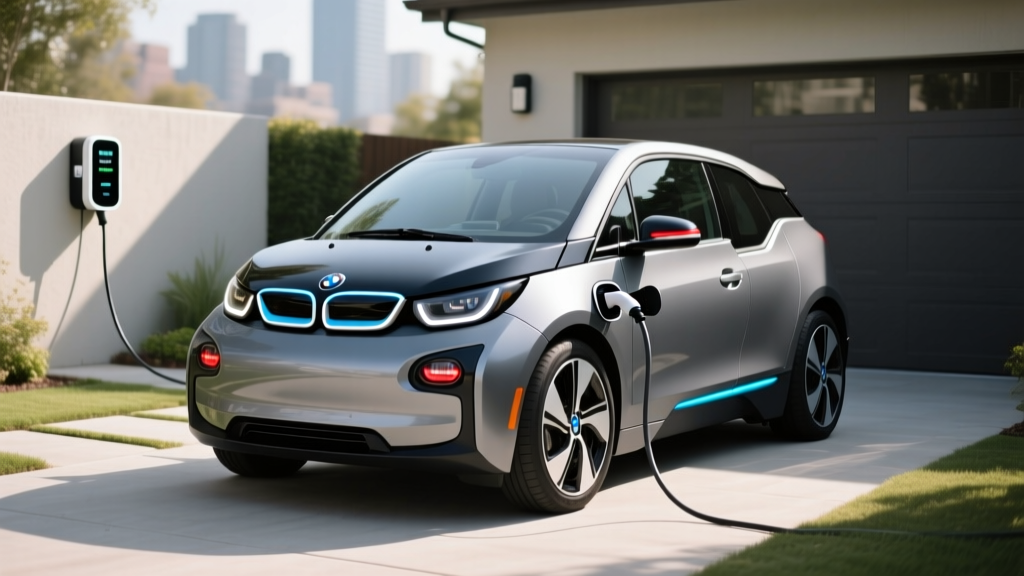
The 2014 BMW i3 was a pioneer in urban electric mobility — a carbon-fiber-reinforced plastic (CFRP) city car with a tiny 22 kWh battery that nonetheless delivered zippy acceleration and a unique driving experience. But in 2026, owning a first-generation i3 means understanding its range limitations intimately and building a charging strategy that works around them. This guide covers exactly what you can expect from the 2014 i3's range, how to charge it at home and in public, what equipment to buy, and how much it all costs.
2014 BMW i3 Real-World Range: What the Numbers Actually Mean
The 2014 BMW i3 BEV (pure electric, no range extender) came with a 22 kWh battery pack, of which approximately 18.8 kWh was usable. The EPA rated it at 81 miles of range. The i3 REx (range-extended) model, which pairs the electric motor with a 647cc two-cylinder BMW Motorrad gasoline engine, received an EPA combined rating of 150 miles total (72 miles electric + 78 miles on gasoline). Source: fueleconomy.gov.
EPA sticker: 81 miles. Expect 65-75 miles on the highway at 70+ mph, and as low as 50-60 miles in freezing temperatures with cabin heating. The i3 REx adds ~78 miles on gasoline but at roughly 39 MPG combined once the engine engages. Battery degradation on a 2014 model in 2026 may reduce usable capacity to 15-17 kWh, dropping real-world range to 60-70 miles in moderate conditions.
Battery degradation is a real factor for any 12-year-old EV. BMW's original battery warranty covered 8 years/100,000 miles for capacity dropping below 70%. Most 2014 i3s are now outside that warranty window. Before purchasing, request a battery State of Health (SoH) reading via the iDrive hidden menu or an OBD2 scanner app like BimmerCode — expect 75-85% SoH on a well-maintained pack.
| Spec | BEV | REx |
|---|---|---|
| Battery (usable) | 18.8 kWh (NMC) | 18.8 kWh (NMC) |
| EPA Range (electric) | 81 mi | 72 mi electric |
| EPA Total Range (REx) | N/A | 150 mi |
| MPGe (combined) | 124 MPGe | 117 MPGe (elec) |
| Motor Output | 170 hp / 184 lb-ft | 170 hp / 184 lb-ft |
| 0-60 mph | 7.0 sec | 7.7 sec |
| Max DC Fast Charge | 50 kW (CCS) | 50 kW (CCS) |
| Level 2 Onboard Charger | 7.4 kW | 7.4 kW |
Charging Levels Explained: kW, Speeds, and What the i3 Accepts
Understanding charging levels is essential. The critical distinction: kW (kilowatts) measures power — how fast energy flows into the battery. kWh (kilowatt-hours) measures energy — the total capacity of the battery. Think of kW as the diameter of a hose and kWh as the size of the bucket.
| Level | Voltage / Amps | Power (kW) | Miles of Range Added per Hour | Full Charge Time (0-100%) |
|---|---|---|---|---|
| Level 1 (120V household) | 120V / 12A | ~1.4 kW | ~4-5 mi/hr | 16-20 hours |
| Level 2 (240V home/public) | 240V / 32A | 7.4 kW (max) | ~22-25 mi/hr | ~3 hours |
| DC Fast Charging (CCS) | Up to 500V DC | 50 kW peak | ~90-100 mi/hr (to 80%) | 10-80% in ~25 min |
The 2014 i3's onboard charger maxes out at 7.4 kW on Level 2. Even if you plug into a 48-amp (11.5 kW) home charger, the car will only draw 7.4 kW. On DC fast charging, the i3 uses a CCS1 connector and peaks at 50 kW. The charge curve tapers significantly above 80% State of Charge (SoC), so a 10-80% session takes roughly 25-30 minutes while 80-100% can add another 20+ minutes.
Home Charger Installation: Requirements, Costs & Panel Considerations
For a 2014 i3, you don't need the most powerful home charger on the market — a 32-amp, 7.7 kW unit matches the car's 7.4 kW onboard limit. However, installing a 40-amp or 48-amp circuit is smart future-proofing if you plan to own a higher-capacity EV later.
Electrical Requirements
- Circuit: Dedicated 40-amp breaker (for a 32A charger) or 50-amp breaker (for a 40A charger) on a 240V line
- Wire gauge: 8 AWG copper (40A) or 6 AWG copper (50A) — run in conduit if exposed
- Panel capacity: Your electrical panel needs available headroom. A typical 200-amp panel can usually accommodate an EV circuit. A 100-amp panel in an older home may require an upgrade ($1,500-$3,000) or a load-management device
- Permit: Most jurisdictions require an electrical permit for a new 240V circuit — typically $50-$200 depending on your municipality
- GFCI: NEC 2020 and later require GFCI protection for EV charging outlets in garages. Hardwired chargers may have built-in GFCI; receptacle installations need a GFCI breaker
| Item | Simple Install (Near Panel) | Complex Install (Long Run / Conduit) |
|---|---|---|
| Level 2 Charger (Equipment) | $350 - $650 | $350 - $650 |
| Electrician Labor | $300 - $600 | $800 - $1,800 |
| Electrical Permit | $50 - $150 | $50 - $200 |
| Panel Upgrade (if needed) | $0 | $1,500 - $3,000 |
| Total Estimated Cost | $700 - $1,400 | $2,700 - $5,650 |
If your home was built before 1980 and still has a 100-amp panel, budget for a potential upgrade. A licensed electrician can assess panel headroom during a site visit — many offer free or low-cost estimates. Some utilities offer rebates of $250-$500 for Level 2 installations, which can offset costs significantly.
Connector Compatibility: What Plugs Into a 2014 BMW i3?
The 2014 BMW i3 uses the CCS1 (Combined Charging System) standard for both Level 2 AC charging (the upper J1772 portion) and DC fast charging (the full CCS1 connector with two additional DC pins). BMW did not equip the i3 with CHAdeMO or NACS (Tesla's North American Charging Standard).
| Connector | Use Case | Compatible? | Adapter Needed? |
|---|---|---|---|
| J1772 (Level 1 & 2 AC) | Home & public AC charging | Yes — native | No |
| CCS1 (DC Fast) | Electrify America, EVgo, Ionity | Yes — native | No |
| NACS (Tesla) | Tesla Superchargers (now open to non-Tesla) | With adapter | Yes — CCS-to-NACS adapter ($150-$250) |
| CHAdeMO | Nissan Leaf standard (legacy) | No | No reliable adapter exists |
With Tesla opening its Supercharger network to non-Tesla EVs via the "Magic Dock" CCS adapter at select stations, and third-party CCS-to-NACS adapters available from brands like Lectron and A2Z, the 2014 i3 can now access a much broader fast-charging network than it could at launch. Verify adapter compatibility with your specific model year before purchasing.
Recommended Home Chargers for the 2014 BMW i3
Since the i3 maxes out at 7.4 kW (32 amps), you have flexibility — you can buy a charger that matches its limit exactly, or invest in a higher-amperage unit for future EVs. All recommendations below use the J1772 connector, which plugs directly into the i3's charge port.
ChargePoint Home Flex
Power: Up to 12 kW (50A), adjustable down to 16A-50A
Connector: J1772 (25-foot cable)
Smart Features: Wi-Fi, app scheduling, Alexa, energy tracking
Price: ~$550
Why for i3: Set to 32A to match the i3's 7.4 kW limit. Future-proofs for your next EV.
Emporia Level 2 EV Charger
Power: Up to 11.5 kW (48A)
Connector: J1772 (24-foot cable)
Smart Features: Wi-Fi, app control, real-time energy monitoring, solar integration
Price: ~$400
Why for i3: Budget-friendly smart charger with excellent energy monitoring for cost tracking.
Tesla Wall Connector (with J1772 adapter)
Power: Up to 11.5 kW (48A)
Connector: NACS native; J1772 adapter included (24-foot cable)
Smart Features: Wi-Fi, OTA updates, power sharing between units
Price: ~$450
Why for i3: Reliable build quality. Use the included J1772 adapter for the i3; native NACS for a Tesla.
For outdoor installations, all three units carry NEMA 4 or NEMA 4X ratings, meaning they're sealed against rain and dust. The ChargePoint Home Flex is the most versatile for mixed-EV households, while the Emporia offers the best value-to-features ratio.
Charging Cost: Per-Mile Breakdown vs Gasoline
One of the strongest arguments for EV ownership — even for a small-battery car like the i3 — is the per-mile energy cost. The 2014 i3 consumes approximately 27 kWh per 100 miles (its EPA-rated efficiency is 124 MPGe). Here's what that translates to in real dollars:
| Scenario | Rate | Cost per Full Charge (18.8 kWh) | Cost per Mile |
|---|---|---|---|
| Home (off-peak utility rate) | $0.12/kWh | $2.26 | $0.028/mi |
| Home (national avg residential) | $0.17/kWh | $3.20 | $0.040/mi |
| Public Level 2 (ChargePoint/EVgo) | $0.30/kWh | $5.64 | $0.070/mi |
| DC Fast Charging (Electrify America) | $0.48/kWh | $9.02 | $0.112/mi |
| Gas Car (30 MPG, $3.50/gal) | $3.50/gal | N/A | $0.117/mi |
At home on off-peak rates, the i3 costs roughly 3 cents per mile to drive — about one-quarter the cost of a 30 MPG gas car at $3.50/gallon. Even at DC fast-charging rates, the i3 is roughly cost-competitive with gasoline. The key insight: home charging is where the economics shine. Public fast charging erodes the cost advantage significantly, which is why a home Level 2 setup is essential for i3 ownership.
Public Charging with the 2014 i3: What to Expect
The 2014 i3's 50 kW DC fast-charging capability was competitive at launch but is slow by 2026 standards (modern EVs charge at 150-350 kW). At a 50 kW CCS station, expect a 10-80% session in approximately 25-30 minutes. At newer 150+ kW stations, the i3 will still only pull 50 kW max — the car limits the rate, not the station.
For a car with 81 miles of EPA range (realistically 65-75), public fast charging is more of a range-extending top-up than a road-trip strategy. Plan stops around the i3's real-world range, and expect to charge for 20-25 minutes to add 40-50 miles of range. The REx model's gasoline engine reduces this pressure considerably, acting as a generator to extend range without stopping.
Apps like PlugShare, A Better Routeplanner, and ChargePoint are essential for locating CCS-compatible stations along your route. Filter for CCS connectors — CHAdeMO-only stations won't work without an adapter that doesn't practically exist for the i3.
Safety, Code & Maintenance Considerations
Installing a Level 2 charger involves real electrical work. Key safety and code requirements include:
- Dedicated circuit: EV chargers must be on their own dedicated breaker — no shared circuits with other appliances
- GFCI protection: Required by NEC 625 for all EV supply equipment. Hardwired units often include internal GFCI; plug-in units (NEMA 14-50 receptacle) require a GFCI breaker in the panel
- Outdoor rating: If installing outside, the charger must be rated NEMA 4 (weatherproof). All recommended units above meet this standard
- Cable management: Use a holster or cable organizer to prevent tripping hazards and protect the connector from ground moisture
- Inspection: Your local building department will likely require an inspection after installation — factor this into your timeline
For the i3 itself, keep the charge port clean and dry, and avoid routinely charging to 100% on DC fast chargers — the NMC chemistry in the 22 kWh pack benefits from staying between 20-80% SoC for daily use to slow degradation.
Frequently Asked Questions
How much does it cost to install a home EV charger for my 2014 BMW i3?
A straightforward Level 2 installation (short wire run, adequate panel) typically costs $700-$1,400 including the charger, electrician labor, and permit. Complex installations with long conduit runs or a panel upgrade can reach $2,700-$5,650. Get three quotes from licensed electricians and ask about utility rebates.
How fast will each charging level add range to the i3?
Level 1 (120V): about 4-5 miles of range per hour. Level 2 (240V, 32A): about 22-25 miles per hour — enough for a full charge in roughly 3 hours. DC fast charging (50 kW CCS): 10-80% in approximately 25-30 minutes, adding about 40-50 miles of real-world range.
Which connector and charger is compatible with my 2014 BMW i3?
The i3 uses J1772 for Level 1 and Level 2 AC charging, and CCS1 for DC fast charging. Any J1772 Level 2 home charger will work. For Tesla Supercharger access, you'll need a CCS-to-NACS adapter ($150-$250). CHAdeMO stations are not compatible.
How much does charging the i3 cost per mile vs a gas car?
At home on off-peak electricity ($0.12/kWh), the i3 costs about 3 cents per mile. A comparable 30 MPG gas car at $3.50/gallon costs about 12 cents per mile. Public DC fast charging at $0.48/kWh brings the i3 to roughly 11 cents per mile — nearly the same as gasoline.
What electrical upgrades might I need for a home charger?
If your home has a 200-amp electrical panel with available breaker slots, you likely need no upgrade. Homes with 100-amp panels, full breaker boxes, or knob-and-tube wiring may need a panel upgrade ($1,500-$3,000) or a smart load-management device like the Emporia VUE with automated load shedding.
Is the 2014 BMW i3 eligible for any federal tax credits in 2026?
No. The federal §30D tax credit applies to new EV purchases only, and the i3 was discontinued after the 2021 model year. For used EVs, the IRS §25E credit (up to $4,000 or 30% of sale price, whichever is less) may apply if you purchase a qualifying used i3 from a dealer for $25,000 or less and meet income thresholds ($75,000 single / $150,000 joint). Verify current rules at irs.gov.