If you're shopping for a new BMW electric vehicle — or just took delivery of one — you've likely seen mentions of BMW Electrify America free charging as a purchase perk. But how does that complimentary charging actually work in 2026, how long does it last, and what happens when the credits run out? More importantly, how should you set up home charging so you're not dependent on public networks for daily driving?
This guide breaks down the BMW/Electrify America partnership details, walks through every charging level with exact speeds, maps out home installation costs with real numbers, and gives you the per-mile cost math you need to budget accurately. Whether you're driving a 2026 BMW i4, i5, i7, or iX, the physics and economics below apply.
BMW's Electrify America Partnership: What You Actually Get
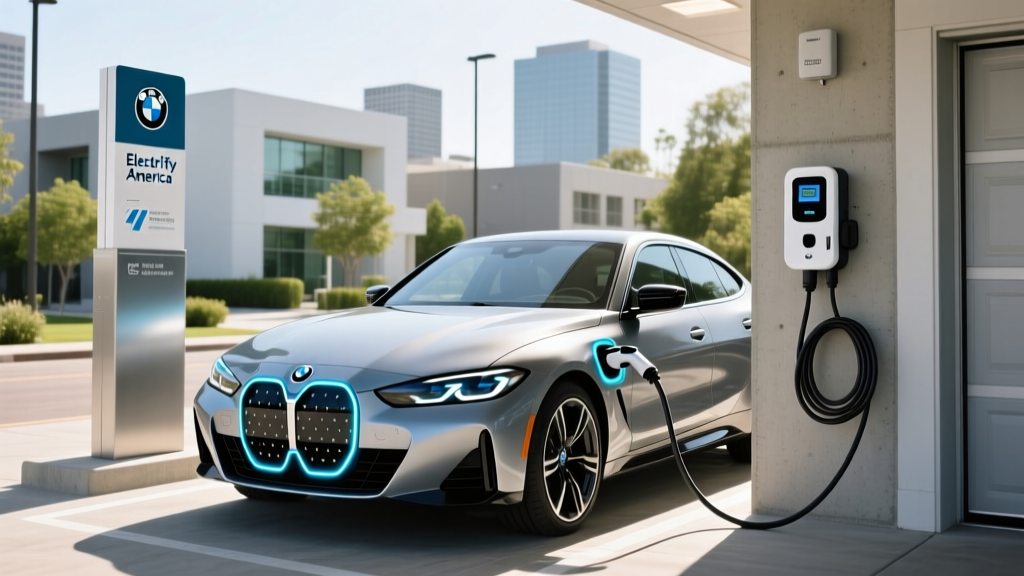
BMW has partnered with Electrify America (EA) to offer complimentary DC fast charging to buyers of qualifying new BMW electric vehicles. Here's how the program has evolved through 2026:
- Complimentary charging period: Typically 2 years of unlimited (or capped kWh) DC fast charging on the Electrify America network, starting from the vehicle's in-service date.
- Eligible models: New BMW i4, i5, i7, iX, and i5 Touring purchased or leased through authorized BMW dealers. Certified pre-owned BMW EVs generally do not qualify for the full EA perk — check your specific CPO documentation.
- Activation: Charging access is linked to your BMW ConnectedDrive account and the Electrify America app. You'll need to register and link accounts before your first session.
- Network scope: Electrify America operates 900+ stations with 4,000+ individual chargers across the U.S. as of early 2026, with many capable of 150-350 kW peak output.
Real-world caveat: "Free charging" means free DC fast charging sessions at EA stations. It does not cover Level 2 public charging at other networks (ChargePoint, EVgo, etc.), and it does not reduce your home electricity bill. Plan your home Level 2 setup separately — that's where 80-90% of your charging will actually happen.
Charging Levels Explained: Speeds, kW, and Miles Per Hour
Before evaluating equipment or installation, you need to understand the three charging levels. The distinction between kW (kilowatts — power, or the rate of energy flow) and kWh (kilowatt-hours — energy, or the battery's capacity) is critical. Think of kW as how fast water flows from a hose, and kWh as the size of the bucket you're filling.
| Level | Voltage | Power (kW) | Miles of Range Added Per Hour | Best Use Case |
|---|---|---|---|---|
| Level 1 | 120V AC | 1.0–1.4 kW | 3–5 miles/hour | Emergency/trickle; PHEVs with small batteries |
| Level 2 | 240V AC | 3.3–19.2 kW | 12–75 miles/hour | Daily home and workplace charging |
| DC Fast (Level 3) | 200–900V DC | 50–350 kW | 150–1,200+ miles/hour (peak) | Road trips; rapid top-ups away from home |
BMW EV onboard charger limits: Most 2026 BMW electric vehicles (i4, i5, iX) come with an 11 kW onboard AC charger, meaning even if your home Level 2 station delivers 19.2 kW, the car will only accept 11 kW AC. At 11 kW, expect roughly 35–40 miles of range per hour — plenty for overnight replenishment of a 80–105 kWh battery.
DC fast charging capability: BMW i4/i5 models support up to 205 kW peak DC charging (CCS1 or NACS, depending on model year and adapter). The iX can peak at around 195–200 kW. A typical 10–80% DC fast charge takes roughly 28–35 minutes on a capable 200+ kW Electrify America station, though sustained rates taper significantly above 60% state of charge (SoC).
Home Charger Installation: Electrical Requirements and Costs
Home Level 2 charging is the foundation of practical EV ownership. Here's what a proper installation requires and what it costs.
Electrical Requirements
A standard home Level 2 setup for a BMW EV requires:
- Circuit: Dedicated 240V circuit, typically 50A or 60A (to support continuous 40A or 48A charging, respectively — NEC requires circuits rated 125% above continuous load)
- Wiring: 6 AWG copper (for 50A) or 4 AWG copper (for 60A), run through conduit where required
- Outlet vs. hardwired: NEMA 14-50 outlet offers portability; hardwired units allow higher amperage (48A–80A) and eliminate the outlet as a failure point
- Panel capacity: Your main electrical panel must have sufficient spare capacity. A 200A panel with significant existing loads may need an upgrade to 300A–400A, or a load-management device
Installation Cost Breakdown
| Cost Component | Simple Install (Near Panel) | Complex Install (Long Run / Upgrade) |
|---|---|---|
| Level 2 Charger Equipment | $400–$700 | $500–$1,200 |
| Electrician Labor (2–4 hrs simple; 6–12+ hrs complex) | $300–$800 | $1,200–$3,500 |
| Electrical Permit | $50–$200 | $100–$300 |
| Panel Upgrade (if needed: 200A → 300A+) | $0 (not needed) | $2,000–$5,000+ |
| Conduit, Wire, Misc. Materials | $100–$250 | $300–$800 |
| Total Estimated Cost | $850–$1,950 | $4,100–$10,800 |
Panel upgrade gotcha: Homes built before 2000 often have 100A or 150A panels that are already near capacity. Adding a 50A continuous EV load can push you over the limit. An electrician will perform a load calculation per NEC Article 220. If an upgrade is needed, factor in utility coordination time (4–12 weeks in some regions) and the $2,000–$5,000+ panel replacement cost. Some utilities offer panel-upgrade rebates — check with your local provider.
The IRS residential clean energy provisions and various state/utility programs may offset a portion of charger equipment and installation costs. Eligibility varies by jurisdiction and tax year — consult a tax professional for your specific situation.
Connector Compatibility: NACS, CCS1, and Adapters for BMW
The North American charging connector landscape has shifted dramatically. BMW announced its transition to the North American Charging Standard (NACS, the Tesla connector) for new vehicles, but the timeline matters for what's actually on your car.
| Connector | BMW Models / Years | Public Network Access | Adapter Needed? |
|---|---|---|---|
| CCS1 (Combined Charging System) | i4, iX, i5, i7 (2022–2024 model years) | Electrify America, EVgo, ChargePoint (CCS stations) | CCS-to-NACS adapter needed for Tesla Superchargers |
| NACS (native) | Newer BMW EVs from ~2025 model year onward (varies by model) | Tesla Supercharger network + NACS-equipped EA/ChargePoint stations | NACS-to-CCS adapter may be needed at older CCS-only stations |
| CHAdeMO | Not used on BMW EVs | N/A | N/A |
Practical advice: If you own a 2022–2024 BMW i4 or iX with CCS1, purchase a reputable CCS-to-NACS adapter ($150–$250) to unlock Tesla Supercharger access, which adds thousands of additional fast-charging locations. BMW has indicated it will provide or support adapter availability during the transition. Confirm adapter compatibility with your specific model year through your dealer.
Charging Cost Per Mile: Home vs. Public vs. Gas
This is where EV ownership economics crystallize. The cost to charge depends entirely on where and when you plug in.
| Charging Scenario | Rate ($/kWh) | Cost to Add 250 Miles | Cost Per Mile |
|---|---|---|---|
| Home (off-peak utility rate) | $0.08–$0.14 | $7.20–$12.60 | $0.029–$0.050 |
| Home (standard residential, no TOU) | $0.14–$0.22 | $12.60–$19.80 | $0.050–$0.079 |
| Public Level 2 (ChargePoint, etc.) | $0.20–$0.39 | $18.00–$35.10 | $0.072–$0.140 |
| DC Fast (Electrify America, non-subscription) | $0.36–$0.56 | $32.40–$50.40 | $0.130–$0.202 |
| DC Fast (EA Pass+ subscription, $7/mo) | $0.28–$0.42 | $25.20–$37.80 | $0.101–$0.151 |
| BMW EA Free Charging Period | $0.00 | $0.00 | $0.000 |
| Gas Sedan (28 MPG combined, $3.40/gal) | — | $30.36 | $0.121 |
The math is clear: Home off-peak charging at $0.10/kWh costs roughly 4 cents per mile — about one-third the cost of a 28 MPG gas car at $3.40/gallon. Even public DC fast charging at full retail ($0.48/kWh) is comparable to or slightly above gas costs per mile. The BMW Electrify America free charging perk effectively makes road-trip fuel costs $0 for the first two years of ownership, which can save $500–$1,500 depending on driving patterns.
BMW i5 efficiency reference: The 2026 BMW i5 eDrive40 achieves approximately 3.0–3.3 miles per kWh (EPA combined), meaning 250 miles requires roughly 76–83 kWh. Actual efficiency drops to 2.5–2.8 mi/kWh at sustained 75+ mph highway speeds and further in cold weather (below 32°F), where battery heating and cabin climate demands increase consumption 15–30%.
Level 2 Home Charger Recommendations for BMW EVs
Since BMW's onboard AC charger caps at 11 kW, you don't need the most powerful residential charger available — but you do want reliability, smart features, and proper cable length. Here are proven options:
ChargePoint Home Flex
- Power: Up to 12 kW (50A) — adjustable down to match your circuit
- Connector: J1772 (CCS-compatible); NACS version available
- Cable: 23 ft
- Smart features: Wi-Fi, scheduled charging, Alexa, energy tracking
- Price: ~$550–$700
Best for: Most BMW owners. Flexible amperage settings prevent panel overload.
Tesla Wall Connector (Universal)
- Power: Up to 11.5 kW (48A)
- Connector: NACS native + built-in J1772 adapter (Universal model)
- Cable: 24 ft
- Smart features: Wi-Fi, OTA updates, power-sharing between units
- Price: ~$600–$650
Best for: BMW owners with NACS-equipped models or those wanting Supercharger ecosystem compatibility.
Emporia Vue + Level 2 Charger
- Power: Up to 11.5 kW (48A)
- Connector: J1772 (NACS adapter available)
- Cable: 24 ft
- Smart features: Whole-home energy monitoring, solar integration, load management
- Price: ~$550–$800 (with energy monitor)
Best for: Homes with solar panels or those wanting detailed energy-use visibility.
Grizzl-E Smart
- Power: Up to 10 kW (40A)
- Connector: J1772
- Cable: 24 ft
- Smart features: Wi-Fi, OCPP protocol, adjustable amperage
- Price: ~$400–$550
Best for: Budget-conscious installs; rugged outdoor-rated enclosure.
Important note on BMW's 11 kW limit: Even if you install a 48A/11.5 kW charger, a BMW with an 11 kW onboard charger will draw ~11 kW (46A at 240V). The extra circuit headroom is fine — it means the wiring and breaker aren't running at maximum capacity, which improves longevity. Don't overspend on a 19.2 kW/80A charger for a BMW unless you plan to charge a future vehicle with a larger onboard charger.
Safety, Code Compliance, and Installation Best Practices
A Level 2 charger installation involves significant continuous electrical load. Cutting corners creates fire risk and may void your homeowner's insurance coverage.
- Dedicated circuit: Your EV charger must be on its own dedicated breaker — never shared with other appliances. NEC 625 governs EV charging equipment.
- GFCI protection: NEC 2023 (and later) requires GFCI protection for outlet-based EV chargers (NEMA 14-50). Hardwired units may be exempt depending on jurisdiction. Your electrician will ensure compliance with your local code cycle.
- Outdoor rating: If your charger is installed outdoors or in an unconditioned garage, ensure it carries a NEMA 4 (weather-resistant) rating. All recommended units above meet this standard.
- Permit and inspection: Every jurisdiction requires an electrical permit for new 240V circuits. The inspection ensures your wire gauge, breaker sizing, and grounding meet code. Unpermitted work can complicate home sales and insurance claims.
- Load management: If your panel is near capacity, consider a smart load-management device (such as the Emporia Smart Load Center or a utility-approved demand-response device) that dynamically throttles charger amperage when other loads spike, avoiding a costly panel upgrade.
Always hire a licensed electrician experienced with EV charger installations. The National Fire Protection Association's NEC guidelines are the governing standard, but local amendments may apply.
Frequently Asked Questions
How much does it cost to install a home EV charger for my BMW?
A straightforward installation (panel near the garage, no upgrade needed) typically costs $850–$1,950 including equipment, labor, and permit. Complex installations requiring long wire runs, conduit through finished walls, or a panel upgrade can reach $4,100–$10,800. Get 2–3 quotes from licensed electricians before committing.
How fast will each charging level add range to my BMW i4 or i5?
Level 1 (120V): roughly 3–5 miles per hour — impractical for daily use on a ~80 kWh battery. Level 2 (240V, 11 kW): about 35–40 miles per hour, fully replenishing a depleted BMW i5 overnight in 8–9 hours. DC Fast (200 kW peak): up to ~200 miles in 15 minutes under ideal conditions, though the 10–80% session takes 28–35 minutes due to charge-curve taper.
Which connector is compatible with my BMW EV?
BMW EVs from 2022–2024 use the CCS1 connector. Starting around the 2025 model year, BMW is transitioning to NACS (the Tesla connector). Check your vehicle's charge port or your owner's documentation. If you have CCS1, a CCS-to-NACS adapter ($150–$250) unlocks Tesla Supercharger access.
How much does charging cost per mile compared to gas?
Home off-peak charging at $0.10/kWh costs roughly $0.03–$0.05 per mile in a BMW i5 (3.0–3.3 mi/kWh). A comparable gas sedan at 28 MPG and $3.40/gallon costs about $0.12 per mile. Home charging saves 60–70% on fuel. Public DC fast charging at $0.48/kWh costs $0.13–$0.20 per mile — comparable to or slightly above gas. During your BMW Electrify America free charging period, road-trip DC fast charging costs $0.00 per mile.
What electrical upgrades might I need for a home charger?
The most common upgrade is a panel replacement (100A/150A → 200A/300A) if your existing panel lacks capacity for a 50A continuous EV load. This costs $2,000–$5,000+ and requires utility coordination. Alternatives include smart load-management devices that dynamically share capacity, or installing a lower-amperage circuit (30A/40A) that charges more slowly but avoids the panel upgrade entirely. A licensed electrician's load calculation will determine your specific needs.
Sources: EPA efficiency data via fueleconomy.gov; BMW USA model specifications at bmwusa.com; Electrify America network and pricing at electrifyamerica.com.