If you've pulled up to a Blink charging station and wondered what you're actually paying — or if you're considering a Blink home charger and trying to budget the full installation — you're not alone. Blink operates one of the largest public Level 2 and DC fast charging networks in the U.S., and their home chargers are a common pick for residential setups. But the Blink EV charging cost picture involves more than just the sticker price on the hardware.
This guide breaks down every layer: what Blink chargers cost to buy and install at home, what you'll pay per kWh on the public Blink network, how that compares to gasoline on a cost-per-mile basis, and what electrical upgrades your home might need. All figures reflect 2026 pricing and the current Blink network rate structure.
Understanding Charging Levels: Speed, Power, and What They Mean for Your EV
Before calculating costs, you need to understand the three charging levels and how they differ in power output (measured in kW, kilowatts — the rate of energy delivery) versus energy stored (measured in kWh, kilowatt-hours — the total capacity of your battery). Confusing kW and kWh is the single most common EV mistake. Think of kW as the speed of water flowing through a hose, and kWh as the total gallons in the bucket.
| Level | Voltage | Power (kW) | Miles of Range Added Per Hour | Typical Use Case |
|---|---|---|---|---|
| Level 1 | 120V AC | 1.0–1.4 kW | 3–5 mi/hr | Overnight top-up, PHEV owners, emergency |
| Level 2 | 240V AC | 3.3–19.2 kW | 12–75 mi/hr | Home daily charging, workplace, Blink public L2 |
| DC Fast Charge | 400–800V DC | 50–350 kW | 150–1,000+ mi/hr (peak) | Road trips, Blink DCFC stations |
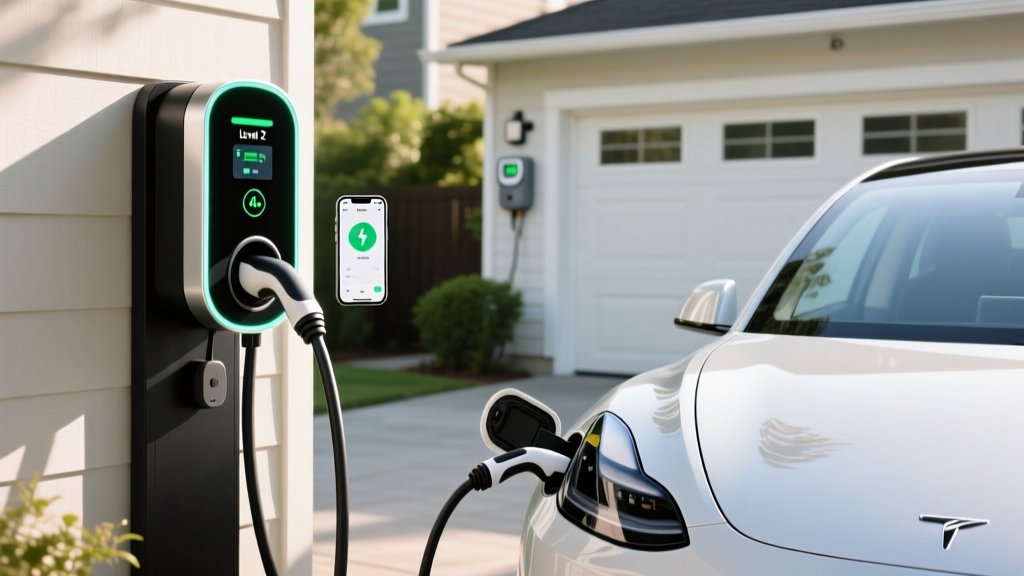
Most Blink public locations are Level 2 (typically 6.6–19.2 kW), while their DC fast chargers range from 50 kW to 180 kW depending on the site. Blink home chargers are Level 2 units, available in 32-amp (7.7 kW) and 48-amp (11.5 kW) configurations.
Blink Home Charger: Equipment Cost and Model Options
Blink offers two primary residential Level 2 chargers in 2026:
Blink HQ 200 (32-Amp)
- Power Output: 7.7 kW (240V, 32A)
- Connector: J1772 (NACS adapter included for Tesla vehicles)
- Cable Length: 25 feet
- Smart Features: Wi-Fi enabled, Blink app scheduling, energy monitoring, load balancing
- Indoor/Outdoor: NEMA 4 rated (outdoor-safe)
- Price: $449–$549 (hardwired); $499–$599 (NEMA 14-50 plug)
Blink HQ 200 (48-Amp)
- Power Output: 11.5 kW (240V, 48A)
- Connector: J1772 (NACS adapter included)
- Cable Length: 25 feet
- Smart Features: Wi-Fi, app scheduling, energy monitoring, load sharing between two units
- Indoor/Outdoor: NEMA 4 rated
- Price: $599–$699 (hardwired only — 48A requires hardwire per NEC code)
For most EVs with an onboard charger rated at 11.5 kW or below (which includes the Hyundai Ioniq 5, Ford Mustang Mach-E, and most Tesla models on a single charger circuit), the 48-amp unit will max out your vehicle's AC charging capability. If your EV's onboard charger tops out at 7.7 kW (some base-model Nissan Leafs and older Bolt EVs), the 32-amp unit is sufficient and saves money.
How Much Does It Cost to Install a Home Blink EV Charger?
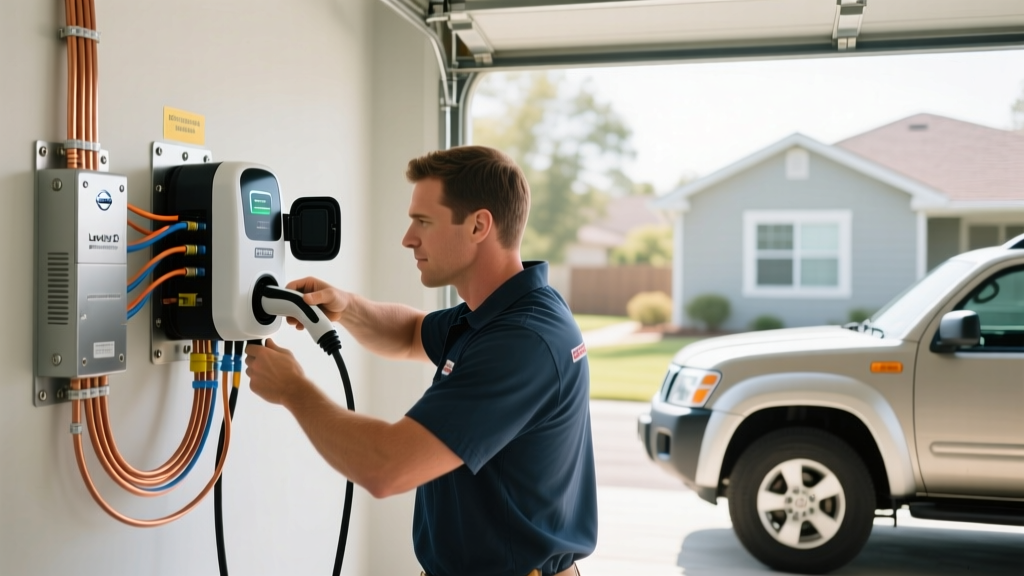
The hardware is only part of the equation. Professional installation by a licensed electrician is where costs vary significantly based on your home's electrical infrastructure. Here's a realistic breakdown for a 2026 Blink HQ 200 installation:
| Component | Low-End Estimate | High-End Estimate | Notes |
|---|---|---|---|
| Blink HQ 200 charger (equipment) | $449 | $699 | 32A vs 48A, plug vs hardwired |
| Electrician labor (new 240V circuit) | $400 | $1,200 | Depends on run length from panel to garage/driveway |
| Electrical permit | $50 | $250 | Varies by municipality; some jurisdictions bundle |
| Circuit breaker + wiring materials | $75 | $200 | 40A breaker for 32A charger; 60A breaker for 48A |
| NEMA 14-50 receptacle (if plug-in) | $50 | $150 | Not needed for hardwired; must be GFCI-protected per NEC 2023+ |
| Panel upgrade (if needed) | $1,500 | $4,500 | Required if existing panel is 100A or maxed out; 200A upgrade typical |
| Total (no panel upgrade) | $1,024 | $2,499 | Most homes with 200A service fall here |
| Total (with panel upgrade) | $2,524 | $6,999 | Older homes with 100A or 150A panels |
What Electrical Upgrades Might I Need?
A 48-amp Blink charger requires a dedicated 60-amp, 240-volt circuit. A 32-amp unit needs a dedicated 40-amp circuit. Your electrician will perform a load calculation on your panel to determine if there's enough spare capacity. Homes with 200-amp service and modern panels usually have headroom. Homes with 100-amp service, older Federal Pacific or Zinsco panels, or those already running heavy loads (electric range, dryer, HVAC) may need a panel upgrade — the single biggest variable in installation cost.
The Blink HQ 200's load-sharing feature allows two chargers to share a single 60A circuit, which is valuable for two-EV households wanting to avoid a panel upgrade.
Blink Public Charging Rates: What You Pay Per kWh
Blink's public network pricing varies by location, state regulations, and whether you're a Blink Member or a Guest user. As of 2026, here's the typical rate structure:
| Charger Type | Guest Rate ($/kWh) | Member Rate ($/kWh) | Idle Fee |
|---|---|---|---|
| Blink Level 2 (6.6–19.2 kW) | $0.39–$0.59 | $0.35–$0.49 | $0.10–$0.25/min after full |
| Blink DC Fast (50–180 kW) | $0.49–$0.69 | $0.44–$0.59 | $0.25–$0.40/min after 80% |
Blink Membership costs $4.99/month and typically saves $0.05–$0.15/kWh. If you charge publicly more than twice a month, the membership pays for itself. Rates are highest in California, New York, and urban areas where utility demand charges are steep, and lowest in the Southeast and Midwest.
Sessions can be initiated via the Blink app, RFID membership card, or credit card tap. Blink also supports Plug & Charge on compatible vehicles, eliminating the need to open an app at supported stations.
Cost Per Mile: Blink Charging vs Gasoline
To compare fairly, we need to calculate the cost per mile for a representative EV charged on Blink versus a comparable gas car. Let's use the 2026 Hyundai Ioniq 5 (which achieves roughly 3.0 miles per kWh, or ~114 MPGe combined per EPA data) versus a 2026 gas crossover averaging 28 MPG combined.
| Scenario | Rate | Cost Per Mile | Annual Cost (12,000 mi) |
|---|---|---|---|
| Home Level 2 (off-peak utility rate) | $0.12/kWh | $0.040 | $480 |
| Home Level 2 (standard utility rate) | $0.18/kWh | $0.060 | $720 |
| Blink Public Level 2 (member rate) | $0.45/kWh | $0.150 | $1,800 |
| Blink DC Fast (member rate) | $0.55/kWh | $0.183 | $2,196 |
| Gasoline (28 MPG, $3.50/gal) | — | $0.125 | $1,500 |
The takeaway: home charging on a Blink HQ 200 is dramatically cheaper than gasoline — roughly one-third to one-half the per-mile cost. But relying exclusively on public Blink DC fast chargers is actually more expensive per mile than gas in most markets. This is why home Level 2 charging is the economic foundation of EV ownership. Public DC fast charging should be treated as a road-trip convenience, not a daily strategy.
Connector Compatibility: Will a Blink Charger Fit Your EV?
Connector standards have shifted significantly with the industry-wide adoption of NACS (North American Charging Standard, originally the Tesla connector). Here's what you need to know about Blink charger compatibility in 2026:
| Connector Type | Blink Hardware Support | Vehicles Using This Connector | Adapter Needed? |
|---|---|---|---|
| J1772 (Level 2) | Native on all Blink L2 chargers | Pre-2025 Ford, GM, Hyundai, Kia, VW, BMW, Rivian, Subaru | No |
| NACS (Level 2 & DCFC) | Native on newer Blink units; adapter cable included with HQ 200 | Tesla (all years); 2025+ Ford, GM, Hyundai, Kia, Rivian, BMW, Volvo | Adapter included with Blink HQ 200 |
| CCS1 (DC Fast) | Native on Blink DCFC stations | Pre-2025 non-Tesla EVs | No |
| CHAdeMO (DC Fast) | Legacy Blink DCFC only (being phased out) | Nissan Leaf (2011–2025), Mitsubishi Outlander PHEV (older) | No, but stations increasingly rare |
If you drive a 2025+ model-year vehicle from Ford, GM, Hyundai, or Kia, your EV likely has a NACS port natively. The Blink HQ 200 ships with a J1772-to-NACS adapter in the box, so it works with both legacy and new connector types. For public Blink DCFC stations, newer installations include both CCS1 and NACS cables; older stations may be CCS1-only, in which case Tesla's CCS adapter (or your automaker's equivalent) is required.
Charging Time Examples: How Long Does a Blink Session Take?
Charging times depend on your battery size, the charger's power output, and your vehicle's onboard charger limit (for Level 2) or DC fast-charge acceptance curve. Here are realistic 10–80% estimates for common battery sizes:
| Vehicle (Battery Size) | Blink HQ 200 (48A / 11.5 kW) | Blink HQ 200 (32A / 7.7 kW) | Blink DCFC (180 kW peak) |
|---|---|---|---|
| Tesla Model Y (75 kWh usable) | ~4 hr 30 min | ~6 hr 45 min | ~22 min (peak curve) |
| Hyundai Ioniq 5 (77.4 kWh, NMC) | ~4 hr 40 min | ~7 hr 00 min | ~18 min (800V architecture) |
| Ford F-150 Lightning (131 kWh, ext. range) | ~7 hr 45 min | ~11 hr 30 min | ~40 min |
| Chevrolet Equinox EV (85 kWh, NMC) | ~5 hr 10 min | ~7 hr 40 min | ~28 min |
Important caveats: DC fast charging times reflect the peak portion of the charge curve. Most EVs taper charging speed significantly above 80% State of Charge (SoC) to protect battery health — this is why the industry standard metric is 10–80%, not 0–100%. In cold weather (below 32°F), expect 10–80% times to increase by 15–30% unless your EV has active battery preconditioning. The Ioniq 5's 800V architecture allows it to sustain higher charge rates longer, which is why it outpaces vehicles with similar battery sizes on 400V systems.
Safety, Code, and Installation Best Practices
A proper Blink HQ 200 installation must comply with the National Electrical Code (NEC) and local amendments. Key requirements:
- Dedicated circuit: The charger must be on its own dedicated breaker — no sharing with other outlets or appliances.
- GFCI protection: NEC 2023 and later require GFCI protection for all EV receptacles (NEMA 14-50). Hardwired installations may be exempt depending on jurisdiction, but many inspectors now require GFCI breakers for hardwired EVSE as well.
- Outdoor rating: The Blink HQ 200 carries a NEMA 4 enclosure rating, meaning it's sealed against rain, snow, and dust — suitable for outdoor mounting without an additional weatherproof box.
- Breaker sizing: Per NEC continuous-load rules, the breaker must be rated at 125% of the charger's maximum draw. A 32-amp charger requires a 40-amp breaker; a 48-amp charger requires a 60-amp breaker.
- Wire gauge: 6 AWG copper for 48A circuits; 8 AWG for 32A circuits (assuming standard run lengths under 100 feet).
- Permit and inspection: Most municipalities require an electrical permit for new 240V circuits. The inspection ensures the installation meets code — don't skip this step, as it affects homeowner's insurance coverage.
Some Blink chargers qualify for the federal Alternative Fuel Vehicle Refueling Property Credit (IRS Form 8911), which covers up to 30% of the combined hardware and installation cost (capped at $1,000 for residential installations). Eligibility depends on whether you live in a qualifying census tract and the charger meets current domestic-content requirements. Check with a tax professional for your specific situation.
Frequently Asked Questions About Blink EV Charging Costs
How much does it cost to install a Blink home charger?
A complete Blink HQ 200 home installation typically costs between $1,024 and $2,499 if your electrical panel has sufficient capacity. If a panel upgrade from 100A to 200A is needed, total costs can reach $2,500–$7,000. The charger hardware itself runs $449–$699.
Is Blink public charging more expensive than charging at home?
Significantly so. Home charging at a typical utility rate of $0.12–$0.18/kWh costs $0.04–$0.06 per mile. Blink public Level 2 charging at member rates (~$0.45/kWh) costs about $0.15 per mile — roughly 2.5 to 3.75 times more. Blink DC fast charging (~$0.55/kWh) pushes cost per mile to $0.18 or higher.
Do I need a NACS adapter to use a Blink charger with my Tesla?
The Blink HQ 200 home charger includes a J1772-to-NACS adapter in the box, so Tesla owners can use it immediately. For public Blink DCFC stations, newer units include native NACS cables. Older CCS1-only Blink stations require Tesla's CCS adapter (included with newer Teslas, ~$175 separately).
Can I charge two EVs with one Blink installation?
Yes. The Blink HQ 200 supports load sharing, allowing two units to split a single 60A circuit. This means two 48A chargers can operate on one circuit, automatically reducing output when both vehicles are plugged in simultaneously. This can save $1,000+ by avoiding a panel upgrade or second dedicated circuit.
How does Blink compare to ChargePoint or Tesla Wall Connector for home use?
The Blink HQ 200 at 11.5 kW (48A) matches the ChargePoint Home Flex and Tesla Wall Connector in maximum output. The Tesla Wall Connector ($420, NACS native) is slightly cheaper but lacks a J1772 connector without a separate adapter. The ChargePoint Home Flex ($699, up to 50A/12 kW) offers marginally higher output and a more robust app. Blink's advantage is load sharing between two units and competitive pricing at the 32A tier.
What happens if my home doesn't have a 240V outlet?
Most homes with an electric dryer or electric range already have 240V service at the panel. If you lack a 240V outlet in your garage or driveway, an electrician can install a NEMA 14-50 receptacle ($200–$600 for typical runs) or hardwire the Blink unit directly. The hardwire option eliminates the receptacle cost and is required for 48-amp installations.