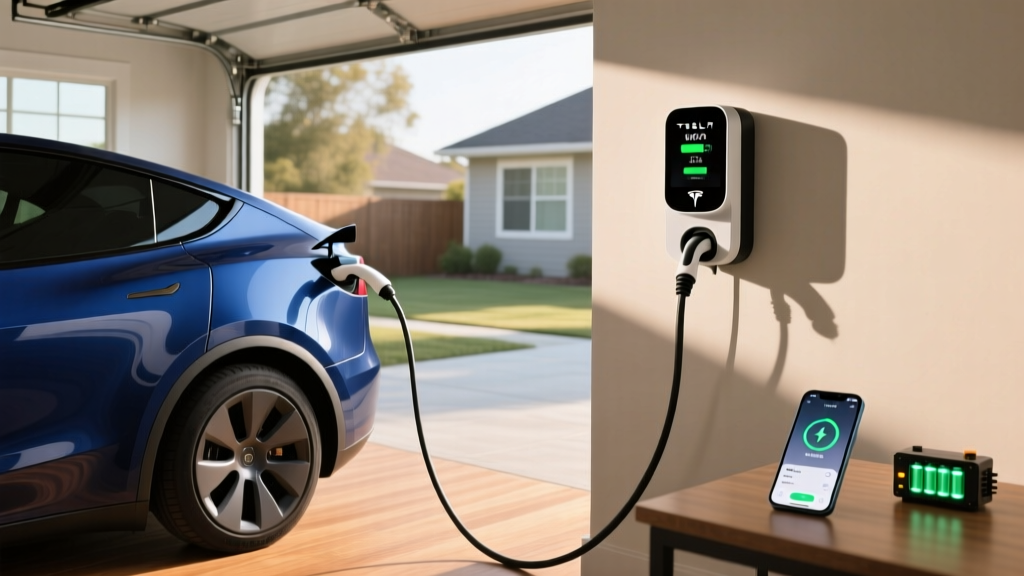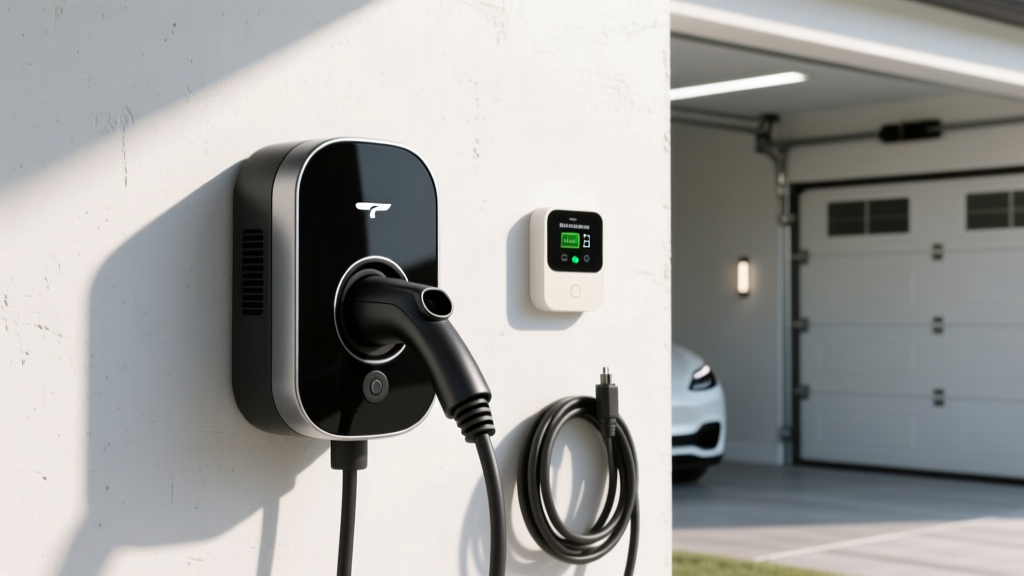
If you've spent months researching paint samples and architectural finishes for your garage, the last thing you want is a glossy white plastic box bolted next to your Tesla or Rivian. The "blacked out charger" trend—matte or satin-black Level 2 EV wall units with minimalist housings and dark cables—has moved from niche aesthetic preference to mainstream demand. Manufacturers have responded with genuinely capable hardware wrapped in stealthy enclosures that disappear against dark walls and modern garage interiors.
But aesthetics can't come at the expense of charging performance, safety certification, or electrical code compliance. This guide breaks down the best blacked-out Level 2 chargers available in 2026, the real cost of home installation (including the panel-upgrade scenario nobody warns you about), connector compatibility for the shifting NACS/CCS landscape, and exactly how much range each setup adds per hour.
Charging Levels Explained: kW, Miles Per Hour, and Real-World Expectations
Before picking hardware, you need to understand the three charging tiers and how they translate to actual range recovery. The critical distinction: kW (kilowatts) measures power—the rate of energy delivery—while kWh (kilowatt-hours) measures energy, the total capacity stored in your battery. A 48-amp Level 2 charger delivers up to 11.5 kW of power; your 75 kWh battery needs a certain number of kWh to fill up.
| Level | Voltage / Amps | Max Power (kW) | Miles of Range Per Hour | Typical Use Case |
|---|---|---|---|---|
| Level 1 | 120V / 12–16A | 1.4–1.9 kW | 3–5 mi/hr | Overnight trickle, PHEVs, low-mileage commuters |
| Level 2 | 240V / 16–80A | 3.8–19.2 kW | 14–70+ mi/hr | Home daily charging, workplace, destination |
| DC Fast Charge | 200–900V DC | 50–350+ kW | 150–1,200+ mi/hr | Road trips, highway corridors, commercial fleets |
For most EV owners, Level 2 is the workhorse. A 48-amp (11.5 kW) unit replenishes a Tesla Model Y's ~75 kWh battery from 10–80% in roughly 5.5 hours. A higher-output 80-amp (19.2 kW) unit on a capable vehicle like the GMC Hummer EV or Lucid Air cuts that to around 3–3.5 hours. Your vehicle's onboard charger dictates the ceiling: a Ford Mustang Mach-E accepts up to 10.5 kW on AC, so an 80-amp wall unit won't charge it any faster than a 48-amp one.
Best Blacked Out EV Chargers: Specs, Power Output, and Pricing
The following units all ship in matte-black or satin-black housings with dark cable jackets. Each is UL-listed (or ETL-listed to UL standards), which your electrician and local inspector will require for permitted installations.
ChargePoint Home Flex (Matte Black Edition)
- Power Output: Up to 11.5 kW (48A) on a 60A circuit; configurable down to 16A via DIP switches
- Connector: NACS native (2025+ models); CCS1 versions still available
- Cable Length: 23 feet
- Smart Features: Wi-Fi, app-based scheduling, Alexa/Google Home, utility demand-response integration, energy tracking
- Price: $649 MSRP
Verdict: The default pick for most buyers. Circuit-amperage flexibility means it works on existing 50A or 60A circuits without requiring a panel upgrade. The matte black version blends well in finished garages.
Emporia Level 2 EV Charger (Black)
- Power Output: Up to 11.5 kW (48A) on a 60A circuit
- Connector: J1772 (NACS adapter included with 2025+ units)
- Cable Length: 24 feet
- Smart Features: Wi-Fi, Emporia app with solar-integration scheduling, real-time cost tracking, load management when paired with Emporia Vue panel monitor
- Price: $399 MSRP
Verdict: Best value in the category. The solar-aware scheduling is genuinely useful if you have rooftop panels and want to charge only on excess production. The black housing is compact and unobtrusive.
Tesla Wall Connector (Black / Gen 4)
- Power Output: Up to 11.5 kW (48A); Wi-Fi firmware updates can enable higher output on compatible vehicles
- Connector: NACS native; built-in Magic Dock adapter provides CCS1 compatibility for non-Tesla EVs
- Cable Length: 24 feet
- Smart Features: Wi-Fi, over-the-air updates, Tesla app integration, Power Sharing (link up to 6 units on one circuit), vehicle-specific access control
- Price: $495 MSRP
Verdict: If you own a Tesla, this is the obvious match. Gen 4's integrated CCS adapter eliminates dongle clutter. The matte black housing with black glass faceplate is the cleanest-looking unit in this segment.
FLO Home X8 (Carbon Black)
- Power Output: Up to 19.2 kW (80A) on a 100A circuit
- Connector: J1772 (NACS adapter sold separately); CCS1 via adapter
- Cable Length: 25 feet
- Smart Features: Wi-Fi, FLO app scheduling, utility demand-response, RFID access lock, -40°F cold-weather rating
- Price: $1,149 MSRP
Verdict: For owners of vehicles with high-capacity onboard chargers (Lucid Air at 22 kW AC, some commercial EVs) or those running two EVs on a load-sharing setup. Requires a 100A dedicated circuit—confirm panel capacity before purchasing.
Home Installation Cost Breakdown: Electrician, Permit, and the Panel-Upgrade Gotcha
A blacked-out charger is only as good as the circuit feeding it. Installation costs vary wildly depending on your home's electrical panel capacity, the distance from panel to garage, and local permit fees. Here's what to budget:
| Cost Component | Simple Install (Panel Adjacent) | Standard Install (50–80 ft Run) | Complex Install (Panel Upgrade Needed) |
|---|---|---|---|
| Charger Equipment | $399–$699 | $399–$699 | $399–$1,149 |
| Electrician Labor (2–4 hrs @ $100–$175/hr) | $200–$400 | $500–$1,200 | $1,500–$3,000 |
| Electrical Materials (conduit, wire, breaker) | $50–$150 | $200–$600 | $300–$800 |
| Permit Fee | $50–$200 | $50–$200 | $100–$300 |
| Panel Upgrade (100A → 200A service, if needed) | N/A | N/A | $2,000–$5,000 |
| Total Estimated Cost | $700–$1,450 | $1,150–$2,700 | $4,300–$10,250 |
The panel-upgrade scenario deserves attention. Homes built before 2000 frequently have 100-amp main service panels. Adding a 60-amp dedicated EV circuit to an already-loaded 100A panel may exceed safe capacity, triggering a mandatory upgrade to 200A service. This is the single biggest cost variable in EV charger installation. Before buying a charger, have an electrician perform a load calculation on your panel—this is typically a $100–$200 service call that prevents a costly surprise mid-project.
Federal tax credit note: The IRS §30D alternative fuel vehicle refueling property credit covers up to 30% of home charger equipment and installation costs (capped at $1,000). However, this credit is subject to census-tract eligibility requirements—it's primarily available in low-income or non-urban areas. Check your eligibility at the IRS alternative fuel credit page and consult a tax professional before claiming.
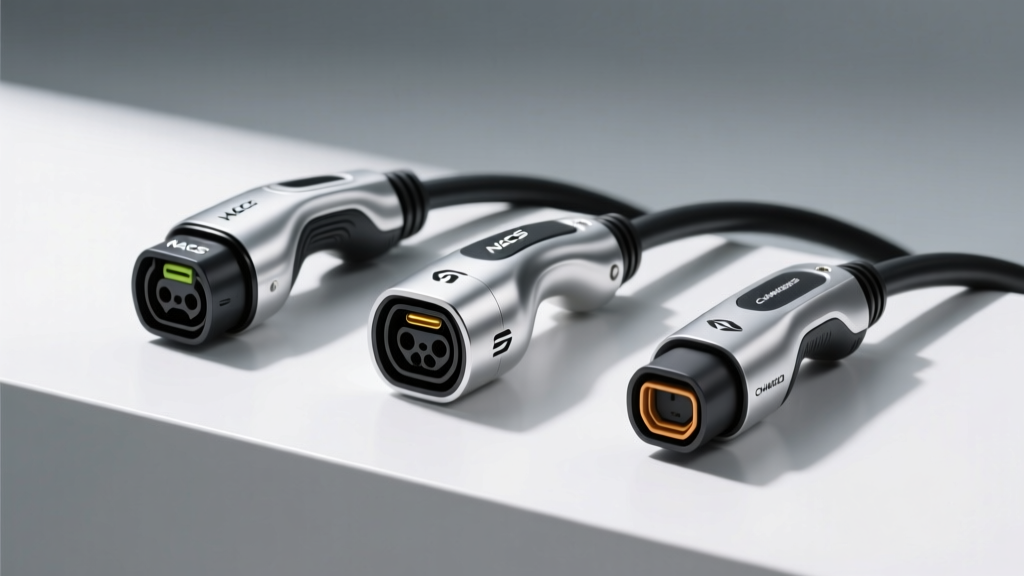
Connector Compatibility: NACS, CCS1, CHAdeMO, and Adapter Realities in 2026
The connector landscape has shifted dramatically since Ford, GM, Rivian, and most major automakers adopted Tesla's North American Charging Standard (NACS) for new vehicles starting in the 2025 model year. Here's where things stand:
| Connector | Native Vehicle Brands | Adapter Situation |
|---|---|---|
| NACS (Tesla standard) | Tesla, Ford, GM (Chevy/Cadillac/GMC), Rivian, Volvo, Polestar, Mercedes-Benz, BMW, Hyundai/Kia (2026+), Honda (2026+) | CCS1→NACS adapters available from Tesla, Lectron, A2Z for legacy vehicles |
| CCS1 | Legacy models (pre-2025 Ford, GM, VW ID.4, Hyundai Ioniq 5 pre-2026, most Stellantis PHEVs) | NACS→CCS1 adapters available; Tesla Wall Connector Gen 4 has built-in Magic Dock |
| CHAdeMO | Nissan Leaf (discontinued), Mitsubishi Outlander PHEV (legacy) | Effectively deprecated; no new CHAdeMO vehicles sold in the US since 2024 |
Practical advice: If you're buying a new EV in 2026, it almost certainly has a NACS port. Buy a NACS-native charger (Tesla Wall Connector, ChargePoint Home Flex NACS edition) to avoid adapter clutter. If you own a 2023–2025 model with CCS1, a J1772-connector charger with a J1772-to-NACS adapter (supplied by most automakers for public charging) works fine at home, or opt for the Tesla Wall Connector Gen 4 with its integrated CCS adapter dock.
Cost to Charge: Per-Mile Economics vs. Gasoline
The financial case for home charging hinges on your local electricity rate and whether you can schedule charging during off-peak hours. Here are realistic scenarios based on a 3.5 mi/kWh efficient EV (representative of a Tesla Model Y or Hyundai Ioniq 5):
| Charging Scenario | Cost per kWh | Cost Per Mile (3.5 mi/kWh) | Full 75 kWh Battery (10–80%) |
|---|---|---|---|
| Home off-peak (utility time-of-use rate) | $0.09–$0.14 | $0.026–$0.040 | $3.35–$5.25 |
| Home standard rate (national avg) | $0.17 | $0.049 | $6.38 |
| Public Level 2 (ChargePoint, EVgo L2) | $0.25–$0.49 | $0.071–$0.140 | $9.38–$18.38 |
| DC Fast Charge (Electrify America, Tesla Supercharger) | $0.32–$0.56 | $0.091–$0.160 | $12.00–$21.00 |
| Gasoline comparison (30 MPG avg, $3.40/gal) | $3.40/gal | $0.113 | ~$42–$50 equivalent |
Home off-peak charging delivers fuel costs at roughly one-quarter to one-third the price of gasoline per mile. Even standard-rate home charging undercuts gas significantly. The economics erode on public DC fast chargers at peak pricing—frequent road-trippers should factor this into total cost of ownership calculations. According to fueleconomy.gov, most current EVs achieve between 3.0 and 4.2 mi/kWh depending on weight and aerodynamics.
Charging Time Examples: 10–80% for Common EV Battery Sizes
Here's what to expect from a 48-amp (11.5 kW) blacked-out Level 2 charger on popular 2026 EVs, charging from 10% to 80% state of charge:
- Tesla Model Y (75 kWh battery, NMC): ~5.5 hours (10–80%)
- Ford F-150 Lightning Extended Range (131 kWh battery, NMC): ~9.5 hours at 11.5 kW; ~6 hours at 19.2 kW (80A circuit)
- Hyundai Ioniq 5 (84 kWh battery, NMC): ~6 hours at 11.5 kW
- Chevrolet Equinox EV (85 kWh battery, NMC): ~6 hours at 11.5 kW
- BMW iX xDrive50 (111.5 kWh battery, NMC): ~8 hours at 11.5 kW
- Toyota bZ4X (71.4 kWh battery, NMC): ~5 hours at 11.5 kW (onboard charger limited to ~6.6 kW on some trims)
DC fast charging is a separate story. Most 2026 EVs with 800V architectures (Hyundai/Kia E-GMP, Porsche Taycan, Lucid Air) can charge 10–80% at a 350 kW station in 18–22 minutes. Vehicles on 400V architectures (older Tesla Model 3/Y, Nissan Ariya) typically take 25–35 minutes at a 150–250 kW charger. Charging always tapers significantly above 80% SoC to protect battery longevity—plan road-trip stops around the 10–80% window.
Safety, Electrical Code, and Permit Requirements
Your blacked-out charger installation must comply with the National Electrical Code (NEC Article 625) and local amendments. Key requirements your electrician will address:
- Dedicated circuit: Level 2 chargers require their own dedicated breaker—no sharing with other appliances. A 48A charger needs a 60A breaker (NEC requires circuits rated at 125% of continuous load).
- GFCI protection: NEC 2020 and later requires GFCI protection for all 240V EV charging outlets in garages. Hardwired installations (no plug) may be exempt in some jurisdictions—confirm with your local inspector.
- Outdoor rating: If your charger mounts outside or in an open carport, it must carry a NEMA 4 or IP65 weather rating. All units listed above meet this standard.
- Wire gauge: 6 AWG copper for 48A/60A circuits; 4 AWG or 3 AWG for 80A/100A circuits. Longer runs (over 100 feet) may require upsizing to prevent voltage drop.
- Permit and inspection: Nearly all US jurisdictions require an electrical permit for a new 240V circuit. Your electrician typically pulls this. An inspector will verify code compliance before the system is energized. Budget $50–$300 for the permit and expect a 1–3 week timeline depending on your municipality.
Skip the permit at your own risk: unpermitted work can void homeowner's insurance claims related to electrical fires and creates problems at resale when the buyer's inspection flags the unpermitted circuit.
Frequently Asked Questions
How much does it cost to install a home EV charger?
A simple installation with the panel nearby runs $700–$1,450 including equipment, labor, and permit. A standard 50–80 foot wire run costs $1,150–$2,700. If your home needs a panel upgrade from 100A to 200A service, expect $4,300–$10,250 total. Always get a load calculation from a licensed electrician before committing to a charger purchase.
How fast will each charging level add range?
Level 1 (120V) adds 3–5 miles of range per hour—adequate only for PHEVs or very low daily mileage. Level 2 at 48 amps (11.5 kW) adds 30–40 miles per hour for efficient EVs like the Model Y or Ioniq 5, and 20–25 miles per hour for heavier vehicles like the F-150 Lightning. DC fast charging adds 150–1,200+ miles per hour of equivalent rate, though sessions are typically 20–35 minutes in practice.
Which connector and charger is compatible with my EV?
For 2025–2026 model-year vehicles from Tesla, Ford, GM, Rivian, Volvo, Hyundai, and Kia, the native connector is NACS. For older CCS1-equipped EVs (2022–2024 models), a J1772-connector charger works with the adapter most automakers provide, or the Tesla Wall Connector Gen 4 with its built-in CCS adapter. CHAdeMO is effectively discontinued for new vehicles. Check your owner's manual or the fueleconomy.gov EV listings for your specific model's port type.
How much does charging cost per mile vs gas?
Home charging at the national average rate ($0.17/kWh) costs about $0.049/mile for an efficient EV. Gasoline at $3.40/gallon in a 30 MPG vehicle costs $0.113/mile—more than double. Off-peak home rates ($0.09–$0.14/kWh) drop EV fueling to $0.026–$0.040/mile. Public DC fast charging ($0.32–$0.56/kWh) narrows the gap to $0.091–$0.160/mile, approaching gas parity on expensive networks.
What electrical upgrades might I need?
The most common upgrade is a panel service increase from 100A to 200A, needed when your existing panel lacks capacity for a dedicated 60A EV circuit. Homes with 200A panels typically accommodate a 48A charger without upgrades. Other potential needs: adding a sub-panel in a detached garage ($800–$2,500), upgrading aluminum wiring to copper, or installing a smart load-management system (like Emporia Vue or Span panel) to dynamically share capacity between the EV charger and other circuits without a full panel upgrade.