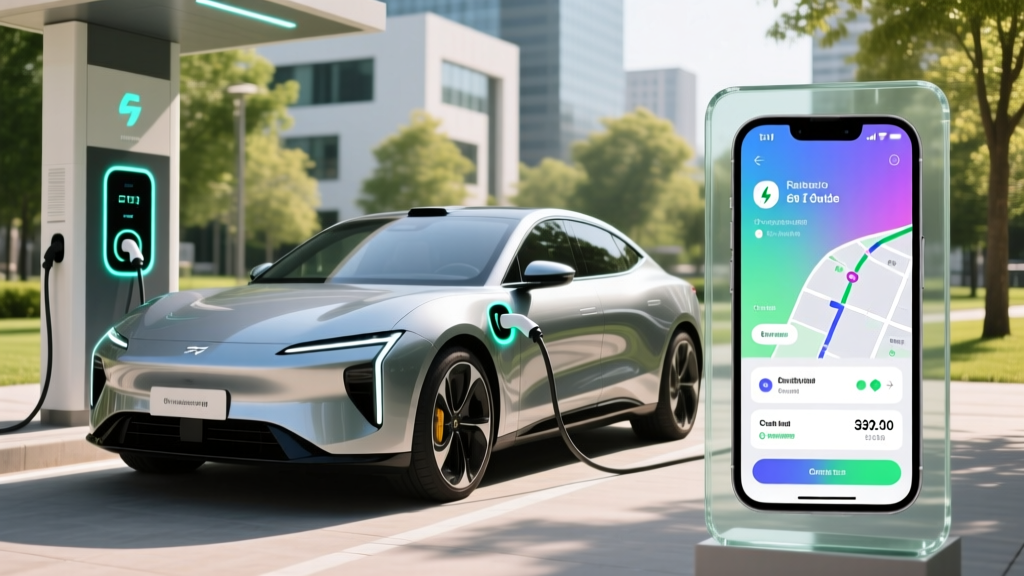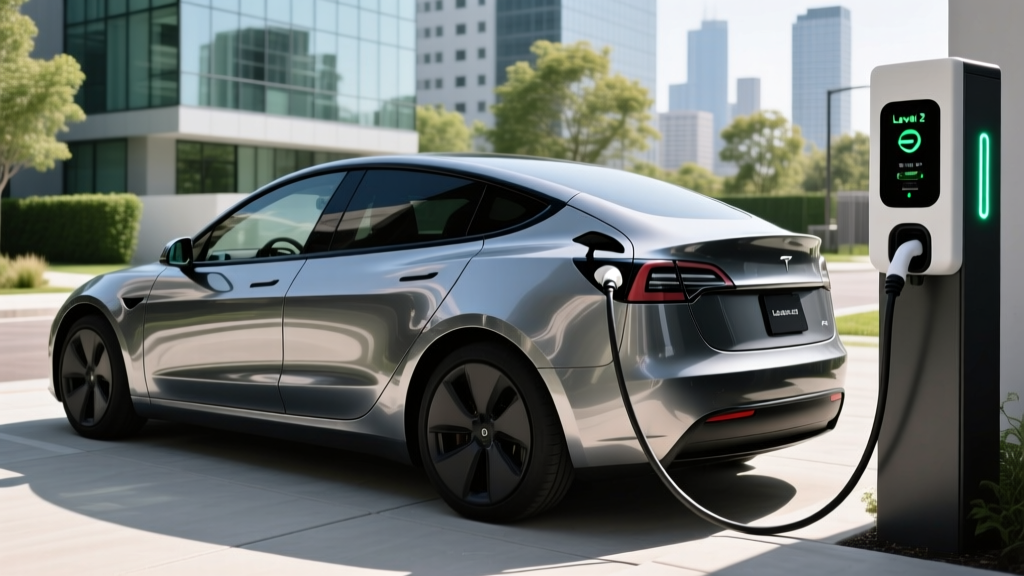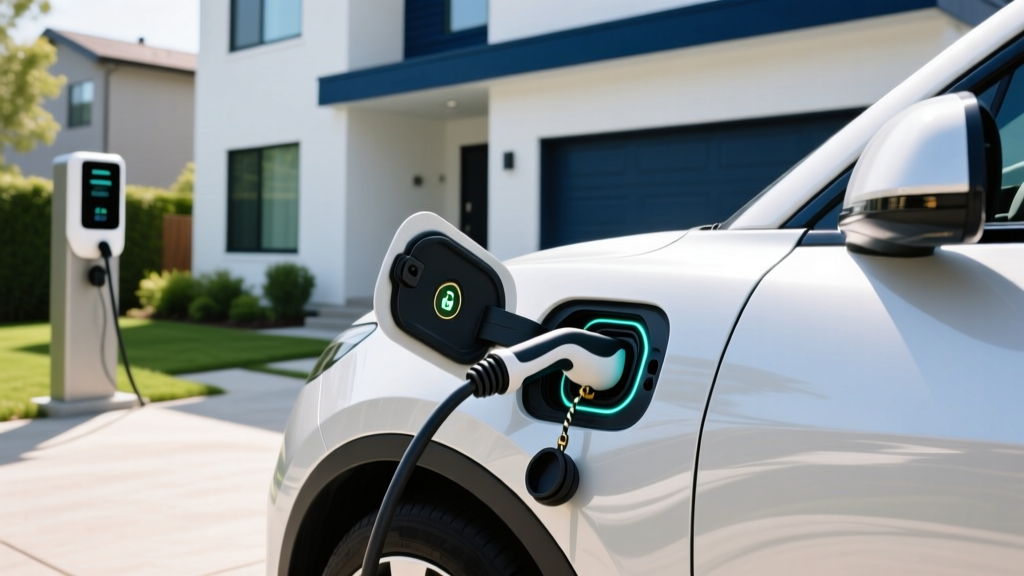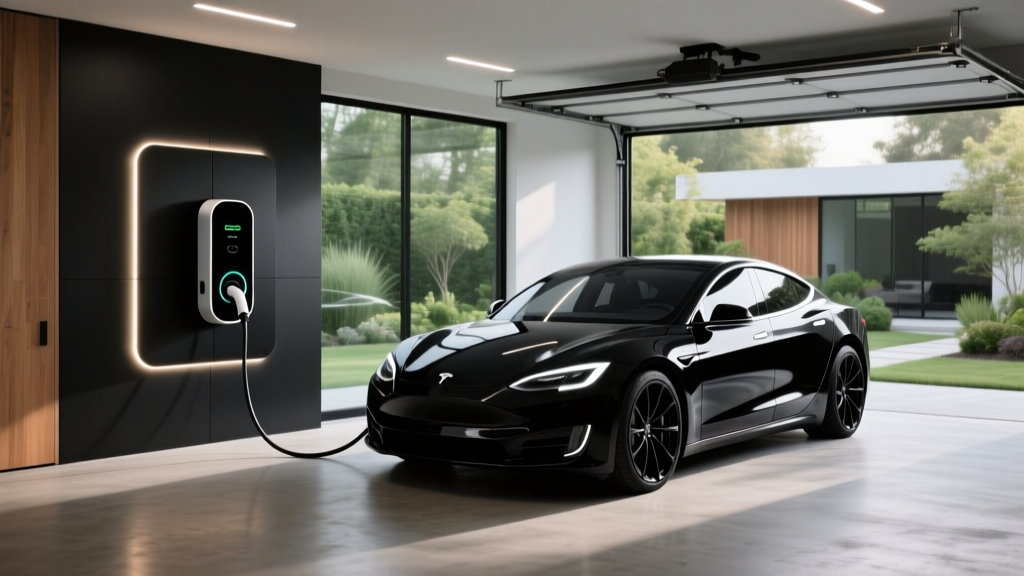
Not every garage deserves a bright white plastic box bolted to the wall. For EV owners who care about aesthetics as much as amperage, the "black on black" charger look — a dark-faced wall connector with a black cable and black holster — has become the go-to spec for modern garages and carports. But looks are only half the equation. You still need the right kilowatt output, the correct connector for your vehicle, and an electrical panel that can handle the load.
This guide covers everything you need to spec, buy, and install a black on black EV charger setup at home in 2026 — from charge speeds and electrical requirements to equipment picks and per-mile costs.
Charging Levels Explained: kW Speeds and Miles Per Hour
Before picking hardware, you need to understand the three charging tiers available to EV owners. The critical distinction: kW (kilowatts) measures power — how fast energy flows into your car. kWh (kilowatt-hours) measures energy — how much your battery holds. A 75 kWh battery charged at 11.5 kW takes roughly 6.5 hours from empty to full. Never confuse the two.
| Level | Voltage | Power (kW) | Miles Added/Hour | Best For |
|---|---|---|---|---|
| Level 1 | 120V AC | 1.0–1.4 kW | 3–5 mi/hr | Overnight top-ups, PHEVs, low-mileage drivers |
| Level 2 | 240V AC | 3.3–19.2 kW | 12–75 mi/hr | Daily home charging, most EV owners |
| DC Fast Charge | 400–800V DC | 50–350 kW | 150–1,000+ mi/hr | Road trips, highway corridors |
For a black on black home charger, you're looking at Level 2. Most residential panels support up to 48 amps continuous draw (a 60-amp circuit), delivering 11.5 kW on a 240V circuit. That's enough to fully replenish a Tesla Model Y Long Range (75 kWh usable) overnight in about 6.5 hours, or add roughly 44 miles of range per hour of charging.
DC fast charging is a public-infrastructure play — you won't install a 350 kW cabinet at home. But understanding its speeds helps contextualize why Level 2 is the home sweet spot. According to fueleconomy.gov, the average American EV driver covers 37 miles per day, meaning a 48-amp Level 2 unit replenishes a full day's driving in under an hour.
How Much Does It Cost to Install a Home EV Charger?
The honest answer: anywhere from $400 to $4,500+, depending entirely on your home's electrical situation. Here's the real breakdown that most guides gloss over.
| Component | Simple Install (Panel Near Garage) | Complex Install (Panel Upgrade + Long Run) |
|---|---|---|
| Charger hardware (40–48A, hardwired) | $400–$700 | $400–$700 |
| Electrician labor (2–4 hrs simple; 6–10 hrs complex) | $300–$800 | $1,200–$2,500 |
| Wiring & conduit (6 AWG copper, 10–50 ft run) | $100–$300 | $300–$800 |
| Permit & inspection | $50–$200 | $100–$300 |
| Electrical panel upgrade (100A → 200A, if needed) | N/A | $1,500–$3,500 |
| Total estimated range | $850–$2,000 | $3,500–$7,800 |
The Panel Upgrade Gotcha
Homes built before 1990 often have 100-amp service panels. Adding a 60-amp EV circuit to an already-loaded 100A panel can push you past safe capacity — especially if you run electric HVAC, a dryer, and an oven simultaneously. A licensed electrician will perform a load calculation (NEC Article 220) to determine if your panel can handle the draw. If it can't, you'll need a 200-amp service upgrade, which typically runs $1,500–$3,500 including the new panel, permit, and utility coordination.
An alternative: some utilities and smart panels now offer load-management devices (like the Emporia V2 Load Management Kit or Span smart panel) that dynamically throttle the charger when other circuits spike. This can avoid a panel upgrade entirely, but adds $300–$600 in equipment cost.
Which Connector Is Compatible With Your EV?
The connector landscape shifted dramatically in 2024–2025 when Ford, GM, Rivian, Volvo, and nearly every major automaker adopted Tesla's NACS (North American Charging Standard) for new vehicles. By 2026, NACS is the dominant connector for new EVs sold in North America. But CCS1-equipped vehicles from 2020–2024 models remain on the road in large numbers, and CHAdeMO persists on older Nissan Leaf models.
| Connector | Brands Using It (2026 New Models) | Adapter Needed? |
|---|---|---|
| NACS (Tesla standard) | Tesla, Ford, GM, Rivian, Volvo, Polestar, Mercedes, Hyundai/Kia (2025+) | No — native on new vehicles |
| CCS1 | Remaining 2022–2024 models (VW ID.4, BMW i4, older Hyundai/Kia) | CCS-to-NACS adapter ($150–$250) for Supercharger access |
| CHAdeMO | Nissan Leaf (2013–2024), Mitsubishi Outlander PHEV (older) | Limited public network; no NACS adapter available |
For a black on black home charger in 2026: If you own a NACS-equipped vehicle (which includes all Teslas and most new-model-year EVs from 2025 onward), buy a NACS-terminated wall connector. If you drive a CCS1 vehicle, buy a J1772-terminated charger (the universal Level 2 connector that all CCS1 vehicles accept for AC charging) or use a NACS charger with a NACS-to-J1772 adapter (approximately $100–$200).
Top Black on Black EV Charger Picks for 2026
Not every charger comes in black. Many popular units ship only in white or gray housings. Below are the best all-black or black-faced Level 2 chargers that deliver both the aesthetic and the performance spec sheet that serious EV owners demand.
Tesla Wall Connector (Gen 3) — Black
- Power output: Up to 11.5 kW (48A on 60A circuit)
- Connector: NACS native
- Cable length: 24 ft
- Smart features: Wi-Fi, OTA updates, load sharing (pair up to 6 units on one circuit), Tesla app scheduling
- Enclosure: Matte black face, black cable, black holster — true black-on-black
- Price: ~$475 (direct from Tesla)
- Best for: Tesla owners, NACS-equipped Ford/GM/Rivian owners
ChargePoint Home Flex — Black Edition
- Power output: Up to 12 kW (50A on 60A circuit) — adjustable via DIP switches down to 16A
- Connector: J1772 (NACS adapter included in 2025+ boxes)
- Cable length: 23 ft
- Smart features: Wi-Fi, ChargePoint app, Alexa integration, energy tracking, scheduled charging
- Enclosure: Available in graphite black with black cable
- Price: ~$599
- Best for: CCS1 vehicle owners, multi-EV households with mixed connectors
Emporia Vue Level 2 EV Charger — Black
- Power output: Up to 11.5 kW (48A)
- Connector: J1772 (with optional NACS adapter)
- Cable length: 24 ft
- Smart features: Integrated with Emporia Vue energy monitor, solar-aware charging, time-of-use scheduling
- Enclosure: Black housing, black cable
- Price: ~$399 (charger only; ~$449 with energy monitor bundle)
- Best for: Budget-conscious buyers, solar-home owners
Wallbox Pulsar Max — Black
- Power output: Up to 11.5 kW (48A)
- Connector: Available in J1772 or NACS
- Cable length: 25 ft (longest in class)
- Smart features: Wi-Fi + Bluetooth, myWallbox app, Power Sharing, Eco-Smart (solar matching)
- Enclosure: Compact black housing, integrated black cable wrap
- Price: ~$549
- Best for: Tight garage spaces (smallest footprint), long cable needs
All four units are hardwired (no plug — required by NEC for circuits above 40A in most jurisdictions), UL-listed, and rated for indoor or outdoor use (NEMA 4 or equivalent weather resistance). The Tesla Wall Connector remains the value leader at $475 for 48A, but if you drive a non-Tesla CCS1 vehicle, the ChargePoint Home Flex's included NACS adapter and adjustable amperage make it the more flexible pick.
Charging Cost Per Mile: Home vs. Public vs. Gas
The single biggest financial advantage of home charging is cost. Electricity rates vary by state and utility, but the pattern is consistent: home Level 2 charging costs a fraction of DC fast charging, and both cost far less than gasoline per mile.
| Scenario | Rate | Cost Per Mile (at 3.5 mi/kWh or 28 MPG) |
|---|---|---|
| Home Level 2 — off-peak utility rate | $0.10/kWh | $0.029/mile |
| Home Level 2 — standard residential rate | $0.16/kWh | $0.046/mile |
| Public Level 2 (network pricing) | $0.30/kWh | $0.086/mile |
| DC Fast Charging (Electrify America, Tesla Supercharger) | $0.38/kWh | $0.109/mile |
| Gasoline vehicle (28 MPG combined, $3.40/gal) | $3.40/gallon | $0.121/mile |
At the national average residential rate of roughly $0.16/kWh (U.S. EIA data), a 75 kWh battery fill from 10% to 90% (about 60 kWh) costs approximately $9.60 at home — versus $33–$40 at a gas station for equivalent range in a 28 MPG sedan. Over 12,000 miles per year, home charging saves $600–$1,100 versus gas, depending on your local electricity rate.
Time-of-use tip: Many utilities offer off-peak rates below $0.10/kWh between 10 PM and 6 AM. Every charger recommended above supports scheduled charging via its app — set it to start at 11 PM and you'll cut your per-mile cost nearly in half.
Charging Time Examples: 10% to 80% at Level 2
Charging time depends on your battery's usable capacity (kWh) and your charger's sustained power output (kW). Note that Level 2 charging is nearly linear — unlike DC fast charging, which tapers significantly above 80% state of charge, Level 2 delivers consistent power through most of the curve.
| Vehicle (Usable Battery) | 32A / 7.7 kW | 40A / 9.6 kW | 48A / 11.5 kW |
|---|---|---|---|
| Tesla Model Y LR (75 kWh) | 6.8 hrs | 5.5 hrs | 4.6 hrs |
| Ford Mustang Mach-E ER (91 kWh) | 8.3 hrs | 6.6 hrs | 5.5 hrs |
| Hyundai Ioniq 5 (77.4 kWh) | 7.0 hrs | 5.6 hrs | 4.7 hrs |
| BMW i4 eDrive40 (81.5 kWh) | 7.4 hrs | 5.9 hrs | 5.0 hrs |
| Chevy Equinox EV (85 kWh) | 7.7 hrs | 6.2 hrs | 5.2 hrs |
| Toyota RAV4 Prime PHEV (18.1 kWh) | 1.6 hrs | 1.3 hrs | 1.1 hrs |
For most EV owners, a 48A hardwired charger replenishes from 10% to 80% overnight — which is exactly the use case. You rarely need to charge from 0% to 100% at home; the 10–80% window covers daily driving needs and is gentler on battery longevity.
Safety, Electrical Code, and Installation Requirements
EV chargers draw sustained high current for hours — more like a welding outlet than a phone charger. The National Electrical Code (NEC) treats them seriously, and so should your electrician.
Critical Safety Requirements for Home EV Charger Install
- Dedicated circuit: Your Level 2 charger must be on its own dedicated breaker — no sharing with other outlets or appliances. A 48A charger requires a 60A breaker (NEC requires 125% oversizing for continuous loads).
- Wire gauge: 6 AWG copper THHN in conduit for a 60A circuit; 4 AWG for runs over 100 feet to minimize voltage drop.
- GFCI protection: NEC 2023 (Article 625.54) requires GFCI protection for all EVSE receptacles. Hardwired units with integrated ground-fault protection (all four chargers above) satisfy this requirement.
- Outdoor rating: If mounting outside, ensure the unit carries a NEMA 4 or IP54+ rating. All recommended units above are outdoor-rated, but the cord and connector must also be rated for UV and moisture exposure.
- Permit & inspection: Virtually all jurisdictions require an electrical permit for a new 240V circuit. Your electrician pulls the permit; the city/county inspector verifies the work. Skipping this step can void homeowner's insurance coverage for any related electrical incident.
- Do NOT use extension cords: Never run an EV charger through an extension cord or adapter plug. The sustained 40–48A draw generates heat at every connection point — a fire risk.
Always hire a licensed electrician — specifically one experienced with EV charger installs. Ask if they've done load calculations for EVSE before. The National Fire Protection Association (NFPA) publishes the NEC standards that govern these installations, and a qualified electrician will know Article 625 cold.
Federal Tax Credit: The §30C Alternative Fuel Refueling Property Credit
While the well-known §30D credit applies to EV purchases, a separate credit — §30C (Alternative Fuel Refueling Property Credit) — covers home charger hardware and installation. As of 2026, this credit provides up to 30% of the cost of qualified EV charging equipment and installation, capped at $1,000 for residential property.
- Applies to the charger hardware AND electrician labor
- Must be installed at your primary residence
- Equipment must be new and UL-listed
- Subject to income limitations and census-tract eligibility requirements
- File IRS Form 8911 with your federal return
Check current eligibility on IRS.gov — rules and eligible census tracts update periodically. Consult a tax professional to confirm your specific qualification before purchase.
Frequently Asked Questions
Can I install a black on black EV charger outdoors?
Yes. All four chargers recommended above carry outdoor ratings (NEMA 4 or equivalent). The black housing and cable are UV-stable. If your install location is exposed to direct sunlight, consider a small shade cover to reduce thermal load on the electronics during summer charging sessions — heat reduces charging efficiency slightly.
Do I need a panel upgrade for a 48-amp EV charger?
It depends on your home's total electrical service and existing loads. A 200-amp panel with gas appliances (gas range, gas dryer, gas furnace) almost always has headroom for a 60A EV circuit. A 100-amp panel with all-electric appliances likely does not. Your electrician will perform a NEC Article 220 load calculation to determine this — don't guess.
Is a NACS or J1772 connector better for a home charger?
Neither is inherently "better" — it depends on your vehicle. If you own a Tesla or a 2025+ NACS-equipped EV (Ford, GM, Rivian, Hyundai/Kia), a NACS charger plugs in natively. If you own a 2022–2024 CCS1 vehicle (VW ID.4, BMW i4, older Ioniq 5), you need a J1772-terminated charger or a NACS-to-J1772 adapter. Since NACS is the North American standard going forward, NACS-terminated chargers offer better future-proofing.
How does cold weather affect Level 2 home charging?
Cold temperatures (below 32°F / 0°C) increase battery internal resistance, which slightly reduces charging speed and increases energy consumption. Expect 10–20% longer charge times in deep cold. More importantly, cold reduces driving range by 15–30% (per AAA and fueleconomy.gov testing), so you'll need to charge more frequently in winter. A Level 2 home charger handles this easily — you simply plug in every night regardless.
Can I use a smart charger to charge only when solar panels are producing?
Yes. The Emporia Vue charger and the Wallbox Pulsar Max both offer solar-matching modes that adjust charge rate in real time based on your solar production. This maximizes self-consumption and minimizes grid draw. You'll need a home energy monitor (Emporia Vue 2 or similar) integrated with the charger's app to enable this feature.
What's the difference between hardwired and plug-in (NEMA 14-50) chargers?
Hardwired chargers connect directly to your electrical panel via a junction box — no outlet. They support up to 48A continuous (60A breaker) and are required for the highest power levels. Plug-in chargers use a NEMA 14-50 outlet, are limited to 40A continuous (50A breaker), and offer portability if you move. For a permanent black on black garage install, hardwired is the cleaner, higher-power choice.
A black on black EV charger setup isn't just an aesthetic choice — it's a statement that you've thought through the details. Pick the right amperage for your panel, the right connector for your car, and a unit with the smart features to optimize your electricity costs. The result is a garage that looks as sharp as it performs.