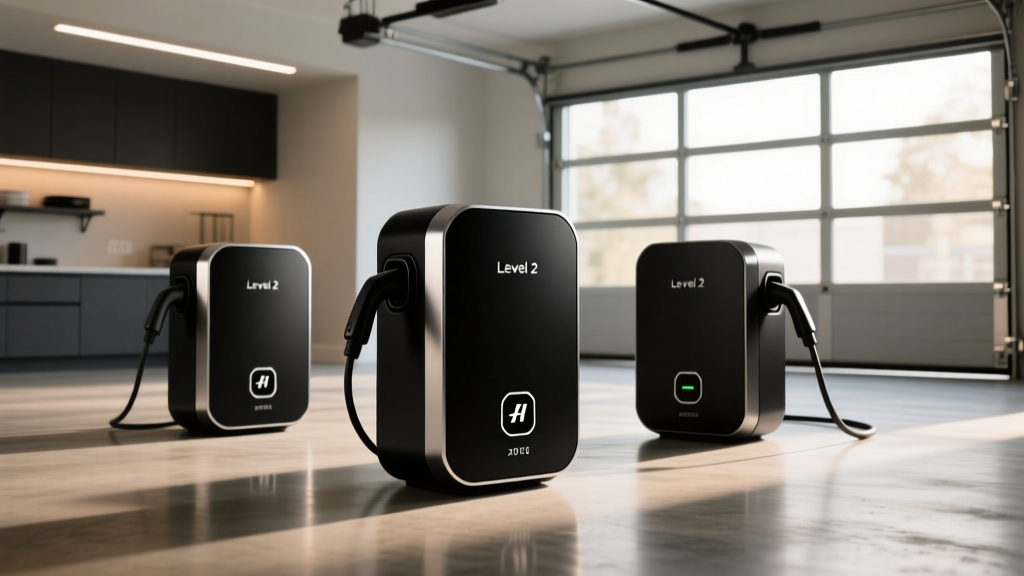
Most Level 2 home EV chargers ship in appliance-white or industrial gray. If your garage doubles as a workspace, or your driveway charger sits next to a modern facade, aesthetics matter alongside amperage. The good news: a growing number of manufacturers now offer a black matte EV charger that matches contemporary home finishes while delivering the 32–48 amps most EVs can accept. This guide compares the best black-finish wallbox and plug-in units on the market, then walks through the electrical requirements, installation costs, connector compatibility, and real charging speeds you need to make an informed purchase.
Charging Levels Explained: Speeds in kW and Miles Per Hour
Before picking hardware, you need the three charging tiers straight. The critical distinction: kW (kilowatts) measures power — how fast energy flows. kWh (kilowatt-hours) measures energy — what your battery stores. Think of kW as the width of the hose and kWh as the bucket size.
| Level | Voltage | Max Power (kW) | Miles of Range Added Per Hour | Typical Use |
|---|---|---|---|---|
| Level 1 | 120V AC | 1.4–1.9 kW | 3–5 mi/hr | Overnight trickle; PHEVs, low-mileage commutes |
| Level 2 | 240V AC | 7.2–11.5 kW | 20–44 mi/hr | Home wallbox; daily charging for BEVs |
| DC Fast | 400–800V DC | 50–350 kW | 150–1,000+ mi/hr (peak) | Road-trip stops; 10–80% in 18–40 min |
For home charging, Level 2 is the sweet spot. A 77 kWh battery (Ford Mustang Mach-E Extended Range) gains a full charge overnight on an 11.5 kW unit. Level 1 is viable only if you drive under 30 miles daily or own a PHEV with a small pack. DC fast charging is strictly a public-road-trip affair — no residential installation applies.
Black Matte Level 2 Chargers: Top Picks Compared
Here are the current black-finish Level 2 chargers that balance design, output, smart features, and reliability. All prices reflect early-2026 retail.
ChargePoint Home Flex (Matte Black Edition)
- Power output: Up to 11.5 kW (48A) on a 60A circuit; configurable down to 16A
- Connector: NACS (Tesla-native) or J1772 (CCS1 vehicles via adapter)
- Cable length: 23 ft
- Smart features: Wi-Fi, scheduled charging, Alexa integration, energy dashboard
- Indoor/outdoor: NEMA 4 rated (both)
- Price: ~$599 (NACS) / ~$549 (J1772)
Best for: Owners who want adjustable amperage to match their panel capacity without buying a new unit if they upgrade later.
Emporia Vue Level 2 Charger (Matte Black)
- Power output: Up to 11.5 kW (48A)
- Connector: J1772 (NACS adapter included for Tesla vehicles)
- Cable length: 24 ft
- Smart features: Real-time energy monitoring via Emporia app, solar integration, TOU scheduling
- Indoor/outdoor: NEMA 4
- Price: ~$399
Best for: Solar-panel owners who want to charge exclusively on excess rooftop generation.
Wallbox Pulsar Max (Stealth Black)
- Power output: Up to 11.5 kW (48A)
- Connector: NACS or J1772 configurations
- Cable length: 25 ft
- Smart features: Bluetooth + Wi-Fi, Power Sharing (two chargers on one circuit), eco-solar mode
- Indoor/outdoor: NEMA 4
- Price: ~$649
Best for: Two-EV households that want to share a single 60A circuit between two wallboxes without a panel upgrade.
Tesla Wall Connector (Black Glass Faceplate)
- Power output: Up to 11.5 kW (48A)
- Connector: NACS native; J1772 adapter included for non-Tesla EVs
- Cable length: 24 ft
- Smart features: Wi-Fi, OTA updates, load sharing with up to 6 units, vehicle-specific access control
- Indoor/outdoor: NEMA 3R (outdoor-rated, but best under cover)
- Price: ~$475
Best for: Tesla owners or mixed-fleet households who want the lowest price on a name-brand 48A unit.
Installation Cost Breakdown: What You Will Actually Pay
The charger itself is often the cheapest part of the project. Labor, permitting, and possible panel upgrades dominate the final bill. Below is a realistic cost range for a 240V/48A hardwired installation in a US home, based on 2025–2026 electrician quotes and DOT/EERE guidance.
| Line Item | Low End | High End | Notes |
|---|---|---|---|
| Level 2 charger unit | $400 | $700 | Black matte models above |
| Electrician labor (hardwired, <30 ft run) | $400 | $800 | Varies by region; conduit and drywall patching extra |
| Materials (wire, conduit, breaker, junction box) | $100 | $300 | 6 AWG copper for 48A circuits |
| Permit and inspection | $50 | $250 | Required in most jurisdictions |
| Panel upgrade (100A → 200A) if needed | $1,500 | $3,500 | Only if existing panel lacks capacity — common in pre-1990 homes |
| Total (no panel upgrade) | $950 | $2,050 | |
| Total (with panel upgrade) | $2,450 | $5,550 |
Panel-upgrade gotcha: A 48A charger requires a 60A dedicated circuit (NEC 80% rule). If your panel is already near capacity — say, running electric heat, a dryer, and an oven on a 100A service — you cannot legally add another 60A breaker. An electrician will perform a load calculation per NEC Article 220. Budget the panel upgrade if your home was built before 1990 or has original wiring.
Connector Compatibility: NACS, CCS1, and CHAdeMO
As of 2026, the North American Charging Standard (NACS) — originally Tesla's proprietary connector — is the dominant plug for new EVs. Ford, GM, Rivian, Hyundai, Kia, and Volvo now ship with NACS ports. Legacy CCS1 vehicles (2022–2025 model years) use adapters at Tesla Superchargers. CHAdeMO is effectively discontinued in the US; only the Nissan Leaf still ships with it.
| Connector | Brands Using It (2026 Models) | Adapter Needed? |
|---|---|---|
| NACS | Tesla, Ford, GM, Rivian, Hyundai (Ioniq 5/6 2025+), Kia (EV6/EV9 2025+), Volvo, Polestar, Mercedes | None for home NACS chargers |
| CCS1 (J1772 + DC pins) | Legacy VW ID.4 (pre-2025), BMW iX/i4, older Ford/GM EVs | NACS-to-CCS adapter (~$200) for Tesla Superchargers; J1772 adapter for Level 2 |
| CHAdeMO | Nissan Leaf only | No home adapter available; use CHAdeMO public DC stations |
Recommendation: If your EV is a 2025+ model from a major brand, buy a NACS-connector home charger. If you drive a 2023–2024 CCS1 vehicle, buy a J1772 charger and use the manufacturer-supplied NACS adapter for DC travel charging.
Charging Cost Per Mile: Home vs. Public vs. Gas
The economics of home Level 2 charging are overwhelmingly favorable compared to gasoline or public DC fast charging. Here is a realistic cost-per-mile comparison for a mid-size EV averaging 3.0 miles/kWh (e.g., Tesla Model Y, Hyundai Ioniq 5) versus a 30 MPG gas car on $3.40/gallon fuel.
| Charging Scenario | Avg. Cost per kWh | Cost per Mile | vs. 30 MPG Gas Car |
|---|---|---|---|
| Home Level 2 (off-peak TOU rate) | $0.09–$0.13 | $0.03–$0.04 | 70–75% cheaper |
| Home Level 2 (standard flat rate) | $0.14–$0.18 | $0.05–$0.06 | 50–60% cheaper |
| Public Level 2 (network like ChargePoint) | $0.25–$0.39 | $0.08–$0.13 | 10–30% cheaper |
| DC Fast (Electrify America, EVgo) | $0.35–$0.56 | $0.12–$0.19 | Comparable or slightly cheaper |
| Gasoline (30 MPG, $3.40/gal) | — | $0.11 | Baseline |
Key insight: Home charging on an off-peak rate saves $600–$900/year over gas for a driver covering 12,000 miles. Public DC fast charging erases most of that savings — use it for road trips, not daily fills. Check fueleconomy.gov for your specific vehicle's kWh/100mi efficiency figure to calculate your own cost per mile.
Charging Time Examples: 10–80% for Common Battery Sizes
Most EVs charge fastest between 10% and 80% state of charge (SoC). Above 80%, the battery management system tapers power to protect cell health. Here is how long common battery sizes take on each charger tier.
| Battery Size (usable kWh) | Example Vehicle | Level 1 (1.4 kW) | Level 2 (11.5 kW) | DC Fast (peak kW) |
|---|---|---|---|---|
| 62 kWh | Tesla Model 3 RWD | ~31 hrs | ~4.5 hrs | ~22 min (170 kW peak) |
| 77 kWh | Ford Mustang Mach-E ER | ~38 hrs | ~5.5 hrs | ~28 min (150 kW peak) |
| 84 kWh | Hyundai Ioniq 5 (2025+) | ~42 hrs | ~6 hrs | ~18 min (350 kW peak, 800V) |
| 100 kWh | Rivian R1S Dual-Motor | ~50 hrs | ~7.5 hrs | ~35 min (200 kW peak) |
| 17 kWh (PHEV) | Toyota RAV4 Prime | ~5 hrs | ~2.5 hrs (7.2 kW) | N/A (no DC port) |
Real-world caveat: DC fast charge times assume battery preconditioning is active (the car navigated to the charger, warming the pack). Arriving at a cold battery without preconditioning can double the 10–80% time. Level 2 home charging is unaffected by pack temperature since you charge over many hours.
Safety and Electrical Code Requirements
A Level 2 charger installation must comply with the National Electrical Code (NEC) and your local authority having jurisdiction (AHJ). Non-negotiable requirements:
- Dedicated circuit: Your charger needs its own breaker — no sharing with outlets, lights, or other appliances.
- 80% continuous-load rule (NEC 210.20): A 48A charger requires a 60A breaker. A 32A charger requires a 40A breaker. Never size the breaker to the exact amperage.
- GFCI protection: NEC 2023 and later require GFCI breakers for all EV charging outlets (NEMA 14-50). Hardwired installations are exempt from the GFCI breaker requirement since most chargers include internal ground-fault protection — another reason to hardwire rather than use a plug.
- Outdoor rating: Any charger mounted outside or in an open carport must carry a NEMA 4 (or 4X) rating for rain and dust ingress. All four black matte chargers above meet this standard.
- Wire gauge: 6 AWG copper for 48A circuits; 8 AWG for 32A. Aluminum wire requires upsizing.
- Permit and inspection: Nearly all US jurisdictions require a permit for new 240V circuits. Skipping this voids home-insurance coverage for electrical fires.
Frequently Asked Questions
How much does it cost to install a home EV charger?
Expect $950–$2,050 for a standard hardwired 48A installation in a home with adequate panel capacity. If your electrical panel needs an upgrade from 100A to 200A service, add $1,500–$3,500. The charger unit itself costs $400–$700 and is usually the smallest line item.
How fast will each charging level add range?
Level 1 (120V) adds 3–5 miles per hour — enough only for PHEVs or very low-mileage drivers. Level 2 (240V, 48A) adds 30–44 miles per hour, fully replenishing most EVs overnight. DC fast charging adds 150–1,000+ miles per hour at peak, delivering a 10–80% charge in 18–40 minutes depending on the vehicle and station power.
Which connector/charger is compatible with my EV?
If your EV is a 2025 or newer model from Tesla, Ford, GM, Rivian, Hyundai, Kia, or Volvo, it uses NACS — buy a NACS home charger. For 2022–2024 CCS1 vehicles (older VW ID.4, BMW iX), buy a J1772 charger and use an adapter for DC travel. The Nissan Leaf is the only vehicle still on CHAdeMO and has no home adapter path.
How much does charging cost per mile vs gas?
Home Level 2 charging on an off-peak rate costs roughly $0.03–$0.04 per mile — about 70% less than a 30 MPG gas car at $3.40/gallon. Public DC fast charging at $0.35–$0.56/kWh costs $0.12–$0.19 per mile, which is comparable to or slightly cheaper than gas. The economics only work if you charge at home most of the time.
What electrical upgrades might I need?
The most common upgrade is a panel replacement from 100A to 200A service, required when your existing panel lacks headroom for a new 60A circuit. An electrician performs a NEC Article 220 load calculation to determine this. Older homes (pre-1990), homes with electric heat, or homes that have added hot tubs or workshop equipment are the most likely candidates. Budget $1,500–$3,500 and a 1–2 day project timeline for a panel upgrade.
Does the IRS offer a tax credit for home charger installation?
The §30C Alternative Fuel Vehicle Refueling Property Credit covers 30% of home charger equipment and installation costs, up to $1,000. However, eligibility depends on census-tract requirements (the home must be in a non-urban or low-income tract) and the equipment must be placed in service during the tax year. Check IRS.gov §30C guidelines and consult a tax professional before claiming.