Bidirectional charging transforms your electric vehicle from a transportation device into a mobile power station. Instead of electricity flowing one way — from grid to battery — bidirectional systems allow energy to flow back out, powering tools at a campsite, backing up your home during an outage, or even selling electricity back to the grid at peak rates. As of 2026, a growing but still limited roster of EVs supports this capability, and the hardware ecosystem required to unlock it varies significantly by use case.
This guide maps out which cars with bidirectional charging are available today, the three distinct flavors of the technology (V2L, V2H, V2G), the charging infrastructure you need, and the real costs involved in setting it all up at home.
What Bidirectional Charging Actually Means: V2L vs V2H vs V2G
Not all bidirectional charging is the same. The acronym tells you exactly where the power is going:
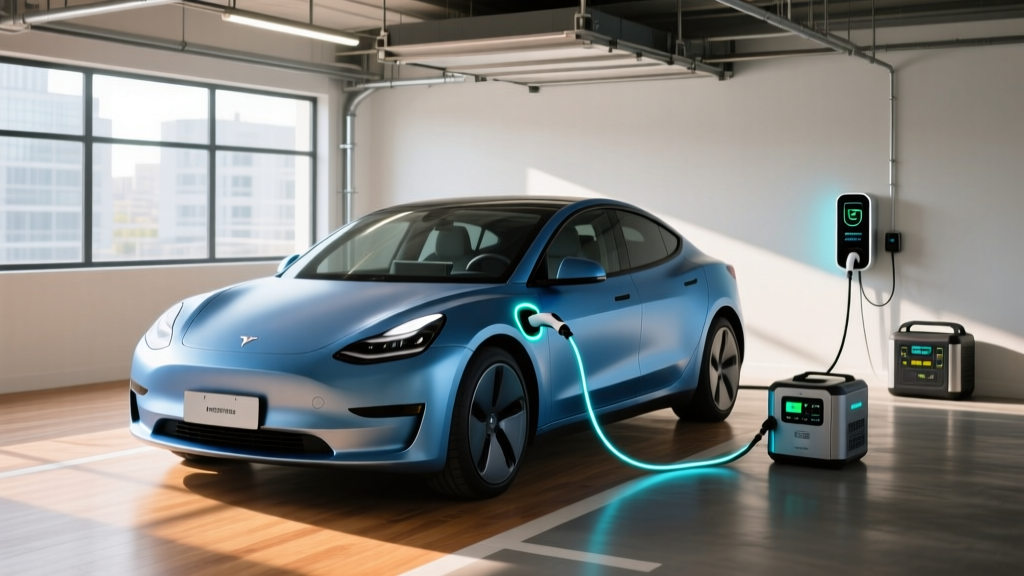
- V2L (Vehicle-to-Load): Your EV powers devices directly via a standard 120V or 240V outlet. Think campsite appliances, power tools, or a refrigerator during a short outage. No special home wiring required — just an adapter plugged into the vehicle's charge port or a dedicated interior outlet.
- V2H (Vehicle-to-Home): Your EV connects to your home's electrical panel through a bidirectional charger and transfer switch, acting as a whole-home backup generator. This requires a dedicated bidirectional Level 2 wallbox and professional installation.
- V2G (Vehicle-to-Grid): Your EV sends power back to the utility grid, potentially earning you money through time-of-use arbitrage or grid-services programs. This requires utility participation, a compatible bidirectional charger, and specific rate plans.
The critical distinction: V2L is portable and simple. V2H and V2G require specialized bidirectional Level 2 equipment and electrical work. A car supporting V2L does not automatically support V2H or V2G.
2026 EVs with Bidirectional Charging: Model-by-Model Breakdown
Here is the current landscape of production vehicles offering bidirectional capability in the US market. Specs reflect 2026 model-year data.
| Vehicle | Battery (kWh) | V2L | V2H | V2G | V2L Output | Starting MSRP |
|---|---|---|---|---|---|---|
| Ford F-150 Lightning | 98 (Std) / 131 (Ext) | Yes (Pro Power Onboard) | Yes (with Charge Station Pro) | Limited pilots | 2.4 kW – 9.6 kW | ~$55,000 |
| Hyundai Ioniq 5 | 62 / 84 | Yes (interior outlet + adapter) | Announced (Vehicle-to-Home via Wallbox) | No | 3.6 kW | ~$42,000 |
| Kia EV9 | 76.1 / 100 | Yes (interior + adapter) | Announced | No | 3.6 kW | ~$55,000 |
| Hyundai Ioniq 6 | 62 / 84 | Yes | No | No | 3.6 kW | ~$38,000 |
| Chevrolet Silverado EV | 200 (max) | Yes (Pro Power) | Yes (with PowerShift) | No | Up to 10.2 kW | ~$57,000 |
| Ford E-Transit (commercial) | 68 | Yes | Yes (with Charge Station Pro) | Limited pilots | 2.4 kW / 7.2 kW | ~$46,000 |
| Nissan Leaf (2026 refresh) | 62 | No (CHAdeMO V2G only in Japan) | No (US) | No (US) | N/A | ~$30,000 |
Key takeaway: V2L is becoming common on Hyundai/Kia E-GMP platforms and American trucks. True V2H is currently production-ready only on the Ford F-150 Lightning (with the $1,300 Ford Charge Station Pro and a home transfer switch) and the Chevrolet Silverado EV. Hyundai's V2H system via the Wallbox Quasar 2 has been announced for Ioniq 5 and EV9 but availability in the US remains limited as of early 2026.
Charging Levels Explained: Speeds, Power, and What Bidirectional Changes
Before setting up bidirectional charging, you need to understand the standard charging hierarchy. Power is measured in kW (kilowatts) — the rate of energy flow. Energy is measured in kWh (kilowatt-hours) — the total amount stored in your battery. A 10 kW charger delivering power for one hour adds 10 kWh of energy. Confusing these two is the single most common EV mistake.
| Charging Level | Voltage | Max Power (kW) | Miles of Range Added per Hour | Typical Use Case |
|---|---|---|---|---|
| Level 1 (120V) | 120V AC | 1.2 – 1.9 kW | 3 – 5 mi/hr | Overnight trickle, emergency top-off |
| Level 2 (240V) | 240V AC | 7.2 – 19.2 kW | 20 – 75 mi/hr | Home daily charging, destination charging |
| Level 2 Bidirectional | 240V AC | Up to 11.5 kW (out) | N/A — exports power | V2H / V2G home backup and grid services |
| DC Fast Charging | 400V–800V DC | 50 – 350 kW | 150 – 1,000+ mi/hr | Road trips, rapid top-ups |
Bidirectional charging currently operates at Level 2 speeds in the home-to-vehicle direction and Level 2 export speeds in the reverse direction. There is no bidirectional DC fast charging in production consumer vehicles. When your F-150 Lightning powers your home via V2H, it exports at up to 9.6 kW — enough to run essential circuits (refrigerator, lights, HVAC blower, internet) for days, depending on battery state of charge and household load.
Home Installation: Electrical Requirements, Panel Upgrades, and Real Costs
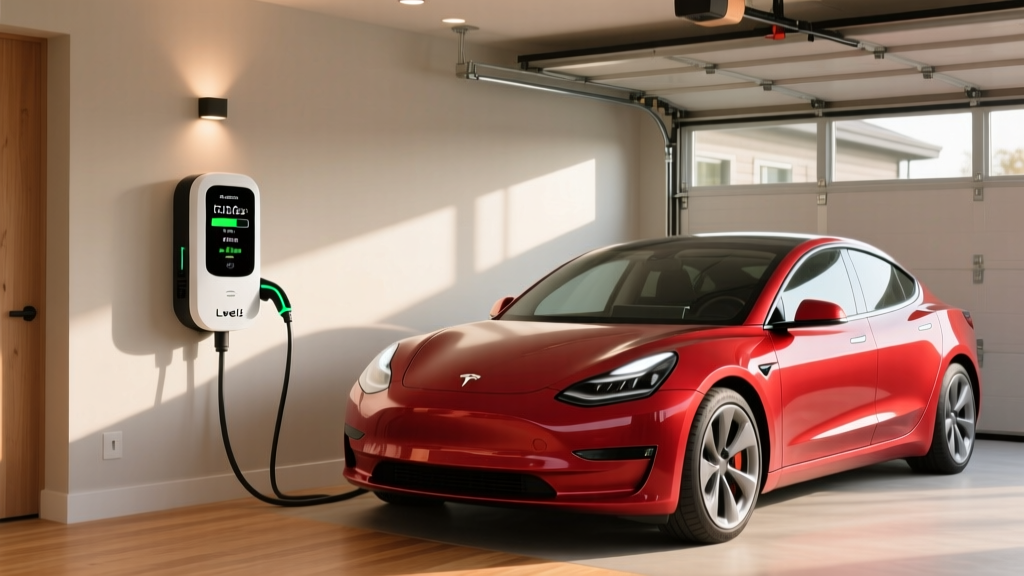
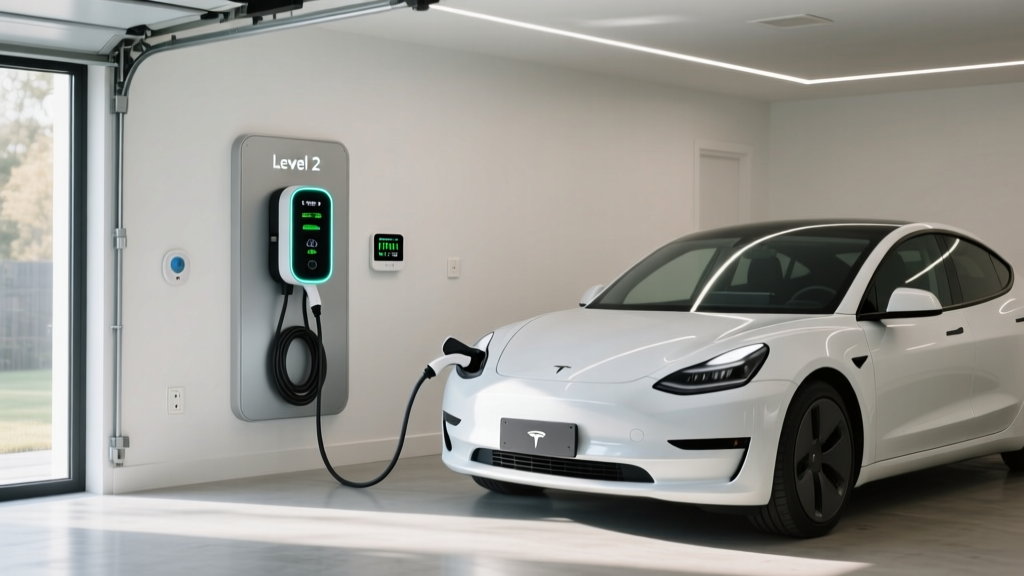
Installing a bidirectional charger at home is more complex than a standard Level 2 wallbox. You need a compatible bidirectional unit, a dedicated high-amperage circuit, and — for V2H — an automatic transfer switch that safely isolates your home from the grid during an outage (a code requirement to prevent backfeeding utility lines and endangering line workers).
Electrical Requirements for Bidirectional Chargers
- Circuit: 240V, 60A dedicated breaker (for 48A continuous charge/discharge at 11.5 kW)
- Wire: 6 AWG copper (THHN in conduit) or 4 AWG aluminum, minimum
- Transfer switch (V2H): Required for whole-home backup; rated for your panel's main breaker amperage (typically 200A)
- Panel capacity: Your main service panel must have physical space for a 60A double-pole breaker AND sufficient load calculation headroom. Older 100A or 150A panels often require an upgrade to 200A service.
- Permit: Required in virtually all US jurisdictions. Inspector will verify wire gauge, breaker sizing, grounding, GFCI protection, and transfer switch installation.
Installation Cost Breakdown
| Component | Cost Range | Notes |
|---|---|---|
| Bidirectional charger unit (e.g., Ford Charge Station Pro, Wallbox Quasar 2) | $1,300 – $3,500 | Standard Level 2 wallboxes cost $400–$800; bidirectional units carry a premium |
| Automatic transfer switch (for V2H) | $500 – $1,500 | Required for home backup; not needed for V2L or V2G-only |
| Electrical labor (licensed electrician) | $1,500 – $4,000 | Varies by run length from panel to garage, wall material, conduit needs |
| Panel upgrade (100A/150A → 200A) | $2,000 – $5,000 | Only if existing panel lacks capacity; common in pre-1990 homes |
| Permit and inspection fees | $100 – $500 | Varies by municipality |
| Total (no panel upgrade) | $3,400 – $9,500 | Typical for homes with 200A service and nearby panel |
| Total (with panel upgrade) | $5,400 – $14,500 | Older homes or panels at capacity |
Real-world note: According to data from the Alternative Fuels Data Center, the national median cost for a standard Level 2 home installation (non-bidirectional) is $1,200–$2,500. Bidirectional setups cost 2–4x more due to the premium hardware and transfer switch requirement. Get at least three quotes from licensed electricians familiar with EV and backup-power installations.
Connector Compatibility: NACS, CCS1, and Bidirectional Adapter Realities
The connector on your EV determines which chargers and bidirectional systems are compatible. The US market has consolidated around NACS (the Tesla-designed standard, now adopted by Ford, GM, Rivian, Hyundai/Kia for 2025+ models, and most others) and CCS1 (still used by many 2023–2024 models and European brands). CHAdeMO is legacy-only.
| Connector | Brands Using (2026) | Bidirectional Support | Adapter Availability |
|---|---|---|---|
| NACS (J3400) | Tesla, Ford, GM, Rivian, Hyundai/Kia (2025+), Volvo, Polestar, BMW, Mercedes | V2L: Yes (with adapter on some). V2H: Ford Charge Station Pro uses NACS on F-150 Lightning | CCS1-to-NACS adapters widely available ($150–$300); NACS-to-CCS1 less common |
| CCS1 | Hyundai/Kia (pre-2025), VW ID.4, BMW i4 (pre-2025), legacy models | V2L: Yes (Hyundai/Kia via CCS adapter). V2H: Wallbox Quasar 2 supports CCS1 | NACS-to-CCS1 adapters available |
| CHAdeMO | Nissan Leaf (legacy), Mitsubishi Outlander PHEV | V2G in Japan only; no US consumer V2H/V2L support | Limited; CHAdeMO infrastructure declining |
Adapter warning: Not all adapters support bidirectional power flow. A standard CCS1-to-NACS adapter allows charging but may not enable V2L or V2H export. Verify with the adapter manufacturer that the unit is rated for bidirectional use before purchasing. Ford's official NACS adapter for the F-150 Lightning, for example, supports Pro Power Onboard V2L output.
Cost to Charge: Home, Public, and DC Fast Compared to Gas
Whether your EV is bidirectional or not, the economics of charging versus fueling remain a primary ownership consideration. Below are 2026 cost benchmarks based on national averages.
| Charging Scenario | $/kWh (approx.) | Cost to Add 200 Miles* | Equivalent Gas Cost (25 MPG, $3.40/gal) |
|---|---|---|---|
| Home Level 2, off-peak utility rate | $0.08 – $0.14 | $4.80 – $8.40 | $27.20 |
| Home Level 2, standard rate | $0.14 – $0.20 | $8.40 – $12.00 | $27.20 |
| Public Level 2 (ChargePoint, EVgo L2) | $0.20 – $0.35 | $12.00 – $21.00 | $27.20 |
| DC Fast Charging (Electrify America, Tesla Supercharger) | $0.30 – $0.55 | $18.00 – $33.00 | $27.20 |
*Based on an EV averaging 3.0 miles/kWh (100 MPGe equivalent), typical of midsize crossovers like the Ioniq 5 or Model Y.
Home off-peak charging delivers fuel cost savings of 65–80% compared to a 25 MPG gas vehicle. Even DC fast charging on road trips is roughly cost-competitive with gas — and often cheaper. The bidirectional bonus: if your utility offers a V2G time-of-use buyback program, you can charge at $0.08/kWh overnight and export at $0.25–$0.40/kWh during peak afternoon hours, turning your EV battery into a revenue-generating asset. As of 2026, V2G buyback programs remain limited to select utilities in California, Hawaii, and parts of the Northeast.
Charging Time Examples: 10–80% for Common Battery Sizes
Charging speed depends on the vehicle's onboard charger (for Level 2 AC) and its peak DC charge rate. The 10–80% window is the practical benchmark — charging above 80% slows dramatically due to battery management system taper, which protects cell longevity. Here's what to expect with bidirectional-capable EVs:
| Vehicle | Battery Size (kWh) | Level 2 at 11.5 kW (10–80%) | DC Fast Peak kW | DC Fast 10–80% |
|---|---|---|---|---|
| Ford F-150 Lightning (Std Range) | 98 | ~6 hours | 150 kW | ~41 min |
| Ford F-150 Lightning (Ext Range) | 131 | ~8 hours | 150 kW | ~54 min |
| Hyundai Ioniq 5 (Long Range) | 84 | ~5 hours | 240 kW (800V) | ~18 min |
| Chevrolet Silverado EV (4WT) | 200 | ~12 hours | 350 kW | ~40 min |
| Kia EV9 (Long Range) | 100 | ~6 hours | 210 kW (800V) | ~24 min |
Charge curve reality check: Peak DC fast-charge kW is sustained only between roughly 10–40% state of charge. After 50%, the rate tapers. After 80%, it drops to Level 2 speeds or slower. A "240 kW peak" Ioniq 5 averages closer to 150–170 kW across the full 10–80% session. Plan road-trip stops around the 10–80% window for the best time efficiency.
Equipment Recommendations: Bidirectional and Standard Chargers for Home
If you own a bidirectional-capable EV, your charger choice depends on which feature you're using (V2L, V2H, or V2G). Here are the leading options for 2026:
Bidirectional Chargers (V2H / V2G)
- Ford Charge Station Pro (11.5 kW): $1,300. NACS connector. Required for F-150 Lightning Intelligent Backup Power (V2H). 25-foot cable. Requires Sunrun or Ford-approved electrician for transfer switch integration. Smart features via FordPass app. Only compatible with Ford vehicles for V2H.
- Wallbox Quasar 2 (11.5 kW): ~$3,000–$3,500. CCS1 connector (NACS version announced). Supports V2H and V2G. 25-foot cable. Works with Hyundai Ioniq 5 and Kia EV9 (firmware-dependent). MyWallbox app with energy management and solar integration. Availability in the US still limited; check Wallbox compatibility tool before ordering.
- GM PowerShift Charger (bidirectional, Silverado EV): Pricing TBD with vehicle delivery. Enables V2H with compatible Silverado EV trims. Requires GM-approved installation partner.
Standard Level 2 Chargers (for daily charging alongside V2L use)
If your car supports V2L via an in-vehicle outlet or portable adapter (no bidirectional wallbox needed), pair it with a high-quality standard Level 2 charger for daily home charging:
- ChargePoint Home Flex (up to 12 kW / 50A): ~$650. NACS or CCS1 connector options. 23-foot cable. NEMA 14-50 plug or hardwired. Smart scheduling, Alexa integration, energy tracking via app. UL-listed. Excellent all-rounder.
- Tesla Wall Connector (11.5 kW / 48A): ~$475. NACS native. 24-foot cable. Hardwired only. Power sharing for multi-charger setups. Best value for NACS vehicles.
- Emporia Vue Level 2 (48A / 11.5 kW): ~$500. NACS or J1772. 24-foot cable. Integrates with Emporia home energy monitoring for solar-aware charging. Good pick for solar homes.
Safety, Code, and Panel-Upgrade Considerations
Bidirectional charger installations carry additional safety and code requirements beyond standard Level 2 setups:
- Dedicated circuit: NEC Article 625 requires a dedicated circuit for EV supply equipment. A 60A breaker for a 48A continuous-load bidirectional charger is standard. Never share this circuit with other appliances.
- GFCI protection: 2023 NEC update requires GFCI protection on all EV circuits, including bidirectional. Your electrician should install a GFCI breaker or use a charger with integrated ground-fault protection.
- Outdoor rating: If your charger is mounted outside or in an unconditioned garage, it must carry a NEMA 4 or IP65 weather rating. The Ford Charge Station Pro and Wallbox Quasar 2 both meet this standard.
- Transfer switch (V2H): An automatic transfer switch is legally required to prevent islanding — sending power back onto de-energized utility lines during an outage, which can electrocute utility workers. Never attempt a DIY interlock or backfeed setup.
- Panel load calculation: Per NEC Article 220, your electrician must perform a load calculation to verify your panel can handle the new 60A circuit plus existing loads. If your 200A panel is already near capacity (electric range, dryer, HVAC, water heater), you may need a panel upgrade or a load-management device like the Emporia Smart Load Center.
Always verify that your electrician holds a current license, pulls the required permit, and schedules the municipal inspection. Unpermitted EV charger installations can void home insurance coverage and create liability in the event of an electrical fire. For authoritative guidance on home EV charging safety, refer to the NFPA 70 National Electrical Code and the Alternative Fuels Data Center home charging guide.
Frequently Asked Questions
How much does it cost to install a home EV charger with bidirectional capability?
Expect $3,400–$9,500 for a bidirectional charger installation in a home that already has 200A electrical service and panel space. If a panel upgrade is needed, total costs can reach $5,400–$14,500. Standard (non-bidirectional) Level 2 installations are significantly cheaper at $1,200–$2,500.
How fast will each charging level add range to my EV?
Level 1 (120V) adds 3–5 miles per hour. Level 2 (240V) adds 20–75 miles per hour depending on amperage and the vehicle's onboard charger. DC fast charging adds 150–1,000+ miles per hour at peak rates, but taper means real sessions average less. Bidirectional export does not add range — it uses your battery's stored energy.
Which connector and charger are compatible with my EV for bidirectional use?
Check your vehicle's charge port: NACS (Tesla-style) or CCS1. Ford's Charge Station Pro uses NACS and works only with Ford vehicles for V2H. The Wallbox Quasar 2 supports CCS1 bidirectional flow. For V2L, many Hyundai/Kia vehicles use a CCS1-to-standard-outlet adapter that plugs into the charge port — no wallbox required.
How much does charging cost per mile versus gasoline?
At home off-peak rates ($0.08–$0.14/kWh), charging costs roughly $0.025–$0.045 per mile for a typical EV. A 25 MPG gas car at $3.40/gallon costs about $0.136 per mile. Home charging saves 65–80% on fuel. DC fast charging on road trips ($0.30–$0.55/kWh) costs $0.10–$0.18 per mile — still competitive with or cheaper than gas.
What electrical upgrades might I need for a bidirectional charger?
The most common upgrade is a panel replacement from 100A or 150A to 200A service ($2,000–$5,000) if your existing panel lacks the amperage headroom or physical breaker slots for a new 60A circuit. You'll also need an automatic transfer switch ($500–$1,500) for V2H capability. Homes built after 2000 with 200A service often need no panel upgrade.
Can I use bidirectional charging to power my entire house?
With V2H and a transfer switch, yes — within limits. An F-150 Lightning with the 131 kWh extended-range battery can power an average US home (roughly 30 kWh/day) for approximately 3–4 days at moderate load. Heavy loads like electric resistance heat or simultaneous EV charging from another vehicle will reduce this. The system manages load automatically, prioritizing essential circuits.