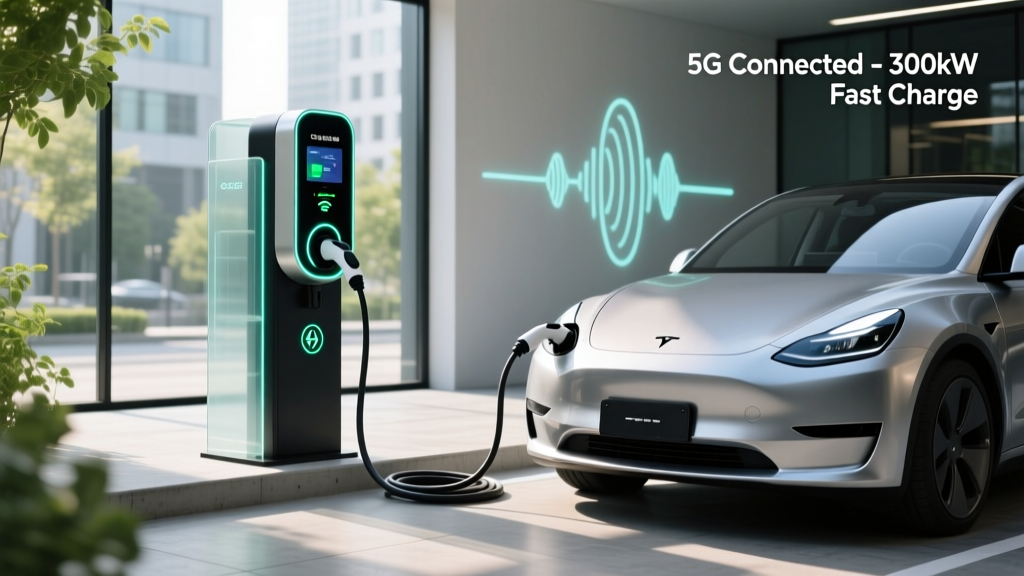
The phrase "5G charging" gets thrown around in EV forums and tech blogs, but let's cut through the noise: no one is beaming electricity over a cellular network. What 5G-enabled charging actually means is the integration of ultra-low-latency 5G connectivity into DC fast-charging stations and smart home chargers — enabling real-time telemetry, over-the-air firmware updates, plug-and-charge authentication, and dynamic load balancing with the grid. For CCS1-equipped EV owners, choosing a vendor with robust 5G-connected infrastructure matters for reliability, payment speed, and uptime transparency.
This guide breaks down the best CCS vendors leveraging 5G connectivity in 2026, explains what 5G actually does for your charging session, and covers everything you need to know about home charging setup — from Level 1 trickle charging to a full Level 2 installation with electrical panel considerations.
What 5G Connectivity Actually Means for EV Charging
Before ranking vendors, it's worth clarifying what 5G brings to the charging experience. A 5G-connected DC fast charger or home Level 2 unit communicates with the network backend at latencies under 10 milliseconds, compared to 50-200ms on 4G LTE. In practical terms, this translates to:
- Plug-and-charge authentication — your car's VIN is recognized instantly, no app or RFID card needed.
- Real-time charge-curve optimization — the charger adjusts power delivery based on your battery's state of charge (SoC) and temperature, communicated via the vehicle's BMS over 5G.
- Live uptime monitoring — networks can detect and remotely resolve faults, reducing the dreaded "out of order" sticker.
- Dynamic pricing and grid response — utilities can signal chargers to reduce load during peak demand, passing savings to the driver.
- Seamless payment — transactions authorize in under a second, eliminating the spinning-wheel-of-death at the kiosk.
None of this changes the physical power delivery — that's still governed by the charger's kW output and your vehicle's onboard charge controller. But 5G connectivity significantly reduces friction, and for CCS1 vehicles without access to Tesla's Supercharger ecosystem, it's a meaningful differentiator.
The Best CCS Vendors Using 5G Charging Technology in 2026
Here's how the major public DC fast-charging networks stack up on 5G integration, CCS1 availability, peak power, and real-world reliability.
| Network | 5G Integration | Peak DC kW | CCS1 Availability | Avg Uptime (2025-2026) | Typical $/kWh |
|---|---|---|---|---|---|
| Electrify America | Full 5G on new sites (2024+) | 350 kW | 100% of stations | ~92% | $0.48–$0.64 |
| EVgo (eXtend stations) | 5G rollout on eXtend 2.0 | 350 kW | 100% of stations | ~89% | $0.43–$0.56 |
| ChargePoint (Express Plus) | 5G-enabled modular stations | 400 kW | 100% of stations | ~90% | $0.39–$0.55 |
| Mercedes-Benz High Power | 5G standard at all hubs | 400 kW | 100% CCS1 + NACS | ~95% | $0.50–$0.65 |
| Shell Recharge | 5G on 2025+ deployments | 180 kW (most sites) | 100% of stations | ~87% | $0.45–$0.58 |
Electrify America remains the largest open CCS1 network in the U.S., with over 1,000 stations and 5,000 individual chargers. Their newer sites feature 5G-connected 350 kW dispensers that sustain higher power deeper into the charge curve. On a 77 kWh battery (like the Hyundai Ioniq 5 or Kia EV6), expect a 10–80% session in roughly 18–22 minutes when the battery is preconditioned.
Mercedes-Benz High Power Charging is the dark horse. Open to all brands, their hubs pair 400 kW chargers with 5G standard, and uptime has been exceptional. The pricing is at the premium end, but the reliability record is the best in the industry per AFDC data.
ChargePoint's Express Plus modular architecture uses 5G for real-time power redistribution between stalls — if one car finishes charging, its power allocation shifts to the next stall automatically. Smart engineering, and it shows in sustained charge rates.
Charging Levels Explained: Speeds, kW, and Miles Per Hour
Whether you're charging at home or on the road, understanding the three charging levels is essential. Remember: kW (kilowatts) measures power — how fast energy flows. kWh (kilowatt-hours) measures energy — the total amount stored in your battery. Think of kW as the width of a hose and kWh as the size of the bucket.
| Level | Voltage | Power (kW) | Miles of Range Per Hour | Best For | Typical 10–80% Time* |
|---|---|---|---|---|---|
| Level 1 (120V) | 120V AC | 1.0–1.4 kW | 3–5 mi/hr | Overnight top-ups, PHEVs | 40–70+ hours |
| Level 2 (240V) | 240V AC | 3.3–19.2 kW | 12–75 mi/hr | Daily home charging | 4–10 hours |
| DC Fast Charging | 200–900V DC | 50–400 kW | 150–1,200+ mi/hr | Road trips, rapid top-ups | 15–45 minutes |
*Times vary by battery size, chemistry (LFP vs. NMC), state of charge, ambient temperature, and charge-curve taper. Peak kW is never sustained for the entire session — expect the rate to drop significantly above 80% SoC.
For context, a 2026 Tesla Model Y Long Range (78.1 kWh usable, NMC) charging on a V4 Supercharger at 250 kW peaks briefly but averages closer to 130–150 kW across a 10–80% session, completing it in about 22–25 minutes. A Hyundai Ioniq 5 with its 800V architecture can sustain higher power longer, hitting 10–80% in roughly 18 minutes on a 350 kW charger.
Home Level 2 Charger Installation: Costs, Electrical Requirements, and Panel Upgrades
Home charging is where 80%+ of all EV charging happens, and a Level 2 setup transforms daily ownership. Here's what's involved.
Electrical Requirements
A standard Level 2 home charger requires a 240V dedicated circuit, typically rated at 40A or 50A (which requires a 50A or 60A breaker, per NEC continuous-load rules that cap usage at 80% of breaker capacity). Most popular home chargers draw between 7.2 kW (30A) and 11.5 kW (48A).
If your home's electrical panel is 100A or older, you may need a panel upgrade to 200A — especially if you're also running electric HVAC, a dryer, and an oven. A panel upgrade adds $1,500–$3,500 to the project. Some homeowners can avoid this with a smart load-management device like the Emporia VUE or a charger with built-in load sharing, which dynamically reduces charger draw when other circuits are active.
Installation Cost Breakdown
| Component | Low Estimate | High Estimate | Notes |
|---|---|---|---|
| Level 2 Charger (hardware) | $350 | $750 | Varies by brand, power, smart features |
| Electrician labor | $500 | $2,000 | Depends on run length, wall type, conduit |
| Electrical permit | $50 | $250 | Required in most jurisdictions |
| Panel upgrade (if needed) | $1,500 | $3,500 | 100A → 200A service upgrade |
| Total (no panel upgrade) | $900 | $3,000 | Typical for most homes with 200A panels |
| Total (with panel upgrade) | $2,400 | $6,500 | Older homes, long wire runs |
Always hire a licensed electrician and pull a permit. Unpermitted work can void home insurance and create fire risk. The National Electrical Code (NEC) requires GFCI protection for outdoor receptacles and specific wire gauges for the circuit length.
Connector Compatibility: NACS, CCS1, and CHAdeMO
The connector landscape shifted dramatically between 2023 and 2026. Here's where things stand.
| Connector | Brands Using It (2026) | DC Fast Charging? | Adapter Needed? |
|---|---|---|---|
| NACS (Tesla / SAE J3400) | Tesla, Ford, GM, Rivian, Volvo, Polestar, Mercedes (new models), Hyundai/Kia (2025+) | Yes — Supercharger + open networks | CCS1→NACS adapters available (~$200–$300) |
| CCS1 (Combo) | VW, BMW, Audi, Hyundai/Kia (pre-2025), Stellantis, Honda, legacy models | Yes — EA, EVgo, ChargePoint | NACS→CCS1 adapters for Supercharger access |
| CHAdeMO | Nissan Leaf (discontinued 2025), Mitsubishi Outlander PHEV | Yes — declining availability | No adapter widely available; use CHAdeMO stations |
If you own a CCS1 vehicle, you can access Tesla Superchargers using a Tesla-approved CCS1-to-NACS adapter (approximately $200–$250). This dramatically expands your charging options, especially in rural corridors. Conversely, NACS-equipped vehicles can use CCS1 stations with the reverse adapter, though most new NACS vehicles ship with one included.
CHAdeMO is effectively legacy. Nissan ended U.S. Leaf sales, and new CHAdeMO station deployments have nearly stopped. If you own a CHAdeMO vehicle, plan routes carefully using the AFDC station locator.
Charging Cost Per Mile vs. Gasoline
The economics of EV charging depend heavily on where and when you charge. Here's a realistic breakdown using a 2026 Hyundai Ioniq 6 SE (3.0 mi/kWh efficiency) compared to a 30 MPG gas car at $3.40/gallon.
| Scenario | $/kWh | Cost Per Mile (EV) | Cost Per Mile (30 MPG Gas) | Savings Per Mile |
|---|---|---|---|---|
| Home (off-peak utility rate) | $0.08–$0.12 | $0.027–$0.040 | $0.113 | $0.073–$0.086 |
| Home (standard rate) | $0.14–$0.18 | $0.047–$0.060 | $0.113 | $0.053–$0.066 |
| Public Level 2 | $0.20–$0.35 | $0.067–$0.117 | $0.113 | -$0.004 to $0.046 |
| DC Fast Charging | $0.40–$0.65 | $0.133–$0.217 | $0.113 | -$0.104 to -$0.020 |
The takeaway: home charging is dramatically cheaper than gas, saving $600–$900 annually for a driver covering 12,000 miles. Public DC fast charging, however, often costs more per mile than gasoline. This is why home Level 2 installation isn't just a convenience — it's where the financial case for EV ownership lives or dies.
Some utilities offer time-of-use (TOU) plans with off-peak rates as low as $0.05–$0.08/kWh overnight. If your utility offers this, scheduling charges between midnight and 6 AM maximizes savings.
Recommended Home Level 2 Chargers for CCS1 and NACS Vehicles
These are the chargers I recommend based on power output, build quality, smart features, and connector options. Each supports 5G or Wi-Fi 6 connectivity for remote monitoring and scheduling.
| Charger | Power Output | Connector | Cable Length | Smart Features | Price (2026) |
|---|---|---|---|---|---|
| ChargePoint Home Flex | Up to 11.5 kW (48A) | NACS or CCS1 (J1772 w/ adapter) | 23 ft | App scheduling, Alexa, load sharing | $549–$649 |
| Emporia Level 2 EV Charger | Up to 11.5 kW (48A) | J1772 (CCS1 compatible) | 24 ft | Energy monitoring, solar integration, V2H ready | $399–$449 |
| Wallbox Pulsar Plus | Up to 11.5 kW (48A) | J1772 or NACS | 25 ft | Power sharing, app control, Eco mode | $499–$599 |
| Tesla Wall Connector | Up to 11.5 kW (48A) | NACS (CCS1 via adapter) | 24 ft | OTA updates, load sharing, power sharing between units | $475 |
| Grizzl-E Smart | Up to 10 kW (40A) | J1772 (CCS1 compatible) | 24 ft | App control, OCPP, extreme cold rated (-40°F) | $449–$549 |
Best overall value: The Emporia charger at $399 delivers 48A output, real-time energy monitoring, and pairs with the Emporia VUE panel monitor for automatic load management — potentially saving you a panel upgrade.
Best for NACS vehicles: The Tesla Wall Connector is hard to beat at $475 with native NACS, OTA updates, and the ability to share load between two units on a single circuit.
Best for cold climates: The Grizzl-E is built in Canada and rated to -40°F. Its aluminum enclosure and thick cable remain flexible when competitors' cables stiffen in sub-zero weather.
Safety, Code, and Installation Best Practices
EV charging draws sustained high current for hours — this is not the same as plugging in a dryer. Follow these guidelines:
- Dedicated circuit required: Your Level 2 charger must be on its own breaker — never shared with other appliances.
- GFCI protection: NEC 2023 (and 2026 updates) requires GFCI protection for all outdoor EV charging receptacles. Hardwired installations may have different requirements depending on your local jurisdiction.
- Outdoor rating: If mounting outside, ensure the charger is rated NEMA 4 (weatherproof). All chargers listed above meet this standard.
- Wire gauge: A 48A charger on a 60A breaker requires 6 AWG copper wire for runs up to 50 feet. Longer runs may need 4 AWG to prevent voltage drop. Your electrician will calculate this.
- Hardwired vs. plug: Hardwired installations eliminate the failure point of a 14-50 or 6-50 receptacle and are generally preferred for permanent setups. A plug-in (NEMA 14-50) gives you portability but requires a higher-quality receptacle — use a Hubbell or Bryant industrial-grade outlet, not a $10 big-box store unit.
- Permit and inspection: Required in nearly all jurisdictions. An unpermitted install can create insurance liability and code violations discovered during a home sale.
Frequently Asked Questions
How much does it cost to install a home EV charger?
A typical Level 2 home charger installation costs $900–$3,000 when no panel upgrade is needed. This includes the charger hardware ($350–$750), electrician labor ($500–$2,000), and permit ($50–$250). If your home needs a 200A panel upgrade, add $1,500–$3,500. Always get 2–3 quotes from licensed electricians.
How fast will each charging level add range?
Level 1 (120V) adds 3–5 miles of range per hour. Level 2 (240V) adds 12–75 miles per hour depending on the charger's kW output and your vehicle's acceptance rate. DC fast charging adds 150–1,200+ miles per hour at peak, but sessions are typically measured in 10–80% time (15–45 minutes) because the charge rate tapers significantly above 80% SoC.
Which connector/charger is compatible with my EV?
Check your vehicle's charge port. If it's NACS (the Tesla-style plug, now SAE J3400), you can use Tesla Superchargers natively and CCS1 stations with an adapter. If it's CCS1, you can use Electrify America, EVgo, and ChargePoint natively, and Tesla Superchargers with a CCS1-to-NACS adapter (~$200–$300). CHAdeMO vehicles (mostly older Nissan Leafs) face declining station availability.
How much does charging cost per mile vs. gas?
Home charging at off-peak rates ($0.08–$0.12/kWh) costs roughly $0.03–$0.04 per mile — about one-third the cost of a 30 MPG gas car at $3.40/gallon ($0.113/mile). Public DC fast charging at $0.48–$0.65/kWh often costs more than gas per mile. The financial case for EVs depends heavily on consistent home charging access.
What electrical upgrades might I need?
If your home has a 100A electrical panel or less, you'll likely need a 200A panel upgrade ($1,500–$3,500) to safely support a Level 2 charger alongside existing appliances. Homes with 200A panels usually have sufficient capacity. Smart load-management devices can sometimes avoid a panel upgrade by dynamically throttling charger draw. Your electrician will perform a load calculation per NEC Article 220 to determine this.
Does 5G connectivity actually improve my charging experience?
Yes, in measurable ways. 5G-connected chargers offer faster authentication (plug-and-charge in under 2 seconds vs. 10–30 seconds on 4G), more reliable session initiation, real-time charge-curve optimization communicated with the vehicle's BMS, and better uptime because the network can remotely diagnose and resolve issues. You won't see faster kW delivery — that's hardware-dependent — but the overall session experience is noticeably smoother.
Is the §30D tax credit available for home charger installation?
The federal residential clean energy credit (sometimes conflated with the §30D vehicle credit) covers 30% of home EV charger equipment and installation costs, up to $1,000, through 2032. Eligibility depends on your tax liability and whether you live in a qualifying census tract. Consult a tax professional — rules are subject to change and interact with other energy credits.