Why Your Audi e-tron's Charging Speed Depends on the Setup You Choose
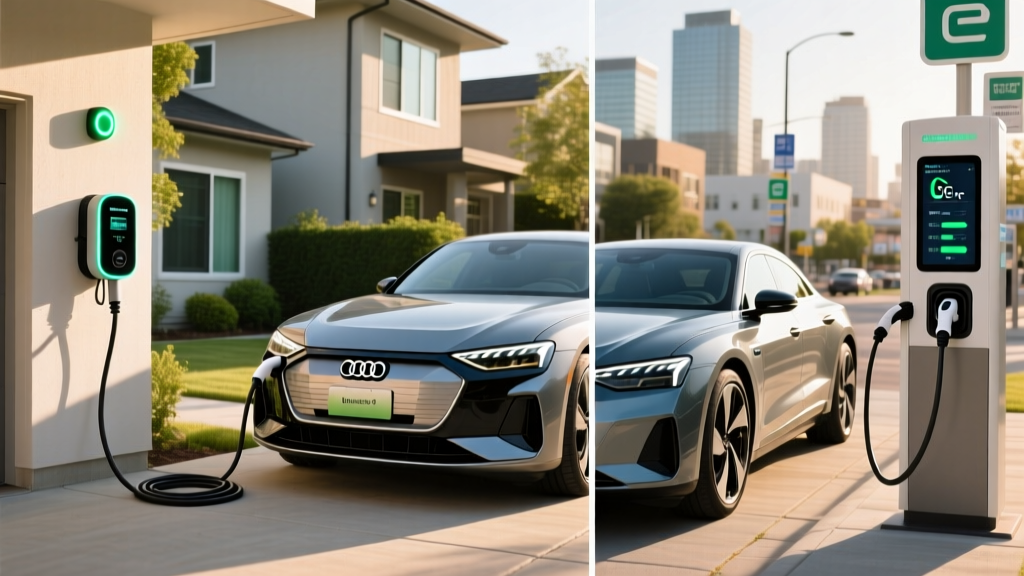
Audi's current electric lineup — the Q8 e-tron, Q4 e-tron, and the upcoming Q6 e-tron family — can accept anywhere from 7.2 kW to 270 kW depending on the model and the charger you plug into. That's the difference between adding 20 miles of range per hour at home versus 250 miles in 30 minutes on a DC fast charger. Understanding the three charging levels, the real-world costs, and the connector your Audi requires is the single most impactful ownership decision you'll make after signing the paperwork.
This guide breaks down every charging scenario an Audi EV owner will face in 2026, from the 240-volt outlet in your garage to the Electrify America corridor charger on your next road trip. We'll cover exact kW speeds, installation costs with panel-upgrade realities, connector compatibility (including the industry-wide shift to NACS), and what you'll actually pay per mile.
Charging Levels Explained: kW Speeds and Miles Per Hour for Audi EVs
Before we get into costs, let's define the three charging tiers. A critical distinction: kW (kilowatts) measures power — how fast energy flows into the battery. kWh (kilowatt-hours) measures energy — the battery's total capacity. Think of kW as the width of a pipe and kWh as the size of the tank.
| Level | Voltage | Max Power (kW) | Miles of Range Per Hour | Best Use Case |
|---|---|---|---|---|
| Level 1 | 120V | 1.2–1.9 kW | 3–5 mi/hr | Overnight top-ups, emergency backup |
| Level 2 | 240V | 7.2–19.2 kW | 20–60 mi/hr | Daily home and workplace charging |
| DC Fast Charging | 400V–800V DC | 50–270 kW | 150–700 mi/hr (peak) | Road trips, rapid top-ups |
For a Q8 e-tron with its 106 kWh usable battery (NMC chemistry), Level 1 charging from a standard 120V outlet would take roughly 55+ hours for a full charge — impractical as a primary strategy. Level 2 at 11.5 kW (the Q8 e-tron's onboard charger limit) fills that same battery in about 9.5 hours, perfect for overnight. On a 170 kW DC fast charger, Audi rates the Q8 e-tron for a 10–80% charge in approximately 31 minutes. The newer Q6 e-tron, built on the PPE 800-volt architecture, pushes that peak to 270 kW and drops 10–80% to roughly 21 minutes, according to Audi's official specifications.
Home Level 2 Charger Installation: Electrical Requirements and Real Costs
Most Audi EV owners will do 80–90% of their charging at home on a Level 2 circuit. Here's what the installation actually involves and what you should budget.
Electrical Requirements
A typical Level 2 installation for an Audi requires a 240-volt, 50-amp dedicated circuit (which delivers up to 40 amps continuous to the vehicle, per the National Electrical Code's 80% rule for continuous loads). This supports up to 9.6 kW — well matched to the Q4 e-tron's 11 kW onboard charger and the Q8 e-tron's 11.5 kW onboard charger.
If you want maximum speed (19.2 kW / 80A circuit), you'll need a 100-amp breaker and heavier-gauge wiring. Most homes don't need this, and most EVs — including all current Audis — won't accept more than 11.5 kW on Level 2 anyway.
Panel Upgrade Reality
Many homes built before 2000 have 100-amp or 150-amp main electrical panels. Adding a 50-amp EV circuit to a panel already near capacity may require a panel upgrade to 200 amps, which is a significant added cost. Your electrician will perform a load calculation (NEC Article 220) to determine if your existing panel can handle the circuit. Don't skip this step — it's a code requirement and a safety necessity.
Permits and Inspections
Virtually every jurisdiction requires an electrical permit for a new 240V circuit. Permit fees typically run $50–$250, and an inspector will verify the work after completion. Skipping the permit risks insurance claim denials if an electrical fire occurs, and it can flag during a home sale.
| Component | Low End | High End | Notes |
|---|---|---|---|
| Level 2 Charger (hardware) | $350 | $700 | Hardwired vs. plug-in, smart features |
| Electrician labor (standard install) | $500 | $1,500 | Depends on run length, wall type, conduit |
| Electrical materials (wire, conduit, breaker) | $150 | $500 | Longer runs from panel = more wire cost |
| Permit and inspection | $50 | $250 | Varies by municipality |
| Panel upgrade (if needed) | $1,500 | $3,500 | 100A → 200A service upgrade |
| Total (no panel upgrade) | $1,050 | $2,950 | Most homeowners fall in $1,200–$2,000 |
| Total (with panel upgrade) | $2,550 | $6,450 | Older homes with undersized panels |
Connector Compatibility: NACS, CCS1, and the Adapter Question for Audi Owners
The connector landscape has shifted dramatically. Here's where Audi stands in 2026:
| Model | Native Connector | DC Fast Charging Networks | Adapter Needed? |
|---|---|---|---|
| Q4 e-tron (2024–2026) | CCS1 | Electrify America, EVgo, ChargePoint | CCS-to-NACS adapter for Tesla Superchargers |
| Q8 e-tron (2024–2026) | CCS1 | Electrify America, EVgo, ChargePoint | CCS-to-NACS adapter for Tesla Superchargers |
| Q6 e-tron (2025–2026) | NACS (native) | Tesla Supercharger, Electrify America, all networks | None — native NACS; CCS adapter may be included |
| e-tron GT (2022–2026) | CCS1 | Electrify America, EVgo, ChargePoint | CCS-to-NACS adapter for Tesla Superchargers |
What this means practically: If you own a Q4 e-tron or Q8 e-tron with CCS1, you'll want a CCS-to-NACS adapter (approximately $200–$250 from Audi or third-party suppliers like Lectron or A2Z) to access the Tesla Supercharger network, which now has over 25,000 stalls in North America. The Q6 e-tron, built on the PPE platform, ships with a native NACS port — no adapter needed. For Level 2 home charging, all models use the standard J1772 connector (or NACS for Q6 e-tron), and every home charger sold in the US supports one or both.
CHAdeMO is effectively dead for new vehicles in North America. No current Audi uses it, and the network is shrinking. If you're shopping used, the original 2019–2023 e-tron (now rebranded Q8 e-tron) also used CCS1, not CHAdeMO, so you're fine.
Cost to Charge: Per-Mile Economics vs. Gasoline
One of the strongest ownership arguments for an Audi e-tron is fuel cost savings — but only if you understand the scenarios. Electricity rates vary enormously, and DC fast charging on road trips costs significantly more than home charging.
| Scenario | Rate ($/kWh) | Cost Per Full Charge (106 kWh) | Cost Per Mile | Annual Cost (12,000 mi) |
|---|---|---|---|---|
| Home, off-peak utility rate | $0.10 | $10.60 | $0.033 | $400 |
| Home, average US rate | $0.17 | $18.02 | $0.057 | $680 |
| Public Level 2 (workplace/mall) | $0.25 | $26.50 | $0.083 | $1,000 |
| DC Fast Charging (Electrify America) | $0.48 | $50.88 | $0.160 | $1,920 |
| Gasoline equivalent (25 MPG, $3.50/gal) | — | — | $0.140 | $1,680 |
The takeaway: Home charging on an off-peak rate makes the Q8 e-tron roughly 4x cheaper per mile than a comparable gas Audi Q7. Even at average US electricity rates, you're paying less than half per mile. But if you rely exclusively on DC fast charging, your per-mile cost actually exceeds gasoline — a crucial consideration for apartment dwellers without home charging access. According to fueleconomy.gov, the 2025 Q8 e-tron achieves 86 MPGe combined, which translates to approximately 31 kWh per 100 miles.
Best Level 2 Home Chargers for Audi EVs: Equipment Picks
Not all Level 2 chargers are equal. Here are three proven options that pair well with Audi's electric lineup, selected for reliability, power output, and smart features.
ChargePoint Home Flex
- Power: Up to 12 kW (50A) / configurable down to 16A
- Connector: J1772 (NACS version available for Q6 e-tron)
- Cable length: 23 feet
- Smart features: Wi-Fi, app scheduling, Alexa, energy reporting
- Installation: Hardwired or NEMA 14-50 plug
- Price: ~$550
Best for: Most Audi owners. Flexible amperage means it works even on smaller circuits.
Wallbox Pulsar Plus
- Power: Up to 11.5 kW (48A)
- Connector: J1772 (NACS version available)
- Cable length: 25 feet
- Smart features: Wi-Fi + Bluetooth, Power Sharing (daisy-chain two units), app control
- Installation: Hardwired only
- Price: ~$450
Best for: Two-EV households. Power Sharing lets two chargers share one 50A circuit.
Tesla Wall Connector (Gen 3)
- Power: Up to 11.5 kW (48A)
- Connector: NACS native (J1772 adapter included)
- Cable length: 24 feet
- Smart features: Wi-Fi, OTA updates, access control, load sharing
- Installation: Hardwired only
- Price: ~$425
Best for: Q6 e-tron owners with native NACS, or mixed Tesla/Audi households.
All three chargers are UL-listed, ENERGY STAR certified, and rated for indoor or outdoor installation (NEMA 4 rating for the Wallbox and Tesla; NEMA 3R for the ChargePoint). For outdoor installations, ensure your electrician uses a weatherproof junction box and that the unit's operating temperature range covers your climate.
Safety and Electrical Code: What Your Installation Must Include
A Level 2 charger installation is not a DIY project. Here are the non-negotiable safety and code requirements your licensed electrician should follow:
- Dedicated circuit: The EV charger must be on its own breaker — no shared circuits with dryers, ovens, or HVAC. A 50-amp breaker with 6 AWG copper wire (or 4 AWG aluminum) is standard.
- GFCI protection: NEC 2020 and later (Article 625.54) requires GFCI protection for all EV supply equipment rated 150V or less to ground and 60A or less. Most modern hardwired chargers have built-in GFCI; plug-in units require a GFCI breaker.
- NEMA 14-50 outlet (if plug-in): Must be installed with the ground pin on top. Use an industrial-grade outlet (Hubbell or Bryant) rated for daily plug/unplug cycles — the cheap $10 outlets from big-box stores can overheat and fail under sustained EV loads.
- Outdoor rating: If installed outside, the charger must carry at least a NEMA 3R rating (rain-resistant). NEMA 4 (watertight) is preferred in areas with driving rain or snow.
- Cable management: NEC requires the charging cable not be a tripping hazard. Wall-mounted cord organizers or retractable reels keep the area safe and code-compliant.
Public DC Fast Charging: Maximizing Speed on Road Trips
When you're away from home, your Audi's DC fast charging capability determines how long you're parked. Here's how to get the most from it:
| Model | Battery (usable kWh) | Peak DC Rate (kW) | 10–80% Time (min) | Charger Type Needed |
|---|---|---|---|---|
| Q4 e-tron | 77 kWh (NMC) | 175 kW | ~28 min | 150+ kW CCS1 station |
| Q8 e-tron | 106 kWh (NMC) | 170 kW | ~31 min | 150+ kW CCS1 station |
| Q6 e-tron | 94 kWh (NMC) | 270 kW | ~21 min | 350 kW NACS/CCS station |
| e-tron GT | 83.7 kWh (NMC) | 270 kW | ~22 min | 350 kW CCS1 station (800V) |
Three critical factors affect your real-world DC charging speed:
- Battery preconditioning: Navigate to the charger in your Audi's MMI system. The car will automatically warm or cool the battery to optimal temperature (roughly 25–35°C) before arrival. Without preconditioning, a cold battery can reduce peak charge rate by 30–50%.
- State of charge: Arrive at 5–15% SoC for the fastest charge. The charge curve is steepest at low SoC and tapers dramatically above 80%. Charging from 80–100% can take as long as 10–80%.
- Station power: A 350 kW Electrify America stall will deliver peak speeds to the Q6 e-tron and e-tron GT. But a 50 kW CHAdeMO/CCS station will take over an hour for the same 10–80% fill. Check station ratings in your Audi's navigation or the PlugShare app before detouring.
For Q8 e-tron and Q4 e-tron owners wanting Supercharger access, Audi has confirmed compatibility with the Tesla Supercharger network via CCS-to-NACS adapter. As of 2026, Tesla's Supercharger network includes over 7,000 V3 stalls (250 kW) and growing V4 stalls across the US — a significant expansion of your road-trip options.
Frequently Asked Questions
How much does it cost to install a home EV charger for my Audi?
Expect $1,050–$2,950 for a standard Level 2 installation (charger + electrician + materials + permit) if your electrical panel has capacity. If your home needs a panel upgrade from 100A to 200A service, add $1,500–$3,500, bringing the total to $2,550–$6,450. The IRC §25D Residential Clean Energy Credit covers 30% of the total cost through 2032.
How fast will each charging level add range to my Audi e-tron?
Level 1 (120V): 3–5 miles per hour. Level 2 (240V, 48A): approximately 35–40 miles per hour for a Q8 e-tron. DC fast charging at 170 kW: roughly 250+ miles in 30 minutes at peak rate, though the actual rate tapers as the battery fills. The 10–80% time (28–31 minutes depending on model) is the most practical metric.
Which connector and charger is compatible with my Audi EV?
The Q4 e-tron, Q8 e-tron, and e-tron GT use CCS1 for DC fast charging and J1772 for Level 2. The Q6 e-tron uses NACS natively for both. For home charging, any J1772 Level 2 charger works with CCS1 Audis; Q6 e-tron owners can use a NACS-native charger or a J1772-to-NACS adapter. For Tesla Supercharger access on CCS1 Audis, you need a CCS-to-NACS adapter.
How much does charging an Audi e-tron cost per mile versus gas?
Home charging at the US average rate of $0.17/kWh costs approximately $0.057/mile in a Q8 e-tron (3.0 mi/kWh). A comparable gas Audi Q7 at 22 MPG combined with $3.50/gallon fuel costs $0.159/mile — nearly 3x more. Even at DC fast charging rates ($0.48/kWh), the e-tron costs $0.16/mile, roughly equal to gas. Home charging is where the economics win decisively.
What electrical upgrades might I need for a home charger?
The most common upgrade is a panel capacity increase. If your main service panel is 100A or 150A and already heavily loaded (electric range, dryer, HVAC), adding a 50A EV circuit may exceed the panel's rated capacity per NEC load calculations. A 200A panel upgrade costs $1,500–$3,500. Less common but possible: your utility may need to upgrade the service drop from the transformer, particularly in older neighborhoods. Always get a load calculation from your electrician before committing to a charger location.