Audi A6 e-tron Quick Specs: Range, Battery & Charging at a Glance
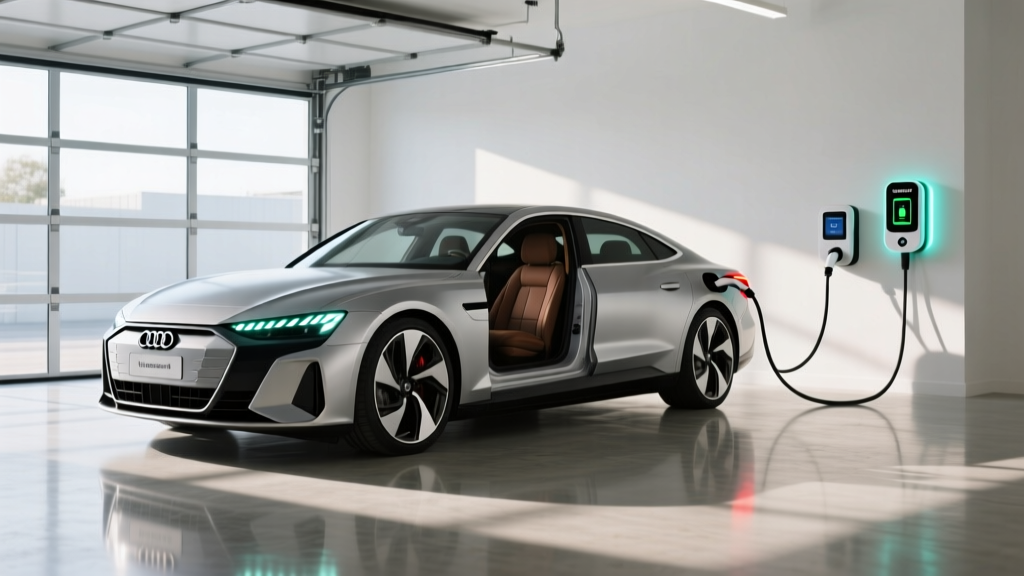
The 2025 Audi A6 e-tron arrives on the Premium Platform Electric (PPE) architecture co-developed with Porsche, bringing 800-volt capability to Audi's midsize luxury sedan segment. Before we break down how to charge it at home and on the road, here are the numbers that define the ownership experience.
| Specification | A6 e-tron (RWD) | A6 e-tron quattro |
|---|---|---|
| Usable Battery Capacity | 94.9 kWh (NMC) | 94.9 kWh (NMC) |
| EPA-Estimated Range | ~403 miles (est.) | ~370 miles (est.) |
| Real-World Highway Range | ~330–350 miles | ~300–320 miles |
| Peak DC Fast Charge Rate | 270 kW | 270 kW |
| 10–80% DC Fast Charge Time | ~21 minutes | ~21 minutes |
| Level 2 AC Charge Rate | 11 kW (onboard) | 11 kW (onboard) |
| Horsepower | 362 hp | 456 hp |
| 0–60 mph | 5.8 sec | 4.4 sec |
| Connector (US Delivery) | NACS (native) | NACS (native) |
| Base MSRP (est.) | ~$66,000 | ~$70,000 |
Charging Levels Explained: How Fast Will Each Add Range?
Understanding charging speed requires distinguishing kW (kilowatts) — the rate of power delivery, like water pressure in a hose — from kWh (kilowatt-hours) — the total energy stored in the battery, like the size of the tank. A higher kW means faster filling; a higher kWh means a bigger tank to fill.
The A6 e-tron's 94.9 kWh battery is the tank. The charger's kW rating determines how quickly you refill it.
| Level | Voltage | Power (kW) | Miles of Range per Hour | Typical Use Case |
|---|---|---|---|---|
| Level 1 | 120V AC | 1.0–1.4 kW | 3–5 mi/hr | Emergency / trickle top-up |
| Level 2 (Standard) | 240V AC | 7.2 kW | ~23 mi/hr | Basic home charging |
| Level 2 (Optimal) | 240V AC | 11.5 kW | ~37 mi/hr | Full home charging setup |
| DC Fast Charge | 400–800V DC | Up to 270 kW | ~180+ mi in 10 min | Road trips, highway travel |
At the A6 e-tron's 11 kW onboard AC charger, a full 0–100% Level 2 session takes approximately 9–10 hours. Most owners charging overnight from 20% to 80% will need about 5–6 hours — easily handled while sleeping.
On DC fast charging, the 800V architecture enables the 270 kW peak, but that peak is not sustained. The charge curve tapers significantly above 80% State of Charge (SoC) to protect battery longevity. Expect 10–80% in roughly 21 minutes at a 350 kW-capable station, but 80–100% may take an additional 20+ minutes. For road trips, the 10–80% window is what matters — plan stops around it.
Home Charger Installation: Electrical Requirements & Costs
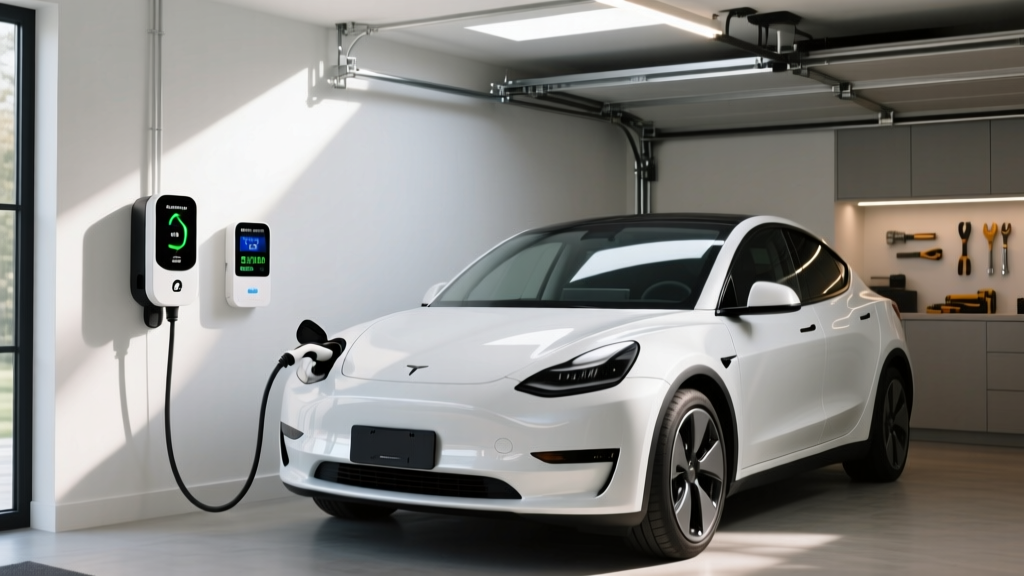
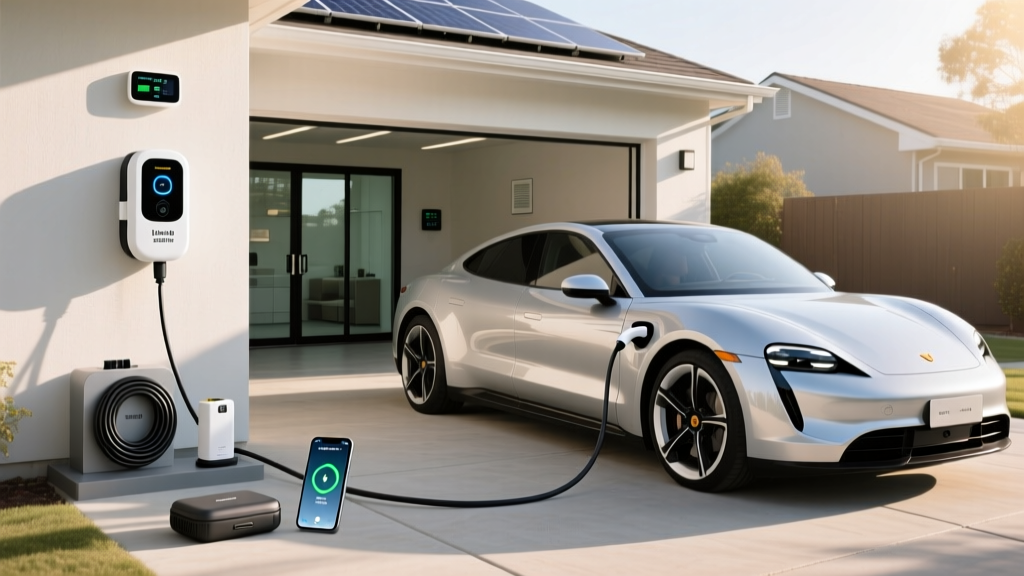
Installing a Level 2 home charger for the A6 e-tron is the single most impactful ownership decision you'll make. Home charging delivers the lowest per-mile cost and the most convenience, but the upfront installation requires planning.
Electrical Requirements for the A6 e-tron
To extract the full 11 kW AC charge rate from the A6 e-tron's onboard charger, you need a 240V circuit rated at 48–50 amps (EVSE set to 40A continuous output, since NEC code requires circuits rated 125% above continuous load). This delivers 9.6–11.5 kW depending on exact voltage (240V vs 248V).
If your home's electrical panel has limited capacity, a 240V/32A circuit (7.7 kW output) is a viable fallback — it still adds roughly 25 miles of range per hour and will refill the 94.9 kWh battery overnight.
Installation Cost Breakdown
| Component | Simple Install (panel nearby) | Complex Install (long run / panel upgrade) |
|---|---|---|
| EVSE Equipment (Level 2 charger) | $400–$700 | $400–$700 |
| Electrician Labor (2–4 hrs basic) | $300–$600 | $800–$1,500 |
| Wiring & Conduit (50A, 240V) | $100–$300 | $400–$1,000 |
| Permit & Inspection | $50–$150 | $100–$300 |
| Panel Upgrade (if needed) | — | $1,500–$3,500 |
| Total Estimated Cost | $850–$1,750 | $3,200–$7,000 |
According to the U.S. Department of Energy, most homeowners spend between $1,000 and $2,500 for a straightforward Level 2 installation. Costs climb sharply when conduit runs exceed 40 feet, walls need to be opened, or the main service panel requires upgrading.
Safety & Code Considerations
- Dedicated circuit: The EV charger must have its own dedicated breaker — never share with appliances or outlets.
- GFCI protection: NEC 2020 and later require GFCI breakers for outdoor receptacles; hardwired EVSE units often bypass this requirement since they include internal ground-fault protection.
- Outdoor rating: If installing outside (garage exterior, driveway post), ensure the EVSE carries a NEMA 4 or NEMA 4X weather rating.
- Hardwired vs. plug: Hardwired installations (no NEMA 14-50 receptacle) are generally preferred for 48A+ chargers — they eliminate a failure point and often simplify permitting.
- WiFi connectivity: Smart chargers enable scheduled charging during off-peak utility rates, a significant cost saver detailed below.
Connector Compatibility: NACS, CCS, and the A6 e-tron
Audi confirmed that US-market A6 e-tron models ship with the North American Charging Standard (NACS) connector — the Tesla-originated standard now adopted by nearly every major automaker. This is a major advantage for charging-network access.
| Connector | Description | Networks Available | A6 e-tron Compatible? |
|---|---|---|---|
| NACS (J3400) | Tesla-originated, now industry standard | Tesla Supercharger, Electrify America (new stalls), Rivian Adventure Network | Yes — native |
| CCS1 | Legacy standard, phasing out in US | Electrify America (existing), EVgo, ChargePoint | Adapter required (check OEM availability) |
| CHAdeMO | Japanese legacy standard | Limited; mostly older stations | No — not supported |
With native NACS, the A6 e-tron gains direct access to Tesla's Supercharger network — over 25,000 stalls in North America and widely regarded as the most reliable DC fast-charging infrastructure. This eliminates the need for the CCS-to-NACS adapter that older-model EV owners must carry.
For the remaining CCS1 stations operated by Electrify America and others, Audi is expected to offer or approve a CCS-to-NACS adapter. Verify adapter compatibility with your dealer before purchasing third-party options — improper adapters can damage the charge port or void warranty.
Level 2 Charger Equipment Recommendations
Not all Level 2 chargers are equal. The A6 e-tron's 11 kW onboard charger means you'll want an EVSE capable of at least 40A output (9.6 kW) to capture most of that capacity. A 48A unit (11.5 kW) fully saturates it.
ChargePoint Home Flex
- Power Output: Up to 12 kW (50A)
- Connector: NACS (J3400) or CCS1
- Cable Length: 23 ft
- Smart Features: WiFi, app scheduling, Alexa, utility integration
- Price: ~$550–$650
- Install Type: Hardwire or NEMA 14-50
Best all-around pick for A6 e-tron owners who want scheduling and energy tracking.
Tesla Wall Connector
- Power Output: Up to 11.5 kW (48A)
- Connector: NACS (native)
- Cable Length: 24 ft
- Smart Features: WiFi, OTA updates, power sharing (multiple units), load management
- Price: ~$425–$475
- Install Type: Hardwire only
Best value for NACS-native vehicles. Load-sharing feature lets two units share one 60A circuit.
Emporia Vue Level 2
- Power Output: Up to 11.5 kW (48A)
- Connector: NACS or J1772
- Cable Length: 24 ft
- Smart Features: WiFi, solar integration, real-time energy monitoring, scheduled charging
- Price: ~$400–$500
- Install Type: Hardwire or NEMA 14-50
Best for solar-panel owners wanting to charge exclusively on excess generation.
Charging Cost: Per-Mile Economics vs. Gasoline
The A6 e-tron's efficiency is rated at approximately 97 MPGe combined (roughly 3.1–3.3 miles per kWh). Let's translate that into real cost per mile across charging scenarios and compare against a gasoline equivalent.
| Scenario | Rate | Cost per kWh | Cost per Mile | |
|---|---|---|---|---|
| Home Off-Peak (utility time-of-use) | Level 2 | $0.08–$0.12 | $0.025–$0.038 | |
| Home Standard Rate | Level 2 | $0.14–$0.18 | $0.044–$0.056 | |
| Public Level 2 (workplace/retail) | Level 2 | $0.20–$0.35 | $0.062–$0.109 | |
| DC Fast Charge (Tesla Supercharger avg) | DCFC | $0.28–$0.38 | $0.087–$0.118 | |
| DC Fast Charge (Electrify America) | DCFC | $0.36–$0.48 | $0.112–$0.150 | |
| Gasoline Comparison: BMW 5 Series (28 MPG combined, $3.50/gal) | $0.125/mile | |||
At home off-peak rates, the A6 e-tron costs roughly 3 cents per mile — about one-quarter the cost of a comparable gasoline luxury sedan. Even on the most expensive DC fast chargers, the per-mile cost roughly matches gasoline. The break-even point heavily favors home charging.
For an owner driving 12,000 miles annually with 80% home charging at $0.14/kWh and 20% DC fast charging at $0.35/kWh, the annual fuel cost is approximately $620. A gasoline equivalent at 28 MPG and $3.50/gallon would cost about $1,500 — a savings of roughly $880 per year on energy alone.
Federal Tax Credits & Incentives for Home Charging
The IRS §30C Alternative Fuel Vehicle Refueling Property Credit covers 30% of home EV charger equipment and installation costs, up to a maximum of $1,000. Key eligibility requirements:
- The charger must be installed at your primary residence.
- The property must be located in an eligible census tract (generally non-urban or low-income communities — check the IRS census tract locator).
- Both equipment and installation labor qualify.
- Income caps apply (adjusted gross income limits vary by filing status).
This credit is separate from the §30D new clean vehicle credit for the A6 e-tron itself. Consult a tax professional to confirm eligibility — rules and eligible census tracts are subject to legislative updates.
Frequently Asked Questions
How much does it cost to install a home EV charger for the Audi A6 e-tron?
A straightforward installation with a nearby 200A panel typically costs $850–$1,750 including equipment, electrician labor, wiring, and permit. If your home needs a panel upgrade from 100A to 200A service, total costs can reach $3,200–$7,000. Always get a load calculation from a licensed electrician first.
How fast will each charging level add range to the A6 e-tron?
Level 1 (120V) adds 3–5 miles per hour — useful only for overnight trickle top-ups. Level 2 at 11.5 kW adds roughly 37 miles per hour, refilling the 94.9 kWh battery in about 9 hours. DC fast charging at 270 kW peak can add approximately 180 miles in 10 minutes under optimal conditions, with the 10–80% session taking around 21 minutes.
Which connector does the Audi A6 e-tron use?
US-market A6 e-tron models ship with the NACS (J3400) connector natively, granting direct access to Tesla Superchargers and new NACS-equipped Electrify America stations. A CCS-to-NACS adapter may be needed for legacy CCS1 stations — verify OEM-approved adapters with your dealer.
How much does charging cost per mile vs. a gas car?
Home charging at standard residential rates ($0.14/kWh) costs approximately 4.5 cents per mile. DC fast charging at $0.35/kWh costs about 11 cents per mile. A comparable gasoline sedan at 28 MPG and $3.50/gallon costs roughly 12.5 cents per mile. Home charging delivers the greatest savings — typically 60–75% less per mile than gasoline.
What electrical upgrades might my home need?
The most common upgrade is a main service panel increase from 100A or 125A to 200A, required when existing load plus the new 50A EV circuit exceeds safe panel capacity. Older homes may also need wiring upgrades (aluminum to copper), new conduit runs, or sub-panel installation for detached garages. A licensed electrician's load calculation is the definitive answer — don't skip this step.
Does the Audi A6 e-tron's 270 kW charging speed mean every session is that fast?
No. The 270 kW figure is a peak rate achieved only between roughly 10–30% State of Charge at a charger capable of 350 kW output. The charge curve tapers progressively: expect ~200 kW through 50%, ~150 kW through 65%, and a steep taper above 80%. This is normal for lithium-ion battery protection. For road-trip planning, the 10–80% time of ~21 minutes is the practical metric — not the peak kW number.