If you are still driving an Audi A6 3.0T Supercharged—likely a 2009–2018 C7-generation sedan with the 3.0-liter V6 producing 272–333 hp—you already know the thrill of instant torque delivery. What you may not realize is that a modern electric sedan or SUV can replicate (and often exceed) that supercharged thrust while slashing your cost per mile by 60–80%. The catch? You need a proper home charging setup before the car even arrives in your driveway.
This guide breaks down exactly what it takes to transition from a supercharged V6 Audi to a battery-electric vehicle, with hard numbers on installation costs, charging speeds, connector compatibility, and per-mile fueling economics for 2026.
Why Audi A6 3.0T Supercharged Owners Make Great EV Candidates
The 3.0T Supercharged Audi A6 (EA837 engine) was engineered for effortless highway passing and smooth city acceleration. That powertrain peaked at 333 hp and 325 lb-ft of torque in its final model years, with a 0–60 mph time around 4.9 seconds in the S4 variant sharing the same block. But supercharged V6s also demand premium fuel (typically 91–93 octane), return 20–22 mpg combined in real-world mixed driving per fueleconomy.gov, and require periodic supercharger belt and tensioner service.
A 2026 EV like the Audi e-tron GT (0–60 in 3.1 s, 522 hp) or the BMW i5 xDrive40 (0–60 in 4.4 s, 389 hp, EPA 295 mi) delivers equal or better performance with zero supercharger maintenance. The key unlock: Level 2 home charging that adds range overnight while you sleep, at a cost of roughly 3–5 cents per mile versus the 15–22 cents per mile your A6 3.0T burns.
Charging Levels Explained: kW, Speed, and What You Actually Need
Before evaluating equipment, understand the three charging tiers. Power is measured in kilowatts (kW)—the rate at which energy flows. Energy is measured in kilowatt-hours (kWh)—the total amount stored in your battery. Think of kW as the width of a hose and kWh as the size of the bucket.
| Level | Voltage / Amps | Power (kW) | Miles of Range Added per Hour | Best Use Case |
|---|---|---|---|---|
| Level 1 | 120V / 12–16A | 1.4–1.9 kW | 3–5 mi/hr | Overnight top-up, PHEVs, emergency |
| Level 2 | 240V / 32–48A | 7.7–11.5 kW | 25–44 mi/hr | Daily home charging (primary) |
| DC Fast | 400–800V DC | 50–350 kW | 150–1,000+ mi/hr (peak) | Road trips, 10–80% in 15–30 min |
For a former A6 3.0T owner accustomed to a 5-minute gas fill-up, DC fast charging is the closest analog on road trips. At a 350 kW Electrify America or Tesla Supercharger V4 station, a vehicle like the Hyundai Ioniq 6 (84 kWh battery, peak 350 kW acceptance) can add 10–80% state of charge in approximately 18 minutes. However, peak kW is not sustained kW—charging curves taper significantly above 80% SoC to protect the battery. Expect the final 20% to take as long as the first 80%.
How Much Does a Home Level 2 Charger Installation Cost?
This is the single most important budget question. A Level 2 home charger installation involves the charger hardware, a licensed electrician, a dedicated circuit, and typically a local permit. Costs vary dramatically based on your electrical panel's capacity and the distance from the panel to your parking spot.
| Component | Low Estimate | High Estimate | Notes |
|---|---|---|---|
| Level 2 Charger (Equipment) | $350 | $750 | 32A–48A smart charger, 18–25 ft cable |
| Electrician Labor | $500 | $2,000 | Depends on run length and conduit needs |
| Electrical Permit | $50 | $250 | Varies by municipality |
| Panel Upgrade (if needed) | $1,500 | $4,500 | 100A → 200A service upgrade for older homes |
| Total (No Panel Upgrade) | $900 | $3,000 | Typical for homes with 200A service |
| Total (With Panel Upgrade) | $2,400 | $7,750 | Common in pre-2000 homes with 100A panels |
Panel upgrade gotcha: Many homes built before 2000 have 100-amp main service panels. A 48-amp Level 2 charger requires a dedicated 60-amp breaker, which consumes a significant portion of a 100A panel's capacity—especially if you also run electric HVAC, a dryer, and an oven. An electrician will perform a load calculation per NEC Article 220 to determine if an upgrade is mandatory. Do not skip this step; overloading a panel is a fire risk and will fail inspection.
The IRS §30D credit does not cover home charger installation for 2026, but the Alternative Fuel Vehicle Refueling Property Credit (Form 8911) offers up to 30% of installation costs, capped at $1,000, subject to census-tract eligibility. Consult a tax professional to confirm whether your address qualifies.
Which Connector Is Compatible With Your New EV?
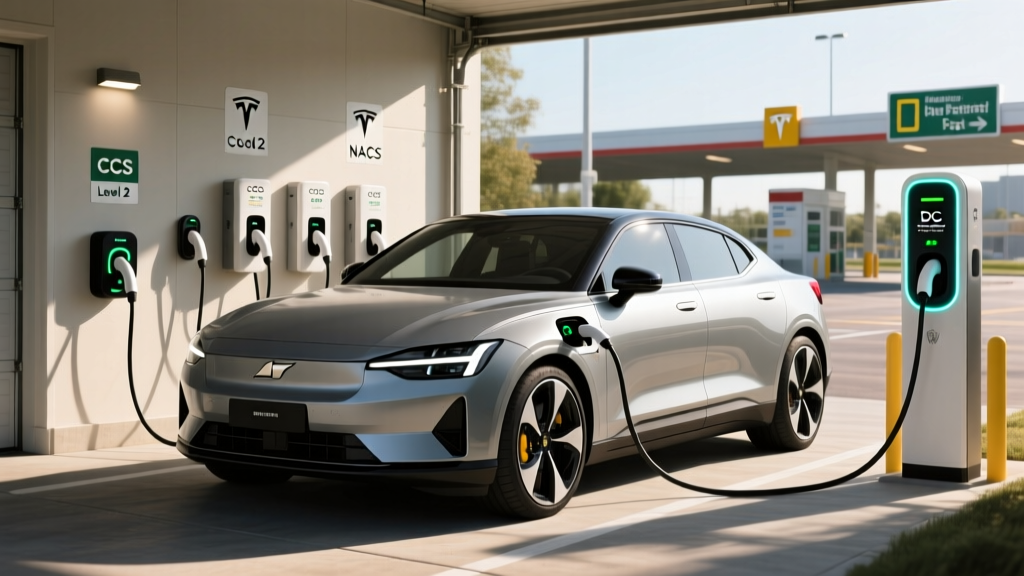
The connector landscape shifted decisively in 2024–2025 when nearly every major automaker adopted the North American Charging Standard (NACS), originally developed by Tesla. By 2026, NACS is the dominant connector on new EVs sold in North America. Here is the compatibility map:
| Connector | Brands Using It (2026) | Adapter Needed? |
|---|---|---|
| NACS (Tesla-style) | Tesla, Ford, GM, Rivian, Volvo, Polestar, Hyundai, Kia, BMW, Mercedes, Audi (new models) | No (native) |
| CCS1 | VW ID.4 (pre-2025), some legacy models still on road | CCS-to-NACS adapter (~$200) for Tesla Superchargers |
| CHAdeMO | Nissan Leaf (discontinued), Mitsubishi Outlander PHEV | Limited; CHAdeMO infrastructure declining |
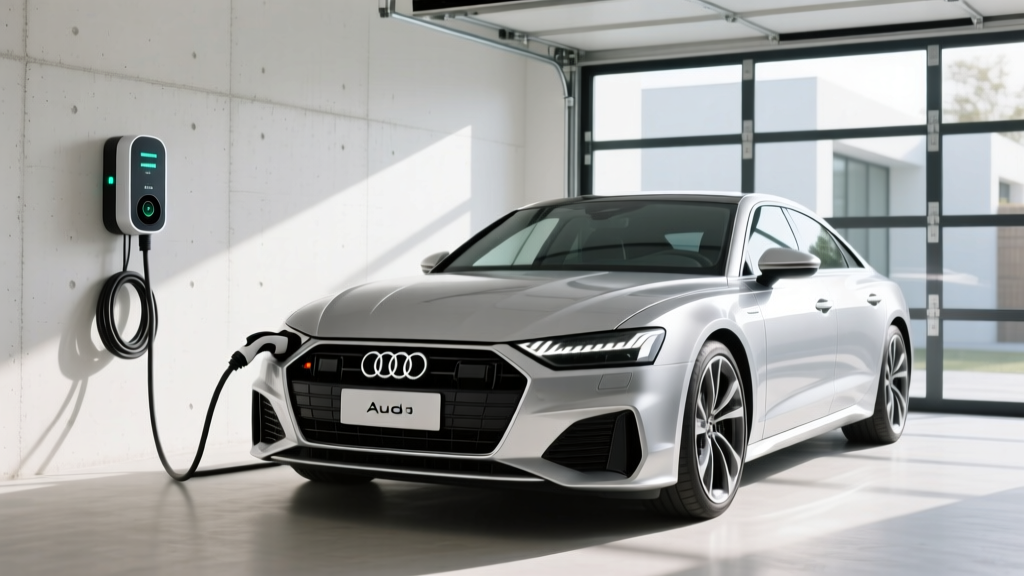
If you are buying a 2026 Audi (e.g., the Q6 e-tron or A6 e-tron), it ships with a native NACS port, granting direct access to Tesla's Supercharger network—over 25,000 stalls in North America—without an adapter. For home Level 2 charging, virtually all chargers use the J1772 connector, which is included as a pigtail adapter with NACS-equipped vehicles, or the charger itself may offer a NACS-terminated cable.
Cost Per Mile: EV Charging vs. Your A6 3.0T's Gas Bill
This is where the economics become undeniable. The Audi A6 3.0T Supercharged averages roughly 21 mpg combined in real-world driving. At $3.80/gallon for premium (91 octane, national average early 2026), that works out to approximately $0.181 per mile.
An efficient electric sedan like the BMW i5 eDrive40 consumes about 30 kWh per 100 miles (3.33 mi/kWh). Your cost per mile depends entirely on where and when you charge:
| Scenario | Rate ($/kWh) | Cost Per Mile (EV) | Cost Per Mile (A6 3.0T) | Annual Savings (12,000 mi) |
|---|---|---|---|---|
| Home Off-Peak (utility rate) | $0.09 | $0.027 | $0.181 | $1,848 |
| Home Standard Rate | $0.15 | $0.045 | $0.181 | $1,632 |
| Public Level 2 (ChargePoint, EVgo) | $0.35 | $0.105 | $0.181 | $912 |
| DC Fast Charging (road trips) | $0.48 | $0.144 | $0.181 | $444 |
Even in the worst-case scenario—exclusive DC fast charging—the EV still saves roughly $444 per year over the A6 3.0T. With predominantly home charging, annual fuel savings exceed $1,600. Over a typical 5-year ownership period, that is $8,000–$9,200 back in your pocket, not including savings from eliminating oil changes, supercharger belt replacements, and transmission fluid services.
Recommended Level 2 Home Chargers for 2026
Based on sustained power output, cable quality, smart features, and reliability track records, these are the top Level 2 units for a former A6 owner transitioning to an EV:
ChargePoint Home Flex (NACS)
- Power Output: Up to 11.5 kW (48A on 60A circuit) or 9.6 kW (40A on 50A circuit)
- Cable Length: 23 feet
- Smart Features: Wi-Fi, app scheduling, energy tracking, Alexa integration
- Connector: NACS (native) or J1772 available
- Price: ~$599
- Best For: Flexible amperage adjustment to match your panel capacity
Emporia Vue EV Charger
- Power Output: Up to 11.5 kW (48A)
- Cable Length: 24 feet
- Smart Features: Real-time energy monitoring, solar integration, load management
- Connector: J1772 (NACS adapter included with most EVs)
- Price: ~$399
- Best For: Budget-conscious buyers who want whole-home energy visibility
Tesla Wall Connector (NACS)
- Power Output: Up to 11.5 kW (48A)
- Cable Length: 24 feet
- Smart Features: Wi-Fi updates, power sharing (dual units on one circuit), access control
- Connector: NACS native
- Price: ~$450
- Best For: Tesla owners or those buying NACS-native vehicles (Audi, Ford, GM, etc.)
For a 75–100 kWh battery pack common in 2026 EVs, a 48A / 11.5 kW charger will fully replenish from 10% to 100% in roughly 7–9 hours—easily within a single overnight session. If your electrical panel can only support a 40A circuit (32A charger / 7.7 kW), plan for 10–13 hours for a full charge, which still covers most overnight needs.
Charging Time Examples for Common 2026 EV Battery Sizes
Here is how long a 10–80% charge takes across common battery sizes and charger types. These figures assume optimal battery temperature (preconditioned) and peak charge rates:
| Battery Size (usable kWh) | Example Vehicle | Level 2 Home (11.5 kW) | DC Fast (Peak kW) | 10–80% DC Time |
|---|---|---|---|---|
| 60 kWh | VW ID.4 Standard | ~4.5 hours | 170 kW | ~28 min |
| 77 kWh | Ford Mustang Mach-E Extended | ~5.5 hours | 150 kW | ~32 min |
| 84 kWh | Hyundai Ioniq 5 / Ioniq 6 | ~6 hours | 350 kW | ~18 min |
| 100 kWh | Audi e-tron GT / BMW iX | ~7.5 hours | 270 kW | ~22 min |
Real-world caveat: DC fast charging times assume the battery is preconditioned (warmed to optimal temperature). In sub-30°F weather, an un-preconditioned battery may accept less than half its peak charge rate until it warms up, adding 10–15 minutes. Always use your vehicle's built-in navigation to route to a charger—it will automatically begin preconditioning the battery en route.
Safety, Code, and Electrical Considerations
Home EV charging is safe when installed to code. Key requirements per the 2023 National Electrical Code (NEC), adopted by most US jurisdictions by 2026:
- Dedicated circuit: Your Level 2 charger must have its own dedicated breaker—no sharing with other appliances. A 48A charger requires a 60A breaker per NEC 125% continuous-load rule.
- GFCI protection: NEC 2023 §625.40 requires GFCI protection for all EV charging outlets. Hardwired chargers may have GFCI built into the unit; plug-in units (NEMA 14-50 receptacle) require a GFCI breaker, which adds $50–$150 to material costs.
- Outdoor rating: If your charger is mounted outside or in an unsealed garage, it must carry a NEMA 4 (weather-resistant) rating. All chargers recommended above meet this standard.
- Cable management: Avoid running charging cables across driveways or walkways. Use a wall-mounted holster or retractable cable system to prevent tripping hazards and cable wear.
- Permit and inspection: Virtually all jurisdictions require an electrical permit for EV charger installation. The inspection ensures proper grounding, breaker sizing, and wire gauge. Skipping the permit risks insurance claim denial in the event of an electrical fire.
Frequently Asked Questions
How much does it cost to install a home EV charger?
Expect $900–$3,000 for a standard installation in a home with an adequate 200-amp electrical panel. If your home needs a panel upgrade from 100A to 200A, add $1,500–$4,500. The total all-in cost for most homeowners falls between $1,200 and $2,500.
How fast will each charging level add range?
Level 1 (120V) adds 3–5 miles per hour. Level 2 (240V, 48A) adds 35–44 miles per hour depending on vehicle efficiency. DC fast charging can add 150–300+ miles in 15–25 minutes at a 150–350 kW station, though speeds taper above 80% state of charge.
Which connector/charger is compatible with my EV?
For 2026 models, most new EVs use the NACS connector natively, including Tesla, Ford, GM, Rivian, Hyundai, Kia, BMW, and Audi. Older CCS1 vehicles can use a CCS-to-NACS adapter (~$200) to access Tesla Superchargers. CHAdeMO is largely legacy and infrastructure is declining. For home Level 2, all vehicles accept J1772 or include a J1772-to-NACS adapter.
How much does charging cost per mile vs. gas?
Home charging at $0.12/kWh costs roughly $0.036 per mile for an efficient EV sedan. Your Audi A6 3.0T Supercharged at 21 mpg on $3.80 premium costs approximately $0.181 per mile. That is a per-mile savings of $0.145, or about $1,740 per year at 12,000 miles driven.
What electrical upgrades might I need?
The most common upgrade is a 100A-to-200A panel replacement, required when your existing panel lacks capacity for a dedicated 60A EV circuit alongside your other loads. Older homes (pre-2000) with fuse boxes or 60A/100A service almost always need an upgrade. Your electrician will perform an NEC Article 220 load calculation to determine this. Some utilities offer rebates of $200–$500 for panel upgrades when paired with EV adoption—check with your local provider.
Sources: fueleconomy.gov (EPA efficiency data), IRS Form 8911 Refueling Property Credit. Tax credit and incentive rules are subject to change; consult a qualified tax professional for your specific situation.