What Is an Arm Charger and Why Choose Wall-Mounted?
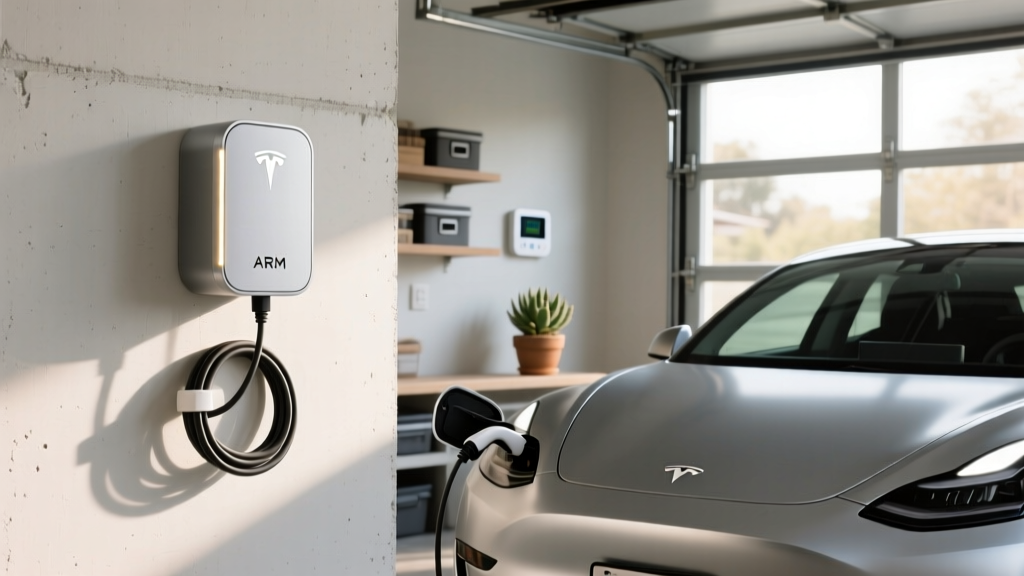
An arm charger is a wall-mounted Level 2 EV charging station featuring a fixed or articulated arm that holds the connector and cable neatly off the floor. Unlike portable chargers that drape over hooks, arm chargers integrate cable management into a rigid or semi-rigid boom, reducing trip hazards and wear on the cable jacket. For garage installations, they keep the J1772 or NACS connector within arm's reach of the charge port without letting the cord drag across concrete.
The wall-mounted arm design has become the dominant form factor for home Level 2 charging in 2026, replacing the older "cord wrap" style that required users to manually coil 18–25 feet of heavy cable. Most modern arm chargers deliver 9.6 kW to 19.2 kW of continuous power on a 240V circuit, adding 30 to 65 miles of range per hour depending on the vehicle's onboard charger acceptance rate.
Charging Levels Explained: Speed in kW and Miles Per Hour
Understanding the three EV charging tiers is essential before selecting equipment. The key distinction: kW measures power (the rate of energy delivery), while kWh measures energy (the battery's total capacity). A 10 kW charger running for one hour delivers 10 kWh of energy into your battery.
| Level | Voltage | Max Power (kW) | Miles of Range Added/Hour | Typical Use |
|---|---|---|---|---|
| Level 1 | 120V | 1.4–1.9 kW | 3–5 mi/hr | Overnight trickle; PHEVs or low-mileage commuters |
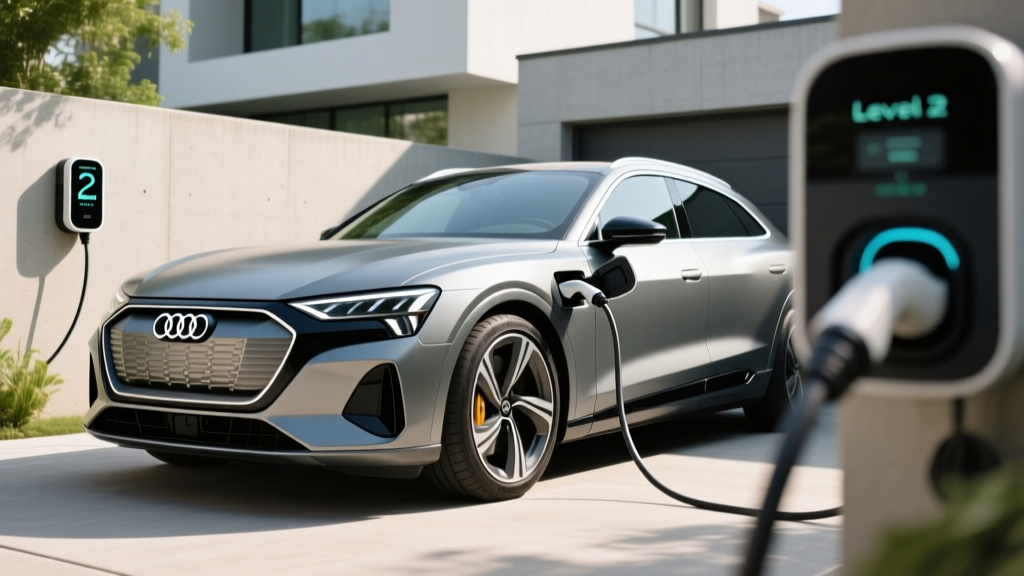
| Level 2 | 240V | 7.2–19.2 kW | 20–65 mi/hr | Home daily charging; workplace; destination |
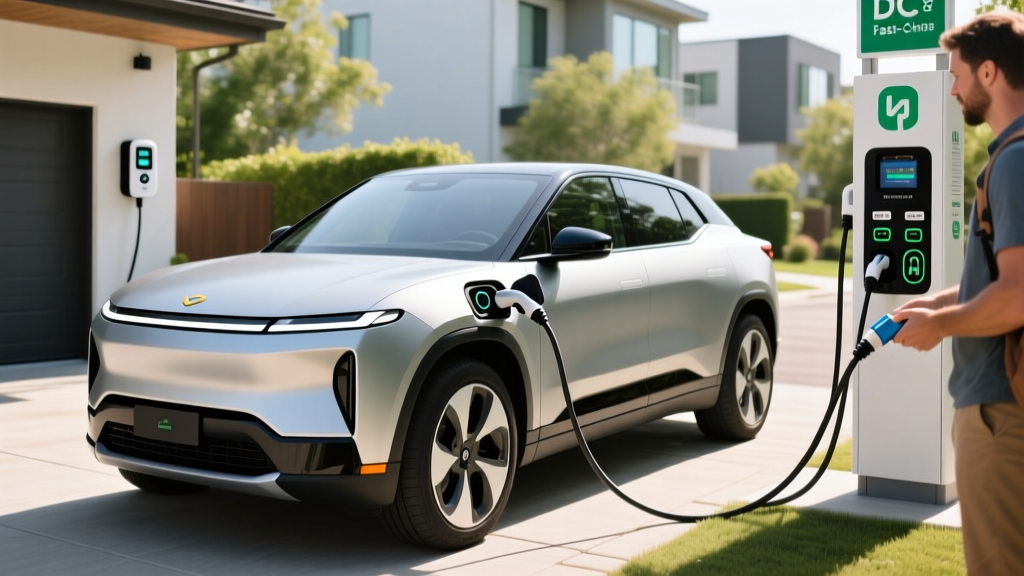
| DC Fast | 400–800V DC | 50–350 kW | 150–1,000+ mi/hr (short bursts) | Road trips; 10–80% in 15–30 min |
For context, a 2026 Tesla Model Y Long Range with an 82 kWh usable battery charging at 11.5 kW (48A Level 2) will recover roughly 35 miles of range per hour. A full 10–80% session takes approximately 5 hours at home — easily handled overnight. On a 250 kW DC fast charger, that same 10–80% window completes in about 22 minutes, though the charge curve tapers significantly above 60% state of charge.
Electrical Requirements: 240V Circuits, Amperage, and Panel Upgrades
Most arm chargers require a dedicated 240V circuit, typically 40A, 50A, or 60A depending on the unit's maximum output. The National Electrical Code (NEC) requires continuous loads — which EV charging qualifies as — to be limited to 80% of the circuit breaker rating. A 48A charger therefore needs a 60A breaker and 6 AWG copper wire.
Homes built before 1990 often have 100A main service panels that may already be near capacity. Adding a 60A EV circuit can push total calculated load beyond the panel's rating, triggering a panel upgrade to 200A service. This is the single largest variable in installation cost.
What Electrical Upgrades Might I Need?
- Panel upgrade (100A → 200A): Required if existing load calculations leave insufficient headroom. Cost: $1,500–$3,500 including utility coordination.
- Dedicated circuit run: New 6 AWG or 4 AWG copper from panel to garage. Cost varies with distance: $8–$15 per linear foot for wire plus conduit.
- GFCI breaker: NEC 2020 and later require GFCI protection for EV outlets in garages. A 60A GFCI breaker costs $80–$150.
- Subpanel: If the garage is detached or far from the main panel, a subpanel may be more economical than a long wire run.
How Much Does It Cost to Install a Home Arm Charger?
Installation costs vary widely based on panel capacity, wire run distance, and local permit fees. Below is a realistic breakdown for a typical attached-garage installation in 2026.
| Component | Low End | High End | Notes |
|---|---|---|---|
| Arm charger unit (40A–48A) | $350 | $750 | Wi-Fi enabled, 24-ft cable, NACS or J1772 |
| Electrician labor (circuit + mount) | $500 | $1,800 | Depends on wire run length, wall type |
| Materials (wire, conduit, breaker) | $150 | $500 | 6 AWG copper, PVC conduit, 60A GFCI breaker |
| Permit and inspection | $50 | $300 | Varies by municipality |
| Panel upgrade (if needed) | $1,500 | $3,500 | 100A → 200A service upgrade |
| Total (no panel upgrade) | $1,050 | $3,350 | Most common scenario |
| Total (with panel upgrade) | $2,550 | $6,850 | Older homes with 100A service |
The IRS §30D tax credit does not cover home charger installation after 2022 for most taxpayers — the alternative fuel vehicle refueling property credit (§30C) expired for residential use in most areas after 2022, though some census-tract-based eligibility may apply. Check irs.gov for current rules.
Connector Compatibility: NACS, CCS1, and CHAdeMO
As of 2026, the North American Charging Standard (NACS) has become the dominant connector for new EVs sold in the US, adopted by Ford, GM, Rivian, Hyundai, Kia, BMW, and others alongside Tesla. CCS1 remains on some 2023–2025 models still on the road, and CHAdeMO is limited to the Nissan Leaf and a handful of legacy vehicles.
| Connector | Brands Using It (2026) | Adapter Needed for Arm Charger? |
|---|---|---|
| NACS (Tesla-style) | Tesla, Ford, GM, Rivian, Hyundai, Kia, BMW, Volvo, Polestar, Mercedes | Buy a NACS-terminated arm charger; or use J1772-to-NACS adapter |
| CCS1 | Remaining 2023–2025 VW ID.4, some Stellantis models | J1772 arm charger + CCS adapter, or native CCS1 unit |
| CHAdeMO | Nissan Leaf (final model years) | Rare for home; CHAdeMO home chargers are discontinued |
Most arm chargers sold in 2026 ship with either a NACS or J1772 connector. If you drive a CCS1-equipped vehicle, a J1772-to-CCS adapter (approximately $150–$250) enables Level 2 home charging. For DC fast charging, adapters do not work — you must use a station with the correct connector.
Equipment Picks: Top Arm Chargers for 2026
These wall-mounted arm chargers represent the strongest options for residential installation, evaluated on power output, cable management, smart features, and price.
ChargePoint Home Flex (NACS)
- Power: Up to 12 kW (50A) on a 60A circuit; configurable down to 16A
- Connector: NACS (also available in J1772)
- Cable: 24 ft, integrated into articulating arm
- Smart features: Wi-Fi, Alexa/Google Home, scheduling, energy tracking via app
- Price: ~$549
Best for: Multi-EV households needing flexible amperage settings and robust app control.
Wallbox Pulsar Max
- Power: Up to 11.5 kW (48A) on a 60A circuit
- Connector: J1772 or NACS (configurable at order)
- Cable: 25 ft with built-in arm holster
- Smart features: Wi-Fi + Bluetooth, Power Sharing for dual installations, solar integration
- Price: ~$499
Best for: Homes with solar panels wanting to match charging to excess production.
Emporia Vue EV Charger
- Power: Up to 11.5 kW (48A)
- Connector: J1772 (NACS adapter included)
- Cable: 24 ft with wall-mount arm bracket
- Smart features: Real-time energy monitoring, grid-aware scheduling, integrates with Emporia home energy monitor
- Price: ~$399
Best for: Budget-conscious buyers who want whole-home energy visibility alongside EV charging.
Tesla Wall Connector (Gen 4)
- Power: Up to 11.5 kW (48A)
- Connector: NACS native; J1772 adapter available
- Cable: 24 ft with integrated arm and auto-retract option
- Smart features: Wi-Fi updates, load sharing between multiple units, Powerwall integration
- Price: ~$475
Best for: Tesla owners who want the cleanest aesthetic and native NACS without adapters.
Cost to Charge: Home vs. Public vs. Gas Per Mile
The economic case for home charging rests on electricity rates that are typically far lower per mile than gasoline. Here's how common scenarios compare for a vehicle averaging 3.5 miles per kWh (approximately 105 MPGe combined, typical of a 2026 midsize electric SUV).
| Scenario | Rate | Cost/Mile | Annual Cost (12,000 mi) |
|---|---|---|---|
| Home off-peak (utility TOU) | $0.09/kWh | $0.026 | $312 |
| Home standard rate | $0.16/kWh | $0.046 | $552 |
| Public Level 2 (ChargePoint/EVgo) | $0.30/kWh | $0.086 | $1,032 |
| DC Fast Charging (Electrify America) | $0.48/kWh | $0.137 | $1,644 |
| Gasoline (28 MPG, $3.40/gal) | $3.40/gal | $0.121 | $1,452 |
Home off-peak charging delivers fuel cost roughly 80% lower than gasoline. Even standard-rate home charging undercuts gas by ~60%. The breakeven point shifts if you rely exclusively on DC fast charging — at $0.48/kWh, electricity costs more per mile than gas for a 28 MPG vehicle. This is why home arm charger installation is the single highest-impact financial decision for EV ownership.
For a more detailed look at efficiency ratings across current models, consult fueleconomy.gov for EPA-rated kWh/100mi and MPGe figures.
Charging Time Examples: 10–80% by Battery Size
The time to charge from 10% to 80% state of charge is the most practical metric, as most drivers avoid charging above 80% on DC fast chargers (where the curve tapers sharply) and rarely let the battery drop below 10%.
| Battery (usable kWh) | Example Vehicle | Level 2 at 9.6 kW (40A) | Level 2 at 11.5 kW (48A) | DC Fast (peak kW) |
|---|---|---|---|---|
| 62 kWh | 2026 Chevy Equinox EV | ~4.5 hrs | ~3.8 hrs | ~22 min at 150 kW |
| 82 kWh | 2026 Tesla Model Y LR | ~6.0 hrs | ~5.0 hrs | ~22 min at 250 kW |
| 94 kWh | 2026 Hyundai Ioniq 9 | ~6.8 hrs | ~5.7 hrs | ~18 min at 350 kW (800V) |
| 112 kWh | 2026 Ford F-150 Lightning Ext. | ~8.2 hrs | ~6.8 hrs | ~35 min at 200 kW |
These times assume the vehicle's onboard charger can accept the full power offered. Some vehicles (notably the standard-range Chevy Equinox at 7.2 kW onboard) will charge slower than the arm charger's maximum output. Always check your vehicle's onboard charger specification — it's the bottleneck for Level 2, not the wall unit.
Safety, Code, and Installation Best Practices
EV charging is a continuous high-amperage load that runs for hours — often 6 to 10 hours unattended overnight. Safety requirements are correspondingly strict.
- Dedicated circuit: The EV charger must be on its own dedicated breaker — no shared circuits with laundry, HVAC, or workshop tools.
- GFCI protection: Required by NEC Article 625 for all EV supply equipment in garages and outdoor locations. Hardwired units may have GFCI built into the charger; plug-in units require a GFCI breaker.
- Outdoor rating: If mounted outside or in an open carport, the unit must carry a NEMA 4 or IP65 rating. Most arm chargers rated for indoor garage use are NEMA 3R at minimum.
- Hardwired vs. plug: Hardwired installations avoid the NEMA 14-50 receptacle, which has been associated with overheating incidents under continuous EV loads. Many electricians now recommend hardwiring for any charger above 32A.
- Permit and inspection: Most jurisdictions require an electrical permit and post-installation inspection. Skipping this can void homeowner's insurance coverage for electrical fires.
The National Fire Protection Association (NFPA) publishes the NEC articles governing EV charging installations. Your licensed electrician will handle code compliance, but understanding these requirements helps you evaluate quotes and avoid shortcuts.
Frequently Asked Questions
How fast will each charging level add range?
Level 1 (120V) adds 3–5 miles per hour — sufficient for PHEVs with 30–40 mile batteries. Level 2 at 9.6 kW adds roughly 30–35 miles per hour for most EVs. At 11.5 kW, expect 35–42 miles per hour. DC fast charging adds 150–300 miles in 15–25 minutes but is not practical for daily home use due to cost and infrastructure requirements.
Which connector or charger is compatible with my EV?
If your 2026 model-year EV is a Tesla, Ford, GM, Rivian, Hyundai, Kia, BMW, Volvo, or Polestar, it uses NACS. Order your arm charger with a NACS connector. If you drive a 2023–2025 VW ID.4 or older CCS-equipped model, order J1772 and use a CCS adapter for DC fast charging on the road. Nissan Leaf owners with CHAdeMO should use a J1772-to-CHAdeMO adapter for Level 2 home charging.
Can I install an arm charger myself?
Hardwired installations must be performed by a licensed electrician for code compliance and insurance validity. If you have an existing NEMA 14-50 outlet (common for welders or RV hookups), you can plug in a compatible arm charger yourself — but have an electrician verify the outlet was installed to current code with proper torque specifications, as loose 14-50 receptacles are a known fire risk under continuous EV loads.
Does an arm charger work with time-of-use utility rates?
Yes. All smart arm chargers listed above support scheduled charging via their companion apps. Set the charger to begin at 10 PM or whenever your utility's off-peak window starts. Combined with a TOU rate plan (typically $0.07–$0.11/kWh overnight), this can cut your annual fuel cost below $350 for 12,000 miles of driving.
What if my garage is detached or far from the panel?
Long wire runs increase cost significantly — roughly $8–$15 per linear foot for 6 AWG copper in conduit. For runs exceeding 80 feet, your electrician may recommend upsizing to 4 AWG to prevent voltage drop. In some cases, installing a subpanel near the garage is more cost-effective. Budget an additional $500–$1,500 for extended runs or subpanel installations.