If you've ever pulled up to a shopping center and spotted an EV charger marked "complimentary," you're not alone in wondering: are charging stations for electric cars free? The short answer is mostly no — but the full picture is more nuanced. A shrinking number of workplaces, hotels, and dealerships still offer free Level 2 access, while the vast majority of public chargers in 2026 bill by the kilowatt-hour (kWh), by the minute, or through a session fee. Understanding what you'll actually pay — at home, on the road, and at a DC fast charger — is essential before you commit to an electric vehicle.
This guide breaks down every layer of EV charging cost: the three charging levels and how fast they add range, what home installation really costs (including the panel-upgrade scenario nobody warns you about), which connector your car needs, and how EV charging stacks up against gasoline on a per-mile basis.
The Three Charging Levels: Speed, Cost, and Real-World Use
Before we talk price, let's nail down the infrastructure. EV charging happens at three distinct levels, each with different power delivery (measured in kW, or kilowatts — the rate of energy flow) and energy storage implications (your battery capacity is measured in kWh, or kilowatt-hours — the total energy it holds). Confusing kW with kWh is the single most common mistake new EV buyers make. Think of it this way: kW is how fast water flows from a hose; kWh is how many gallons your bucket holds.
| Level | Voltage | Typical Power (kW) | Miles of Range Added per Hour | Best Use Case | Typical Cost |
|---|---|---|---|---|---|
| Level 1 | 120V AC | 1.0–1.4 kW | 3–5 mi/hr | Overnight top-off for PHEVs or low-mileage commuters | Home electricity rate (~$0.03–0.06/mi) |
| Level 2 | 240V AC | 3.3–19.2 kW | 12–75 mi/hr | Daily home charging; destination charging | Home rate or $0.20–$0.49/kWh public |
| DC Fast Charge | 400–800V DC | 50–350 kW | 150–1,200+ mi/hr (peak) | Road trips, rapid top-ups | $0.30–$0.65/kWh (some idle fees) |
Real-world charging time examples: A Hyundai Ioniq 5 with its 77.4 kWh (usable) battery charging from 10–80% on a 350 kW DC fast charger takes approximately 18 minutes under ideal battery-temperature conditions — but expect 25–30 minutes at a 150 kW station, and significantly longer in cold weather if your vehicle hasn't preconditioned the battery. A Level 2 home charger at 11.5 kW (48A) will refill that same battery from 10–80% overnight in roughly 4.5 hours.
Are Public Charging Stations Actually Free?
The honest answer: free public EV charging is becoming rare. Here's what the landscape looks like in 2026:
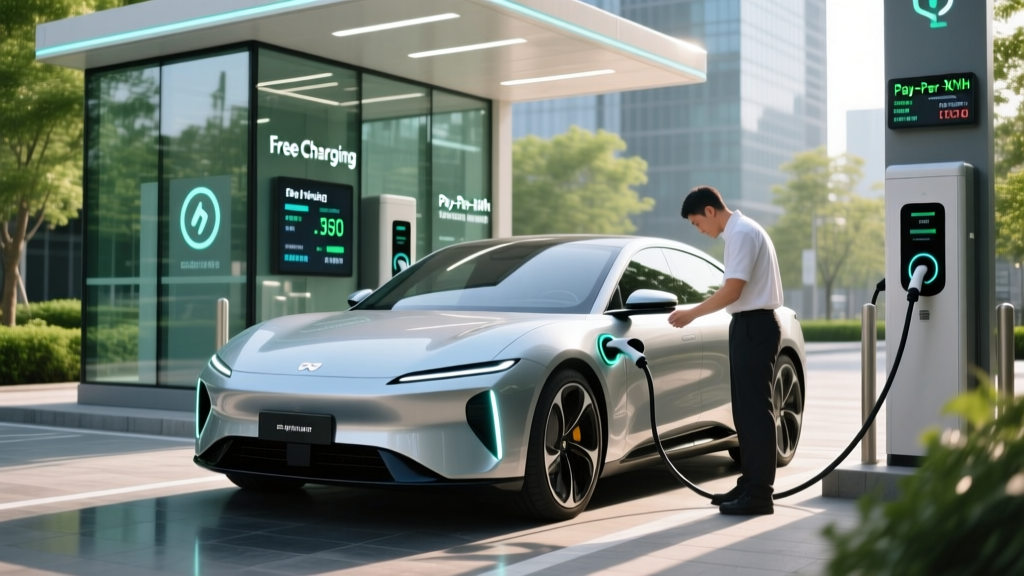
- Truly free stations — Mostly limited to Level 2 units at some workplaces, municipal garages, select hotels, and a handful of retail locations using free charging as a customer perk. These are often slower (6.6–7.2 kW), shared among multiple drivers, and may enforce time limits of 2–4 hours.
- "Free" with a purchase — Some dealerships, shopping centers, and restaurants offer complimentary charging while you're a paying customer. Verify before you rely on it — policies change frequently.
- Pay-per-use (the majority) — Networks like Electrify America, EVgo, ChargePoint, and Tesla Superchargers charge by the kWh in most states, though some jurisdictions still bill by the minute due to utility regulations. Expect to pay $0.30–$0.48/kWh for DC fast charging and $0.20–$0.49/kWh for public Level 2.
- Subscription plans — EVgo and Electrify America offer monthly subscriptions ($4.99–$9.99/month) that reduce per-kWh rates by 15–25%, worth it if you charge publicly more than twice a month.
- Manufacturer credits — Some new EV purchases include complimentary charging for a limited period (e.g., 2 years or 1,000 kWh on a specific network). These expire and should not factor into long-term ownership cost calculations.
Bottom line: if your daily driving depends on public charging, budget for it. If you can charge at home, public stations are an occasional road-trip expense, not a daily cost.
Home EV Charger Installation: What It Really Costs
Charging at home is where EV ownership economics shine — but getting a Level 2 station installed isn't always a simple plug-and-play affair. Here's the full cost picture, including the scenarios that catch homeowners off guard.
Electrical Requirements
A Level 2 home charger requires a 240-volt dedicated circuit, identical to what powers your electric dryer or oven. The most common residential setup is a 40-amp or 60-amp circuit, which delivers 9.6 kW or 11.5 kW of continuous power respectively (EV chargers are limited to 80% of the circuit's rated amperage under the National Electrical Code).
If your home's electrical panel is already at or near capacity (common in homes built before 2000 with 100-amp service), you may need a panel upgrade to 200 amps — a significant added cost. Signs you'll need an upgrade: your panel is full with no open breaker slots, you already run multiple high-draw appliances simultaneously, or your electrician flags a load-calculation issue.
| Component | Cost Range | Notes |
|---|---|---|
| Level 2 charger hardware | $300–$750 | Smart Wi-Fi-enabled units; basic non-smart units from $200 |
| Electrician labor (standard install) | $500–$1,500 | Short run from panel to garage; longer runs cost more |
| Electrical permit | $50–$250 | Varies by municipality; required for code compliance |
| Panel upgrade (if needed) | $1,500–$4,000 | 100A → 200A service upgrade; not needed in most newer homes |
| Conduit/wiring (long runs) | $200–$800 | Chargers far from panel or requiring trenching |
| Total (standard install) | $850–$2,500 | Most homeowners fall in this range |
| Total (with panel upgrade) | $2,350–$6,550 | Older homes with 100A service |
Important incentive note: The federal §30C Alternative Fuel Vehicle Refueling Property Credit covers 30% of home charger hardware and installation costs, up to $1,000, but only if you live in an eligible census tract (typically non-urban or lower-income areas). Check IRS guidelines and confirm with a tax professional before assuming eligibility. Some states and utilities offer additional rebates of $200–$1,000 on top of the federal credit.
Safety and Code Considerations
A proper installation isn't just about getting power to your charger — it's about doing so safely and legally:
- Dedicated circuit: Your Level 2 charger must be on its own breaker, not shared with other appliances. This prevents overloads and tripped breakers.
- GFCI protection: The 2023 NEC update requires GFCI (Ground Fault Circuit Interrupter) protection for all EV receptacles. Most hardwired chargers have built-in GFCI, but if you're installing a NEMA 14-50 outlet, your electrician must install a GFCI breaker.
- Outdoor rating: If your charger is mounted outside or in an open carport, it must carry a NEMA 4 or IP65 weather-resistance rating. All major chargers sold in the U.S. meet this standard, but verify before purchasing.
- Permit and inspection: Skipping the permit saves $50–$250 upfront but can void your homeowner's insurance coverage for electrical fires and create problems at resale. Always permit the work.
- Hardwired vs. plug: Hardwired installations (no outlet) are preferred for chargers above 40A, as NEMA 14-50 receptacles have been associated with overheating in some high-draw EV applications. Many electricians now recommend hardwiring as the safer default.
Connector Compatibility: Which Plug Does Your EV Use?
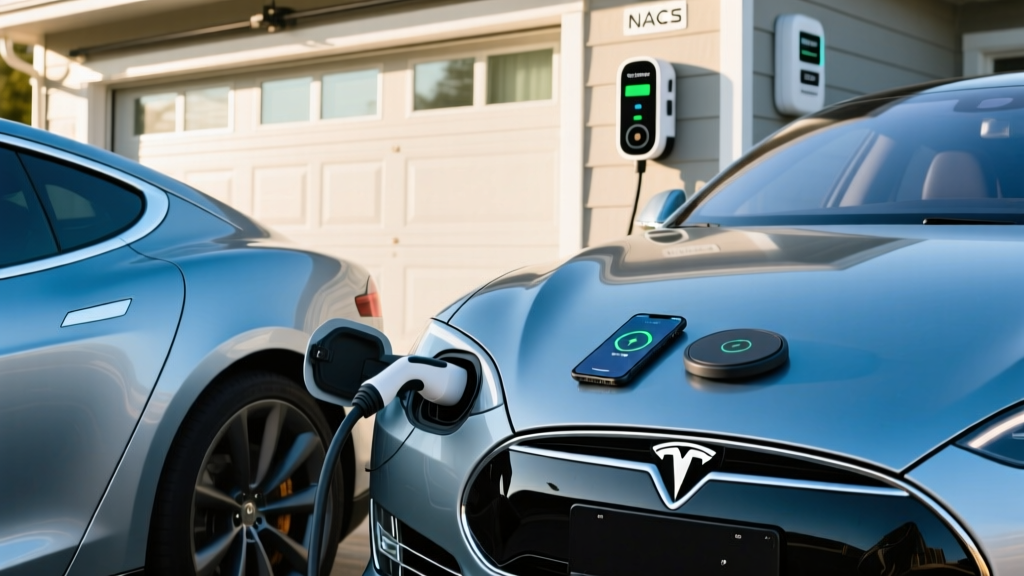
The North American charging connector landscape consolidated significantly between 2023 and 2026, with the North American Charging Standard (NACS) — originally developed by Tesla — now adopted by nearly every major automaker. Here's what you need to know:
| Connector | Brands Using It (Native) | Charging Type | Adapter Needed? |
|---|---|---|---|
| NACS (J3400) | Tesla, Ford, GM, Rivian, Volvo, Polestar, Mercedes-Benz, Hyundai/Kia (2025+), Nissan (2025+) | Level 2 AC + DC Fast | None for Tesla Superchargers; CCS adapter may be needed for some legacy stations |
| CCS1 | Legacy models pre-2025 (VW ID.4, older Hyundai/Kia, BMW iX pre-2025, Stellantis) | Level 2 AC + DC Fast | NACS-to-CCS adapter (~$150–$250) for Tesla Superchargers |
| CHAdeMO | Nissan Leaf (discontinued 2025), Mitsubishi Outlander PHEV (older) | DC Fast only | CHAdeMO-to-NACS adapters are rare; network access declining |
Practical advice: If you're buying a new EV in 2026, it almost certainly has a NACS port. If you're buying a used EV from 2022–2024, it likely has CCS1 and you'll want to purchase a NACS adapter for Tesla Supercharger access (Ford and GM provide these to owners; aftermarket options from Lectron and A2Z are widely available). CHAdeMO infrastructure is actively shrinking — plan accordingly if you own a Leaf.
Cost per Mile: EV Charging vs. Gasoline
This is the calculation that determines whether an EV saves you money. The answer depends heavily on where and when you charge.
| Scenario | Energy Cost | Vehicle Efficiency | Cost Per Mile |
|---|---|---|---|
| Home charging (off-peak TOU rate) | $0.10/kWh | 3.0 mi/kWh (typical sedan) | $0.033/mi |
| Home charging (standard rate) | $0.16/kWh | 3.0 mi/kWh | $0.053/mi |
| Public Level 2 (network average) | $0.35/kWh | 3.0 mi/kWh | $0.117/mi |
| DC fast charging (network average) | $0.45/kWh | 3.0 mi/kWh | $0.150/mi |
| Gas car (28 MPG combined) | $3.40/gal | 28 MPG | $0.121/mi |
| Gas car (40 MPG hybrid) | $3.40/gal | 40 MPG | $0.085/mi |
Key takeaway: Home-charged EVs cost 55–72% less per mile than an average gas car. But if you rely exclusively on DC fast charging at public rates, your per-mile cost can actually exceed that of a fuel-efficient hybrid. This is why home charging access is the single most important financial variable in EV ownership.
For a driver covering 12,000 miles per year, the annual fuel cost difference is stark:
- Home-charged EV at off-peak rates: ~$400/year
- Average gas car at 28 MPG: ~$1,457/year
- Annual savings: ~$1,057
These savings compound over a 5-year ownership period to roughly $5,285 — enough to offset a meaningful portion of the EV's typically higher purchase price. According to fueleconomy.gov, EVs convert over 77% of electrical energy to power at the wheels, compared to 12–30% for gasoline vehicles, which is the fundamental efficiency advantage.
Recommended Home Chargers for 2026
Not all Level 2 chargers are equal. Here are three proven options across different budgets, all NACS-native (with CCS compatibility via adapter or built-in cable):
Best Overall: ChargePoint Home Flex
- Power output: Up to 12 kW (50A) on a 60A circuit, adjustable down to 16A
- Connector: NACS (native), J1772 adapter included
- Cable length: 23 feet
- Smart features: Wi-Fi, app scheduling, Alexa integration, energy tracking, utility TOU optimization
- Price: ~$549 (hardware only)
- UL listed, NEMA 4 outdoor rated
Best Value: Emporia Level 2 EV Charger
- Power output: Up to 11.5 kW (48A) on a 60A circuit
- Connector: NACS (native), J1772 adapter included
- Cable length: 24 feet
- Smart features: Wi-Fi, solar integration (pairs with Emporia Vue energy monitor), TOU scheduling
- Price: ~$399 (hardware only)
- UL listed, NEMA 4 outdoor rated
Premium Pick: Tesla Wall Connector
- Power output: Up to 11.5 kW (48A) on a 60A circuit
- Connector: NACS (native), J1772 version also available
- Cable length: 24 feet
- Smart features: Wi-Fi, power sharing (link up to 6 units on one circuit), OTA updates, load management
- Price: ~$475 (hardware only)
- UL listed, NEMA 4 outdoor rated
All three units support charge scheduling — a critical feature if your utility offers time-of-use (TOU) rates. Programming your charger to start at 10 PM when off-peak rates kick in can cut your charging cost by 40–60% compared to charging during afternoon peak hours.
Frequently Asked Questions
How much does it cost to install a home EV charger?
A standard Level 2 home charger installation costs between $850 and $2,500 including hardware, electrician labor, and permits. If your home requires a 200-amp panel upgrade (common in homes built before 2000 with 100-amp service), the total can reach $2,350–$6,550. The federal §30C tax credit may cover 30% of the cost up to $1,000, depending on your census tract eligibility. Always get at least two quotes from licensed electricians and verify they pull a permit.
How fast will each charging level add range?
Level 1 (120V) adds roughly 3–5 miles of range per hour — suitable only for plug-in hybrids or very low daily mileage. Level 2 (240V) adds 12–75 miles per hour depending on amperage and your vehicle's onboard charger capacity. DC fast charging adds 150–1,200+ miles per hour at peak rates, but charging speed tapers significantly above 80% state of charge to protect the battery. A realistic 10–80% DC fast charge session takes 18–35 minutes for most modern EVs.
Which connector/charger is compatible with my EV?
For 2025–2026 model-year vehicles, nearly all new EVs use the NACS (J3400) connector, which works natively at Tesla Superchargers and a growing number of third-party networks. Older EVs (2022–2024) with CCS1 ports can access Tesla Superchargers using a NACS-to-CCS adapter ($150–$250). CHAdeMO vehicles (Nissan Leaf) face declining infrastructure and no viable adapter path. Check your vehicle's owner's manual or the fueleconomy.gov listing for your specific model.
How much does charging cost per mile vs. gas?
Home-charged EVs cost $0.03–$0.05 per mile on average, compared to $0.12 per mile for a 28 MPG gas car at $3.40/gallon. That's a 58–75% savings per mile. Public DC fast charging at $0.45/kWh costs roughly $0.15 per mile — actually more than the average gas car. The economics strongly favor home charging. If you cannot charge at home, a plug-in hybrid (PHEV) may be a more cost-effective choice than a full EV.
What electrical upgrades might I need?
The most common upgrade is a new 240V dedicated circuit with a 40A–60A breaker. If your panel has open slots and sufficient amperage headroom (determined by an electrician's load calculation), this is straightforward. If your panel is at capacity, you'll need a panel upgrade from 100A to 200A service — typically $1,500–$4,000. Homes with older Federal Pacific or Zinsco panels may be required to replace the entire panel for safety reasons regardless of EV charging. Some utilities now offer managed charging programs that provide a smart charger and a secondary meter at reduced cost, bypassing the need for a panel upgrade in some cases.
Are there truly any free charging stations left?
Yes, but they're dwindling. Free stations are most commonly found at workplaces (as an employee benefit), some municipal parking garages, select hotels, and auto dealerships. Apps like PlugShare and ChargeHub let you filter for free stations in your area. However, free stations often have slower charging speeds (6.6 kW or less), higher competition for access, and no guarantee of availability. Relying on them as your primary charging strategy is risky — treat them as a bonus, not a plan.