Why the Amazon Rivian Van Range Matters for EV Charging Planning
When Amazon and Rivian began rolling out the Electric Delivery Van (EDV) across U.S. metro routes, the headline number was always range. But for fleet managers, depot operators, and EV-curious drivers who've seen these boxy blue-and-smile vans in their neighborhoods, the real question is: what does the Amazon Rivian van range actually look like under real-world delivery conditions, and what charging infrastructure supports it?
The Rivian EDV comes in three body configurations — the EDV-500, EDV-700, and EDV-900 — with the number referring to cargo volume in cubic feet, not range. All three share Rivian's commercial-grade skateboard platform, but battery capacity and efficiency vary slightly. Understanding the van's energy consumption, charging curve, and connector ecosystem is essential whether you're spec'ing a depot charger, evaluating last-mile electrification, or simply trying to understand how these vans stay charged on 150-mile daily routes.
EPA-estimated range: ~150 miles (EDV-700, estimated; Rivian has not published formal EPA stickers for the commercial EDV line as of early 2026).
Real-world delivery route expectation: 110–135 miles with frequent stops, HVAC use, and partial loads. In cold climates (below 32°F), expect 15–25% range reduction, dropping usable range to roughly 90–115 miles per charge cycle.
Rivian has kept EDV battery specifications relatively close to its consumer platform. Industry teardowns and Rivian's commercial disclosures indicate a usable battery capacity in the range of 105–120 kWh (NMC chemistry) depending on configuration, with DC fast-charge capability peaking around 150–180 kW. That's enough to take the van from 10% to 80% state of charge in approximately 40–50 minutes at a compatible depot charger — critical for mid-shift top-ups on longer suburban routes.
Charging Levels Explained: kW, Miles Per Hour, and What Each Level Means
Before spec'ing hardware, it's essential to separate kW (kilowatts), which measures charging power or speed, from kWh (kilowatt-hours), which measures battery energy capacity. Think of kW as the flow rate of a hose and kWh as the size of the tank. A 120 kWh battery charged at 11.5 kW (Level 2) fills in roughly 10–11 hours; at 150 kW (DC fast), the same battery reaches 80% in under an hour.
| Level | Voltage / Phase | Max Power (kW) | Miles of Range Added Per Hour | Typical Use Case |
|---|---|---|---|---|
| Level 1 | 120V AC / Single | 1.4 kW | 3–5 mi/hr | Emergency trickle; overnight for PHEVs |
| Level 2 | 240V AC / Single | 7.2–19.2 kW | 20–65 mi/hr | Home, workplace, fleet depot overnight |
| DC Fast (Level 3) | 200–500V DC | 50–350 kW | 150–1,000+ mi/hr (peak) | Highway, depot mid-shift, public corridors |
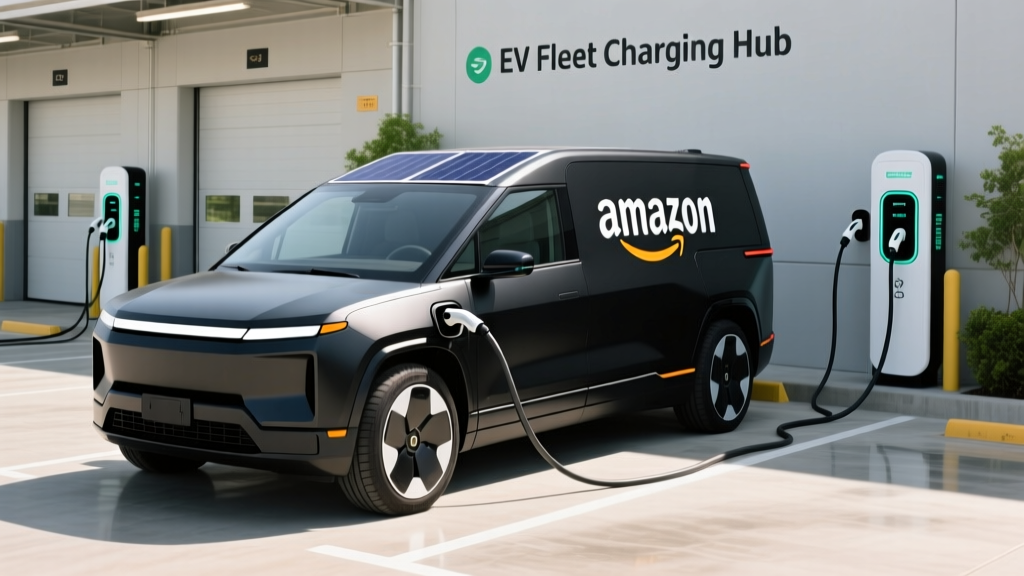
For the Rivian EDV fleet, Amazon primarily relies on Level 2 depot charging overnight (typically 19.2 kW per stall using commercial-grade EVSE) supplemented by DC fast chargers at select high-throughput delivery stations. Level 1 is irrelevant for a 120 kWh van — it would take over 80 hours for a full charge.
How Much Does It Cost to Install a Home or Depot EV Charger?
Whether you're a fleet operator adding a single Level 2 stall at a satellite depot or a homeowner installing a 240V outlet for personal EV use, the cost structure follows the same framework: equipment, electrical labor, permits, and potential panel upgrades.
| Component | Residential Range | Commercial/Depot Range |
|---|---|---|
| EVSE Equipment (Level 2 unit) | $400–$1,200 | $1,500–$4,000 (networked) |
| Electrician Labor (240V/50A circuit run) | $600–$2,500 | $2,000–$8,000 |
| Permit & Inspection | $100–$400 | $300–$1,500 |
| Electrical Panel Upgrade (100A→200A) | $1,500–$3,500 | $5,000–$20,000+ (3-phase service) |
| Total (no panel upgrade) | $1,100–$4,100 | $3,800–$13,500 |
| Total (with panel upgrade) | $2,600–$7,600 | $8,800–$33,500+ |
Panel upgrade reality: Many older homes and small commercial buildings have 100-amp electrical panels. Adding a 40A or 50A dedicated circuit for EV charging may exceed available capacity, requiring a service upgrade to 200A (residential) or a new 3-phase drop (commercial). This is the single biggest variable in installation cost and should always be assessed by a licensed electrician before purchasing equipment.
For fleet depots, Amazon has invested in managed charging systems that stagger charge sessions across dozens of vans to avoid peak-demand utility charges. The U.S. Department of Energy notes that smart load management can reduce depot electricity costs by 20–40% compared to unmanaged simultaneous charging.
Connector Compatibility: NACS, CCS1, and What the Rivian EDV Uses
The Rivian EDV uses the CCS1 (Combined Charging System) connector standard for DC fast charging, consistent with Rivian's consumer vehicles (R1T, R1S) built prior to the 2025 NACS transition. Rivian's consumer lineup began adopting the NACS (Tesla-style) port for 2025+ model years, but the commercial EDV fleet — designed and deployed starting in 2022 — remains CCS1-equipped.
| Connector | Brands Using It | DC Fast Max kW | Notes |
|---|---|---|---|
| NACS (Tesla) | Tesla, Ford, GM, Rivian (2025+), Hyundai, Kia (2025+) | 250–350 kW (V4 Supercharger) | Adopted as SAE J3400 standard |
| CCS1 | VW, BMW, Rivian (pre-2025), Rivian EDV, Stellantis | 150–350 kW | Legacy standard; adapters available to NACS |
| CHAdeMO | Nissan Leaf (legacy), Mitsubishi | 50–100 kW | Discontinued for new vehicles post-2024 |
If you're installing a charger for a mixed fleet or personal use that includes a CCS1-equipped Rivian EDV alongside newer NACS vehicles, dual-connector DC fast stations (offering both CCS1 and NACS cables) are available from ChargePoint, ABB, and BTC Power. For Level 2, the J1772 connector is universal across all non-Tesla EVs, and Tesla provides a J1772-to-NACS adapter with every vehicle.
Charging Time Examples: How Long to Charge Common EV Battery Sizes
Charge time depends on battery capacity (kWh), the charger's power output (kW), and the vehicle's charge curve. Most EVs — including the Rivian EDV — accept peak charge rates only between roughly 10% and 50% state of charge, then taper significantly above 80% to protect battery health. This is why 10–80% time is the industry-standard metric, not 0–100%.
| Battery Size | Level 2 (11.5 kW) | Level 2 (19.2 kW) | DC Fast 150 kW (10–80%) | DC Fast 250 kW (10–80%) |
|---|---|---|---|---|
| 60 kWh (compact EV) | ~5.2 hrs | ~3.1 hrs | ~22 min | ~15 min |
| 85 kWh (mid-size SUV) | ~7.4 hrs | ~4.4 hrs | ~30 min | ~20 min |
| 120 kWh (Rivian EDV-700 est.) | ~10.4 hrs | ~6.3 hrs | ~45 min | ~30 min |
| 200 kWh (heavy-duty/commercial) | ~17.4 hrs | ~10.4 hrs | ~70 min | ~48 min |
For the Rivian EDV on an Amazon depot schedule, overnight Level 2 charging at 19.2 kW provides a full replenishment in roughly 6–7 hours — sufficient for vans that return to the depot by 8 PM and deploy by 6 AM. DC fast charging at 150 kW is used selectively for mid-day top-ups on extended routes, adding roughly 80 miles of range in 20 minutes.
Cost to Charge: $/kWh Scenarios and Cost Per Mile vs. Gas
Electricity pricing varies dramatically by region, time of day, and whether you're charging at home, at a public Level 2 station, or at a DC fast charger. Here's how the numbers break down for a vehicle consuming roughly 2.0 kWh per mile (a reasonable estimate for the Rivian EDV-700 under delivery-cycle conditions, equivalent to approximately 1.5–1.8 MPGe-rated efficiency for a vehicle of this mass and duty cycle).
| Scenario | $/kWh | Cost Per Mile (2.0 kWh/mi) | Equivalent Gas Cost (25 MPG @ $3.40/gal) |
|---|---|---|---|
| Home Off-Peak (utility TOU rate) | $0.09–$0.14 | $0.18–$0.28 | $0.14/mi |
| Home Standard Rate | $0.15–$0.20 | $0.30–$0.40 | $0.14/mi |
| Public Level 2 (ChargePoint, EVgo) | $0.25–$0.45 | $0.50–$0.90 | $0.14/mi |
| DC Fast Charging (EA, Tesla) | $0.35–$0.55 | $0.70–$1.10 | $0.14/mi |
For Amazon's fleet operations, depot charging on commercial off-peak rates (often $0.06–$0.10/kWh with negotiated utility contracts) brings the per-mile energy cost well below gasoline — typically $0.12–$0.20 per mile for the EDV. This is a primary economic driver of fleet electrification: even though the EDV's upfront cost exceeds a comparable gas van, the per-mile fuel savings on 150-mile daily routes yield payback within 3–5 years, before factoring in reduced maintenance (no oil changes, fewer brake replacements due to regenerative braking).
Equipment Recommendations: Level 2 Chargers for Home and Fleet Use
Below are current-production Level 2 charging stations suited for either residential or light-commercial use, each with verified power output, connector type, and smart features.
ChargePoint Home Flex
- Power Output: Up to 12 kW (50A, 240V) — configurable down to 16A for panel-limited homes
- Connector: J1772 (NACS adapter included for Tesla/Rivian 2025+ owners)
- Cable Length: 23 feet
- Smart Features: Wi-Fi, app scheduling, Alexa integration, energy tracking
- Price: ~$699 (2026)
- Best For: Residential; flexible amperage avoids panel upgrades in many homes
Emporia Vue Level 2 Charger
- Power Output: Up to 11.5 kW (48A, 240V)
- Connector: J1772
- Cable Length: 24 feet
- Smart Features: Integrates with Emporia energy monitor for solar-aware charging, TOU scheduling
- Price: ~$399
- Best For: Budget-conscious homeowners with solar or time-of-use plans
Grizzl-E Smart
- Power Output: Up to 10 kW (40A, 240V)
- Connector: J1772
- Cable Length: 24 feet
- Smart Features: OCPP-compatible for commercial network integration, rugged outdoor housing (NEMA 4)
- Price: ~$549
- Best For: Outdoor installations, cold climates (-40°F rated), light fleet use
Wallbox Pulsar Plus (48A)
- Power Output: Up to 11.5 kW (48A, 240V)
- Connector: J1772
- Cable Length: 25 feet
- Smart Features: Wi-Fi + Bluetooth, load balancing, Power Sharing for multi-unit installs
- Price: ~$649
- Best For: Multi-stall residential or small fleet depots needing load management
Safety, Electrical Code, and Installation Best Practices
EV charging installations must comply with the National Electrical Code (NEC Article 625) and local amendments. Key requirements that any licensed electrician will verify include:
- Dedicated circuit: Level 2 EVSE must be on its own dedicated breaker — no sharing with other appliances. A 48A charger requires a 60A breaker (NEC mandates 125% overhead for continuous loads).
- GFCI protection: NEC 2020 and later require GFCI protection for all 240V EV charging outlets (NEMA 14-50 or hardwired). Hardwired EVSE units typically have built-in GFCI, eliminating the need for a GFCI breaker.
- Outdoor rating: Any outdoor charger must carry a NEMA 4 (weatherproof) or NEMA 4X rating. Indoor-rated units (NEMA 1 or 2) cannot be installed outdoors even under a carport.
- Wire gauge: 6 AWG copper for 50A circuits; 4 AWG for 60A. Aluminum wire may be used at larger gauges but requires specific terminations.
- Permit and inspection: Virtually all jurisdictions require an electrical permit for new 240V circuits. The inspection ensures proper grounding, breaker sizing, and wire routing. Skipping the permit risks insurance denial in the event of an electrical fire.
For commercial depot installations serving multiple Rivian EDVs, additional considerations include utility demand-charge management, transformer capacity, and compliance with local fire codes for indoor charging bays. Amazon has worked with utilities in over 30 U.S. metro areas to secure dedicated feeder lines and favorable commercial EV rates for its delivery stations.
Frequently Asked Questions
How much does it cost to install a home EV charger?
A typical residential Level 2 installation (240V, 50A circuit, hardwired or NEMA 14-50 outlet) costs between $1,100 and $4,100 including equipment, electrician labor, and permits — assuming no panel upgrade is needed. If your home has a 100A panel and needs a 200A upgrade, add $1,500–$3,500. Always get a site assessment from a licensed electrician before purchasing equipment.
How fast will each charging level add range?
Level 1 (120V) adds 3–5 miles of range per hour — essentially useless for a large-battery vehicle like the Rivian EDV. Level 2 (240V) adds 20–65 miles per hour depending on amperage (32A–80A). DC fast charging at 150 kW can add 150+ miles in 20 minutes during the peak portion of the charge curve (typically 10–50% SoC), then tapers significantly above 80%.
Which connector/charger is compatible with my EV?
Check your vehicle's charge port. The Rivian EDV uses CCS1 for DC fast charging and J1772 for Level 2. Rivian's 2025+ consumer vehicles (R1T, R1S) switched to NACS. All non-Tesla EVs use J1772 for Level 2, so any J1772 home charger will work. For DC fast charging, verify whether your vehicle is CCS1 or NACS, and check that your preferred public network (Electrify America, EVgo, Tesla Supercharger) supports it.
How much does charging cost per mile vs. gas?
At home on off-peak utility rates ($0.09–$0.14/kWh), EV charging costs $0.18–$0.28 per mile for a vehicle consuming 2.0 kWh/mi (like the Rivian EDV). A comparable gasoline van at 15 MPG with gas at $3.40/gallon costs $0.23/mile. For a more efficient passenger EV consuming 0.30 kWh/mi, home charging drops to $0.03–$0.04 per mile — roughly one-quarter the cost of a 30 MPG gas car.
What electrical upgrades might I need?
The most common upgrade is a panel service increase from 100A to 200A, costing $1,500–$3,500 for residential. You may also need a new circuit run from the panel to the garage (longer runs increase wire cost), a sub-panel if your main panel is full, or a utility transformer upgrade for commercial sites. Some utilities offer rebates of $250–$1,000 for panel upgrades done in conjunction with EV charger installation — check with your local provider.
What is the real-world Amazon Rivian van range on a delivery route?
The Rivian EDV-700 is estimated at approximately 150 miles of range under ideal conditions. On a real delivery route with 100–150 stops, HVAC running, and mixed urban driving, expect 110–135 miles. In winter conditions (below freezing), range drops 15–25%, yielding roughly 90–115 miles. Amazon designs routes to stay within these bounds and uses mid-shift DC fast charging for longer suburban routes.
Understanding the interplay between the Amazon Rivian van range, battery capacity, and charging infrastructure — whether at a 500-van depot or a single home garage — is the foundation of practical EV ownership and fleet electrification. The numbers above reflect real-world conditions, not marketing brochures, and should guide your equipment, electrical, and budget decisions.