AeroVironment Electric Car Chargers: What Buyers Need to Know
AeroVironment (AV) built its reputation supplying factory wall chargers for early EVs like the Nissan Leaf and Chevrolet Bolt. Today, the brand's residential Level 2 lineup competes in a crowded market against ChargePoint, Emporia, and Wallbox. If you're researching an AeroVironment electric car charger for your garage, this guide covers current models, real installation costs, connector compatibility with 2026 EVs, and whether AV still represents the best value for home charging.
kW (kilowatts) measures charging power — how fast energy flows into your battery. kWh (kilowatt-hours) measures battery capacity — how much energy your EV holds. A 40A Level 2 charger delivers up to 9.6 kW of power. A 75 kWh battery stores 75 kWh of energy. Confusing the two leads to wildly wrong expectations about charge times and costs.
Charging Levels Explained: Speed, Power, and Real-World Range Added
Before choosing hardware, understand what each charging level delivers. Most EV owners use Level 2 at home and DC fast charging on road trips.
| Level | Voltage | Max Power (kW) | Typical Miles Added/Hour | Best Use Case |
|---|---|---|---|---|
| Level 1 (120V) | 120V AC | 1.4 kW (12A) | 3–5 miles | Overnight top-ups, PHEVs, low-mileage drivers |
| Level 2 (240V) | 240V AC | 7.2–19.2 kW (30A–80A) | 20–60 miles | Daily home charging, most EVs |
| DC Fast Charge | 400V–800V DC | 50–350 kW | 150–1,200 miles (per hour equivalent) | Road trips, rapid top-ups |
A typical 2026 EV with a 75–85 kWh battery and 270–320 miles of EPA range will gain roughly 30–35 miles per hour on a 9.6 kW (40A) Level 2 AeroVironment charger. That's enough to replenish a full day's driving in 2–3 hours.
AeroVironment Charger Lineup: Specs and Pricing
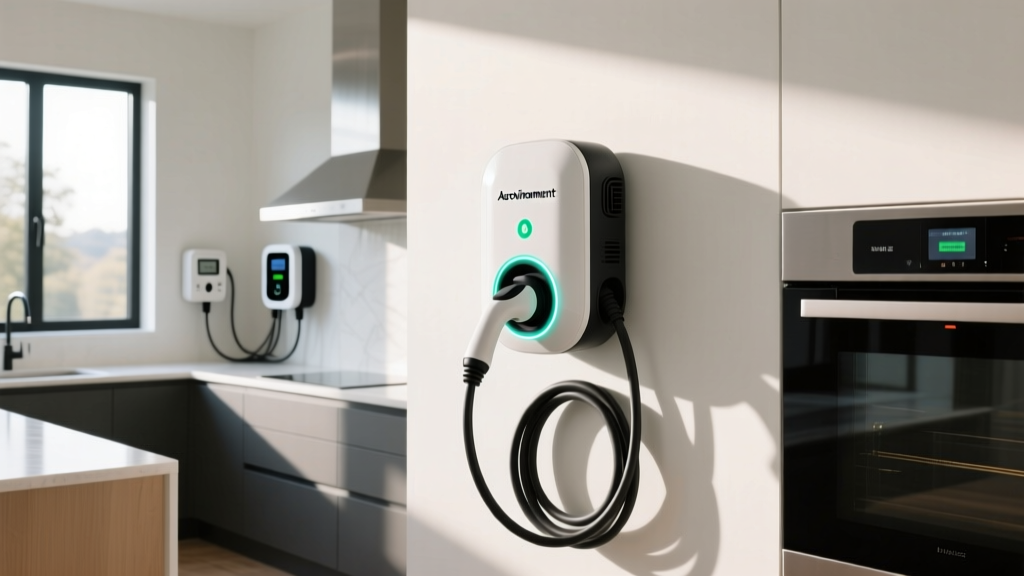
AeroVironment's residential portfolio centers on the HomeSmart EVSE series. Here's how the current models stack up:
AeroVironment HomeSmart (40A)
- Power Output: 9.6 kW (240V / 40A)
- Connector: J1772 (NACS adapter required for Tesla-protocol vehicles)
- Cable Length: 18 feet
- Smart Features: Wi-Fi enabled, app scheduling, energy monitoring, utility demand-response compatible
- Indoor/Outdoor: NEMA 4 rated (outdoor-safe)
- Price: $549–$649 MSRP
AeroVironment HomeSmart (32A)
- Power Output: 7.7 kW (240V / 32A)
- Connector: J1772
- Cable Length: 18 feet
- Smart Features: Wi-Fi, app control, load management
- Indoor/Outdoor: NEMA 4 rated
- Price: $449–$529 MSRP
Both units include a 3-year warranty. The 40A model is the better pick for EVs with onboard chargers rated at 11.5 kW or higher (such as the Ford F-150 Lightning Extended Range, Rivian R1S, and Tesla Model Y) — it won't bottleneck their acceptance rate. The 32A version suffices for vehicles like the Hyundai Ioniq 5 (10.9 kW onboard) and Chevrolet Equinox EV (11.5 kW onboard), though you'll leave a small amount of speed on the table.
Home Installation: Electrical Requirements, Permits, and Total Cost
The charger itself is only part of the expense. Professional installation typically matches or exceeds the equipment cost, especially in older homes.
Electrical Requirements
A 40A AeroVironment charger requires a dedicated 50A, 240V circuit (the National Electrical Code mandates that continuous loads use only 80% of a breaker's rated capacity — so 40A continuous needs a 50A breaker). The circuit runs from your main panel to the charger location using 6 AWG copper wire for runs under 50 feet, or 4 AWG for longer distances.
Does Your Panel Need an Upgrade?
Homes with a 100A main service panel often lack the spare capacity for a 50A dedicated circuit, especially if you already have electric ranges, dryers, or HVAC systems. Upgrading to a 200A panel costs $1,500–$3,000. Some homeowners avoid this by using a smart load-management device (such as the Emporia Smart Load Center or Span panel integration) that dynamically shares capacity between the EV charger and other appliances — this can cost $300–$800 additional but avoids a full panel swap.
| Item | Low Estimate | High Estimate | Notes |
|---|---|---|---|
| AeroVironment HomeSmart 40A charger | $549 | $649 | Direct or through authorized dealers |
| Electrician labor (2–5 hours) | $300 | $900 | Varies by region, run length, conduit needs |
| Materials (wire, conduit, breaker) | $100 | $400 | 6 AWG copper, PVC/EMT conduit |
| Permit fee | $50 | $250 | Required in most jurisdictions |
| Panel upgrade (if needed) | $1,500 | $3,000 | 100A → 200A service upgrade |
| Total (no panel upgrade) | $999 | $2,199 | Typical for modern 200A homes |
| Total (with panel upgrade) | $2,499 | $5,199 | Older homes with 100A service |
Always hire a licensed electrician and pull a permit. Unpermitted work can void home insurance coverage and create fire risk. The NEC requires a GFCI breaker for any outlet-installed EVSE; hardwired units (which the HomeSmart supports) are exempt from this requirement in many jurisdictions but check local code.
Connector Compatibility: NACS, CCS1, and What Your EV Needs
The connector landscape shifted dramatically between 2023 and 2026. Here's how the AeroVironment HomeSmart fits in:
| Connector | Standard On | Compatible with AeroVironment HomeSmart? |
|---|---|---|
| J1772 | 2011–2024 non-Tesla EVs (Leaf, Bolt, Ioniq 5 pre-2026, Mach-E pre-2025) | Yes — native plug |
| NACS (Tesla plug) | All Teslas; 2025+ Ford, GM, Rivian, Hyundai, Kia, Volvo, BMW, and most others | Yes — with a J1772-to-NACS adapter (~$150–$250) |
| CCS1 | Legacy DC fast-charge standard (phasing out for new vehicles) | N/A — CCS1 is for DC fast charging, not Level 2 AC |
| CHAdeMO | Nissan Leaf (DC fast charge only) | N/A — DC fast-charge connector |
If you're buying a 2026 model-year EV, it almost certainly uses the NACS connector natively. AeroVironment has not released a native NACS-terminated HomeSmart as of early 2026, so you'll need a quality adapter (Tesla's official J1772-to-NACS adapter or a third-party equivalent rated for 48A+). Alternatively, consider a charger with a native NACS plug from ChargePoint, Wallbox, or Emporia — see the comparison below.
Charging Time Examples: 10–80% for Common Battery Sizes
Charging speed isn't linear. Batteries accept peak power up to roughly 50–60% State of Charge (SoC), then taper significantly. Here are realistic 10–80% times on the AeroVironment HomeSmart 40A (9.6 kW):
| Vehicle (2026 MY) | Battery (kWh usable) | Onboard Charger | 10–80% Time (9.6 kW) | EPA Range |
|---|---|---|---|---|
| Tesla Model Y Long Range | 75 kWh | 11.5 kW | ~5 hrs 30 min | 330 mi |
| Hyundai Ioniq 5 (84 kWh) | 80.5 kWh | 10.9 kW | ~6 hrs 00 min | 310 mi |
| Ford F-150 Lightning Ext. Range | 123 kWh | 19.2 kW | ~9 hrs 15 min | 320 mi |
| Chevrolet Equinox EV 3RS | 85 kWh | 11.5 kW | ~6 hrs 15 min | 315 mi |
| BMW iX xDrive50 | 105.2 kWh | 11 kW | ~7 hrs 45 min | 310 mi |
These times assume the vehicle's onboard charger can accept the full 9.6 kW. The F-150 Lightning's 19.2 kW onboard charger could charge faster on an 80A circuit (19.2 kW), cutting that time to under 5 hours.
Cost to Charge: Home vs. Public vs. Gas per Mile
Home Level 2 charging remains dramatically cheaper than public DC fast charging or gasoline. Here's a realistic breakdown based on 2026 national averages:
| Scenario | $/kWh | Cost to Add 200 mi* | Cost Per Mile |
|---|---|---|---|
| Home Level 2 (off-peak utility rate) | $0.09–$0.14 | $4.50–$7.00 | $0.023–$0.035 |
| Home Level 2 (standard rate, no TOU) | $0.15–$0.20 | $7.50–$10.00 | $0.038–$0.050 |
| Public Level 2 (ChargePoint, EVgo L2) | $0.25–$0.49 | $12.50–$24.50 | $0.063–$0.123 |
| DC Fast Charge (Electrify America, Tesla Supercharger) | $0.35–$0.65 | $17.50–$32.50 | $0.088–$0.163 |
| Gasoline vehicle (28 MPG avg, $3.30/gal) | — | $23.57 | $0.118 |
*Assumes 3.0 mi/kWh efficiency (typical for a mid-size crossover EV like the Model Y or Ioniq 5). Actual varies by vehicle, terrain, and temperature.
At off-peak home rates, charging an EV costs roughly one-quarter to one-third the per-mile cost of gasoline. Even at peak public DC fast-charging rates, EVs often match or beat gas on a per-mile basis. Source: fueleconomy.gov efficiency data and EIA electricity rate surveys.
AeroVironment vs. Top 2026 Alternatives
The AeroVironment HomeSmart is competent but faces stiff competition. Here's how it compares:
| Charger | Max Power | Connector | Smart Features | Price (2026) |
|---|---|---|---|---|
| AeroVironment HomeSmart 40A | 9.6 kW | J1772 | Wi-Fi, app, scheduling, utility DR | $549–$649 |
| ChargePoint Home Flex (48A) | 11.5 kW | J1772 or NACS | Wi-Fi, app, Alexa, load sharing | $599–$699 |
| Emporia Vue Smart EV Charger (48A) | 11.5 kW | J1772 or NACS | Wi-Fi, solar integration, energy panel | $399–$499 |
| Wallbox Pulsar Plus (48A) | 11.5 kW | J1772 or NACS | Wi-Fi, Bluetooth, app, Power Sharing | $549–$649 |
| Tesla Wall Connector (48A) | 11.5 kW | NACS | Wi-Fi, OTA updates, load sharing | $425 |
The Emporia Vue Smart EV Charger offers the best value at under $500 with 48A output and solar-aware scheduling — ideal if you have rooftop panels. The ChargePoint Home Flex remains the best overall pick for its NACS-native option and robust app ecosystem. The Tesla Wall Connector is the cheapest 48A option but only works with NACS vehicles (no J1772 adapter included).
The AeroVironment HomeSmart holds its own on build quality and utility demand-response features (valuable if your utility offers time-of-use rebates), but its 40A max and J1772-only termination put it a step behind competitors in 2026.
Safety, Code, and Maintenance Considerations
Proper installation protects your home and your vehicle:
- Dedicated circuit: The EVSE must have its own breaker — never share a circuit with other high-draw appliances.
- GFCI protection: NEC 2023/2026 requires GFCI for plug-in (NEMA 14-50) installations. Hardwired installations may be exempt depending on jurisdiction.
- Outdoor rating: The HomeSmart's NEMA 4 enclosure handles rain and dust. For coastal or high-humidity areas, confirm the unit's corrosion resistance.
- Cable management: Use a wall-mounted holster or retractable reel to prevent trip hazards and cable damage.
- Firmware updates: Keep the Wi-Fi connected so AV can push safety and performance updates.
- UL listing: The HomeSmart is UL-listed. Avoid non-UL-certified chargers from overseas marketplaces — they may lack overcurrent and ground-fault protection.
Frequently Asked Questions
How much does it cost to install a home EV charger?
Expect $999–$2,199 total for an AeroVironment HomeSmart 40A in a home with an existing 200A panel. This includes the charger ($549–$649), electrician labor ($300–$900), materials ($100–$400), and permit ($50–$250). Homes needing a panel upgrade to 200A should budget an additional $1,500–$3,000.
How fast will each charging level add range?
Level 1 (120V) adds 3–5 miles per hour. Level 2 at 9.6 kW (40A) adds roughly 30–35 miles per hour for a typical crossover EV. DC fast charging at 150+ kW can add 150–250 miles in 20–30 minutes, depending on battery size and charge-curve taper.
Which connector and charger is compatible with my EV?
Check your vehicle's charge port. Pre-2025 non-Tesla EVs use J1772 for Level 2. Most 2025–2026 EVs from Ford, GM, Hyundai, Kia, Rivian, and others have switched to NACS (Tesla's plug). The AeroVironment HomeSmart ships with J1772; you'll need a J1772-to-NACS adapter (~$150–$250) for NACS-equipped vehicles.
How much does charging cost per mile vs gas?
Home Level 2 charging at off-peak rates costs $0.023–$0.035 per mile — roughly one-quarter the cost of a 28 MPG gasoline vehicle at $3.30/gallon ($0.118/mile). Even public DC fast charging at $0.35–$0.65/kWh ($0.088–$0.163/mile) is competitive with gas.
What electrical upgrades might I need?
A 40A charger needs a dedicated 50A, 240V breaker. If your panel is 100A or has few spare slots, you may need a 200A service upgrade ($1,500–$3,000). A licensed electrician can perform a load calculation per NEC Article 220 to determine if your panel has capacity. Smart load-management devices offer a lower-cost alternative in some cases.
Does the AeroVironment HomeSmart qualify for any tax credits?
The federal Alternative Fuel Vehicle Refueling Property Credit (§30C) covers up to 30% of home charger equipment and installation costs, capped at $1,000. Eligibility depends on your census tract meeting certain low-income or non-urban criteria. Check the IRS §30C page and consult a tax professional for your specific situation.
Verdict: Is the AeroVironment HomeSmart Right for You?
The AeroVironment HomeSmart 40A is a reliable, well-built Level 2 charger with solid utility-integration features. It's a sensible pick if your utility partners with AV for demand-response programs or if you already own a J1772-equipped EV. However, for 2026 EV buyers with NACS-port vehicles, the lack of a native NACS plug and the 40A ceiling (vs. competitors' 48A) make the ChargePoint Home Flex or Emporia Vue Smart EV Charger stronger choices at similar or lower prices. If you do choose the HomeSmart, budget for a quality J1772-to-NACS adapter and confirm your electrical panel has capacity before scheduling the electrician.