Trading the Eaton Supercharger for Electrons: What Changes
If you've spent years listening to the whine of an Eaton M90 supercharger on a 3.8L V6 in a 1999 Pontiac Grand Prix GTP, the jump to an electric vehicle is a shift in every measurable way. The 3800 Series II engine made 240 horsepower and roughly 280 lb-ft of torque, returned about 18 MPG combined per fueleconomy.gov, and needed a $45-$60 fill-up every 350 miles. An EV replaces the gas station with electrons — but only if your home electrical system can deliver them reliably.
This guide is built for drivers making that exact transition. We cover the three charging levels with real numbers (kW, miles per hour, cost), what your home's electrical panel actually needs, which connector your new EV will use, and what it all costs compared to premium fuel in the Grand Prix's tank.
The Three Charging Levels: Speed, Power, and Real-World Range Added
EV charging breaks into three tiers. The critical distinction: kW (kilowatts) measures power — how fast energy flows into the battery. kWh (kilowatt-hours) measures energy — the total capacity stored, like gallons in a tank. Never confuse them.
| Level | Voltage | Max Power (kW) | Miles of Range Per Hour | Best For |
|---|---|---|---|---|
| Level 1 | 120V (standard outlet) | 1.0–1.4 kW | 3–5 mi/hr | Overnight top-ups, PHEVs, low-mileage days |
| Level 2 | 240V (dryer-style circuit) | 7.2–19.2 kW | 25–70 mi/hr | Daily home charging, full overnight replenishment |
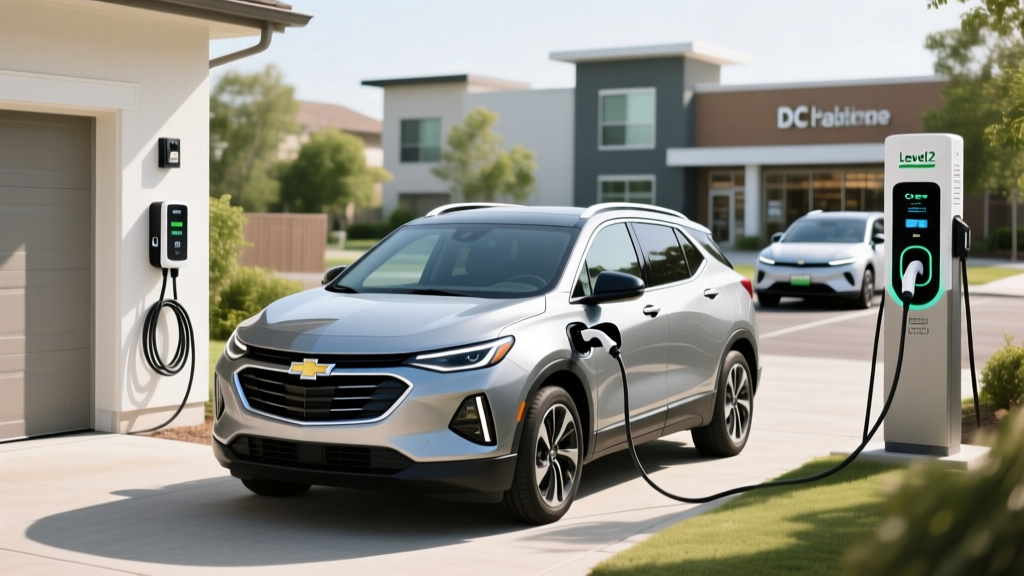
| DC Fast Charging | 400V–800V DC | 50–350 kW | 150–1,200+ mi/hr (peak) | Road trips, quick stops at public stations |
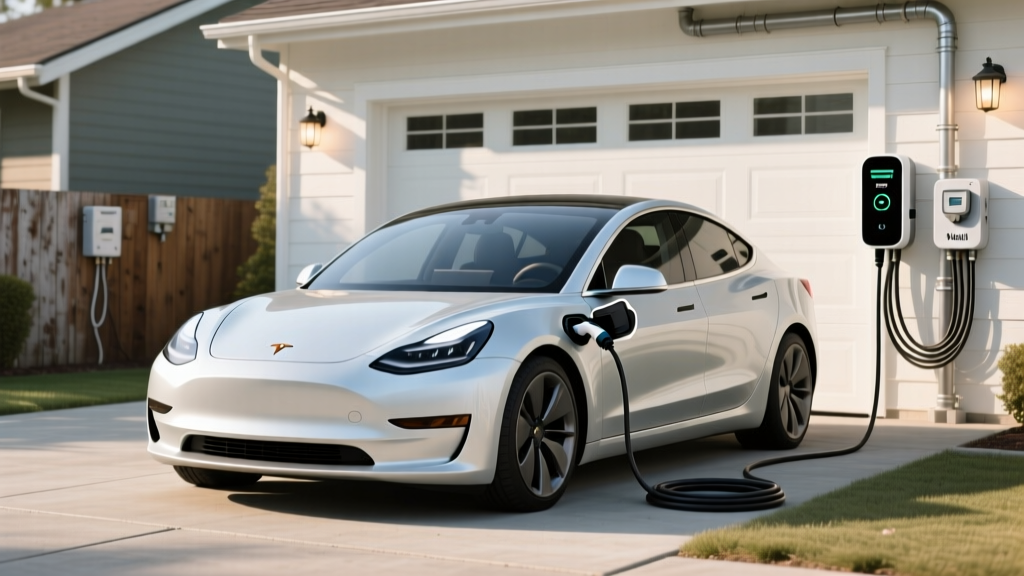
A Level 1 outlet adds roughly 40 miles overnight (10 hours). That works for a plug-in hybrid with a 12-15 kWh battery but will take over two days to refill a 75 kWh EV battery. Level 2 at 240V is the home-charging standard — it fills most EV batteries in 6-10 hours, matching a sleep cycle. DC fast charging is for public use and road trips; you won't install it at home.
Home Installation: What Your Electrical Panel Actually Needs
This is where the '99 Grand Prix owner hits a real wall. Your house was wired for lights, a stove, a dryer, and maybe central AC. Adding a Level 2 charger is like adding another major appliance — and your panel may not have the headroom.
Voltage, Amperage, and Circuit Requirements
A typical Level 2 home charger runs on a 240V circuit at 40 amps, delivering 9.6 kW of continuous power. By National Electrical Code (NEC), continuous loads must be derated to 80% of the circuit breaker rating, so a 40A charger requires a 50A breaker. Higher-output chargers (48A, 11.5 kW) need a 60A breaker.
Will You Need a Panel Upgrade?
Homes built before 2000 — the era when your Grand Prix GTP rolled off the Fairfax, Kansas assembly line — commonly have 100A or 150A service panels. If your panel is already running electric heat, a dryer, a water heater, and central AC, a load calculation by a licensed electrician may show you're near capacity. A panel upgrade to 200A service typically costs $1,500-$3,500 before the charger circuit is even run. This is the single biggest variable in home charging cost and the one most online guides gloss over.
| Cost Component | Typical Range | Notes |
|---|---|---|
| Level 2 Charger (Equipment) | $350 – $700 | Smart Wi-Fi-enabled units; basic models from $250 |
| Electrician Labor (circuit + outlet) | $500 – $1,500 | Depends on run distance from panel to garage |
| Permit & Inspection | $50 – $300 | Varies by municipality; required for code compliance |
| Panel Upgrade (if needed) | $1,500 – $3,500 | 100A→200A service; older homes often need this |
| Total (no panel upgrade) | $900 – $2,500 | Most common scenario for 2000s-era or newer homes |
| Total (with panel upgrade) | $2,400 – $6,000 | Common for pre-2000 homes with 100A service |
Always hire a licensed electrician and pull a permit. Unpermitted work can void your homeowner's insurance and create fire risk. The NEC requires a dedicated circuit for EV charging — sharing with other appliances is a code violation.
Connector Compatibility: NACS, CCS1, and CHAdeMO Explained
The plug that connects your charger to the car matters enormously, and the landscape has shifted dramatically. As of the 2025-2026 model years, nearly every automaker has adopted the NACS (North American Charging Standard) connector, originally developed by Tesla. Here's the current state:
| Connector | Brands Using It (2026 Models) | Adapter Needed? |
|---|---|---|
| NACS (Tesla-style) | Tesla, Ford, GM, Rivian, Hyundai, Kia, BMW, Mercedes, Volvo, Polestar, most others | No — native on most new EVs |
| CCS1 (Combo) | Legacy models (pre-2025 VW ID.4, some Stellantis); still on Electrify America stations | NACS-to-CCS adapters available (~$150-$250) |
| CHAdeMO | Nissan Leaf (discontinued), Mitsubishi Outlander PHEV (legacy) | Increasingly rare at public stations |
If you're buying a 2025 or 2026 EV, it almost certainly has a NACS port. Buy a NACS Level 2 home charger. If you own a slightly older EV with CCS1, you can either buy a CCS1 charger or use a manufacturer-approved adapter. Check your vehicle's manual before using any third-party adapter.
Cost to Charge Per Mile vs. Your Grand Prix GTP's Gas Bill
The 1999 Grand Prix GTP required premium fuel (91+ octane) due to its supercharged compression ratio. At $3.80/gallon for premium and 18 MPG combined, fuel cost ran roughly $0.21 per mile. Here's how EV charging compares:
| Scenario | Rate | Cost per kWh | Cost per Mile (3.0 mi/kWh EV) |
|---|---|---|---|
| Home Off-Peak (utility time-of-use) | $0.08–$0.12/kWh | $0.10 avg | $0.033 |
| Home Standard Rate | $0.13–$0.18/kWh | $0.15 avg | $0.05 |
| Public Level 2 (ChargePoint, etc.) | $0.25–$0.49/kWh | $0.35 avg | $0.12 |
| DC Fast Charging (Electrify America, etc.) | $0.35–$0.55/kWh | $0.45 avg | $0.15 |
| 1999 Grand Prix GTP (premium gas) | $3.80/gal, 18 MPG | — | $0.21 |
Even at the most expensive DC fast charger, you're spending less per mile than the supercharged 3800 V6 demanded. At home on off-peak rates, the EV costs roughly one-sixth what the Grand Prix costs per mile. Over 15,000 miles per year, that's a savings of approximately $2,600-$3,100 annually on energy alone.
For current federal incentive information on EV purchases, including the §30D tax credit with income caps, MSRP limits, and battery-sourcing requirements, refer to the IRS clean vehicle credits page. Eligibility rules change and vary by buyer.
Charging Time Examples: What to Expect with Common Battery Sizes
Charging time depends on battery capacity (kWh) and the charger's power output (kW). Most EVs taper charge speed above 80% State of Charge to protect battery health, so the 10-80% window is the practical metric.
| Battery Size | Example Vehicles | Level 2 (9.6 kW) 10-80% | DC Fast (150 kW) 10-80% | DC Fast (350 kW) 10-80% |
|---|---|---|---|---|
| 58 kWh (usable) | VW ID.4 Standard, base Hyundai Ioniq 5 | ~4 hr 30 min | ~22 min | ~18 min |
| 75 kWh (usable) | Tesla Model Y Long Range, Ford Mustang Mach-E Extended | ~5 hr 45 min | ~28 min | ~22 min |
| 85–100 kWh (usable) | Tesla Model S, Rivian R1S, Chevy Silverado EV | ~7 hr | ~35 min | ~25 min |
Real-world DC fast charging rarely sustains peak rates. A vehicle rated for 250 kW peak may average 130-170 kW across the 10-80% session due to the charge curve taper, battery temperature, and ambient conditions. Cold weather (below 40°F) can extend these times by 20-40% unless the vehicle has active battery preconditioning — a feature that warms the pack before you arrive at the charger. Always enable navigation-based preconditioning if your EV supports it.
Equipment Picks: Level 2 Chargers That Earn Our Recommendation
We evaluate chargers on power output, cable length, smart features, connector type, build quality, and price. Here are three that cover different needs:
Emporia Vue Smart EV Charger
- Power: 48A / 11.5 kW (requires 60A breaker)
- Connector: NACS (also available in J1772)
- Cable: 24 ft
- Smart features: Wi-Fi, app scheduling, energy monitoring, solar integration
- Price: ~$399
- Best for: Budget-conscious buyers wanting full smart features and max Level 2 speed
ChargePoint Home Flex
- Power: Configurable 16A–50A / up to 12 kW (adjustable to your circuit)
- Connector: NACS or J1772 (swappable plug)
- Cable: 23 ft
- Smart features: Wi-Fi, app scheduling, Alexa/Google Home, flexible amperage
- Price: ~$549
- Best for: Homes with limited panel capacity — can be set to 32A (40A breaker) and upgraded later
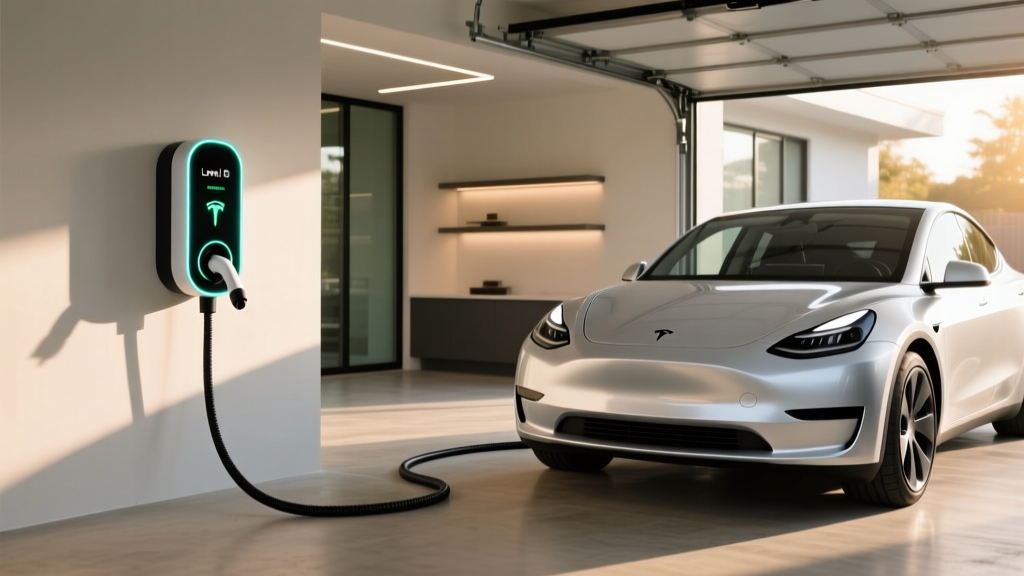
Tesla Wall Connector
- Power: 48A / 11.5 kW (requires 60A breaker)
- Connector: NACS native (also includes J1772 adapter in box for 2025+ models)
- Cable: 24 ft
- Smart features: Wi-Fi, power sharing (daisy-chain two units on one circuit), OTA updates
- Price: ~$475
- Best for: Tesla and NACS-vehicle owners wanting a clean, reliable wall-mounted unit
Safety, Code, and Installation Non-Negotiables
EV charging draws sustained high current for hours — this is not the same duty cycle as a toaster. Safety requirements are strict for good reason:
- Dedicated circuit: Your Level 2 charger must have its own breaker. No sharing with the dryer or workshop outlets.
- GFCI protection: NEC 2020 and later require GFCI (Ground Fault Circuit Interrupter) protection for all EV charging outlets, especially outdoors. Many modern chargers have built-in GFCI; verify with your electrician.
- Outdoor rating: If your charger is mounted outside or in an unenclosed carport, it must carry a NEMA 4 (weatherproof) rating. Indoor garage units with NEMA 3R are acceptable in most jurisdictions.
- Wire gauge: A 50A circuit requires 6 AWG copper wire; a 60A circuit requires 6 AWG or 4 AWG depending on run length. Your electrician will calculate this.
- Permit and inspection: Required in virtually all US jurisdictions. Unpermitted electrical work can void insurance claims and create liability.
For installation standards and safety requirements, reference NFPA's National Electrical Code resources.
Frequently Asked Questions
How much does it cost to install a home EV charger?
Expect $900-$2,500 for a standard Level 2 installation (charger, electrician, permit) if your panel has capacity. If your home needs a 200A panel upgrade — common in pre-2000 homes — total cost rises to $2,400-$6,000. Always get a load calculation from a licensed electrician before committing.
How fast will each charging level add range?
Level 1 (120V): 3-5 miles per hour. Level 2 (240V, 9.6 kW): 30-40 miles per hour for most EVs. DC Fast Charging: 150-1,200+ miles per hour at peak, though real sessions average much less due to charge curve taper. For daily driving of 30-50 miles, Level 2 replenishes overnight with hours to spare.
Which connector/charger is compatible with my EV?
For 2025-2026 model-year EVs, NACS is the dominant standard — Ford, GM, Hyundai, Kia, Rivian, BMW, and Tesla all use it. Older CCS1 vehicles can use adapters. CHAdeMO is effectively discontinued for new vehicles. Check your owner's manual for the specific connector type before purchasing a charger.
How much does charging cost per mile vs. gas?
Home charging at $0.10-$0.15/kWh costs $0.03-$0.05 per mile for a typical EV averaging 3.0 miles per kWh. Compare that to the '99 Grand Prix GTP at roughly $0.21/mile on premium. Even public DC fast charging at $0.45/kWh comes in around $0.15/mile — still cheaper than the supercharged 3800 V6.
What electrical upgrades might I need?
The most common upgrade is a 50A or 60A dedicated 240V circuit from your panel to the garage. If your panel lacks capacity (common in homes with 100A service and existing electric appliances), a panel upgrade to 200A service costs $1,500-$3,500. Some utilities offer rebates or time-of-use rate plans that partially offset these costs — check with your local provider.
Can I just use a regular 120V outlet?
Yes, but Level 1 charging adds only 3-5 miles per hour. If you drive 40+ miles daily, Level 1 won't keep up. It works well for plug-in hybrids with small batteries or EV drivers with very short commutes. For most BEV owners, Level 2 is the practical minimum for stress-free daily charging.
Does fast charging damage my battery?
Modern EVs have sophisticated thermal management that limits DC fast charging to protect battery health. Occasional fast charging has minimal impact. For daily use, Level 2 home charging at moderate rates is gentler on the battery. Most manufacturers warranty the battery for 8 years/100,000 miles with a 70% capacity retention threshold — see your specific warranty terms.