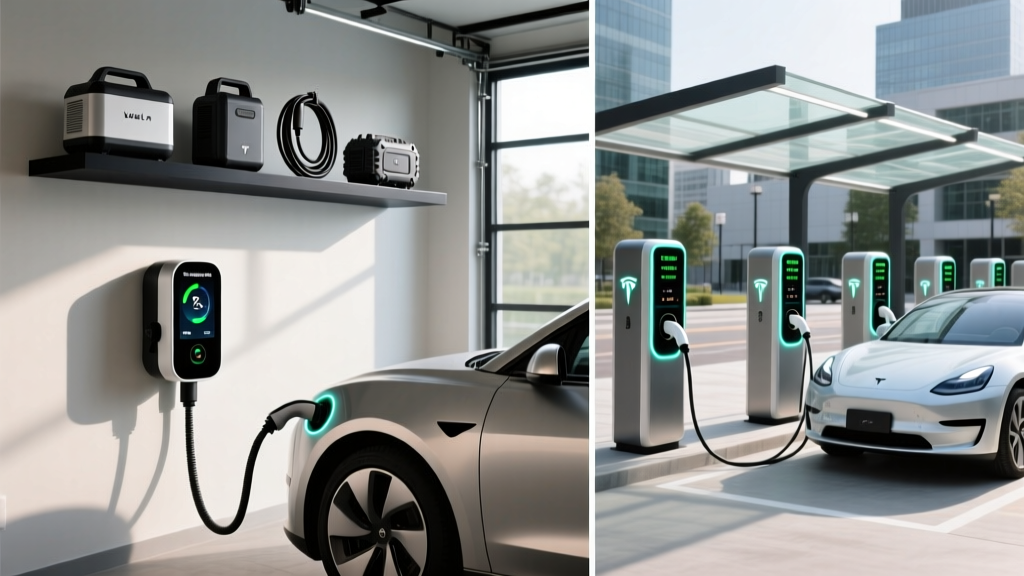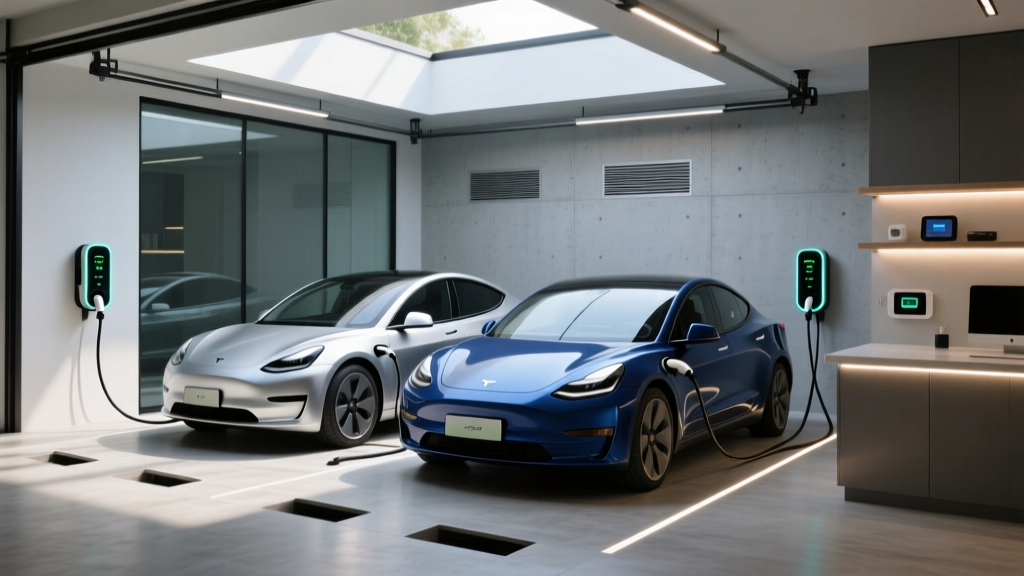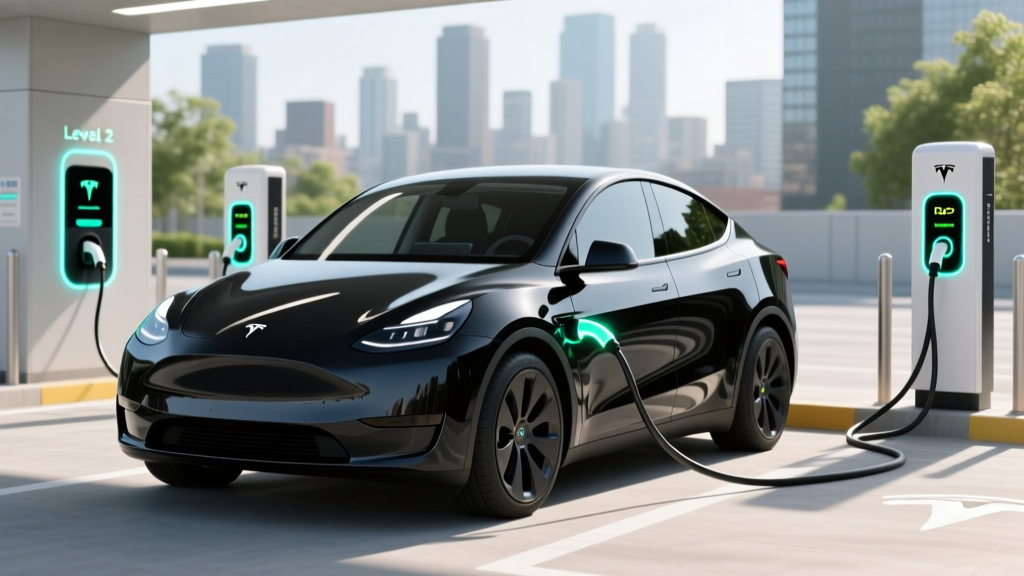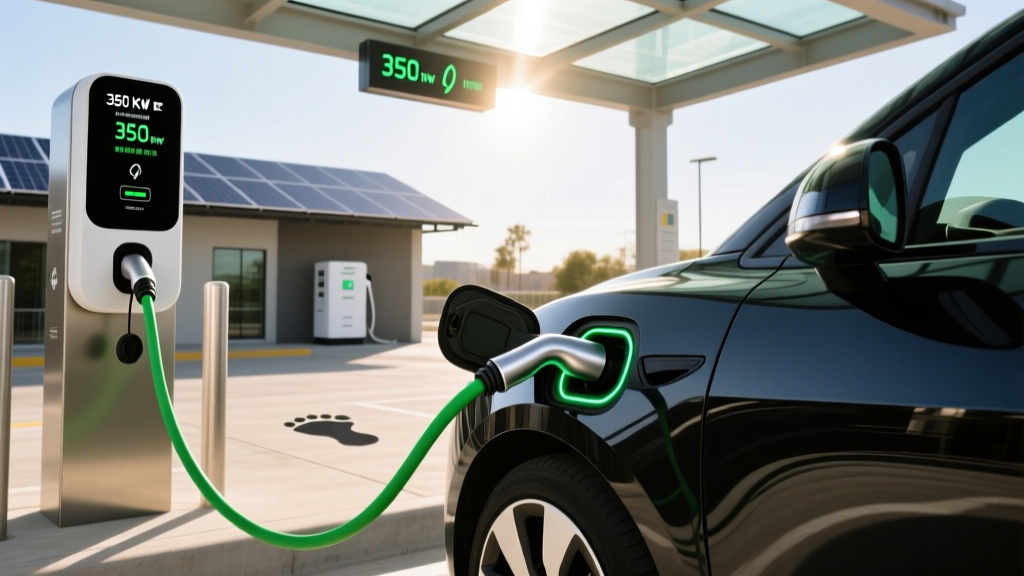
Ultra-fast 350 kW DC charging is the headline spec on public fast-charging networks, but very few EVs can actually accept that full power delivery. Understanding what 350 kW means for your specific vehicle, how it compares to Level 2 home charging, and what your total charging costs look like is essential before plugging in or investing in home equipment.
Understanding 350 kW Charging and Real-World Speeds
The "350 kW" figure refers to the maximum power output of the DC fast charger itself, not what your vehicle will necessarily receive. Your EV's onboard battery management system (BMS) dictates the actual charge rate based on battery chemistry, temperature, state of charge (SoC), and the vehicle's peak acceptance rate.
kW (kilowatts) is power — how fast energy flows, like water pressure from a hose. kWh (kilowatt-hours) is energy — how much is stored or delivered, like gallons in a tank. A 350 kW charger can theoretically deliver 350 kWh in one hour, but your 75 kWh battery won't be charging anywhere near that long or rate.
Here's what peak acceptance rates look like for popular 2026 EVs at a 350 kW station:
| Vehicle (2026) | Battery (kWh usable) | Peak Acceptance Rate | 10-80% Time (est.) | Miles Added in 15 min |
|---|---|---|---|---|
| Hyundai Ioniq 5 N | 84 kWh (NMC) | ~240 kW | ~18 min | ~150 mi |
| Porsche Taycan (Performance Battery Plus) | 93.4 kWh (NMC) | ~320 kW | ~16 min | ~170 mi |
| Chevrolet Silverado EV | 200+ kWh (NMC) | ~350 kW | ~20 min | ~160 mi |
| Tesla Model 3 Long Range | 75 kWh (NMC) | ~250 kW | ~22 min | ~175 mi |
| Ford Mustang Mach-E GT | 91 kWh (NMC) | ~150 kW | ~32 min | ~90 mi |
The charging curve reality: Peak kW is only sustained for a portion of the session. Most EVs charge fastest between 10-50% SoC, then taper significantly. A vehicle rated for 240 kW peak may only sustain that rate for 5-8 minutes before stepping down to 150 kW, then 100 kW, then 50 kW as it approaches 80%. This is why 10-80% time is a more useful metric than peak kW alone.
Charging Levels: Speed Comparison
Whether you're charging at home or on the road, understanding the three charging levels helps set accurate expectations:
| Level | Power (kW) | Voltage/Amps | Miles of Range Per Hour | Typical Use Case |
|---|---|---|---|---|
| Level 1 | 1.4 - 1.9 kW | 120V / 12-16A | 3-5 mi/hr | Overnight trickle, PHEVs |
| Level 2 | 3.3 - 19.2 kW | 240V / 16-80A | 12-60 mi/hr | Home daily charging |
| DC Fast (50 kW) | 50 kW | 200-920V DC | 100-150 mi/hr | Public road-trip charging |
| DC Fast (150 kW) | 150 kW | 200-920V DC | 200-400 mi/hr | Public highway corridors |
| DC Fast (350 kW) | Up to 350 kW | 200-920V DC | 300-600+ mi/hr (peak) | Ultra-fast highway hubs |
For context, a 75 kWh battery charged at 11.5 kW (a common 48A Level 2 home charger) will go from 10% to 80% in about 5.5 hours — perfect for overnight. That same battery at a sustained 150 kW DC rate would take roughly 25 minutes for the same range gain.
Connector Compatibility: NACS, CCS, and CHAdeMO
The connector landscape has shifted dramatically. Tesla's North American Charging Standard (NACS) is now the dominant connector in North America, with most major automakers adopting it for 2025+ models.
| Connector | DC Fast Capable? | Brands Using It | Adapter Needed? |
|---|---|---|---|
| NACS (Tesla) | Yes (up to 350 kW at Superchargers) | Tesla, Ford, GM, Rivian, Volvo, Polestar, Hyundai/Kia (2025+), most 2026 models | CCS-to-NACS adapter for non-Tesla CCS stations |
| CCS1 (Combined) | Yes (up to 350 kW) | Legacy models, some 2024-2025 VW/ID.4, BMW iX, older EVs | NACS-to-CCS adapter for Tesla Superchargers |
| CHAdeMO | Yes (up to 100 kW typical) | Nissan Leaf (legacy), Mitsubishi Outlander PHEV | No adapter; network support declining |
Key takeaway for 2026 buyers: If you're purchasing a new EV, it almost certainly has NACS. This means access to Tesla Supercharger stations (over 25,000 stalls in North America) plus Electrify America and other networks via CCS-to-NACS adapters. Verify your vehicle's connector before purchasing home equipment.
Home Level 2 Charger Installation: Costs and Electrical Requirements
A Level 2 home charger is where most daily charging happens. Here's what installation actually requires and costs:
Electrical requirements: A typical 48A Level 2 charger requires a dedicated 60A circuit at 240V (the National Electrical Code requires circuits to be rated at 125% of continuous load — so 48A × 1.25 = 60A breaker). This uses 6 AWG copper wire for runs under 50 feet, or 4 AWG for longer runs.
| Component | Low Estimate | High Estimate | Notes |
|---|---|---|---|
| Level 2 charger (hardware) | $400 | $750 | Smart WiFi chargers, 40-48A |
| Electrician labor | $500 | $2,000 | Varies by run length, wall type |
| Permit and inspection | $50 | $300 | Required in most jurisdictions |
| Electrical panel upgrade (if needed) | $1,500 | $4,000 | Older 100A panels often need 200A upgrade |
| Total (no panel upgrade) | $950 | $3,050 | Most common scenario for modern homes |
| Total (with panel upgrade) | $2,450 | $7,050 | Common for pre-1990 homes |
Panel upgrade reality: If your home has a 100A electrical panel (common in homes built before 1990), adding a 60A EV circuit may exceed your panel's capacity, especially if you already have electric appliances (dryer, oven, HVAC). A licensed electrician will perform a load calculation per NEC Article 220. Many older homes need a 200A panel upgrade before adding a high-amperage EV charger. Budget accordingly — this is the single biggest variable in installation cost.
Safety and code requirements: Your installation must include a dedicated circuit (not shared with other appliances), GFCI protection (required for outdoor outlets and garages in most jurisdictions per NEC 2023+), and proper weatherproofing for outdoor installations (NEMA 4-rated enclosures). The charger must be hardwired or use a NEMA 14-50 receptacle installed with proper torque specifications — loose 14-50 outlets are a documented fire risk.
Recommended Home Level 2 Chargers
Based on reliability, smart features, and value for 2026 installations:
Emporia Vue Level 2 EV Charger
- Power: 48A (11.5 kW) at 240V
- Connector: NACS (J1772 adapter included)
- Cable length: 24 ft
- Smart features: WiFi, energy monitoring via Emporia app, solar integration, scheduled charging
- Price: ~$400
- Best for: Budget-conscious buyers who want full smart features and solar pairing
ChargePoint Home Flex
- Power: Up to 50A (12 kW) adjustable at 240V
- Connector: NACS or J1772 (select at purchase)
- Cable length: 23 ft
- Smart features: WiFi, Alexa integration, scheduling, charging history, works with utility demand-response programs
- Price: ~$550
- Best for: Flexibility to adjust amperage for older electrical panels
Wall Connector (Tesla, 3rd Gen)
- Power: 48A (11.5 kW) at 240V
- Connector: NACS native
- Cable length: 24 ft
- Smart features: WiFi, OTA updates, power sharing (link up to 6 units on one circuit), Tesla app integration
- Price: ~$475
- Best for: Tesla owners and multi-EV households
Charging Cost: Home vs. Public vs. Gas
The cost per mile of driving varies enormously depending on where and how you charge:
| Scenario | Cost per kWh | Vehicle Efficiency | Cost Per Mile |
|---|---|---|---|
| Home Level 2 (off-peak utility rate) | $0.08 - $0.14 | 3.5 mi/kWh (avg EV) | $0.023 - $0.040 |
| Home Level 2 (standard rate) | $0.14 - $0.20 | 3.5 mi/kWh | $0.040 - $0.057 |
| Public Level 2 (workplace/mall) | $0.20 - $0.35 | 3.5 mi/kWh | $0.057 - $0.100 |
| DC Fast Charging (350 kW station) | $0.35 - $0.55 | 3.5 mi/kWh | $0.100 - $0.157 |
| Gas car (28 MPG combined, $3.40/gal) | — | 28 mi/gal | $0.121 |
| Gas car (28 MPG combined, $4.00/gal) | — | 28 mi/gal | $0.143 |
The economics: Home charging on an off-peak rate delivers fuel costs roughly 70-80% lower than gasoline. Even at peak DC fast-charging rates ($0.48/kWh), the per-mile cost is comparable to or slightly below gas at $3.50/gallon. The savings multiply if you have rooftop solar, where marginal charging cost can drop to nearly zero after system payback.
However, if you rely exclusively on public DC fast charging at $0.45+/kWh, your per-mile cost can exceed that of an efficient hybrid. Home charging access remains the single biggest factor in EV ownership economics. Per fueleconomy.gov, the average EV achieves 97-130 MPGe combined, translating to roughly 3.0-4.0 miles per kWh.
Charging Time Examples for Common Battery Sizes
To make 350 kW charging speeds tangible, here are estimated 10-80% charging times across different scenarios:
| Battery Size (kWh usable) | Level 2 Home (11.5 kW) | DC Fast 50 kW | DC Fast 150 kW | DC Fast 350 kW (vehicle-limited) |
|---|---|---|---|---|
| 58 kWh (e.g., VW ID.4 Standard) | ~4 hr 20 min | ~58 min | ~24 min | ~22 min (limited to ~135 kW) |
| 75 kWh (e.g., Tesla Model 3 LR) | ~5 hr 40 min | ~75 min | ~28 min | ~22 min (limited to ~250 kW) |
| 84 kWh (e.g., Ioniq 5) | ~6 hr 20 min | ~84 min | ~30 min | ~18 min (limited to ~240 kW) |
| 100 kWh (e.g., BMW iX xDrive50) | ~7 hr 30 min | ~100 min | ~35 min | ~20 min (limited to ~200 kW) |
| 131 kWh (e.g., F-150 Lightning Extended) | ~9 hr 50 min | ~130 min | ~45 min | ~35 min (limited to ~170 kW) |
Cold-weather charging note: Battery temperatures below 50°F significantly reduce DC fast-charging speeds unless your EV has battery preconditioning. A cold 75 kWh battery at 30°F might accept only 40-60 kW at a 350 kW station until the thermal management system warms it — adding 15-25 minutes to your session. Always enable preconditioning (via your EV's navigation system routing to the charger) for 15-30 minutes before arriving.
Is 350 kW Charging Worth Seeking Out?
For road trips, yes — if your EV can accept high charge rates. The difference between a 50 kW and 350 kW station is the difference between a 75-minute stop and an 18-minute stop for the same range gain. Networks like Electrify America, EVgo, and Tesla Superchargers (V4 stalls) now offer 350 kW-capable hardware at major highway corridors.
For daily driving, Level 2 home charging at 11.5 kW remains the most practical and cost-effective solution. You plug in when you get home, wake up to a full battery every morning, and never visit a gas station or public charger for routine commuting. Reserve DC fast charging for road trips and situations where you genuinely need range quickly.
Frequently Asked Questions
How much does it cost to install a home EV charger?
A Level 2 home charger installation typically costs $950 to $3,050 when your electrical panel has sufficient capacity. The breakdown: $400-$750 for the charger hardware, $500-$2,000 for electrician labor, and $50-$300 for permits. If your home needs a 200A panel upgrade (common in pre-1990 homes), add $1,500-$4,000, bringing the total to $2,450-$7,050. Always get a load calculation from a licensed electrician before committing.
How fast will each charging level add range?
Level 1 (120V) adds 3-5 miles per hour — suitable only for PHEVs or emergency trickle charging. Level 2 (240V, 48A) adds 30-40 miles per hour and fully replenishes most EVs overnight. DC fast charging at 50 kW adds roughly 100-150 miles per hour, while 150-350 kW stations can add 200-600+ miles per hour at peak rates (though sustained rates taper as the battery fills).
Which connector/charger is compatible with my EV?
For 2025-2026 model-year EVs, NACS is the standard connector for nearly all brands (Tesla, Ford, GM, Rivian, Hyundai, Kia, Volvo, Polestar, and more). Older EVs (pre-2025) may have CCS1. The Nissan Leaf uses CHAdeMO. Check your vehicle's charge port or owner's manual. For home chargers, buy one matching your EV's native connector — or use a certified adapter.
How much does charging cost per mile vs gas?
Home charging on off-peak electricity ($0.10/kWh) costs roughly $0.03/mile — about 75% less than a 28 MPG gas car at $3.40/gallon ($0.12/mile). Even standard-rate home charging ($0.17/kWh) costs ~$0.05/mile. Public DC fast charging ($0.45/kWh) runs ~$0.13/mile, comparable to gas. The biggest savings come from consistent home charging access.
What electrical upgrades might I need?
The most common upgrade is a 200A panel replacement if your home has an older 100A service — this costs $1,500-$4,000 depending on your utility and local labor rates. You may also need: a new 240V circuit with appropriate wire gauge (6 AWG for 60A), a GFCI breaker (required for garage/outdoor installations in most jurisdictions), and in some cases, a smart panel or load-management device if your utility requires it. Homes with existing 200A+ panels and gas appliances usually need only the new circuit and charger — no panel work required.
For current federal incentive information on home charger installation, consult the IRS Residential Clean Energy Credit page — the §30C alternative fuel infrastructure credit may cover up to $1,000 of home charging equipment and installation costs, subject to income and location requirements. Always verify eligibility with a tax professional.