The 2026 Tesla Model Y Long Range AWD remains one of the most popular electric vehicles on American roads, and for good reason: an EPA-estimated 330 miles of range, access to the Supercharger network, and a usable battery capacity of approximately 75 kWh (NMC chemistry). But owning an EV is only half the equation — how you charge it determines your daily convenience, your electricity bill, and whether you ever need to visit a gas station again. This guide covers every charging scenario a Model Y Long Range AWD owner will face, from a standard 120V outlet in the garage to a 250 kW Supercharger on a cross-country road trip.
2026 Model Y Long Range AWD: Key Charging Specs at a Glance
| Specification | Value |
|---|---|
| EPA Range | 330 miles (real-world highway: ~280–300 mi; cold weather: ~240–260 mi) |
| Battery Usable Capacity | ~75 kWh (NMC chemistry) |
| Max DC Fast Charge Rate | 250 kW peak |
| 10–80% DC Fast Charge Time | ~25 minutes (at V3/V4 Supercharger) |
| Max Level 2 AC Charge Rate | 11.5 kW (48A onboard charger) |
| Connector | NACS (native Tesla) |
| EPA Efficiency | 122 MPGe combined (28 kWh/100 mi) |
| 0–60 mph | 4.8 seconds |
| Horsepower | 384 hp (dual motor AWD) |
| Base MSRP | $48,990 (before incentives) |
| Battery Warranty | 8 years / 120,000 miles (≥70% capacity retention) |
Understanding Charging Levels: How Fast Does Each Add Range?
EV charging comes in three tiers. The critical distinction: kW (kilowatts) measures the power flowing into your car at any moment — think of it as the speed of water through a hose. kWh (kilowatt-hours) measures the total energy stored in the battery — the size of the tank. A higher kW charge rate fills your kWh battery faster, but the rate tapers as the battery approaches full capacity to protect cell longevity.
| Charging Level | Voltage / Phase | Power (kW) | Miles of Range Added Per Hour | Best Use Case |
|---|---|---|---|---|
| Level 1 (Standard Outlet) | 120V / 1-phase | 1.0–1.4 kW | 3–5 mi/hr | Overnight trickle; emergency top-ups |
| Level 2 (Home / Workplace) | 240V / 1-phase | 7.2–11.5 kW | 25–44 mi/hr | Daily home charging; destination charging |
| DC Fast Charging | 400V+ DC | 50–250 kW | 150–1,000+ mi/hr (peak) | Road trips; rapid top-ups |
For the 2026 Model Y Long Range AWD, Level 1 charging on a standard household outlet adds roughly 4 miles of range per hour — enough to recover about 40 miles over a 10-hour overnight session if your daily commute is short. Level 2 at the car's maximum 11.5 kW (48 amps on a 60-amp circuit) adds approximately 44 miles per hour, meaning a full 10–80% session takes about 6 hours. DC fast charging at a V3 or V4 Tesla Supercharger peaks at 250 kW, adding up to 200 miles in roughly 15 minutes under ideal battery-temperature conditions.
Home Level 2 Installation: Electrical Requirements, Costs & Panel Upgrades
Installing a dedicated Level 2 home charger is the single highest-impact upgrade an EV owner can make. For the Model Y Long Range AWD with its 11.5 kW onboard charger, you want a 240V circuit rated for at least 60 amps to deliver the full 48 amps of continuous draw (electrical code requires circuits to be rated at 125% of continuous load).
Electrical Requirements
- Voltage: 240V single-phase (standard US residential split-phase)
- Circuit amperage: 60A breaker minimum for full 48A continuous charging
- Wire gauge: 6 AWG copper (or 4 AWG aluminum) for a 60A circuit
- Dedicated circuit: Required — the EV charger cannot share a breaker with other appliances
- GFCI protection: Required by NEC 2020+ for all EV supply equipment (built into most modern chargers)
Do You Need a Panel Upgrade?
This is the cost variable most buyers underestimate. The Model Y pulling 48A continuous represents a significant load. Homes with a 100-amp main panel almost certainly need an upgrade to 200 amps, especially if you already run electric range, dryer, and HVAC. Homes with an existing 200-amp panel usually have sufficient headroom, but a licensed electrician must perform a load calculation per NEC Article 220.
| Cost Component | Simple Install (200A panel, short run) | Complex Install (panel upgrade, long run) |
|---|---|---|
| Level 2 Charger (Equipment) | $400–$650 | $400–$650 |
| Electrician Labor | $500–$1,200 | $1,500–$3,000 |
| Permit & Inspection | $50–$200 | $100–$350 |
| Panel Upgrade (if needed) | N/A | $1,500–$3,500 |
| Conduit & Wiring (long runs) | $100–$300 | $500–$1,500 |
| Total Estimated Cost | $1,050–$2,350 | $4,000–$9,000 |
Always hire a licensed electrician and pull a permit. Unpermitted EV charger installations can void homeowners insurance claims and create fire risk. The National Electrical Code (NEC) governs all EV supply equipment installation, and local jurisdictions may have additional requirements.
Connector Compatibility: NACS, CCS, and Adapter Needs
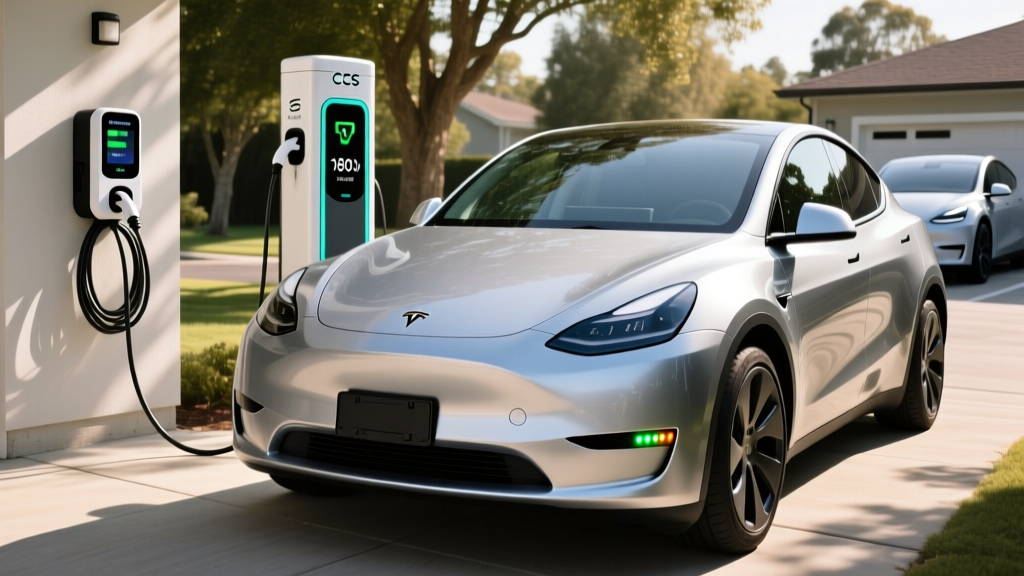
The 2026 Tesla Model Y Long Range AWD ships with a native NACS (North American Charging Standard) port — Tesla's proprietary connector, now formally adopted as SAE J3400. This is a significant advantage: you plug directly into every Tesla Supercharger and Destination Charger without an adapter.
| Connector Standard | Compatible with 2026 Model Y? | Adapter Required? | Where You'll Find It |
|---|---|---|---|
| NACS (Tesla) | Yes — native | No | Tesla Superchargers, Destination Chargers, growing third-party networks |
| CCS1 (Combined Charging System) | With adapter | Yes — Tesla CCS adapter (~$250) | Electrify America, EVgo, ChargePoint DC stations |
| CHAdeMO | With adapter (limited availability) | Yes — third-party adapter ($400+) | Older Nissan Leaf-era stations (declining network) |
| J1772 (Level 2 public) | With adapter | Yes — included with vehicle | Public Level 2 stations, workplaces, hotels |
As of 2026, most major charging networks (Electrify America, EVgo, ChargePoint) have begun adding NACS cables to new and retrofitted stations, but CCS1 connectors still dominate many existing locations. Carrying Tesla's CCS adapter in the frunk ensures access to virtually every DC fast charger in North America. The included J1772-to-NACS adapter handles all public Level 2 charging.
Cost to Charge: Home vs. Public vs. Gasoline Comparison
The economic case for the Model Y Long Range AWD hinges on charging costs versus gasoline. At its EPA-rated efficiency of 28 kWh per 100 miles, the math is straightforward once you know your local electricity rate.
| Charging Scenario | Cost per kWh | Cost per 100 Miles | Cost per Mile |
|---|---|---|---|
| Home (national avg. residential) | $0.17 | $4.76 | $0.048 |
| Home (off-peak utility rate) | $0.09 | $2.52 | $0.025 |
| Home (high-cost state, e.g., CA) | $0.30 | $8.40 | $0.084 |
| Tesla Supercharger (avg.) | $0.30 | $8.40 | $0.084 |
| Third-party DC fast (avg.) | $0.38 | $10.64 | $0.106 |
| Comparable gas SUV (25 MPG, $3.50/gal) | — | $14.00 | $0.140 |
Even at national average residential rates, charging the Model Y at home costs roughly one-third of fueling a comparable 25 MPG gas SUV. Off-peak utility rates (available through time-of-use plans from most major utilities) push that advantage even further. The gap narrows when relying exclusively on public DC fast charging at $0.30–$0.45/kWh, but home charging remains the baseline for most owners. According to fueleconomy.gov, the Model Y Long Range AWD's combined MPGe of 122 places it among the most efficient all-wheel-drive electric crossovers available.
Recommended Home Level 2 Chargers for the Model Y
Because the Model Y's onboard charger accepts up to 11.5 kW (48A), pairing it with a charger that can deliver at least 48 amps ensures you get the fastest possible Level 2 charge. Here are three proven options:
Tesla Wall Connector (Gen 4)
- Power Output: Up to 11.5 kW (48A)
- Connector: NACS native — no adapter needed
- Cable Length: 24 feet
- Smart Features: Wi-Fi, OTA updates, power sharing between two units, Tesla app integration
- Price: ~$475
- Best For: Tesla-only households wanting seamless integration
ChargePoint Home Flex
- Power Output: Up to 12 kW (50A) — configurable down to 16A
- Connector: NACS (2025+ models) or J1772 with adapter
- Cable Length: 23 feet
- Smart Features: Wi-Fi, scheduling, Alexa/Google integration, detailed energy tracking
- Price: ~$599
- Best For: Multi-EV households with non-Tesla vehicles
Emporia Vue Smart EV Charger
- Power Output: Up to 11.5 kW (48A)
- Connector: NACS or J1772 (configurable at purchase)
- Cable Length: 24 feet
- Smart Features: Wi-Fi, solar integration, energy monitoring, scheduling
- Price: ~$399
- Best For: Budget-conscious buyers wanting smart features and solar pairing
DC Fast Charging & the Supercharger Network: Real-World Charge Curves
The 2026 Model Y Long Range AWD's 250 kW peak DC fast-charge rate is only sustainable at low state of charge (SoC) and optimal battery temperature. Understanding the charge curve is essential for road-trip planning.
Preconditioning matters. When you navigate to a Supercharger in the Tesla navigation system, the car automatically begins warming the battery to the ideal temperature for fast charging — typically 20–30 minutes before arrival. Skipping this step (by navigating to a non-Tesla charger or arriving with a cold-soaked battery) can add 5–10 minutes to your session.
Here's what a typical Supercharger session looks like:
- 10–30% SoC: Peaks near 250 kW, adding roughly 4–5 miles per minute
- 30–60% SoC: Sustains 150–180 kW, still adding 3+ miles per minute
- 60–80% SoC: Tapers to 80–110 kW as the battery management system protects cell health
- 80–100% SoC: Drops below 30 kW — charging above 80% at a DC station is rarely time-efficient
A 10–80% session at a V3 or V4 Supercharger takes approximately 25 minutes. At non-Tesla CCS chargers (using the adapter), expect similar speeds at Electrify America's 150–350 kW stations, though connector availability and station uptime remain less reliable than the Supercharger network according to J.D. Power's annual EV charging satisfaction studies.
Safety, Electrical Code & Best Practices
EV charging involves sustained high-current draw — often for 6–8 hours at a stretch. Proper installation and ongoing safety practices are non-negotiable.
- Dedicated circuit: Your Level 2 charger must have its own breaker. Sharing a circuit with a dryer or range is a code violation and fire hazard.
- GFCI protection: NEC 625.41 requires ground-fault protection for all EV supply equipment. Modern chargers integrate this internally.
- Outdoor rating: If your charger is installed outdoors (carport, driveway), ensure it carries a NEMA 4 or IP55+ weatherproof rating. All three chargers recommended above are outdoor-rated.
- Cable management: Use a holster or hook to keep the cable off the ground and prevent tripping hazards or connector damage.
- Annual inspection: Check the plug, cable, and wall connection for discoloration, warmth, or cracking annually. Thermal stress at connections is the most common failure point.
- Never use extension cords: No extension cord — even heavy-duty — is rated for sustained EV charging loads.
Frequently Asked Questions
How much does it cost to install a home EV charger for the 2026 Model Y?
A straightforward installation with an existing 200-amp panel and short wire run typically costs $1,050–$2,350 (equipment, labor, and permit). If your home needs a panel upgrade from 100A to 200A, or the charger is far from the panel, total costs can reach $4,000–$9,000. Always get at least two quotes from licensed electricians.
How fast will each charging level add range to the Model Y Long Range AWD?
Level 1 (120V): 3–5 miles per hour. Level 2 (240V, 48A): approximately 44 miles per hour. DC fast charging at a 250 kW Supercharger: up to 200 miles in 15 minutes under ideal conditions. The actual rate depends on battery temperature and state of charge.
Which connectors and chargers are compatible with the 2026 Model Y?
The Model Y uses a native NACS connector. It plugs directly into all Tesla Superchargers and Destination Chargers. For CCS1 stations (Electrify America, EVgo), you need Tesla's CCS adapter (~$250). For J1772 public Level 2 stations, a J1772-to-NACS adapter is included with the vehicle.
How much does charging cost per mile compared to gas?
At the national average residential electricity rate of $0.17/kWh, the Model Y costs about $0.048 per mile to charge at home — roughly one-third the $0.14 per mile cost of a comparable 25 MPG gas SUV at $3.50/gallon. Off-peak utility rates can push the EV cost below $0.03 per mile.
What electrical upgrades might I need for a Level 2 charger?
You need a dedicated 240V/60A circuit. If your home has a 100-amp main electrical panel, an upgrade to 200 amps is likely required ($1,500–$3,500). Homes with existing 200-amp panels usually have sufficient capacity, but a licensed electrician must verify via a NEC Article 220 load calculation. Older wiring, insufficient breaker spaces, or long conduit runs add cost.
Does the 2026 Model Y Long Range AWD qualify for the federal EV tax credit?
Under current IRS §30D rules, the federal tax credit offers up to $7,500 for qualifying new EVs, subject to buyer income caps ($150K single / $300K joint), vehicle MSRP caps ($80K for SUVs), and battery sourcing/critical mineral requirements. The credit can be transferred to the dealer at point of sale as an immediate price reduction. Eligibility depends on battery component and mineral sourcing, which changes annually — verify current status at irs.gov or consult a tax professional.
Should I charge to 100% every night?
No. The Model Y Long Range uses NMC battery chemistry, which degrades faster when held at very high or very low states of charge. Tesla recommends setting the daily charge limit to 80% and only charging to 100% before long road trips. This practice significantly extends long-term battery health.