2026 Tesla Model 3 Long Range: Charging Specs at a Glance
The 2026 Tesla Model 3 Long Range pairs a ~79 kWh usable NMC lithium-ion battery with the North American Charging Standard (NACS) connector, giving you access to the largest fast-charging network in the country without an adapter. Below is the spec snapshot every owner or prospective buyer should memorize.
| Spec | 2026 Model 3 Long Range |
|---|---|
| EPA Range | 363 miles |
| Real-World Highway Range | ~290–310 mi (70+ mph, moderate temps) |
| Battery (Usable) | ~79 kWh, NMC chemistry |
| Max DC Fast Charge | 250 kW peak |
| 10–80% DC Fast Charge | ~25 minutes |
| Level 2 (240V) Max Acceptance | 11.5 kW (48A) |
| Connector | NACS (native) |
| EPA Efficiency | 132 MPGe combined (25 kWh/100mi) |
| 0–60 mph | 4.2 seconds |
| Base MSRP | $47,740 (est.) |
Charging Levels Explained: How Fast Each Adds Range
Understanding charging speed requires one critical distinction: kW (kilowatts) measures power — how fast energy flows into the car. kWh (kilowatt-hours) measures energy — how much the battery holds. Think of kW as the width of a hose and kWh as the size of the bucket. The 2026 Model 3 Long Range's bucket is ~79 kWh.
| Level | Voltage | Power (kW) | Miles of Range Per Hour | Best For |
|---|---|---|---|---|
| Level 1 (120V) | 120V / 12A | ~1.4 kW | ~3–4 mi/hr | Emergency / overnight top-up |
| Level 2 (240V) | 240V / 48A | 11.5 kW | ~44 mi/hr | Daily home charging |
| DC Fast Charging | 400V+ DC | Up to 250 kW | ~200+ mi in 15 min | Road trips |
Level 1 uses a standard household outlet. Tesla includes a Mobile Connector with the car, but at 120V, a full charge from 10% takes over 50 hours. This is adequate only if you drive under 30 miles daily and have no other option.
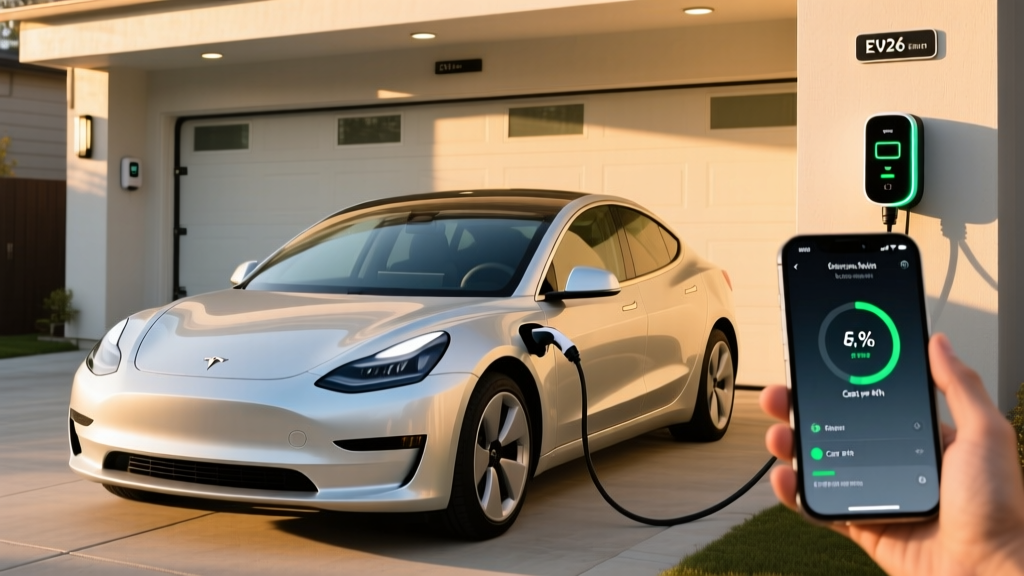
Level 2 is the standard for home ownership. At the Model 3 Long Range's peak acceptance rate of 11.5 kW (48 amps on a 60-amp circuit), you'll add roughly 44 miles of range per hour of charging. A 10–80% charge takes about 5.5 hours — perfect for overnight replenishment.
DC Fast Charging bypasses the car's onboard charger and feeds DC current directly to the battery. At a Tesla Supercharger V4 stall capable of 250 kW, the Model 3 Long Range peaks near 250 kW but sustains high rates only up to roughly 50–60% state of charge (SoC), then tapers. The 10–80% time of approximately 25 minutes reflects this charge curve taper — peak kW is never sustained across the full session.
Home Charger Installation: Requirements, Costs & Panel Upgrades
Installing a Level 2 home charger for the 2026 Model 3 Long Range means hardwiring or installing a NACS outlet on a dedicated 240V circuit. Here's what that involves electrically and financially.
Electrical Requirements
The Model 3 Long Range can accept up to 11.5 kW (48A). Per the National Electrical Code (NEC), continuous loads must not exceed 80% of a circuit's rated capacity, so you need a 60-amp dedicated circuit to deliver the full 48A. If your panel has limited capacity, a 50-amp circuit (delivering 40A / 9.6 kW) is a practical fallback that still adds ~37 miles per hour — more than enough for overnight charging.
Do You Need a Panel Upgrade?
Homes built before 2000 often have 100-amp or 150-amp main service panels. Adding a 60-amp EV circuit to an already-loaded panel may require a service upgrade to 200 amps, which is the single largest variable in installation cost. Signs you may need an upgrade: your panel is near capacity (frequent breaker trips, multiple high-draw appliances running simultaneously), or you have a Federal Pacific or Zinsco panel (known safety hazards that insurers flag).
Installation Cost Breakdown
| Component | Simple Install (panel has space) | Complex Install (panel upgrade needed) |
|---|---|---|
| Level 2 Charger (hardware) | $400–$700 | $400–$700 |
| Electrician labor (2–4 hrs) | $500–$1,200 | $800–$1,500 |
| Permit & inspection | $50–$200 | $100–$300 |
| Panel upgrade (if needed) | $0 | $1,500–$3,500 |
| Conduit/wiring (long runs) | $0–$300 | $200–$800 |
| Total Estimated Cost | $950–$2,400 | $3,000–$6,800 |
The IRS residential clean energy credit covers 30% of home charging equipment and installation costs (up to $1,000) — check current-year eligibility on irs.gov or consult a tax professional, as income and location-based rules apply.
Connector Compatibility: NACS, CCS, and Adapter Needs
The 2026 Model 3 Long Range comes with the NACS (North American Charging Standard) connector, formerly known as the Tesla connector. As of 2025, nearly all major automakers have adopted NACS, and the public charging landscape has shifted heavily in its favor.
| Connector | Used By | Model 3 LR Compatibility |
|---|---|---|
| NACS (native) | Tesla, Ford, GM, Rivian, Volvo, Hyundai (2025+) | ✅ Native — no adapter |
| CCS1 | Older non-Tesla EVs, some public stations | ⚠️ Requires NACS-to-CCS adapter (~$200) |
| CHAdeMO | Nissan Leaf (legacy) | ❌ Not compatible |
What this means in practice: You'll charge natively at all 6,000+ Tesla Supercharger stations and at the growing number of non-Tesla networks that have added NACS cables (including Electrify America and EVgo locations). If you encounter a CCS-only public charger — still common at some older installations — a NACS-to-CCS adapter allows you to use it, though at potentially reduced peak speeds. Always carry the adapter on road trips outside well-mapped Supercharger corridors.
Charging Cost Per Mile: Home vs. Public vs. Gas
The 2026 Model 3 Long Range consumes approximately 25 kWh per 100 miles (EPA combined). Your cost per mile depends entirely on where and when you charge.
| Scenario | Rate ($/kWh) | Cost per 100 Miles | Cost per Mile |
|---|---|---|---|
| Home (off-peak utility rate) | $0.09 | $2.25 | $0.023 |
| Home (national avg. residential) | $0.16 | $4.00 | $0.040 |
| Public Level 2 (ChargePoint, etc.) | $0.25–$0.39 | $6.25–$9.75 | $0.063–$0.098 |
| DC Fast (Tesla Supercharger avg.) | $0.28–$0.36 | $7.00–$9.00 | $0.070–$0.090 |
| Gas car (30 MPG, $3.40/gal) | — | $11.33 | $0.113 |
The bottom line: Charging at home on an off-peak rate is roughly one-fifth the cost per mile of a 30-MPG gas car. Even at DC fast-charger rates, the Model 3 Long Range undercuts gasoline on a per-mile basis. The savings widen further if your utility offers time-of-use (TOU) plans with sub-$0.10/kWh overnight rates — a compelling reason to install Level 2 at home.
For perspective, driving 12,000 miles per year costs approximately $270 on home off-peak charging versus $1,360 in gasoline for an equivalent 30-MPG sedan. That's over $1,000 in annual fuel savings before accounting for reduced maintenance (no oil changes, fewer brake replacements due to regenerative braking).
Recommended Home Chargers for the Model 3 Long Range
Since the Model 3 Long Range uses NACS natively, your best charger options are NACS-equipped units. Here are three proven picks matched to different budgets and install scenarios.
Tesla Wall Connector (NACS)
- Power Output: Up to 11.5 kW (48A)
- Cable Length: 24 ft
- Smart Features: Wi-Fi, OTA updates, Tesla app integration, load sharing with Powerwall
- Price: ~$475
- Verdict: The default choice for Tesla owners. Seamlessly integrates with the Tesla app for scheduling and off-peak charging. Hardwired install required for full 48A output.
ChargePoint Home Flex (NACS)
- Power Output: Up to 12 kW (50A, configurable down to 16A)
- Cable Length: 23 ft
- Smart Features: Wi-Fi, ChargePoint app, Alexa integration, flexible amperage settings for older panels
- Price: ~$599
- Verdict: Best for homes where a 60A circuit isn't feasible — the adjustable amperage lets you match the charger to your available circuit without an electrician re-visit. NACS plug version available.
Emporia Vue Level 2 Charger (NACS)
- Power Output: Up to 11.5 kW (48A)
- Cable Length: 24 ft
- Smart Features: Wi-Fi, energy monitoring, solar integration, budget-friendly app scheduling
- Price: ~$399
- Verdict: The value pick. Solid build quality, good app, and the lowest price among NACS smart chargers. Hardwired or NEMA 14-50 plug option.
All three chargers deliver the Model 3 Long Range's maximum Level 2 acceptance rate of 11.5 kW when installed on a 60-amp circuit. If your panel only supports a 50-amp circuit, configure the charger for 40A (9.6 kW) — you'll still wake up to a full battery every morning for typical daily driving.
Safety, Electrical Code & Best Practices
A Level 2 charger draws significant continuous current for hours at a time. Proper installation isn't optional — it's a fire-safety requirement. Here's what your licensed electrician should address:
- Dedicated circuit: Your EV charger must have its own breaker — never share a circuit with other major appliances (dryer, oven, HVAC).
- GFCI protection: NEC 2020 and later require ground-fault circuit interrupter protection for outdoor receptacles. Hardwired installations may be exempt depending on local code, but GFCI breakers add a valuable safety layer regardless.
- Outdoor rating: If your charger mounts outside, ensure the unit carries a NEMA 4 (weatherproof) rating. All three chargers recommended above are rated for outdoor installation.
- Wire gauge: A 60-amp circuit requires 6 AWG copper wire (or 4 AWG aluminum). Your electrician will size this based on run length and local code.
- Permit and inspection: Most jurisdictions require an electrical permit for a new 240V circuit. The inspection verifies proper grounding, wire sizing, and breaker rating — don't skip this step, as unpermitted work can void homeowners insurance claims.
One frequently overlooked detail: if you install a NEMA 14-50 outlet rather than hardwiring, use an industrial-grade receptacle (Hubbell or Bryant brand, ~$75–$120) rated for daily plug/unplug cycles. Standard residential-grade 14-50 outlets from hardware stores are designed for occasional RV use and can overheat under daily EV charging loads.
Frequently Asked Questions
How much does it cost to install a home EV charger for the 2026 Tesla Model 3 Long Range?
A straightforward Level 2 installation on an existing 200-amp panel with a nearby garage outlet typically runs $950–$2,400 (charger + electrician + permit). If your home needs a panel upgrade to 200 amps, expect $3,000–$6,800 total. Always get 2–3 quotes from licensed electricians — prices vary significantly by region and run length.
How fast will each charging level add range to the Model 3 Long Range?
Level 1 (120V) adds about 3–4 miles per hour. Level 2 at 11.5 kW (240V/48A) adds roughly 44 miles per hour — enough to fully replenish a day's driving in 1–2 hours. DC fast charging at a Tesla Supercharger can add over 200 miles in 15 minutes, though the charge curve tapers significantly above 80% SoC to protect battery health.
Which connector and charger is compatible with the 2026 Model 3 Long Range?
The 2026 Model 3 Long Range uses the NACS connector natively. This plugs directly into all Tesla Superchargers and the growing number of non-Tesla stations with NACS cables. For CCS-only public chargers, you'll need a NACS-to-CCS adapter. CHAdeMO is not compatible.
How much does charging the Model 3 Long Range cost per mile versus a gas car?
At the national average residential electricity rate of ~$0.16/kWh, the Model 3 Long Range costs about $0.04 per mile to fuel at home. A comparable 30-MPG gas car at $3.40/gallon costs roughly $0.11 per mile. Off-peak utility rates can push EV fueling below $0.025/mile — a fraction of gasoline costs.
What electrical upgrades might I need for a home charger?
If your home has a 200-amp service panel with available breaker slots, you likely need only a dedicated 60-amp circuit — no upgrade required. Homes with 100-amp or 150-amp panels, older wiring, or panels near capacity may require a service upgrade ($1,500–$3,500). A licensed electrician can perform a load calculation to determine whether your panel can handle the additional continuous draw. According to NFPA's National Electrical Code, the 80% continuous-load rule means a 48A charger requires a 60A breaker minimum.
Does the 2026 Model 3 Long Range qualify for the federal EV tax credit?
Federal tax credit eligibility under IRS §30D depends on MSRP caps (sedans must be under $55,000), buyer income limits ($150K single / $300K joint), battery critical-mineral sourcing, and North American assembly requirements. The Model 3 Long Range's eligibility can shift between model years based on battery sourcing changes. Always verify current eligibility on the IRS Clean Vehicle Credit page or with a tax professional before purchasing. The credit can now be transferred to the dealer as a point-of-sale discount if you qualify.