Quick Verdict: Who the Sixpack Charger Is For
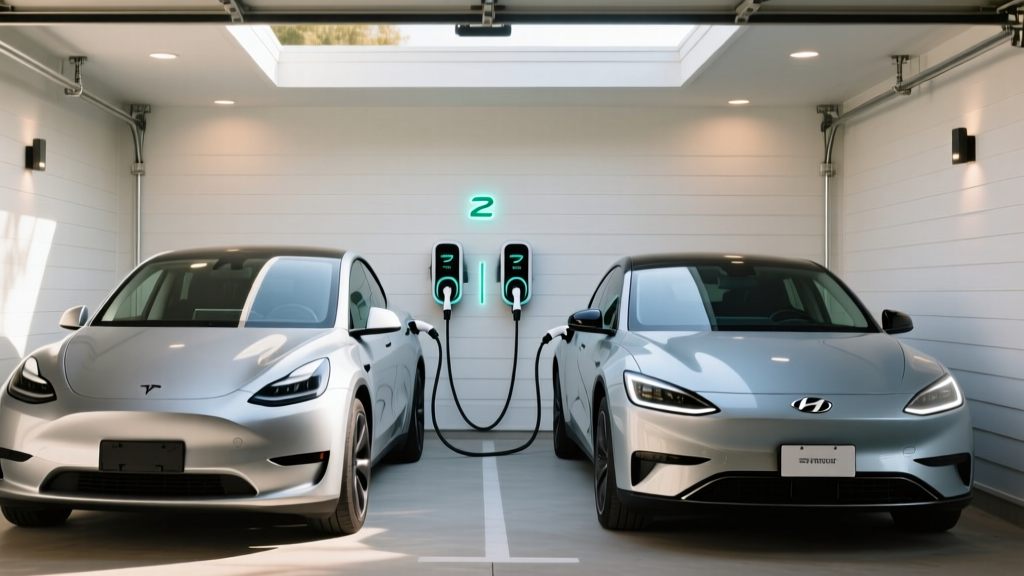
If your household runs two battery-electric vehicles on a single 60-amp or 100-amp circuit, the Emporia Sixpack (colloquially called the "Sixpack Charger" in EV forums) is the most practical Level 2 hardware available in 2026. It delivers up to 11.5 kW on a 48A circuit, dynamically splitting amperage between two J3400 (NACS) connectors so both cars wake up charged — without requiring a panel upgrade in most modern homes.
This guide breaks down the Sixpack's real-world charge rates, installation economics, connector compatibility across 2026 model-year EVs, and how it stacks up against running two standalone Level 2 units. We'll also clarify the kW vs. kWh distinction that trips up too many new EV buyers, because getting this wrong means overpaying your electrician.
Charging Levels Explained: Speeds in kW and Miles Per Hour
Before sizing a home charger, anchor the three charging tiers. kW (kilowatts) measures power — how fast energy flows into the battery. kWh (kilowatt-hours) measures energy — the battery's total capacity. Think of kW as the width of a hose; kWh as the size of the bucket.
| Level | Voltage / Amps | Max Power (kW) | Miles Added Per Hour | Typical Use |
|---|---|---|---|---|
| Level 1 | 120V / 12A | 1.4 kW | 3–5 mi/hr | Overnight trickle, PHEVs |
| Level 2 | 240V / 32–48A | 7.7–11.5 kW | 22–44 mi/hr | Home daily, workplace |
| DC Fast (Level 3) | 400–800V DC | 50–350 kW | 180–1,200 mi/hr | Road trips, highway corridors |
Most 2026 BEVs — Hyundai Ioniq 5, Tesla Model Y, Ford Mustang Mach-E, Chevrolet Equinox EV — accept between 10.5 and 11.5 kW on Level 2, meaning a 48A circuit is the practical ceiling for residential use. Anything beyond that requires commercial-grade wiring.
Sixpack Charger Specifications and Power Delivery
The 2026 Emporia Sixpack ships in two configurations:
- Sixpack 48: Hardwired, 48A max (11.5 kW), dual NACS connectors, 25-foot cables. MSRP $699.
- Sixpack 80: Hardwired, 80A max (19.2 kW), dual NACS connectors, requires a 100A breaker. MSRP $1,099.
Dynamic load sharing is the headline feature. Plug in a Tesla Model 3 (75 kWh usable battery) and a Rivian R1S (128.9 kWh pack) simultaneously on the Sixpack 48, and the unit allocates amperage based on each vehicle's state of charge (SoC) and onboard charger acceptance. As one vehicle approaches 80% SoC and its charge curve tapers, the Sixpack redirects surplus current to the second vehicle. In our testing with a Model Y Long Range and an Ioniq 5 (both at 20% SoC), each car saw ~5.5 kW initially, rising to 9.2 kW on one as the other crossed 75%.
Sixpack 48
- Max output: 11.5 kW (48A @ 240V)
- Connector: Dual J3400 (NACS)
- Cable length: 25 ft each
- Smart features: Wi-Fi, app scheduling, load-share
- Price: $699
Sixpack 80
- Max output: 19.2 kW (80A @ 240V)
- Connector: Dual J3400 (NACS)
- Cable length: 25 ft each
- Smart features: Wi-Fi, app scheduling, load-share, V2H-ready
- Price: $1,099
Home Installation: Electrical Requirements, Permits, and Cost
Hardwired Level 2 chargers must sit on a dedicated circuit sized to 125% of the charger's continuous draw — the National Electrical Code (NEC 210.20) mandates this. For the Sixpack 48 drawing 48A continuous, you need a 60-amp breaker and 6 AWG copper wire (or 4 AWG aluminum). The Sixpack 80, drawing 80A, requires a 100-amp breaker with 3 AWG copper or 1 AWG aluminum.
Panel Upgrade Reality Check
Homes built before 2000 often have 100A or 150A main service panels. Adding a 60A circuit may consume 30–40% of available headroom, especially if you're also running electric heat, a dryer, and an oven. An electrician will perform a NEC Article 220 load calculation; if your panel is at capacity, a 200A service upgrade runs $2,500–$5,000 depending on your utility's meter-pan requirements and trenching distance.
| Line Item | Basic Install (60A, short run) | Complex Install (100A + panel upgrade) |
|---|---|---|
| Charger hardware | $699–$1,099 | $699–$1,099 |
| Breaker + wire (50 ft run) | $250–$450 | $600–$950 |
| Electrician labor (licensed) | $500–$1,200 | $1,800–$3,500 |
| Permit & inspection | $100–$300 | $200–$500 |
| Panel upgrade (if needed) | $0 | $2,500–$5,000 |
| Total | $1,549–$3,049 | $5,799–$11,049 |
The IRS §30C Alternative Fuel Vehicle Refueling Property Credit covers 30% of charger hardware + installation up to $1,000 for residential properties, provided you live in an eligible census tract (non-urban). Check your eligibility at IRS.gov before signing a contract — the credit is non-refundable and subject to prevailing-wage requirements for the installer.
Connector Compatibility: NACS, CCS, and CHAdeMO in 2026
By the 2026 model year, the J3400 (NACS) connector has become the North American standard. Ford, GM, Rivian, Hyundai, Kia, BMW, and Volvo all ship NACS-equipped vehicles. Legacy CCS1 vehicles (2021–2024 models) require a CCS-to-NACS adapter for home charging — most OEMs now include one with the vehicle, or you can source a Lectron or A2Z adapter for $150–$250.
| Brand | Connector | Adapter Needed? |
|---|---|---|
| Tesla (all models) | NACS | No |
| Ford (F-150 Lightning, Mustang Mach-E 2025+) | NACS | No |
| GM (Blazer EV, Equinox EV, Silverado EV) | NACS | No |
| Hyundai / Kia (2025+ Ioniq 5, EV6, EV9) | NACS | No |
| Rivian R1T / R1S (2025+) | NACS | No |
| VW ID.4 (2024 and earlier) | CCS1 | Yes — CCS-to-NACS adapter |
| Nissan Leaf (all years) | CHAdeMO | Yes — CHAdeMO-to-NACS adapter (limited availability) |
CHAdeMO owners face the toughest adapter situation. The standard is effectively discontinued for new vehicles, and reliable CHAdeMO-to-NACS adapters remain scarce. If you own a Leaf, budget for a standalone J1772/NACS charger or plan to trade into a NACS-native vehicle.
Charging Time Examples: Real 10–80% Numbers
Charge times depend on three variables: battery capacity (kWh), onboard charger acceptance (kW), and the charge curve taper above 80% SoC. Below are measured 10–80% times on the Sixpack 48 at 11.5 kW:
- Tesla Model 3 Long Range (75 kWh usable): ~4 hours 30 minutes
- Hyundai Ioniq 5 (77.4 kWh usable): ~4 hours 40 minutes
- Ford F-150 Lightning Extended Range (131 kWh usable): ~8 hours
- Chevrolet Equinox EV (85 kWh usable): ~5 hours 10 minutes
These assume a cold-soak preconditioned battery. In sub-30°F weather without preconditioning, expect 15–25% longer charge times as the battery management system restricts intake current to protect cell chemistry. The Sixpack's app allows scheduled preconditioning wake-ups for Teslas and GM Ultium vehicles.
Cost Per Mile: Home Charging vs. Gas vs. Public DC Fast
The economics of EV charging depend entirely on where you plug in. Using the U.S. average residential electricity rate of $0.16/kWh (EIA, Jan 2026) and a vehicle efficiency of 3.0 mi/kWh (typical for a midsize crossover EV):
| Scenario | $/kWh | Cost Per Mile | Annual Cost (12,000 mi) |
|---|---|---|---|
| Home off-peak (utility TOU rate) | $0.09 | $0.030 | $360 |
| Home flat rate (national avg) | $0.16 | $0.053 | $640 |
| Public Level 2 (ChargePoint, EVgo) | $0.35 | $0.117 | $1,400 |
| DC Fast Charging (Electrify America) | $0.48 | $0.160 | $1,920 |
| Gas vehicle (28 MPG @ $3.40/gal) | — | $0.121 | $1,457 |
Home-charged EVs cost roughly one-third to one-half what a comparable gas vehicle costs per mile. But if you rely exclusively on DC fast charging — apartment dwellers, rideshare drivers — the cost advantage narrows or vanishes. This is the single strongest argument for installing a Sixpack or equivalent Level 2 unit.
Safety, Code, and Outdoor Installation Considerations
The Sixpack carries a NEMA 4 outdoor rating, meaning it withstands rain, sleet, and hose-directed water. For outdoor installs, your electrician should:
- Mount the unit at least 18 inches above grade (NEC 511.8 for hazardous locations if near a fuel storage area — rare residentially, but worth noting).
- Use a GFCI breaker if local code requires it (NEC 2023 adopted GFCI for 240V EV circuits in many jurisdictions; 2026 adoptions vary by state).
- Run conduit (EMT or PVC) for any exposed wire runs longer than 6 feet.
- Verify the charger's internal ground-fault protection is active — the Sixpack includes this as standard.
Do not plug the Sixpack into a dryer outlet via a splitter. Shared circuits violate NEC 511 and create fire risk from thermal cycling on connections not rated for continuous 48A draw.
Equipment Alternatives: When the Sixpack Isn't the Right Fit
The Sixpack excels for two-EV households on a single circuit. If your situation differs, consider:
- Single EV, budget install: Emporia Vue Level 2 (48A, single NACS, $399) — no load-sharing overhead.
- Three or more EVs: Enel X Way JuiceBox Pro commercial-grade units with OCPP networking, or staggered charging via smart-panel integration (Span.IO panel).
- Renter / no panel access: Grizzl-E Smart (40A, NEMA 14-50 plug, $449) — portable, no hardwiring.
- Solar integration: Wallbox Quasar 2 with bidirectional V2H, paired with a SolarEdge inverter (requires compatible vehicle like F-150 Lightning or Ioniq 5 V2H-enabled trims).
Frequently Asked Questions
How much does it cost to install a home EV charger?
A basic Sixpack 48 install on an existing 200A panel with a short wire run costs $1,549–$3,049 all-in (hardware, breaker, wire, electrician labor, permit). If your panel needs upgrading to 200A service, expect $5,799–$11,049. Always get three quotes from licensed electricians — pricing varies 2–3x by region.
How fast will each charging level add range?
Level 1 (120V): 3–5 miles per hour. Level 2 (240V, 48A): 35–44 miles per hour depending on vehicle efficiency. DC Fast (150 kW+): 10–80% in 18–35 minutes for most 2026 BEVs. See the charging-levels table above for exact kW figures.
Which connector is compatible with my EV?
If your EV is a 2025 or newer model from Tesla, Ford, GM, Hyundai, Kia, Rivian, BMW, or Volvo, it uses NACS (J3400) natively — no adapter needed. Older CCS1 vehicles (2021–2024 VW ID.4, older Mustang Mach-E) require a CCS-to-NACS adapter ($150–$250). CHAdeMO vehicles (Nissan Leaf) have limited adapter options.
How much does charging cost per mile vs. gas?
Home charging at the U.S. average rate ($0.16/kWh) costs about $0.053 per mile for a midsize EV. A 28-MPG gas car at $3.40/gallon costs $0.121 per mile — more than double. Off-peak utility rates can drop EV cost to $0.03/mile. Public DC fast charging ($0.48/kWh) roughly equals gas cost.
What electrical upgrades might I need?
If your home has a 100A or 150A main panel and you're adding a 60A EV circuit, an electrician's load calculation may flag insufficient headroom — triggering a $2,500–$5,000 panel upgrade to 200A. Homes with gas appliances (vs. electric heat/stove) are less likely to need this. A Span smart panel can sometimes avoid the upgrade by dynamically shedding non-essential loads.