Why a Six Pack Charger Makes Sense for Multi-EV Households in 2026
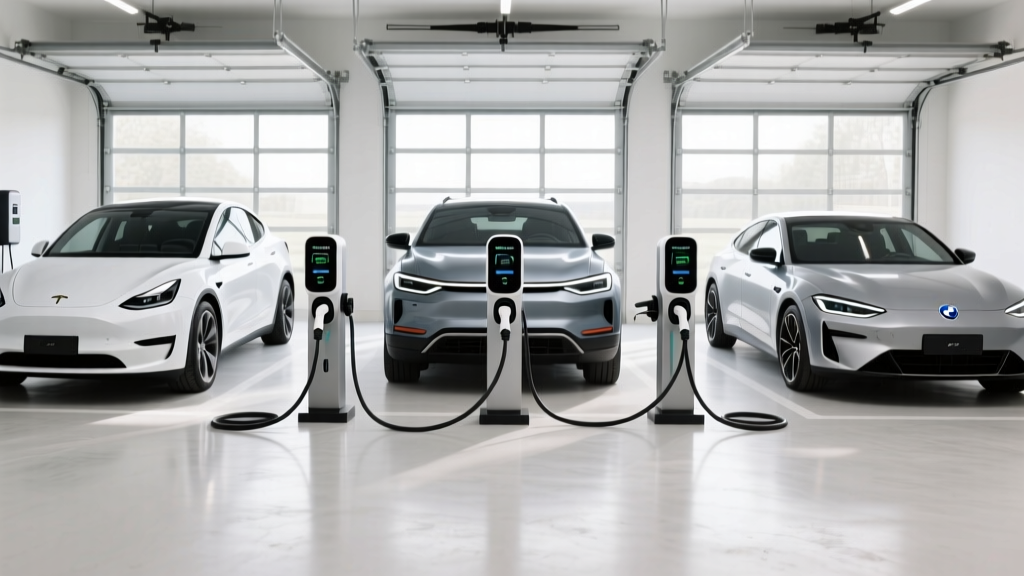
As more households run two, three, or even four electric vehicles, the single wall-box paradigm is breaking down. The so-called "six pack charger" concept — a centralized Level 2 charging hub capable of serving multiple vehicles simultaneously or sequentially with intelligent load management — has emerged as a practical answer for EV-dense homes, small fleets, and shared residential properties. In 2026, several manufacturers offer load-sharing stations that distribute up to 19.2 kW across two to six connectors, dynamically adjusting amperage per port based on each vehicle's state of charge and acceptance rate.
This guide breaks down what a six pack charger setup actually requires electrically, what it costs to install, how fast each port charges, and whether your home's panel can support it. We'll also clarify the critical difference between kW (power — the rate of energy delivery) and kWh (energy — the total capacity stored in your battery), because confusing them is the single most common mistake new EV owners make when sizing charging equipment.
Charging Levels Explained: Speeds in kW and Miles Per Hour
Before sizing a multi-port system, you need to understand the three charging tiers and what each delivers in practical terms.
| Level | Voltage | Max Power (kW) | Miles of Range Added Per Hour | Typical Use |
|---|---|---|---|---|
| Level 1 | 120V AC | 1.4–1.9 kW | 3–5 mi/hr | Overnight top-up, PHEVs, emergencies |
| Level 2 | 240V AC | 3.3–19.2 kW | 12–75 mi/hr | Home daily charging, workplaces, six pack hubs |
| DC Fast Charge | 400–900V DC | 50–350 kW | 150–1,200+ mi/hr (peak) | Road trips, commercial corridors |
A six pack charger operates at Level 2. On a 48-amp shared circuit delivering 11.5 kW total, each of six ports might receive roughly 1.9 kW when all are active — comparable to Level 1 speeds. But with intelligent load balancing, the system prioritizes vehicles with lower state of charge, delivering up to 40 amps (9.6 kW) to a single vehicle when others are full or disconnected. This is the key advantage over simply installing six independent wall boxes: you avoid the need for six dedicated 40-amp circuits and a massive panel upgrade.
Electrical Requirements: Voltage, Amperage, and Panel Capacity
A six-port Level 2 hub typically requires a 240V dedicated circuit rated between 60 and 100 amps, depending on the unit's total power envelope and the National Electrical Code (NEC) continuous-load derating rule, which limits circuit usage to 80% of the breaker rating. A 60-amp breaker, for example, supports 48 amps of continuous draw — about 11.5 kW at 240V.
Here's what most installations demand:
- Service panel capacity: Most modern homes have 200-amp main panels. A 60-amp EV circuit consumes 30% of that capacity. Homes with electric ranges, dryers, HVAC, and water heaters may need a panel upgrade to 300–400 amps or a secondary sub-panel.
- Load calculation: A licensed electrician will perform an NEC Article 220 load calculation to verify your panel can handle the EV circuit alongside existing loads. This is non-negotiable for permit approval.
- Wire gauge: 60-amp circuits typically require 6 AWG copper wire (THHN in conduit or NM-B). Longer runs may need 4 AWG to minimize voltage drop.
- GFCI protection: NEC 2020 and later require GFCI protection for all EV charging outlets. Hardwired units often include built-in GFCI, while receptacle-based installs need a GFCI breaker.
Home Installation Cost Breakdown: Equipment, Electrician, and Permits
The total cost of a six pack charger installation varies enormously based on your existing electrical infrastructure. Here's a realistic range based on 2026 contractor pricing and equipment costs:
| Component | Low Estimate | High Estimate | Notes |
|---|---|---|---|
| Load-sharing charger unit (6-port) | $2,800 | $6,500 | Varies by brand, power output, smart features |
| Electrical panel upgrade (if needed) | $0 | $5,000 | Only if existing panel lacks capacity |
| Electrician labor (circuit + mount) | $1,200 | $4,500 | Depends on run length, conduit, wall type |
| Permit and inspection fees | $100 | $500 | Varies by municipality |
| Wire, conduit, breaker, misc. | $300 | $1,200 | Longer runs = more material |
| Total (no panel upgrade) | $4,400 | $12,700 | Typical for homes with 200A+ panels |
| Total (with panel upgrade) | $6,000 | $17,700 | Older or heavily loaded homes |
For comparison, installing six independent Level 2 wallboxes (each on its own 40-amp circuit) would require 240 amps of dedicated breaker space — far exceeding most residential panels — and could cost $15,000–$30,000+ in electrical work alone. The load-sharing approach is almost always more economical for multi-vehicle setups.
Connector Compatibility: NACS, CCS1, and CHAdeMO in 2026
The connector landscape has consolidated significantly since 2024, when Ford, GM, Rivian, and most major automakers adopted the North American Charging Standard (NACS), originally developed by Tesla. By 2026, NACS is the dominant plug for new EVs sold in the U.S., though millions of CCS1-equipped vehicles remain on the road.
| Connector | Brands Using It (Native) | Adapter Needed? |
|---|---|---|
| NACS (Tesla-style) | Tesla, Ford, GM, Rivian, Volvo, Polestar, Mercedes, Hyundai/Kia (2025+), BMW, Lucid, Fisker | None for these brands |
| CCS1 | VW (pre-2026), Audi (pre-2026), Porsche Taycan (pre-2025), older BMW i4/iX, Stellantis EVs | CCS1-to-NACS adapter (~$150–$250) |
| CHAdeMO | Nissan Leaf (all years), Mitsubishi Outlander PHEV (older) | CHAdeMO-to-NACS adapter (rare, ~$300+) |
When specifying a six pack charger, choose units with native NACS connectors if all household vehicles use that standard. For mixed fleets, look for units offering interchangeable connector heads or budget for quality adapters. According to SAE International's J3400 standard, which formalized NACS, adapters must maintain full communication protocol compatibility — cheap, uncertified adapters risk charging failures or equipment damage.
Cost to Charge: Per-Mile Economics vs. Gasoline
The financial case for home Level 2 charging rests on electricity rates that are typically far below gasoline on a per-mile basis. However, public DC fast charging narrows or eliminates that gap.
| Scenario | Rate ($/kWh) | Cost Per Mile* | Annual Cost (12,000 mi) |
|---|---|---|---|
| Home Level 2 (off-peak utility rate) | $0.08–$0.14 | $0.024–$0.042 | $288–$504 |
| Home Level 2 (standard residential rate) | $0.14–$0.22 | $0.042–$0.066 | $504–$792 |
| Public Level 2 (network pricing) | $0.25–$0.49 | $0.075–$0.147 | $900–$1,764 |
| DC Fast Charge (Electrify America, EVgo, Tesla) | $0.35–$0.65 | $0.105–$0.195 | $1,260–$2,340 |
| Gasoline (25 MPG combined, $3.40/gal) | — | $0.136 | $1,632 |
| Gasoline (30 MPG combined, $3.40/gal) | — | $0.113 | $1,356 |
*Based on an EV averaging 3.0–3.5 kWh per mile (typical for midsize crossovers like the Tesla Model Y, Hyundai Ioniq 5, or Ford Mustang Mach-E). Efficiency varies: a Lucid Air achieves ~4.5 mi/kWh (0.22 kWh/mi), while a GMC Hummer EV manages ~1.6 mi/kWh (0.63 kWh/mi).
Home off-peak charging is the clear winner — roughly one-quarter the per-mile cost of gasoline. The six pack charger's value proposition is that it keeps all household vehicles on that low home rate rather than pushing drivers toward expensive public DC fast chargers out of convenience.
Charging Time Examples: 10–80% for Common Battery Sizes
Here's what to expect when charging popular EV battery sizes on a shared Level 2 system. These times assume a single vehicle receiving the unit's maximum per-port output; when multiple vehicles charge simultaneously, times increase proportionally as power is distributed.
| Vehicle (Example) | Battery (kWh usable) | Single Port @ 9.6 kW | Two Ports Sharing | All Six Ports Active |
|---|---|---|---|---|
| Chevrolet Equinox EV | 85 kWh | ~6 hr 10 min | ~12 hr 20 min | ~37 hr |
| Tesla Model Y Long Range | 75 kWh | ~5 hr 25 min | ~10 hr 50 min | ~32 hr |
| Hyundai Ioniq 5 | 77.4 kWh | ~5 hr 40 min | ~11 hr 20 min | ~34 hr |
| Ford F-150 Lightning (Std Range) | 98 kWh | ~7 hr 5 min | ~14 hr 10 min | ~42 hr |
| BMW i4 eDrive40 | 81.5 kWh | ~5 hr 55 min | ~11 hr 50 min | ~35 hr |
The numbers make clear that a six pack charger is designed for overnight and sequential charging — not rapid turnaround. For households where all six vehicles arrive depleted at 6 PM and need to leave at 7 AM, a higher-capacity system (19.2 kW, 80-amp circuit) or supplemental DC fast charging during the day will be necessary. Most real-world usage involves staggered schedules: one vehicle charges while others sit at adequate SoC, and the load-sharing algorithm rotates priority.
One important nuance: the charge curve. Lithium-ion batteries accept peak power only at low states of charge. As SoC climbs past 80%, the vehicle's onboard charger and battery management system progressively reduce acceptance rate. That's why 10–80% times are the industry standard metric — the final 20% can take as long as the first 70%.
Equipment Recommendations: Leading Six Pack Charger Systems
Several manufacturers offer load-sharing multi-port systems suitable for residential and light-commercial use. Here are representative options available in 2026:
Enel X JuiceBox Pro (Load Sharing Kit)
Power: Up to 19.2 kW total (80A circuit)
Ports: 2–6 units linked via Wi-Fi
Connector: NACS (native), CCS1 available
Cable length: 25 ft per unit
Smart features: App scheduling, energy metering, utility demand-response
Price: ~$700–$900 per unit ($4,200–$5,400 for six)
Wallbox Power Sharing System
Power: Up to 11.5 kW per unit, dynamically shared
Ports: Up to 4 Pulsar Plus units linked (expandable with Commander)
Connector: NACS or J1772
Cable length: 18 or 25 ft options
Smart features: Power Sharing algorithm, RFID access, fleet management dashboard
Price: ~$650–$800 per unit
Grizzl-E Smart (Multi-Unit Grouping)
Power: Up to 10 kW per unit (40A)
Ports: Up to 4 units grouped
Connector: NACS or J1772
Cable length: 24 ft
Smart features: OCPP compatibility, load balancing, outdoor-rated (NEMA 4)
Price: ~$500–$650 per unit — budget-friendly option
Safety, Code Compliance, and Inspection Requirements
A multi-port Level 2 installation is a significant electrical project that must comply with NEC Article 625 (Electric Vehicle Charging System Equipment) and local amendments. Key requirements include:
- Dedicated circuit: The EV charging circuit must be dedicated — no shared outlets or appliances on the same breaker.
- GFCI protection: Required for all receptacle-based installations (NEC 625.54). Hardwired units may integrate GFCI internally.
- Outdoor rating: Any outdoor-mounted unit must carry at least a NEMA 3R rating (rain and sleet resistant). NEMA 4 (watertight) is preferred for exposed locations.
- Cable management: NEC requires that charging cables not create a tripping hazard. Retractor systems or cable hooks are recommended for multi-port setups where cables span parking spaces.
- Permit and inspection: Virtually all jurisdictions require an electrical permit for a new 240V circuit. The inspector will verify wire gauge, breaker sizing, GFCI, grounding, and load calculation. Do not skip this step — unpermitted work can void home insurance and create liability.
- Utility notification: Some utilities require notification for EV charger installations exceeding 40 amps, as it affects local transformer loading. A few offer time-of-use rate plans that make overnight charging significantly cheaper.
Frequently Asked Questions
How much does it cost to install a six pack charger at home?
Expect $4,400–$12,700 for a complete installation in a home with adequate panel capacity (200-amp service with available headroom). If your panel needs upgrading to 300–400 amps, add $1,500–$5,000+. The load-sharing equipment itself runs $2,800–$6,500 depending on brand and total power output.
How fast will each charging level add range?
Level 1 (120V) adds 3–5 miles per hour. Level 2 (240V) adds 12–75 miles per hour depending on amperage and vehicle acceptance rate. DC fast charging adds 150–1,200+ miles per hour at peak power, though sustained rates are lower due to the charge curve taper above 80% SoC. A six pack charger operates at Level 2, delivering roughly 12–30 miles of range per hour per port when multiple vehicles share the circuit.
Which connector and charger is compatible with my EV?
For 2026 model-year vehicles, most new EVs from Tesla, Ford, GM, Rivian, Hyundai, Kia, BMW, and Volvo use the NACS connector natively. Older CCS1-equipped vehicles (pre-2025 VW, Audi, Porsche) can use a CCS1-to-NACS adapter. The Nissan Leaf remains the main CHAdeMO holdout. Check your vehicle's charge port before ordering equipment — and verify adapter compatibility with your specific model year.
How much does charging cost per mile compared to gas?
Home Level 2 charging at off-peak rates ($0.08–$0.14/kWh) costs roughly $0.024–$0.042 per mile for a typical EV — about one-quarter the cost of gasoline at $3.40/gallon and 25 MPG. Public DC fast charging at $0.35–$0.65/kWh costs $0.105–$0.195 per mile, which can exceed the cost of fueling an efficient gasoline car. The six pack charger's economics depend on keeping vehicles on home electricity rates.
What electrical upgrades might I need for a six-port system?
The most common upgrade is a panel increase from 100 or 150 amps to 200 amps ($1,500–$3,000). Homes with existing 200-amp panels that are already heavily loaded may need a 325- or 400-amp service upgrade ($3,000–$7,000). You may also need a new conduit run from the panel to the garage or carport, a sub-panel installation if the charger is far from the main service, and utility transformer verification for high-draw installations. A licensed electrician's load calculation will determine exactly what's required — get this assessment before purchasing equipment.