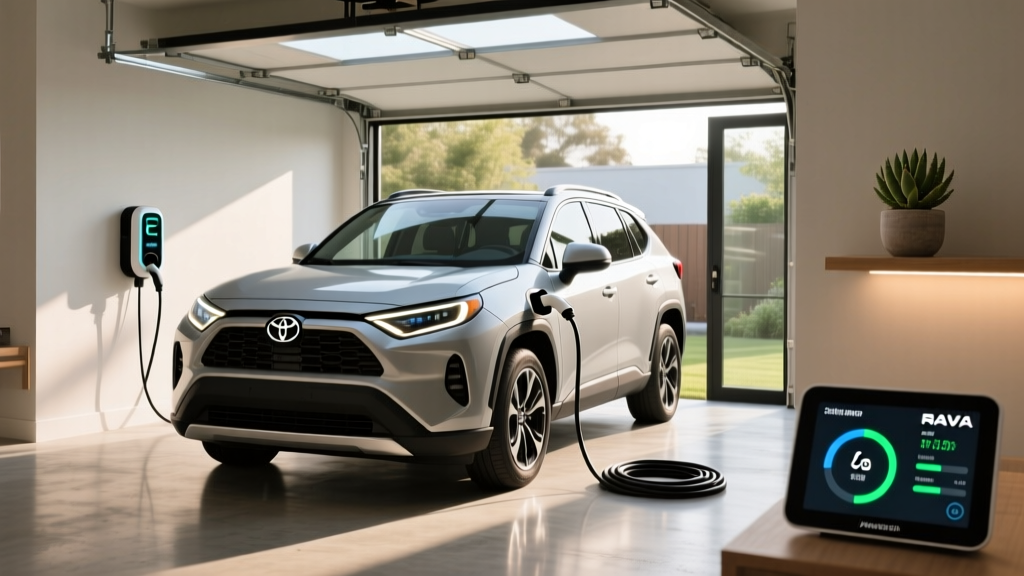
The Toyota RAV4 Prime — rebranded simply as the RAV4 PHEV for the 2026 model year — remains one of the most practical plug-in hybrids on the market. With an EPA-estimated 42 miles of electric-only range, a combined 302 horsepower, and standard all-wheel drive, it bridges the gap for buyers who want daily electric commuting without range anxiety on road trips. But to actually capture those electric miles, you need a charging strategy. This guide covers the 2026 RAV4 PHEV range, battery specs, charging speeds at every level, and the real costs of setting up a home charger.
2026 RAV4 PHEV Range & Battery: The Numbers That Matter
The 2026 RAV4 PHEV carries a 18.1 kWh lithium-ion battery pack (approximately 14.9 kWh usable), paired with a 2.5-liter four-cylinder engine and dual electric motors. Here are the official figures from fueleconomy.gov:
| Spec | Value |
|---|---|
| Electric-only range (EPA) | 42 miles |
| Total range (electric + gas) | ~600 miles |
| Battery capacity (total / usable) | 18.1 kWh / ~14.9 kWh |
| Combined MPGe (electric mode) | 94 MPGe |
| Combined MPG (hybrid mode) | 38 MPG |
| Combined horsepower | 302 HP |
| 0–60 mph | 5.7 seconds |
| Drivetrain | AWD (eAWD with rear electric motor) |
| Onboard charger (AC) | 6.6 kW |
| DC fast charging | Not supported |
| Battery warranty | 10 years / 150,000 miles (hybrid battery) |
| Base MSRP (SE) | $44,210 |
Charging Levels Explained: How Fast Will Each Add Range?
Because the 2026 RAV4 PHEV does not support DC fast charging, your options are Level 1 (standard 120V outlet) and Level 2 (240V dedicated circuit). Understanding the difference between kW (power — how fast energy flows) and kWh (energy — how much the battery holds) is essential. Think of kW as the flow rate of a hose and kWh as the size of the bucket.
| Level | Voltage | Max Power (kW) | Miles of Range Added per Hour | Full Charge Time (0–100%) |
|---|---|---|---|---|
| Level 1 (120V outlet) | 120V | ~1.4 kW | ~4–5 miles/hour | ~12–14 hours |
| Level 2 (240V, 32A) | 240V | 6.6 kW (onboard limit) | ~22–25 miles/hour | ~2.5 hours |
| DC Fast Charging | N/A | N/A | N/A | Not supported |
The RAV4 PHEV's onboard charger caps AC charging at 6.6 kW. Even if you install a 48-amp (11.5 kW) Level 2 charger, the vehicle will only draw 6.6 kW. That's perfectly adequate — a full charge in about 2.5 hours means you can easily top up during the workday or overnight.
Home Charger Installation: Electrical Requirements & Costs
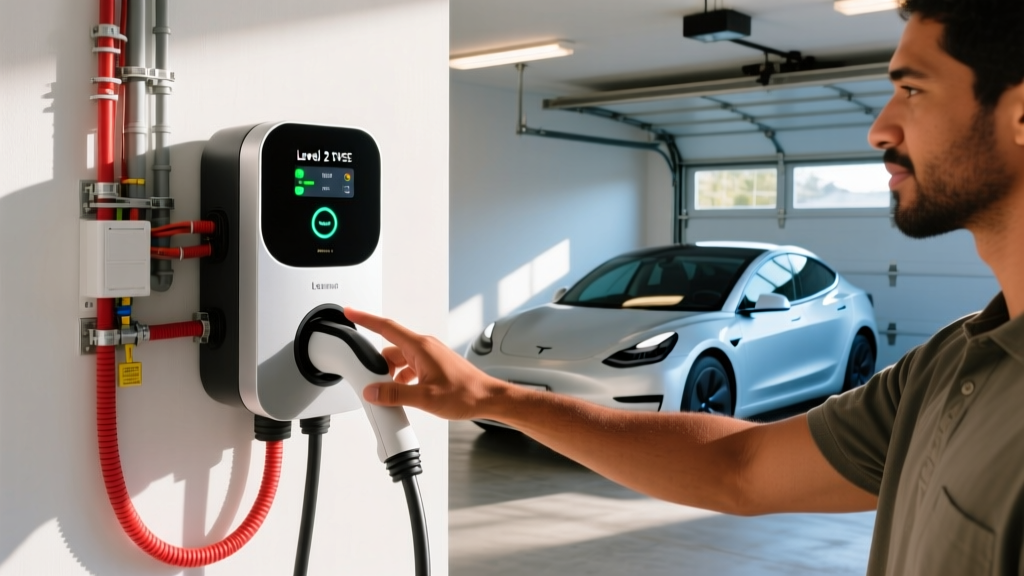
Installing a Level 2 charger at home is the single best investment for PHEV ownership. Here's what's involved electrically and financially.
Electrical Requirements
- Circuit: A dedicated 240V circuit — typically 40 amps for a 32-amp charger (NEC code requires the circuit be rated 125% of the continuous load).
- Wiring: 8-gauge copper wire (or 6-gauge for longer runs over 50 feet).
- Outlet vs. hardwired: A NEMA 14-50 outlet offers portability; hardwired units avoid the ~$50–80 outlet cost and can support higher amperage.
- Panel capacity: Your electrical panel must have spare capacity. A 200-amp panel usually handles a 40A EV circuit. Older 100-amp panels may require an upgrade.
- GFCI protection: The 2020 NEC and later require GFCI protection for outdoor receptacles. Many modern chargers have built-in GFCI, but your electrician will verify compliance.
- Permit: Most jurisdictions require an electrical permit ($50–$200) and a post-installation inspection.
Installation Cost Breakdown
| Item | Low End | High End | Notes |
|---|---|---|---|
| Level 2 charger (equipment) | $300 | $700 | 32A–48A smart charger |
| Electrician labor | $400 | $1,500 | Depends on panel-to-garage distance |
| Electrical permit | $50 | $200 | Varies by municipality |
| NEMA 14-50 outlet (if used) | $50 | $120 | Industrial-grade receptacle recommended |
| Panel upgrade (if needed) | $1,500 | $4,000 | 100A → 200A service upgrade |
| Total (no panel upgrade) | $800 | $2,500 | Most homes with 200A panel |
| Total (with panel upgrade) | $2,300 | $6,500 | Older homes with 100A service |
Charging Cost Per Mile: RAV4 PHEV Electric vs. Gas
One of the RAV4 PHEV's strongest selling points is the cost savings when driving on electricity. Let's compare the per-mile cost of electric driving versus gasoline hybrid mode.
| Scenario | Rate | Cost to Fill/Charge | Cost Per Mile |
|---|---|---|---|
| Home charging (off-peak) | $0.12/kWh | $1.79 (14.9 kWh usable) | $0.043/mi |
| Home charging (standard rate) | $0.18/kWh | $2.68 | $0.064/mi |
| Public Level 2 (typical) | $0.30/kWh | $4.47 | $0.106/mi |
| Gasoline hybrid mode (38 MPG) | $3.40/gallon | $14.50 (14.5-gal tank) | $0.089/mi |
| Gas-only RAV4 (30 MPG combined) | $3.40/gallon | $14.50 | $0.113/mi |
At home off-peak rates, the RAV4 PHEV costs roughly 4.3 cents per mile on electricity — about half the cost of driving it in hybrid mode on gas. Even at standard residential rates, electric mode is cheaper. However, public Level 2 charging at $0.30/kWh is more expensive than gas hybrid mode, so home charging is where the economics shine.
Annual savings estimate: If you drive 12,000 miles per year and cover 8,000 of those on home-charged electricity at $0.12/kWh, your fuel cost is roughly $344 (electric) + $453 (gas for 4,000 hybrid miles) = $797/year. A gas-only RAV4 averaging 30 MPG would cost about $1,360/year. That's roughly $560 in annual fuel savings — and more if gas prices rise.
Connector Compatibility: What Plug Does the 2026 RAV4 PHEV Use?
The 2026 RAV4 PHEV uses the J1772 connector for AC charging (Level 1 and Level 2). This is the standard connector for all non-Tesla plug-in vehicles sold in North America. Since the RAV4 PHEV does not support DC fast charging, you will never need a CCS1, CHAdeMO, or NACS connector for this vehicle.
| Connector | Use Case | Vehicles That Use It | RAV4 PHEV Compatible? |
|---|---|---|---|
| J1772 | Level 1 & Level 2 AC | Toyota RAV4 PHEV, most non-Tesla EVs/PHEVs | Yes (native) |
| NACS (Tesla) | Level 2 AC & DC fast | Tesla vehicles; Ford, GM, Rivian (2025+) | No (not needed) |
| CCS1 | DC fast charging | Most non-Tesla BEVs (Hyundai, VW, BMW) | No (no DC capability) |
| CHAdeMO | DC fast charging | Nissan Leaf (legacy) | No |
Adapter note: If you own a Tesla Wall Connector at home, you'll need a Tesla-to-J1772 adapter (~$150–$200 from third-party brands like Lectron or TeslaTap) to charge the RAV4 PHEV. Alternatively, install a universal J1772 charger alongside it.
Recommended Level 2 Chargers for the RAV4 PHEV
Since the RAV4 PHEV's onboard charger maxes out at 6.6 kW (roughly 28 amps at 240V), a 32-amp charger is the sweet spot. Buying a 48-amp unit isn't wasted money — it future-proofs for a future BEV — but it won't charge the RAV4 any faster.
ChargePoint Home Flex
- Power: Up to 12 kW (50A) — RAV4 will draw 6.6 kW
- Connector: J1772 (native)
- Cable length: 23 feet
- Smart features: Wi-Fi, scheduling, Alexa, energy tracking via app
- Price: ~$549
- Best for: Flexible amperage via DIP switches; works on 20A–60A circuits
Emporia Level 2 EV Charger
- Power: Up to 11.5 kW (48A)
- Connector: J1772 (native)
- Cable length: 24 feet
- Smart features: Wi-Fi, solar integration, real-time energy monitoring
- Price: ~$399
- Best for: Budget-conscious buyers who want smart features
Grizzl-E Smart
- Power: Up to 10 kW (40A)
- Connector: J1772 (native)
- Cable length: 24 feet
- Smart features: Wi-Fi, OCPP compatible, works with utility demand-response
- Price: ~$449
- Best for: Extreme cold climates (rated to -40°F); rugged build
Our pick for RAV4 PHEV owners: The Emporia at $399 offers the best value. Since you only need 32 amps (6.6 kW), you can install it on a 40A circuit — saving on wiring costs compared to a 60A circuit that a 48A charger requires. The ChargePoint Home Flex is worth the premium if you want Amazon Alexa integration or plan to upgrade to a BEV later.
Safety, Code & Installation Best Practices
EV charging is a continuous load — the charger runs at full draw for hours. That makes proper installation non-negotiable. Follow these guidelines:
- Dedicated circuit: Never share the EV charger circuit with other appliances. NEC requires a dedicated breaker.
- Continuous load derating: A 40A breaker supports a maximum continuous load of 32A (80% rule). A 32A charger on a 40A circuit is code-compliant.
- Outdoor rating: If your charger is mounted outside, ensure it carries a NEMA 4 (or IP65+) weather rating. All chargers listed above qualify.
- Wire gauge: For a 40A circuit, use 8 AWG copper (THHN in conduit or NM-B cable). For runs over 50 feet, upgrade to 6 AWG to minimize voltage drop.
- GFCI: The 2020 NEC requires GFCI for outdoor outlets. Hardwired chargers with built-in ground-fault protection satisfy this without a separate GFCI breaker (which can cause nuisance tripping).
- Permit and inspection: Always pull a permit. An unpermitted installation can void home insurance coverage and cause issues at resale.
- Use a licensed electrician: EV charging circuits are not a DIY project. A licensed electrician will perform the NEC Article 220 load calculation and ensure your panel can handle the added demand.
2026 RAV4 PHEV Federal Tax Credit & Incentives
Under current IRS §30D clean vehicle credit rules, the 2026 RAV4 PHEV may qualify for a partial or full federal tax credit of up to $7,500 — but eligibility depends on several factors:
- Buyer income caps: Modified AGI must not exceed $150,000 (single), $225,000 (head of household), or $300,000 (joint).
- MSRP cap: The RAV4 PHEV (classified as an SUV) must have an MSRP at or below $80,000. The 2026 RAV4 PHEV SE at $44,210 and XSE at ~$47,500 both qualify.
- Battery sourcing: The credit splits into two halves — $3,750 for critical minerals and $3,750 for battery component assembly. Toyota's supply chain sourcing determines how much of the $7,500 the RAV4 PHEV actually qualifies for in the 2026 tax year. Check the latest fueleconomy.gov credit listings for the current amount.
- Point-of-sale transfer: You can elect to transfer the credit to the dealer at purchase, reducing your out-of-pocket cost immediately rather than waiting for a tax refund.
Important: Credit eligibility changes as battery sourcing requirements tighten annually. Consult a tax professional and verify current status on IRS.gov before relying on a specific credit amount.
Frequently Asked Questions
How much does it cost to install a home EV charger for the RAV4 PHEV?
Between $800 and $2,500 for most homes with a 200-amp electrical panel. This includes the charger ($300–$700), electrician labor ($400–$1,500), permit ($50–$200), and any outlet or wiring materials. If your home needs a panel upgrade from 100A to 200A, add $1,500–$4,000.
How fast will each charging level add range to the RAV4 PHEV?
Level 1 (120V) adds about 4–5 miles of electric range per hour — a full overnight charge recovers roughly 40–50 miles. Level 2 (240V at 32A) adds 22–25 miles per hour and fully charges the 18.1 kWh battery in about 2.5 hours. DC fast charging is not supported.
Which connector does the 2026 RAV4 PHEV use?
The J1772 connector, which is the North American standard for AC charging on non-Tesla vehicles. Any J1772 Level 2 charger will plug directly into the RAV4 PHEV. If you have a Tesla Wall Connector, you'll need a Tesla-to-J1772 adapter.
Is the real-world electric range really 42 miles?
The EPA rates the 2026 RAV4 PHEV at 42 miles of electric-only range under ideal conditions. In practice, expect 34–38 miles on the highway and 28–35 miles in cold weather. City driving with frequent regenerative braking can sometimes exceed the EPA estimate.
How much does charging cost per mile vs. gas?
At home off-peak rates ($0.12/kWh), the RAV4 PHEV costs about 4.3 cents per mile on electricity. In hybrid mode on gas at $3.40/gallon and 38 MPG, it costs about 8.9 cents per mile. Home charging cuts your per-mile fuel cost roughly in half.
Can I use a public DC fast charger with the RAV4 PHEV?
No. The RAV4 PHEV only accepts AC charging (Level 1 and Level 2) through its J1772 port. It lacks the DC fast-charge hardware found on full battery-electric vehicles. You can plug into public Level 2 stations (common at shopping centers, workplaces, and parking garages), but not DC fast chargers like Electrify America or Tesla Superchargers.
What electrical upgrades might I need for a Level 2 charger?
Most homes with a modern 200-amp panel need nothing beyond a new 40A breaker and a dedicated 240V circuit run to your garage or driveway. Homes with older 100-amp panels may need a full service upgrade to 200A — a $1,500–$4,000 job. Your electrician will calculate your existing load per NEC Article 220 to determine if your panel has headroom.