2026 Nissan Leaf Charging Speed at a Glance
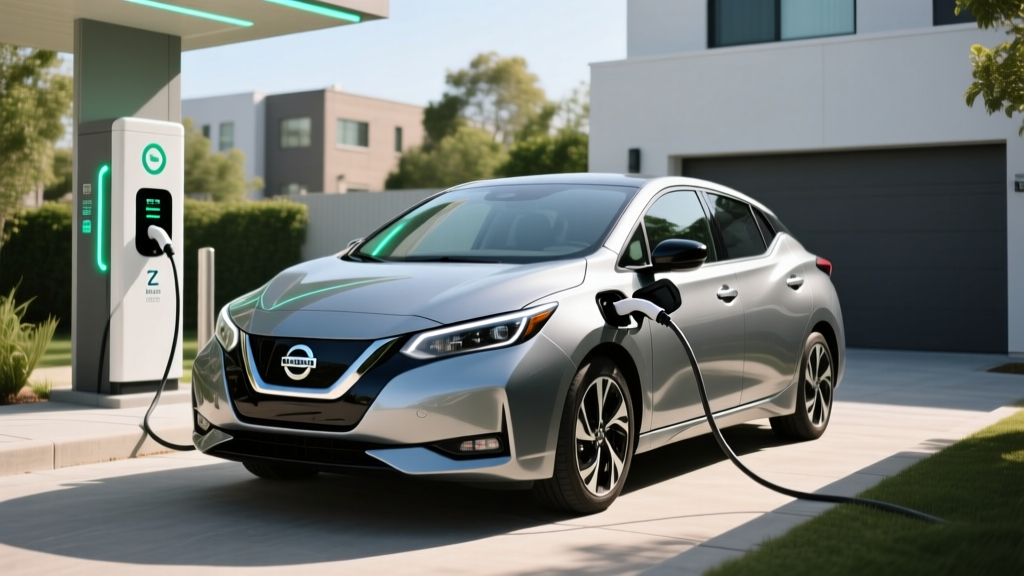
The 2026 Nissan Leaf remains one of the most affordable new battery-electric vehicles on the US market, and understanding its charging behavior is essential before you plug in for the first time. Whether you own the standard Leaf S with its 40 kWh battery or the SV Plus with the larger 60 kWh pack, the charging hardware inside the car sets hard limits on how quickly you can add range — no matter how powerful the station you plug into.
This guide covers every charging scenario a Leaf owner will encounter: overnight Level 1 from a standard outlet, Level 2 home and workplace charging, and DC fast charging on road trips. We'll also walk through the real cost to install a home charger, the CHAdeMO-versus-NACS connector question that has grown more urgent in 2026, and what you'll actually pay per mile compared to a gas car.
| Specification | Leaf S (Standard) | Leaf SV Plus |
|---|---|---|
| Usable Battery Capacity | ~40 kWh (LMO/NMC) | ~60 kWh (LMO/NMC) |
| EPA Range | 149 mi | 212 mi |
| Onboard AC Charger (Level 2) | 6.6 kW (single-phase) | 6.6 kW (single-phase) |
| Max DC Fast Charge Rate | ~50 kW | ~100 kW (peak) |
| DC Fast Connector | CHAdeMO | CHAdeMO |
| AC Connector | J1772 | J1772 |
| 10–80% DC Fast Charge (est.) | ~45 min | ~40 min |
| Liquid Battery Cooling | No (passive air) | No (passive air) |
The critical detail many new Leaf buyers miss: the car uses a CHAdeMO connector for DC fast charging, not the CCS1 or NACS (Tesla-style) plug that now dominates the North American market. That single fact shapes where you can fast-charge on road trips and whether you'll need adapters. More on that below.
Charging Levels Explained: How Fast Will Each Add Range?
EV charging is measured in kW (kilowatts), which is the rate of power flow — think of it as how wide the hose is. The battery capacity is measured in kWh (kilowatt-hours), which is the total energy stored — the size of the tank. A higher kW rate fills the kWh tank faster. Here's how that plays out for the 2026 Leaf at each level:
| Charging Level | Power (kW) | Voltage / Amps | Range Added per Hour | Full Charge Time (60 kWh) |
|---|---|---|---|---|
| Level 1 (Standard Outlet) | ~1.4 kW | 120V / 12A | ~5 mi/hr | ~43 hours |
| Level 2 (Home / Workplace) | 6.6 kW (car-limited) | 240V / 30A circuit | ~24 mi/hr | ~9 hours |
| DC Fast Charging | Up to ~100 kW (SV Plus) | 400V+ DC | ~180 mi/hr (peak) | 10–80% in ~40 min |
Real-World Range Note: The EPA rates the 2026 Leaf SV Plus at 212 miles. In real-world highway driving at 70 mph with climate control, expect roughly 170–190 miles. In cold weather (below 32°F), range can drop 20–30% due to battery resistance and cabin heating demands, bringing usable range to approximately 150–170 miles. The Leaf's lack of a heat pump (it uses resistive PTC heating) makes winter efficiency noticeably worse than EVs equipped with heat pump systems.
Level 1: The Emergency Trickle
Every Leaf ships with a 120V portable charging cord. Plugged into a standard household outlet on a dedicated 15A circuit, it delivers roughly 1.4 kW — adding about 5 miles of range per hour. For the 60 kWh SV Plus pack, a full charge takes over 40 hours. Level 1 is viable only if you drive fewer than 30–40 miles per day and can leave the car plugged in for 10+ hours overnight. It's a fallback, not a daily strategy for most owners.
Level 2: The Daily Workhorse
A 240V Level 2 station is where the Leaf does most of its charging. The car's onboard charger maxes out at 6.6 kW, meaning even if you install a 48A (11.5 kW) home charger, the Leaf will only accept 6.6 kW — roughly 27.5 amps at 240V. This is a hardware ceiling set by the car, not the charger.
At 6.6 kW, the 60 kWh pack charges from empty to full in about 9 hours. In practice, most owners plug in at 20–30% state of charge and wake up to 100% — an 8-hour session adds roughly 190 miles of range, more than enough for daily needs. According to fueleconomy.gov, the 2026 Leaf SV Plus achieves 111 MPGe combined, meaning it consumes about 30 kWh per 100 miles of driving.
DC Fast Charging: Road-Trip Reality
The Leaf SV Plus can accept up to approximately 100 kW at a DC fast charger — but only briefly. Because the Leaf uses passive air cooling for its battery (no liquid thermal management), sustained high-power charging generates heat, and the car's battery management system throttles the charge rate to protect the cells. Here's what a typical session looks like:
- 10–40% SoC: Peak rate of ~80–100 kW (if battery is preconditioned and ambient temps are moderate)
- 40–60% SoC: Rate tapers to ~60–70 kW
- 60–80% SoC: Further taper to ~40–50 kW
- Above 80% SoC: Sharp taper below 20 kW — charging past 80% is painfully slow and generally not worth the wait on a road trip
The standard-range Leaf S with the 40 kWh pack peaks closer to 50 kW, making its 10–80% time roughly 45 minutes. For the SV Plus, expect a 10–80% session in about 35–45 minutes depending on battery temperature and station capability.
Important caveat: The Leaf's lack of active battery thermal management means repeated DC fast charges on a hot day or during back-to-back road-trip stops will trigger progressively more aggressive throttling. This phenomenon, sometimes called "Rapidgate," was widely documented in earlier Leaf generations and persists in reduced form in the 2026 model. If your typical road trip involves more than two DC fast charges in a single day, expect the third and fourth sessions to be significantly slower.
CHAdeMO vs. NACS: The Connector Problem in 2026
The 2026 Nissan Leaf is one of the last mainstream EVs still using the CHAdeMO DC fast-charging connector. Almost every other major automaker — Ford, GM, Rivian, Hyundai, Kia, BMW, and others — has adopted or is transitioning to the NACS (Tesla-style) connector, and many public networks have prioritized NACS/CCS1 stall deployment over CHAdeMO.
| Connector Type | Use Case | Leaf Compatible? | Adapter Available? |
|---|---|---|---|
| J1772 | Level 1 & Level 2 AC charging | Yes (native) | N/A — built-in |
| CHAdeMO | DC fast charging | Yes (native) | N/A — built-in |
| CCS1 | DC fast charging (most non-Tesla networks) | No | CHAdeMO-to-CCS1 adapters exist but are rare, expensive (~$400+), and not universally supported by networks |
| NACS (Tesla) | Tesla Supercharger network | No | No reliable CHAdeMO-to-NACS adapter currently available for DC fast charging |
What this means practically: At home and at workplaces with J1772 Level 2 stations, you'll have zero issues — J1772 is the universal AC standard. For DC fast charging, your best-access networks are Electrify America (which still maintains CHAdeMO connectors at many stations), EVgo (CHAdeMO at select locations), and independent CHAdeMO-equipped stations. However, the CHAdeMO public network has not expanded meaningfully since 2023, while NACS and CCS1 infrastructure has grown rapidly.
Before buying a 2026 Leaf, map your most common road-trip routes against CHAdeMO station availability using apps like PlugShare. If your corridor is well-served, the Leaf works fine. If you frequently drive routes where CHAdeMO stations are sparse or unreliable, a NACS or CCS1-equipped EV will give you far more charging flexibility.
How Much Does It Cost to Install a Home EV Charger?
Home Level 2 charging is where the Leaf makes the most sense economically. But the total installed cost varies enormously depending on your home's electrical panel, the distance from the panel to your parking spot, and local permit requirements.
Electrical Requirements for the Leaf
Because the Leaf's onboard charger maxes at 6.6 kW, you need a 240V circuit rated for at least 30 amps (the National Electrical Code requires circuits to be rated at 125% of the continuous load, so a 6.6 kW / 27.5A load requires a 30A minimum circuit, though a 40A circuit is common and future-proof). If you plan to eventually upgrade to an EV with a faster onboard charger, installing a 50A or 60A circuit now adds modest cost but saves a future re-wire.
Installation Cost Breakdown
| Component | Low End | High End | Notes |
|---|---|---|---|
| Level 2 EVSE (charger hardware) | $250 | $650 | 32A–40A smart charger; see equipment picks below |
| Electrician labor (240V circuit run) | $400 | $1,200 | Depends on distance from panel, wall/floor penetrations, conduit run |
| Electrical permit & inspection | $50 | $250 | Varies by municipality; some jurisdictions waive for simple installs |
| Panel upgrade (if needed) | $1,500 | $3,500+ | Required if your panel is at capacity (common in homes with 100A service or older); involves replacing the panel and possibly the service drop |
| Total (no panel upgrade) | $700 | $2,100 | Most homeowners with 200A service fall in this range |
| Total (with panel upgrade) | $2,200 | $5,600+ | Homes with 100A service or maxed-out panels |
Panel upgrade reality check: Many homes built before 2000 have 100-amp or 150-amp electrical service. Adding a 30–40A dedicated EV circuit may push the panel past its safe capacity, especially if you already run electric dryer, oven, and HVAC. A licensed electrician will perform a load calculation per NEC Article 220 to determine if an upgrade is required. Don't skip this step — an overloaded panel is a fire risk and will fail inspection.
Some utility companies offer rebates of $200–$500 for Level 2 charger installation, and certain states provide additional incentives. Check with your local utility and your state energy office. A licensed electrician should always perform the final installation and pull the required permits — this is not a DIY project for the 240V circuit.
How Much Does Charging Cost per Mile vs. Gas?
One of the strongest arguments for the Leaf is fuel-cost savings. Here's a realistic breakdown using the Leaf SV Plus's efficiency of approximately 30 kWh per 100 miles (per EPA data), compared to a typical compact gas car averaging 30 MPG.
| Charging / Fueling Scenario | Cost per kWh / Gallon | Leaf Cost per Mile | Gas Car Cost per Mile ($3.50/gal) | Savings per Mile |
|---|---|---|---|---|
| Home charging (off-peak utility rate) | $0.12/kWh | $0.036 | $0.117 | $0.081 |
| Home charging (average US rate) | $0.17/kWh | $0.051 | $0.117 | $0.066 |
| Public Level 2 (network pricing) | $0.25/kWh | $0.075 | $0.117 | $0.042 |
| DC Fast Charging (public) | $0.40/kWh | $0.120 | $0.117 | −$0.003 (gas cheaper) |
The takeaway: If you charge primarily at home on an off-peak rate, the Leaf costs roughly 3.6 to 5.1 cents per mile to fuel — about one-third the cost of a 30 MPG gas car. Over 15,000 miles per year, that's a savings of approximately $1,000–$1,200 annually.
However, if you rely exclusively on public DC fast charging at $0.40/kWh or more, the Leaf actually costs slightly more per mile than the gas car. This is why home or workplace Level 2 charging is the economic linchpin of Leaf ownership. The car's value proposition works best when you can charge where you park, not where you stop.
Many utilities offer time-of-use (TOU) rates that drop electricity to $0.08–$0.10/kWh overnight. If your utility offers TOU, programming your Leaf or your smart charger to charge between midnight and 6 AM can push your fuel cost below 3 cents per mile.
Recommended Home Chargers for the 2026 Nissan Leaf
Since the Leaf caps at 6.6 kW on AC, you don't need the most powerful charger on the market — but you do want a reliable, safe, and smart unit on a properly sized circuit. Here are three chargers well-suited to Leaf owners, each with a J1772 connector (native to the Leaf for AC charging):
Emporia Vue Level 2 Smart Charger
- Power Output: Up to 48A / 11.5 kW (Leaf will draw 27.5A / 6.6 kW)
- Connector: J1772
- Cable Length: 24 ft
- Smart Features: Wi-Fi, app scheduling, energy monitoring, solar integration, TOU rate optimization
- Price: ~$350–$400
- Best For: Budget-conscious buyers who want smart scheduling and energy tracking
ChargePoint Home Flex
- Power Output: Configurable 16A–50A / up to 12 kW (set via DIP switch to match circuit)
- Connector: J1772
- Cable Length: 23 ft
- Smart Features: Wi-Fi, app scheduling, Alexa integration, ChargePoint network ecosystem
- Price: ~$550–$650
- Best For: Owners who want a proven brand with flexible amperage and a robust app
Grizzl-E Smart Level 2 Charger
- Power Output: Up to 40A / 9.6 kW
- Connector: J1772
- Cable Length: 24 ft
- Smart Features: Wi-Fi, OCPP-compatible, app control, adjustable amperage
- Price: ~$400–$450
- Best For: Outdoor installations (rated to −40°F, IP65 enclosure) and Canadian/northern US climates
Why not a 48A charger? While you can install a 48A charger on a 60A circuit, the Leaf will never draw more than 6.6 kW (~27.5A). A 32A charger on a 40A circuit is the sweet spot — it fully utilizes the Leaf's onboard charger capacity with room to spare, costs less, and requires a smaller circuit. If you plan to own a faster-charging EV in the future, oversize the circuit now (run 60A/48A-capable wiring) but start with a lower-cost charger.
Safety, Electrical Code, and Installation Best Practices
EV charging is a continuous high-amperage load that runs for hours — it's more demanding on your home wiring than almost any other appliance. Here are the non-negotiable safety and code requirements:
- Dedicated circuit: Your Level 2 charger must be on its own dedicated 240V circuit with no other loads sharing it. The NEC (National Electrical Code) classifies EV charging as a continuous load, so the circuit must be rated at 125% of the charger's maximum draw. A 32A charger requires a 40A circuit; a 40A charger requires a 50A circuit.
- GFCI protection: The 2020 NEC and later require GFCI (Ground Fault Circuit Interrupter) protection for EV outlets in garages and outdoor locations. Many modern EVSEs have built-in ground-fault protection, but your electrician must verify code compliance in your jurisdiction.
- Outdoor rating: If your charger is installed outside (driveway, carport), it must carry an outdoor/NEMA 4 or IP65+ rating. The Grizzl-E and ChargePoint Home Flex both meet this requirement.
- Hardwired vs. plug-in: Chargers rated above 40A generally must be hardwired (no plug). At 32A, a NEMA 14-50 or NEMA 6-50 receptacle is common and allows you to unplug the charger if you move. Hardwired installations are slightly cheaper (no receptacle cost) and eliminate one potential point of connection failure.
- Permit and inspection: Most jurisdictions require an electrical permit for a new 240V circuit. The inspection ensures the wire gauge, breaker size, and grounding meet code. Skipping the permit can void your homeowner's insurance if a fire occurs.
- Wire gauge: For a 40A circuit, 8 AWG copper wire (THHN in conduit) is standard. For a 50A circuit, 6 AWG. Your electrician will size wire based on the circuit length and load — longer runs may require thicker wire to prevent voltage drop.
Frequently Asked Questions
How fast does the 2026 Nissan Leaf charge at home on Level 2?
At its maximum 6.6 kW onboard charger rate on a 240V Level 2 station, the Leaf SV Plus (60 kWh) adds roughly 24 miles of range per hour and charges from empty to full in about 9 hours. A typical overnight session from 30% to 100% takes roughly 6–7 hours.
Can I charge the 2026 Leaf at a Tesla Supercharger?
No. The Leaf uses a CHAdeMO connector for DC fast charging, and Tesla Superchargers use the NACS connector. There is currently no reliable, widely supported CHAdeMO-to-NACS adapter for DC fast charging. You can charge at Tesla Destination Chargers (Level 2, J1772-compatible) with a simple Tesla-to-J1772 adapter for AC charging, but not at Superchargers.
Why does the Leaf's DC fast charging slow down so much?
The Leaf uses passive air cooling for its battery pack rather than the liquid thermal management systems found in most competitors. During DC fast charging, the battery cells generate significant heat, and without active liquid cooling, the car's battery management system must reduce the charge rate to keep cell temperatures within safe limits. This taper becomes more aggressive in hot weather and during repeated same-day fast charging sessions.
Does the 2026 Leaf qualify for the federal EV tax credit?
Federal §30D tax credit eligibility depends on the vehicle's battery component and critical mineral sourcing, MSRP caps (under $55,000 for sedans/hatchbacks), and buyer income limits ($150,000 single / $300,000 joint). The Leaf has historically qualified for partial or full credit, but sourcing requirements change frequently. Check the latest eligibility list at fueleconomy.gov and consult a tax professional. As of 2026, the credit can be transferred to the dealer as a point-of-sale discount under IRS rules.
What electrical upgrades might I need for a home charger?
If your home has a 200-amp electrical panel with available capacity, you likely need only a new 240V dedicated circuit — no panel work required. If your home has 100-amp service or your panel is near capacity (common with electric heat, dryer, oven, and AC), a panel upgrade to 200A may be required, adding $1,500–$3,500+ to the project. An electrician's load calculation per NEC Article 220 will determine this before any work begins.
Is it worth getting a smart charger, or is a basic unit fine?
A smart charger (Wi-Fi enabled, app-controlled) is worth the $50–$100 premium for most Leaf owners. Key benefits include scheduled charging to take advantage of off-peak utility rates, energy consumption tracking, remote start/stop, and firmware updates. If your utility offers time-of-use rates, a smart charger's scheduling feature can save $200–$400 per year by ensuring the Leaf charges only during the cheapest overnight window.
How long will the Leaf's battery last, and what's the warranty?
Nissan provides a battery warranty of 8 years / 100,000 miles against capacity loss below 9 bars (out of 12) on the capacity gauge — roughly equivalent to 65–70% of original capacity. The Leaf's LMO/NMC chemistry has proven durable in moderate climates, but passive air cooling means the battery degrades faster in consistently hot environments (Arizona, Texas) than liquid-cooled competitors. Expect 80–85% state of health after 8 years in moderate climates, based on long-term fleet data from earlier Leaf generations.