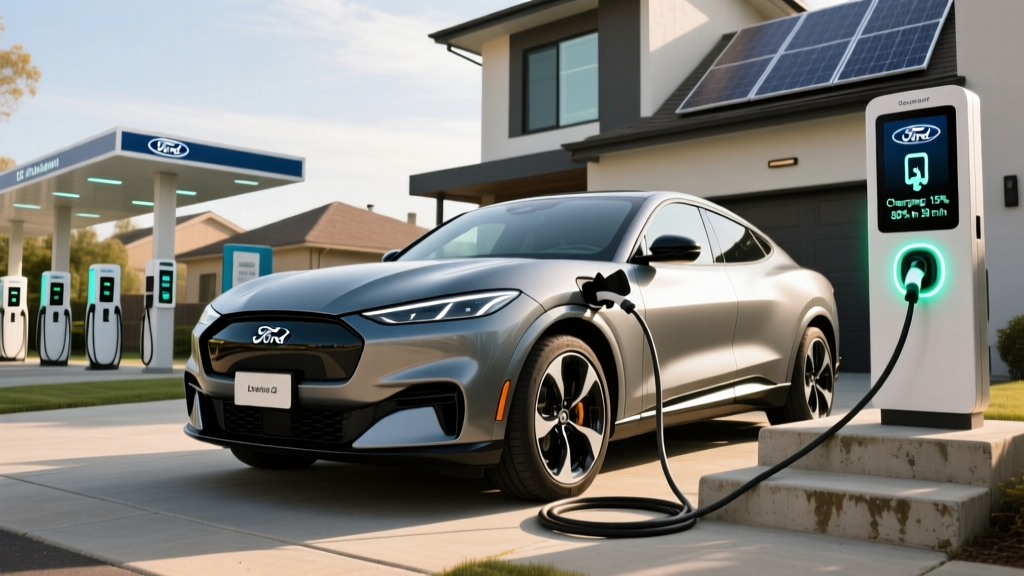
The 2026 Ford Mustang Mach-E arrives with a critical hardware shift: a native NACS (Tesla-style) charge port, replacing the CCS1 connector used on 2021–2025 models. That single change reshapes where and how you charge — unlocking the Tesla Supercharger network without an adapter while altering your public-charging strategy. Whether you're plugging in at home overnight or road-tripping cross-country, this guide gives you the exact numbers for every 2026 Mach-E battery configuration.
2026 Mach-E Battery Options and What They Mean for Charging
Ford offers the 2026 Mustang Mach-E with two lithium-ion battery packs. Both use NMC (nickel manganese cobalt) chemistry, which delivers higher energy density than LFP but benefits from staying between 20–80% state of charge for daily driving to minimize long-term degradation.
| Spec | Standard Range | Extended Range |
|---|---|---|
| Usable Battery Capacity | 75.7 kWh | 91.0 kWh |
| EPA Range (Select/Premium RWD) | 250 mi | 320 mi |
| Real-World Highway Range* | ~215–230 mi | ~270–290 mi |
| Max DC Fast Charge Rate | 150 kW (peak) | 150 kW (peak) |
| DC Fast 10–80% Time | ~35 min | ~42 min |
| Onboard AC Charger (Level 2) | 10.5 kW (48A) | 10.5 kW (48A) |
| Charge Port | NACS (native, no adapter for Tesla Superchargers) | |
Charging Levels Explained: Speeds and Range Added Per Hour
Understanding the three charging levels is essential. kW (kilowatts) measures power — how fast energy flows into the battery. kWh (kilowatt-hours) measures energy — the total capacity of the battery itself. Think of kW as the flow rate of a hose and kWh as the size of the bucket.
| Level | Voltage / Amperage | Power (kW) | Miles of Range Added Per Hour | Best For |
|---|---|---|---|---|
| Level 1 (120V household) | 120V / 12A | ~1.4 kW | ~3–4 mi/hr | Emergency top-ups, PHEVs |
| Level 2 (240V home/public) | 240V / 48A | 10.5 kW (max) | ~28–32 mi/hr | Daily home charging |
| DC Fast Charging | 400V+ DC | Up to 150 kW peak | ~200–250 mi/hr (at peak) | Road trips, quick stops |
At Level 1, a full Standard Range recharge from empty takes roughly 54 hours — impractical for daily use. Level 2 is the home-charging standard: the Mach-E's 10.5 kW onboard charger will replenish the Standard Range battery from 10–100% in about 7.5 hours and the Extended Range in roughly 9 hours. That's ideal for overnight charging.
DC fast charging delivers power directly to the battery, bypassing the onboard charger. However, the Mach-E's peak rate of 150 kW is not sustained across the entire session. Like all EVs, the charge curve tapers significantly above 80% state of charge to protect battery health. That 10–80% time of 35–42 minutes reflects the realistic usable window — charging from 80–100% can add another 20+ minutes for relatively few miles gained.
Home Charger Installation: Requirements, Costs, and Gotchas
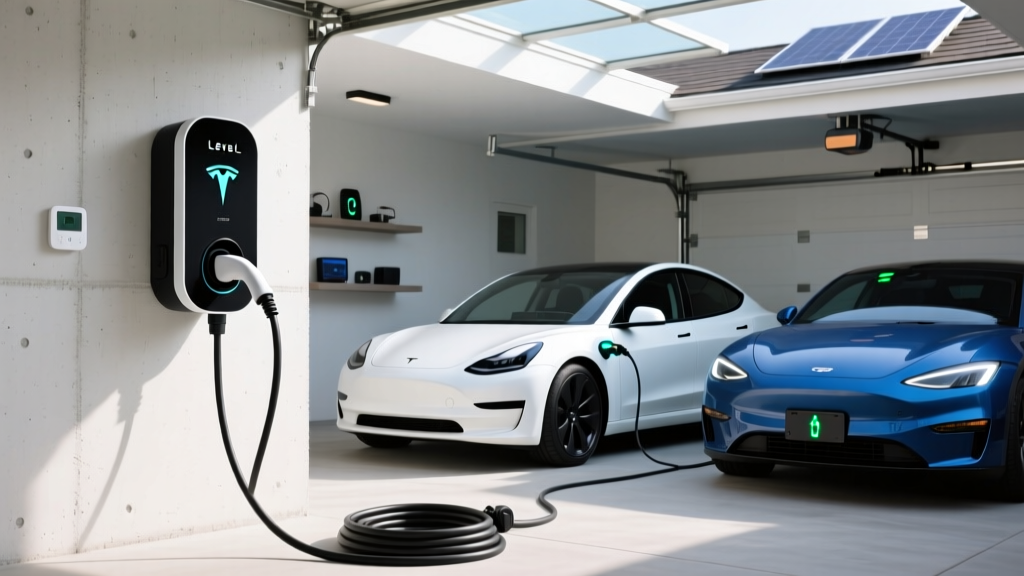
A Level 2 home charger is the single most impactful upgrade for Mach-E ownership. You'll wake up to a full battery every morning, eliminating routine public-charging dependence. But installation costs vary dramatically based on your home's electrical infrastructure.
Electrical Requirements for the 2026 Mach-E
To take full advantage of the Mach-E's 10.5 kW onboard charger, you need a 240V / 60-amp dedicated circuit with a NEMA 14-60 outlet or a hardwired connection. The 60A breaker supports a continuous 48A draw (National Electrical Code requires a 20% headroom above continuous load). If your charger maxes at 40A, a 50A breaker and NEMA 14-50 outlet will suffice, delivering 9.6 kW — slightly slower but still practical overnight.
Panel Upgrade Considerations
Homes built before 2000 often have 100A or 150A main service panels. Adding a 60A EV circuit to an already-loaded panel may require a panel upgrade to 200A, which is the most expensive variable in the installation equation. An electrician will perform a load calculation to determine if your panel can handle the additional circuit. Signs you may need an upgrade: your panel is near capacity with existing appliances (electric range, dryer, HVAC), you have a Federal Pacific or Zinsco panel (known safety hazards requiring replacement), or your home has original 100A service.
| Component | Simple Install (panel has capacity, short run) | Complex Install (panel upgrade, long conduit run) |
|---|---|---|
| Level 2 Charger Equipment | $400–$700 | $400–$700 |
| Electrical Permit | $50–$150 | $50–$200 |
| Electrician Labor (short run, <20 ft) | $400–$800 | — |
| Electrician Labor (long run, conduit, 40+ ft) | — | $1,200–$2,500 |
| Panel Upgrade (if needed) | — | $1,500–$3,500 |
| Total Estimated Range | $850–$1,650 | $3,150–$6,900 |
Always hire a licensed electrician and pull a permit — unpermitted EV charger installations can void homeowner's insurance claims and cause issues at resale. Some utilities offer rebates of $250–$500 for Level 2 installations, and certain states provide additional incentives. Check your utility's website and AFDC's state incentive database for current programs.
Connector Compatibility: NACS, CCS, and the 2026 Transition
The 2026 Mach-E's native NACS port is the biggest charging story for this model year. Here's what that means for every charging scenario you'll encounter:
| Network / Scenario | Connector Required | 2026 Mach-E Status |
|---|---|---|
| Tesla Superchargers (V3/V4) | NACS | ✅ Native — no adapter needed |
| Electrify America | CCS1 or NACS (select stations) | ⚠️ CCS1 adapter may be needed at older stalls |
| EVgo | CCS1 / NACS (expanding) | ⚠️ Check station for NACS availability |
| ChargePoint (DC Fast) | CCS1 or NACS | ⚠️ Varies by station — many adding NACS |
| Home Level 2 (J1772 chargers) | J1772 | ⚠️ NACS-to-J1772 adapter needed (often included with charger) |
| Home Level 2 (NACS chargers) | NACS | ✅ Direct plug-in |
Ford includes a NACS-to-CCS1 adapter with the 2026 Mach-E for use at legacy public DC fast chargers that haven't yet added NACS cables. The public-charging infrastructure is mid-transition: most new installations in 2025–2026 include NACS connectors, but many 2022–2024 vintage stations still have CCS1 only. Keep the adapter in your frunk.
For Level 2 home and public AC charging, many existing J1772 chargers are compatible via a J1772-to-NACS adapter. If you're buying a new home charger, choosing a NACS-connector model eliminates the adapter entirely.
Recommended Home Chargers for the 2026 Mach-E
These Level 2 chargers pair well with the Mach-E's 10.5 kW onboard charger. All are NACS-connector models (or available with NACS) and support the 48A continuous draw needed for maximum charging speed.
Ford Charge Station Pro (NACS)
- Power Output: 10.5 kW (48A at 240V)
- Connector: NACS (native)
- Cable Length: 25 ft
- Smart Features: Wi-Fi, FordPass app scheduling, OTA updates, energy usage tracking
- Price: ~$799 (often discounted with vehicle purchase)
- Best For: Seamless Ford ecosystem integration, Power Control integration for future V2H
Tesla Wall Connector (Gen 4)
- Power Output: 11.5 kW (48A at 240V)
- Connector: NACS (native)
- Cable Length: 24 ft
- Smart Features: Wi-Fi, Tesla app, load sharing with multiple units, power sharing
- Price: ~$499
- Best For: Multi-EV households (including a Tesla), best value at 48A
ChargePoint Home Flex (NACS version)
- Power Output: Up to 12 kW (50A at 240V) — adjustable down
- Connector: NACS (2025+ models)
- Cable Length: 23 ft
- Smart Features: Wi-Fi, ChargePoint app, Alexa, flexible amperage settings
- Price: ~$649
- Best For: Homes with lower-capacity circuits (can be set to 32A or 40A)
Any of these chargers will fully utilize the Mach-E's 10.5 kW onboard charger. The Ford Charge Station Pro offers the tightest app integration, while the Tesla Wall Connector is the most cost-effective at full amperage. The ChargePoint Home Flex is the most flexible if your electrical panel can't support a full 60A circuit — it can be configured down to match your available capacity.
Cost to Charge: Mach-E vs. Gas and by Scenario
Charging costs depend heavily on where and when you plug in. Here's a realistic breakdown using the Extended Range Mach-E (91 kWh battery, ~3.5 mi/kWh efficiency) and a comparable gas vehicle averaging 26 MPG combined.
| Scenario | Rate ($/kWh) | Cost to Add 100 Miles | Cost Per Mile |
|---|---|---|---|
| Home — Off-Peak Utility Rate | $0.09–$0.13 | $2.60–$3.70 | $0.026–$0.037 |
| Home — Standard Residential Rate | $0.14–$0.18 | $4.00–$5.20 | $0.040–$0.052 |
| Public Level 2 (ChargePoint, etc.) | $0.25–$0.39 | $7.20–$11.20 | $0.072–$0.112 |
| DC Fast (Electrify America / EVgo) | $0.35–$0.55 | $10.00–$15.80 | $0.100–$0.158 |
| Tesla Supercharger (V3/V4) | $0.28–$0.42 | $8.00–$12.10 | $0.080–$0.121 |
| Gas Vehicle (26 MPG, $3.40/gal) | — | $13.10 | $0.131 |
At home on off-peak rates, the Mach-E costs roughly one-quarter what a comparable gas vehicle costs per mile. Even on DC fast chargers at peak pricing, the Mach-E is generally cheaper per mile than gasoline. The cost advantage is largest when you charge at home — which is why a Level 2 installation pays for itself relatively quickly for high-mileage drivers.
For a driver covering 12,000 miles per year with 80% home charging (off-peak) and 20% DC fast charging, annual fuel cost runs approximately $550–$700. A comparable gas vehicle at 26 MPG and $3.40/gallon would spend roughly $1,570. That's $870–$1,020 in annual fuel savings, which offsets the home charger installation in 1–3 years depending on your install complexity.
Safety, Code, and Practical Installation Tips
EV charging draws significant current for extended periods — often 8+ hours continuously. This makes proper installation non-negotiable. Key requirements and best practices:
- Dedicated circuit: Your Level 2 charger must be on its own dedicated breaker — never shared with other appliances. The 2026 Mach-E at 48A requires a 60A breaker.
- GFCI protection: The 2023 NEC requires GFCI protection for all EV charging outlets. Hardwired installations may exempt this requirement in some jurisdictions — your electrician will advise based on local code.
- Outdoor rating: If your charger is installed outdoors (garage-adjacent or driveway), ensure the unit is NEMA 4-rated for weather resistance. All three recommended chargers above carry outdoor ratings.
- Cable management: A 25-ft cable is long enough for most garage configurations. If your charge port and outlet are on the same side, 18 ft may suffice, but longer cables add flexibility for future vehicles or parking reconfiguration.
- WiFi and smart scheduling: Use your charger's app or the FordPass app to schedule charging during off-peak utility hours (often 10 PM – 6 AM), reducing your per-kWh cost by 30–50% compared to peak rates.
- Permit and inspection: Every jurisdiction requires a permit for new 240V circuits. The inspection verifies wire gauge, breaker sizing, grounding, and GFCI compliance — protecting you from fire risk and insurance disputes.
Frequently Asked Questions
How much does it cost to install a home EV charger for the 2026 Mach-E?
A straightforward installation with an adequate electrical panel typically runs $850–$1,650 including equipment, labor, and permit. If your home needs a panel upgrade from 100A to 200A service, total costs can reach $3,150–$6,900. Always get two to three quotes from licensed electricians and verify they have specific EV charger installation experience.
How fast will each charging level add range to my Mach-E?
Level 1 (120V) adds about 3–4 miles per hour — essentially useless for daily driving. Level 2 (240V at 48A) adds 28–32 miles per hour, fully replenishing the Extended Range battery overnight in about 9 hours. DC fast charging adds 200–250 miles per hour at its 150 kW peak, though the charge curve tapers above 80%, making 10–80% in 35–42 minutes the practical metric.
Which connector does the 2026 Mach-E use?
The 2026 Mustang Mach-E uses a native NACS (North American Charging Standard / Tesla-style) connector. This means direct compatibility with Tesla Superchargers without an adapter. For legacy CCS1 public chargers, Ford includes a NACS-to-CCS1 adapter. For older J1772 Level 2 public chargers, a J1772-to-NACS adapter is needed.
How much does charging cost per mile compared to gas?
Home charging on off-peak utility rates costs $0.026–$0.037 per mile in the Mach-E Extended Range. A comparable 26 MPG gas vehicle at $3.40/gallon costs $0.131 per mile. Even at peak DC fast-charging rates ($0.10–$0.16/mi), the Mach-E is cheaper than gas. Your biggest savings come from maximizing home charging.
What electrical upgrades might I need?
The most common upgrade is a panel capacity increase from 100A or 150A to 200A service, which costs $1,500–$3,500. You may also need a new conduit run from the panel to the garage ($30–$60 per foot for long runs), a sub-panel if your main panel is far from the charger location, or replacement of an outdated panel (Federal Pacific, Zinsco, or Challenger panels must be replaced regardless of EV charging needs). A licensed electrician's load calculation will determine exactly what your home requires.
Can I charge the 2026 Mach-E at Tesla Superchargers?
Yes. The 2026 Mach-E has a native NACS port, meaning it plugs directly into Tesla Supercharger V3 and V4 stalls without any adapter. Access is managed through the FordPass app, which integrates Supercharger locations and payment. Supercharger V3 stalls deliver up to 150 kW to the Mach-E (matching its peak acceptance rate), while V4 stalls are capable of higher power that the Mach-E cannot fully utilize.
Should I charge to 100% every night?
No. The Mach-E uses NMC battery chemistry, which degrades faster when held at high states of charge for extended periods. Ford recommends setting a daily charge limit of 80% through the FordPass app or the vehicle's infotainment system. Reserve 100% charges for road trips when you need maximum range. This single habit can meaningfully extend your battery's usable lifespan over the 8-year/100,000-mile battery warranty period.