The Real Story Behind the 2026 bZ4X Range
If you're researching the 2026 bZ4X range and charging logistics, you already know Toyota's first mass-market EV has had an interesting evolution. The 2026 model year brings modest but meaningful improvements to efficiency and charging speed, but the real ownership experience hinges on one decision most buyers underprepare for: how you'll charge at home. This guide breaks down exactly what the 2026 bZ4X delivers on a full battery, how fast each charging level replenishes it, what a Level 2 home installation actually costs, and which equipment earns our recommendation based on real-world use.
2026 Toyota bZ4X Range: EPA vs. Real World
EPA Estimated Range: 252 miles (FWD, 19-inch wheels) / 228 miles (AWD, 20-inch wheels)
Real-World Expectation: ~210–230 miles highway (70+ mph); ~180–200 miles in sub-freezing weather; ~235–245 miles mixed city driving with regen. Your actual range depends heavily on temperature, terrain, and driving style.
Battery: 71.4 kWh usable capacity (Lithium-ion, NMC chemistry)
Efficiency: 119 MPGe combined (FWD) / 104 MPGe combined (AWD) per fueleconomy.gov
The 71.4 kWh battery pack is mid-pack for the compact electric SUV segment — smaller than a Hyundai Ioniq 5's 77.4 kWh pack but comparable to the Subaru Solterra's shared platform. That capacity, paired with the bZ4X's relatively conservative thermal management system, means your home charging setup matters more than it does for vehicles with larger buffers or faster charge acceptance.
Charging Levels Explained: Speeds, Times, and What the bZ4X Accepts
Before choosing equipment, you need to understand the three charging tiers and how the bZ4X interacts with each. A critical distinction: kW (kilowatts) measures charging power — how fast energy flows. kWh (kilowatt-hours) measures energy capacity — how much the battery holds. Think of kW as the width of a pipe and kWh as the size of the tank.
| Level | Voltage | Max Power (kW) | Miles Added/Hour | 10–80% Time (bZ4X) | Best Use Case |
|---|---|---|---|---|---|
| Level 1 | 120V AC | 1.4 kW | ~4 mi/hr | ~35+ hours | Emergency / overnight trickle |
| Level 2 | 240V AC | 7.2 kW (bZ4X onboard limit) | ~24 mi/hr | ~7.5 hours (0–100%) | Daily home charging |
| DC Fast | 400V+ DC | 150 kW peak (CCS) | ~180 mi in 15 min (peak) | ~30 minutes (10–80%) | Road trips, quick top-ups |
The 2026 bZ4X's onboard charger maxes out at 7.2 kW on Level 2 AC. That means even if you install a 48-amp (11.5 kW) home charger, the bZ4X will only draw 7.2 kW — roughly 30 amps. You won't damage anything by using a higher-capacity charger (the car regulates its own draw), and a higher-rated unit gives you headroom for a future EV. On DC fast charging, Toyota rates the bZ4X at a peak of 150 kW, though in practice the charge curve tapers significantly above 60% state of charge. Expect sustained rates closer to 80–100 kW through the bulk of the session, with a noticeable slowdown past 80%. This is normal for NMC chemistry — the battery management system protects cell longevity by reducing current as the pack fills.
Home Charger Installation: Electrical Requirements and Real Costs
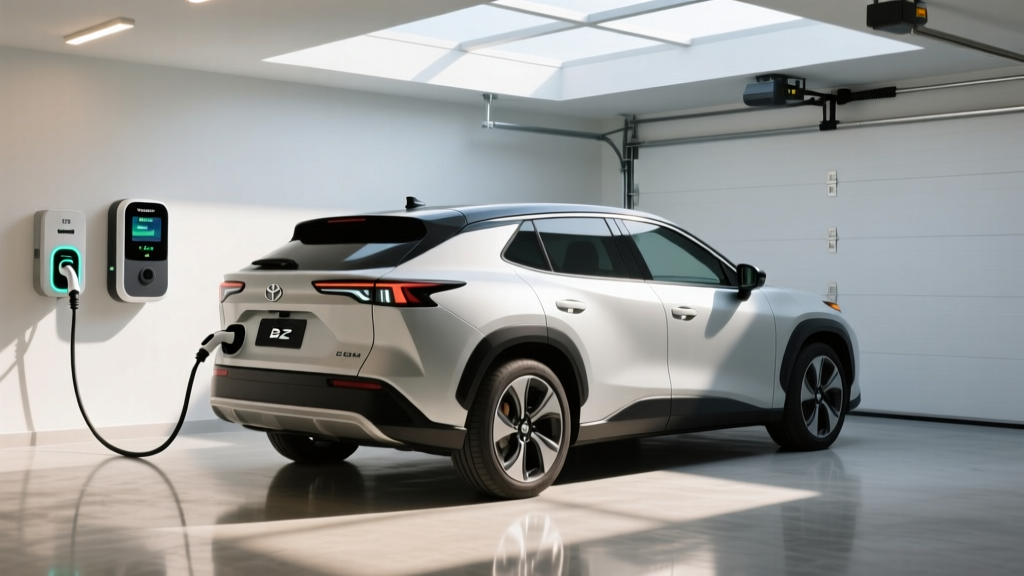
A Level 2 home charger is the backbone of practical EV ownership. For the bZ4X, a 240V circuit delivers a full overnight charge in roughly 7–8 hours — more than enough for daily driving. Here's what's actually involved.
Electrical Requirements for the bZ4X
- Voltage: 240V (standard for Level 2 — same as a dryer or oven circuit)
- Circuit amperage: 40A dedicated breaker minimum (supports 32A continuous draw per NEC 80% rule)
- Recommended circuit: 50A breaker / 40A continuous — provides headroom and future-proofs for a second EV or higher-power vehicle
- Wire gauge: 6 AWG copper (for 50A circuit) or 8 AWG (for 40A circuit), run in conduit where exposed
- Outlet type: NEMA 14-50 (most common) or hardwired connection (required for some chargers above 40A)
Panel Upgrade Reality Check
Most modern homes with 200-amp electrical service can accommodate a 40–50A EV circuit without a panel upgrade. However, if your home has a 100-amp panel (common in houses built before 1990), you'll likely need an upgrade to 200A. A panel upgrade adds $1,500–$3,500 to your project and may require utility coordination. Have a licensed electrician perform a load calculation before committing to equipment.
| Component | Typical Cost Range | Notes |
|---|---|---|
| Level 2 Charger (hardware) | $300–$700 | Varies by brand, power output, smart features |
| Electrician labor (standard install) | $500–$1,500 | Depends on run length, wall type, panel proximity |
| Electrical permit | $50–$200 | Required in most jurisdictions; varies by municipality |
| Panel upgrade (if needed) | $1,500–$3,500 | 100A → 200A; not needed for most modern homes |
| Conduit and wiring materials | $100–$400 | Longer runs and outdoor routing increase cost |
| Total (no panel upgrade) | $950–$2,800 | Most common scenario for 200A homes |
| Total (with panel upgrade) | $2,450–$6,300 | Older homes with 100A service |
The federal Alternative Fuel Vehicle Refueling Property Credit (IRS Form 8911) may cover up to 30% of home charging equipment and installation costs, capped at $1,000, if you live in an eligible census tract. Check current-year eligibility with a tax professional — rules and qualifying areas change.
Connector Compatibility: What Plugs Into the 2026 bZ4X?
The 2026 Toyota bZ4X uses the CCS1 (Combined Charging System) connector for both Level 2 AC and DC fast charging in North America. This is the standard shared by most non-Tesla EVs, though the industry is rapidly shifting toward NACS (Tesla's North American Charging Standard). Here's how the connector landscape looks for bZ4X owners:
| Connector | Type | bZ4X Native? | Adapter Available? | Network Access |
|---|---|---|---|---|
| CCS1 | AC + DC | Yes (native) | Not needed | Electrify America, EVgo, ChargePoint, most public networks |
| J1772 | AC only | Yes (CCS1 includes J1772) | Not needed | All Level 2 public stations |
| NACS (Tesla) | AC + DC | No | Yes — aftermarket CCS-to-NACS adapters (~$200–$300) | Tesla Supercharger network (15,000+ stalls) |
| CHAdeMO | DC only | No | Not available | Limited legacy stations; avoid relying on this |
Practical recommendation: The bZ4X's CCS1 port works natively at Electrify America, EVgo, and most non-Tesla DC fast chargers. However, Tesla's Supercharger network is the largest and most reliable in the U.S. A CCS-to-NACS adapter (from a reputable brand like Lectron or A2Z) unlocks Supercharger access and is worth the $200–$300 investment, especially for road trips. Verify adapter compatibility with the bZ4X's specific CCS port geometry before purchasing — some early adapters had fit issues with Toyota's port design.
Charging Cost: What You'll Actually Spend Per Mile
One of the strongest arguments for the bZ4X over a gas-powered RAV4 is fuel cost, but the savings depend heavily on where and when you charge. Here's a realistic breakdown using the bZ4X's efficiency of approximately 3.2 miles per kWh (FWD, combined driving).
| Charging Scenario | Avg Cost/kWh | Cost per Mile | Cost to "Fill" (10–80%) | vs. Gas (RAV4 AWD, 28 MPG, $3.40/gal) |
|---|---|---|---|---|
| Home (off-peak utility rate) | $0.09 | $0.028 | $3.15 | 88% cheaper |
| Home (standard residential avg) | $0.16 | $0.050 | $5.60 | 78% cheaper |
| Public Level 2 (ChargePoint, etc.) | $0.25–$0.35 | $0.08–$0.11 | $8.75–$12.25 | 55–68% cheaper |
| DC Fast (Electrify America) | $0.35–$0.48 | $0.11–$0.15 | $12.25–$16.80 | 35–55% cheaper |
| Gasoline equivalent (RAV4 AWD) | — | $0.121 | $17.00 (equiv.) | Baseline |
At home on off-peak rates, the bZ4X costs roughly 3 cents per mile — less than a quarter of what a comparable gas SUV spends. Even on the most expensive DC fast chargers, you're still saving money per mile in most scenarios. The key takeaway: home charging is where the economics work best. If you rely exclusively on public DC fast charging, your per-mile cost approaches that of a fuel-efficient gas car, and the time cost of 30-minute stops adds up on commutes.
Recommended Level 2 Chargers for the bZ4X
Since the bZ4X caps Level 2 charging at 7.2 kW (32 amps), you don't strictly need a 48-amp charger. But installing a 40-amp or 48-amp unit on a 50A or 60A circuit gives you flexibility for future EVs and doesn't cost significantly more in hardware. Here are three chargers we recommend based on reliability, features, and value:
Emporia Vue Smart EV Charger
- Max Output: 48A (11.5 kW on 240V)
- Connector: J1772 (CCS1 compatible for AC charging)
- Cable Length: 24 feet
- Smart Features: Wi-Fi, app scheduling, energy monitoring, solar integration
- Price: ~$350–$400
- Why for bZ4X: Best budget smart charger; scheduling lets you target off-peak utility rates automatically. The 48A output exceeds the bZ4X's 7.2 kW draw but future-proofs your install.
ChargePoint Home Flex
- Max Output: 50A (12 kW, configurable down to 16A–50A)
- Connector: J1772 (CCS1 AC compatible)
- Cable Length: 23 feet
- Smart Features: Wi-Fi, Alexa/Google integration, ChargePoint app, detailed session history
- Price: ~$550–$650
- Why for bZ4X: Amperage configurability is excellent for older panels — you can dial it to 32A (matching the bZ4X's max) on a 40A circuit or run it at 50A for future vehicles. Strong app ecosystem.
Grizzl-E Smart
- Max Output: 40A (9.6 kW on 240V)
- Connector: J1772 (CCS1 AC compatible)
- Cable Length: 24 feet
- Smart Features: OCPP-compatible, app control, OTA updates, extreme cold rating (-40°F)
- Price: ~$450–$550
- Why for bZ4X: Built in Canada for harsh winters; ideal if you're charging in an unheated garage or outdoor mount in cold climates. Robust build quality with a 3-year warranty.
All three chargers use the J1772 connector, which is the AC portion of the CCS1 port on your bZ4X. You simply plug in — no adapter needed for home Level 2 charging. For outdoor installations, ensure your charger carries a NEMA 4 (weatherproof) rating, which all three above satisfy.
Safety, Permits, and Code Requirements
A Level 2 charger installation is not a DIY project. The National Electrical Code (NEC) treats EV charging as a continuous load, which triggers specific requirements:
- Dedicated circuit: Your EV charger must have its own breaker — it cannot share a circuit with other appliances or outlets.
- 80% rule: A continuous load (charging for 3+ hours, which EVs routinely do) cannot exceed 80% of the breaker rating. A 40A breaker supports 32A continuous; a 50A breaker supports 40A continuous.
- GFCI protection: The 2020 NEC and later require GFCI protection for outdoor receptacles used for EV charging. Hardwired installations may have different requirements depending on your local jurisdiction.
- Permit and inspection: Most municipalities require an electrical permit for a new 240V circuit. The inspection ensures proper wire gauge, breaker sizing, grounding, and conduit use. Budget $50–$200 for the permit and plan for a 1–2 week inspection window.
- Outdoor rating: If mounting outdoors, the charger must carry at minimum a NEMA 4 rating. The connector holster should include a weather cover. Cable management prevents trip hazards and UV degradation.
Skip the permit and you risk voiding your homeowner's insurance coverage for electrical fires, plus potential issues at resale when unpermitted work is flagged. Always hire a licensed electrician who pulls permits as standard practice.
Charging the bZ4X in Cold Weather: What Changes
The 2026 bZ4X uses a heat pump for cabin climate (standard on most trims), which helps preserve range in cold weather compared to resistive heating. However, battery chemistry still suffers in the cold. Expect the following:
- Range loss: 15–30% reduction in real-world range at temperatures below 32°F. A bZ4X FWD rated at 252 EPA miles may deliver 180–210 miles in sustained 20°F weather with cabin heat.
- Slower DC charging: Cold batteries accept charge more slowly. If you arrive at a DC fast charger without preconditioning the battery, peak charge rates may drop from 150 kW to 80–100 kW until the pack warms. Use the bZ4X's navigation-based preconditioning (set a DC charger as your destination) to mitigate this.
- Level 2 charging time: Cold-weather Level 2 charging may take 10–20% longer as the battery management system diverts some power to warming the pack.
For cold-climate owners, a garage-mounted Level 2 charger is strongly preferred over outdoor charging. Even an unheated garage keeps the battery 10–20°F warmer than ambient, improving both charge acceptance and morning range.
Frequently Asked Questions
How much does it cost to install a home EV charger for the bZ4X?
Most homeowners spend between $950 and $2,800 for a complete Level 2 installation (charger + electrician + permit) assuming a 200-amp panel with adequate capacity. If your home needs a panel upgrade from 100A to 200A, add $1,500–$3,500, bringing the total to $2,450–$6,300. The federal Alternative Fuel Vehicle Refueling Property Credit may offset up to $1,000 of this cost if you're in a qualifying census tract.
How fast will each charging level add range to the 2026 bZ4X?
Level 1 (120V) adds roughly 4 miles per hour — useful only for overnight trickle or emergencies. Level 2 (240V, 7.2 kW max on the bZ4X) adds approximately 24 miles per hour, fully recharging overnight. DC fast charging at 150 kW peak can add roughly 180 miles in a 15–20 minute session (10–80%), though the charge curve tapers above 60% state of charge.
Which connector is compatible with my 2026 bZ4X?
The bZ4X uses CCS1 natively, which includes the J1772 connector for AC charging. This works with virtually all public Level 2 stations and most non-Tesla DC fast chargers (Electrify America, EVgo, ChargePoint). For Tesla Supercharger access, you'll need an aftermarket CCS-to-NACS adapter ($200–$300). CHAdeMO is not compatible and has no adapter solution.
How much does charging the bZ4X cost per mile compared to gas?
Charging at home on off-peak rates (~$0.09/kWh), the bZ4X costs about $0.03 per mile. On standard residential rates (~$0.16/kWh), it's about $0.05 per mile. A comparable gas SUV (Toyota RAV4 AWD at 28 MPG combined, $3.40/gallon) costs roughly $0.12 per mile. Home charging saves 60–88% on fuel costs. Even DC fast charging at $0.40/kWh ($0.13/mile) remains competitive with gas in most markets.
What electrical upgrades might I need for a Level 2 charger?
If your home has a 200-amp electrical panel with available capacity (determined by an electrician's load calculation), you likely need only a new dedicated 40–50A breaker and a 240V circuit run to your garage or parking spot. If you have a 100-amp panel (common in pre-1990 homes), you'll almost certainly need a panel upgrade to 200A, which costs $1,500–$3,500. Other potential upgrades include adding a sub-panel if your main panel is full, or trenching conduit for detached garages with long wire runs.
Should I get a 32-amp or 48-amp charger if the bZ4X only draws 32 amps?
Install the 48-amp unit on a 60A circuit. The incremental hardware cost is small ($50–$100 more), and it future-proofs your installation for your next EV — which will very likely support faster AC charging. The bZ4X will simply draw what it needs (32A / 7.2 kW) and ignore the rest. Never install a charger rated above 80% of your circuit breaker — a 48A charger requires a 60A breaker minimum.
Can I use the Toyota-supplied charging cable for daily Level 2 charging?
The bZ4X comes with a dual-voltage portable charging cable that supports 120V (Level 1) and 240V (Level 2) via a NEMA 14-50 plug. At 240V, it delivers approximately 32A (7.6 kW), which is adequate for daily charging. However, portable cables lack smart scheduling, energy monitoring, and the robust cable management of a wall-mounted unit. They're fine as a primary charger if you already have a 14-50 outlet, but a dedicated wall unit is more reliable for daily use and offers features like off-peak scheduling that directly reduce your electricity bill.
For the most current 2026 bZ4X specifications, consult Toyota's official bZ4X page. For federal charging equipment tax credit details, reference the IRS Alternative Fuel Vehicle Refueling Property Credit page and confirm eligibility with a qualified tax professional before filing.