The 2025 Tesla Model 3 Long Range remains one of the most efficient sedans in the EV market, pairing a 75 kWh (usable) LFP/NMC battery pack with an EPA-estimated 363 miles of range and a peak DC fast-charge rate of 250 kW. But owning one means understanding how to charge it effectively at home, on the road, and at public stations — and what that actually costs in time and dollars.
This guide breaks down every charging scenario for the 2025 Tesla Model 3 Long Range with real numbers: installation costs, electrical requirements, connector compatibility, charging speeds at every level, and a per-mile cost comparison against gasoline. Whether you're preparing your garage before delivery or planning your first road trip, these are the figures that matter.
EPA Estimate: 363 miles (AWD Long Range trim)
Real-world highway (70-75 mph, moderate temps): ~300-320 miles
Cold-weather highway (below 32°F): ~240-270 miles
City/mixed driving with regen: ~330-355 miles
Source: EPA fueleconomy.gov
2025 Tesla Model 3 Long Range: Key Charging Specs at a Glance
| Specification | Value |
|---|---|
| Battery Capacity (usable) | ~75 kWh (NMC chemistry) |
| EPA Range | 363 miles (Long Range AWD) |
| Max DC Fast Charge Rate | 250 kW peak |
| DC Fast Charge 10-80% | ~25 minutes (at V3 Supercharger) |
| Level 2 AC Charge Rate | 11.5 kW max (48A onboard charger) |
| Level 2 Miles Per Hour | ~44 mi/hr at 11.5 kW |
| Connector | NACS (native Tesla) |
| Efficiency | 132 MPGe combined / 25 kWh/100mi |
| Starting MSRP (Long Range AWD) | $47,740 (before incentives) |
Charging Levels Explained: Speeds, kW, and Range Per Hour
Understanding charging levels means understanding the difference between kW (kilowatts) and kWh (kilowatt-hours). kW measures power — how fast energy flows into your battery at any given moment. kWh measures energy — the total capacity stored in your battery. Think of kW as the flow rate of a hose and kWh as the size of the bucket. The 2025 Model 3 Long Range has a ~75 kWh bucket, and you can fill it at different flow rates.
| Charging Level | Voltage | Max Power (kW) | Miles Added Per Hour | Best For |
|---|---|---|---|---|
| Level 1 (Standard Outlet) | 120V | 1.0-1.4 kW | 3-5 mi/hr | Emergency/top-up, low daily mileage |
| Level 2 (Home/Public AC) | 240V | 7.2-11.5 kW | 30-44 mi/hr | Daily home charging, workplace, destination |
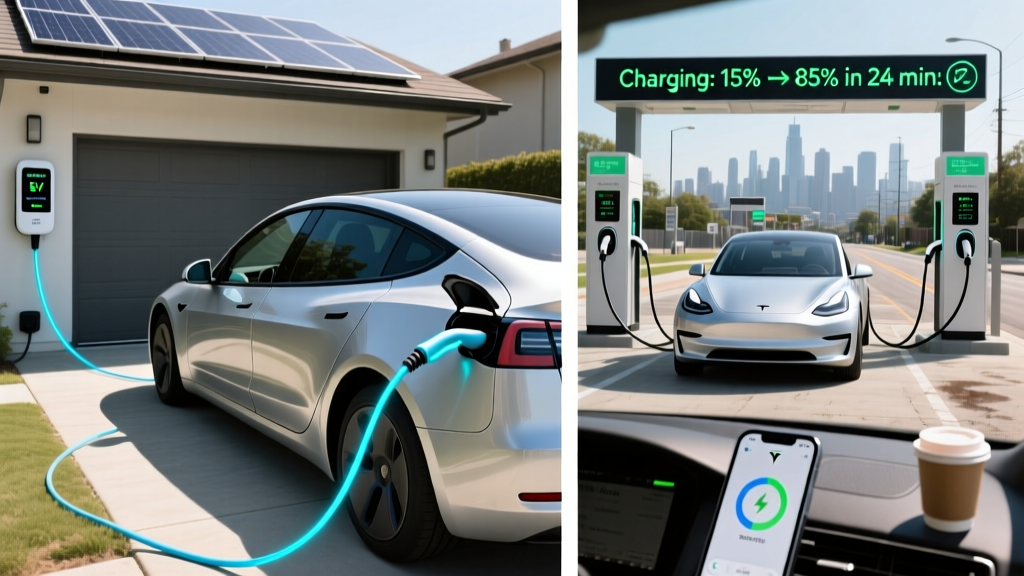
| DC Fast Charging | 400V+ | Up to 250 kW | ~200+ mi in 15 min | Road trips, rapid replenishment |
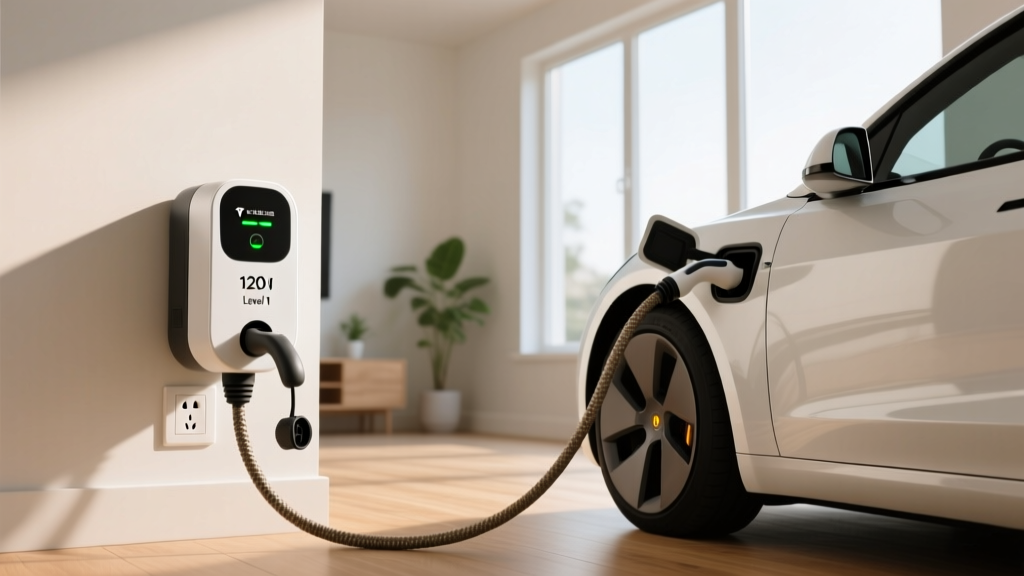
Level 1 uses a standard 120V household outlet with Tesla's included Mobile Connector. At 12A, you'll add roughly 3-5 miles of range per hour — enough for a 30-40 mile daily commute if you plug in every night, but painfully slow for a full recharge (over 50 hours from 10-80%).
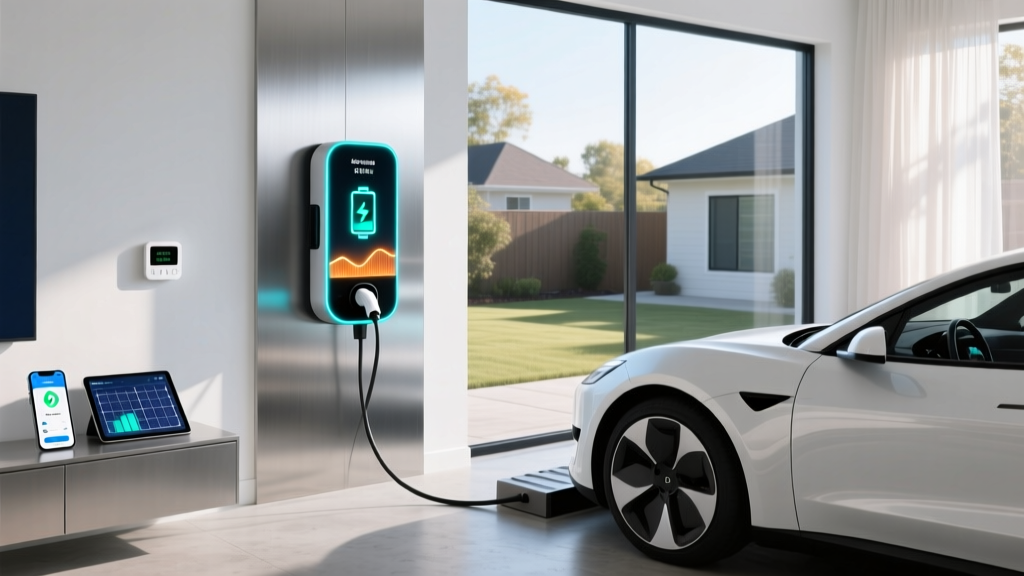
Level 2 is the standard for daily charging. On a 240V circuit at 48 amps, the Model 3 Long Range's onboard charger accepts up to 11.5 kW, adding roughly 44 miles of range per hour. A full 10-80% charge takes approximately 6-7 hours — perfect for overnight replenishment.
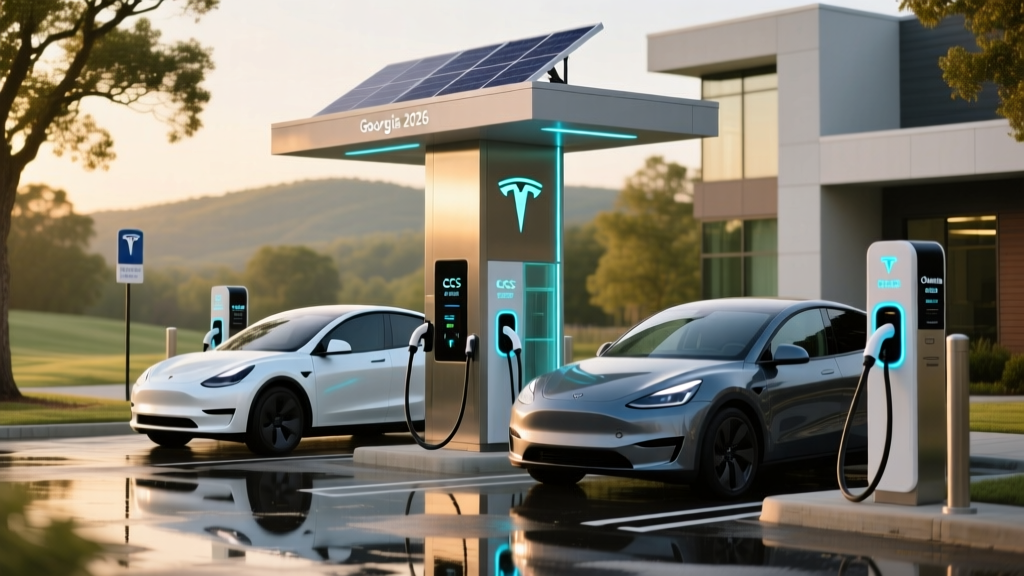
DC Fast Charging bypasses the onboard charger and sends DC power directly to the battery. At a Tesla V3 Supercharger (250 kW peak), the Model 3 Long Range can add up to 175 miles in 15 minutes. However, peak rate is not sustained rate — the charge curve tapers significantly above 50-60% state of charge (SoC), which is why 10-80% takes ~25 minutes rather than a linear calculation would suggest.
Home Charger Installation: Electrical Requirements and Cost Breakdown
Installing a Level 2 home charger for the 2025 Tesla Model 3 Long Range is the single biggest ownership preparation step — and the one with the widest cost variance. Your total depends on your home's electrical panel capacity, the distance from panel to charger location, and local permit requirements.
Electrical Requirements
The Model 3 Long Range's 11.5 kW onboard charger performs best on a 240V, 60-amp dedicated circuit (which delivers a continuous 48A to the vehicle per NEC 80% rule). You'll need:
- A 60A double-pole breaker in your main panel
- 6 AWG copper wire (or 4 AWG aluminum) for runs up to ~100 feet; thicker gauge for longer runs
- A NEMA 14-50 receptacle (if using a plug-in charger) or hardwired connection
- GFCI protection is required by NEC 2020 for outdoor receptacles; many jurisdictions now require it indoors as well
- Outdoor-rated (NEMA 4) enclosure if mounted outside
Panel Upgrade Considerations
Most homes built after 2000 have a 200A main panel, which can usually accommodate a 60A EV circuit. Older homes with 100A service may need a panel upgrade to 200A — a significant added cost. Even with a 200A panel, if your existing loads (electric oven, dryer, HVAC, water heater) are already consuming significant capacity, a licensed electrician may recommend a load-management device or a dedicated sub-panel. Always get a professional load calculation before committing to a circuit size.
| Component | Cost Range | Notes |
|---|---|---|
| EV Charger Equipment | $250 - $700 | Tesla Wall Connector, ChargePoint, Emporia, etc. |
| Electrician Labor (standard install) | $600 - $1,800 | Depends on run distance, wall type, conduit needs |
| Electrical Permit | $50 - $300 | Varies by municipality |
| Panel Upgrade (if needed) | $1,500 - $3,500 | 100A → 200A service upgrade |
| Additional Conduit/Wiring (long runs) | $200 - $800 | Runs over 50 feet, underground conduit |
| Total (no panel upgrade) | $900 - $2,800 | Typical scenario for modern homes |
| Total (with panel upgrade) | $2,400 - $6,300 | Older homes with 100A service |
Which Connector Is Compatible With the 2025 Model 3 Long Range?
The 2025 Tesla Model 3 Long Range comes equipped with the North American Charging Standard (NACS) connector — Tesla's proprietary design that has been adopted as the industry standard by Ford, GM, Rivian, Hyundai, and most other major automakers starting in 2025.
This means you can charge natively at:
- All Tesla Supercharger stations (V2, V3, and V4)
- Growing numbers of non-Tesla public chargers now equipped with NACS cables (Electrify America, EVgo, and others are adding NACS connectors through 2025-2026)
For older public chargers that only have CCS1 connectors, Tesla includes or sells a CCS adapter (~$175-$250) that allows the Model 3 to charge at CCS-equipped stations. CHAdeMO is effectively obsolete for new vehicles and is not supported without a costly third-party adapter that is generally not recommended.
| Connector Type | Compatibility | Adapter Needed? | Availability |
|---|---|---|---|
| NACS (Tesla native) | Direct plug-in | No | All Tesla Superchargers; growing public networks |
| CCS1 | Via adapter | Yes — Tesla CCS Adapter (~$175-250) | Electrify America, EVgo, many public stations |
| CHAdeMO | Not supported | N/A (third-party adapters not recommended) | Declining; mostly older Nissan/Leaf infrastructure |
| J1772 (Level 2 AC) | Via included adapter | Yes — Tesla J1772 adapter (included) | Most public Level 2 stations, workplaces, hotels |
Cost to Charge: Home vs. Public vs. Gasoline
The 2025 Model 3 Long Range consumes approximately 25 kWh per 100 miles (combined EPA). This efficiency figure is the key to calculating your real fuel cost.
| Charging Scenario | Rate ($/kWh) | Cost Per Full Charge (75 kWh) | Cost Per Mile | Annual Cost (12,000 mi) |
|---|---|---|---|---|
| Home (off-peak utility rate) | $0.08 - $0.14 | $6.00 - $10.50 | $0.02 - $0.035 | $240 - $420 |
| Home (standard residential avg.) | $0.16 | $12.00 | $0.04 | $480 |
| Public Level 2 (network pricing) | $0.25 - $0.49 | $18.75 - $36.75 | $0.06 - $0.12 | $750 - $1,470 |
| Tesla Supercharger (avg. 2025) | $0.28 - $0.36 | $21.00 - $27.00 | $0.07 - $0.09 | $840 - $1,080 |
| Gasoline Vehicle (27 MPG, $3.40/gal) | $3.40/gallon | N/A | $0.126 | $1,511 |
The takeaway: Charging at home on off-peak rates saves roughly 75-85% compared to a comparable gasoline sedan. Even exclusive Supercharger use saves 30-45% over gas. The Model 3 Long Range's strong efficiency (25 kWh/100mi) amplifies these savings — less efficient EVs like large SUVs will cost more per mile to charge.
Time-of-use (TOU) utility plans are critical. If your utility offers off-peak rates between 10 PM and 6 AM, scheduling your Model 3 to charge during those windows can cut your home charging cost to $0.02/mile or less. Check with your local utility about EV-specific rate plans — many now offer them.
DC Fast Charging: Real-World Charge Times and Curve Behavior
The 2025 Tesla Model 3 Long Range peaks at 250 kW on a V3 Supercharger — but it does not sustain that rate for the entire session. Understanding the charge curve prevents unrealistic expectations at road-trip stops.
Typical 10-80% Charge Times
- Tesla V3 Supercharger (250 kW peak): ~25 minutes (10-80%). Peak rate sustained from roughly 10-35% SoC, then tapering to ~150 kW through 50%, ~100 kW through 65%, and ~50 kW approaching 80%.
- Tesla V2 Supercharger (150 kW peak): ~35-40 minutes (10-80%). Shared stalls may split power if a second vehicle is plugged in.
- CCS station (via adapter, 150-350 kW rated): ~30-40 minutes (10-80%), depending on station output and adapter throughput limitations. The Tesla CCS adapter may limit throughput to ~150 kW in practice.
- 50 kW DC fast charger (older public stations): ~75-90 minutes (10-80%). Avoid these for road trips if faster options exist on your route.
Pro tip: Use the Tesla navigation system's built-in preconditioning. When you navigate to a Supercharger, the car automatically warms the battery to optimal charging temperature before arrival. In cold weather (below 40°F), preconditioning can shave 5-10 minutes off your charge time and unlock higher peak kW. Without it, a cold battery may initially accept only 50-80 kW even at a 250 kW stall.
Recommended Home Chargers for the 2025 Tesla Model 3 Long Range
Since the Model 3 Long Range uses NACS natively, the most seamless home charging experience comes from NACS-equipped wall connectors. Here are three well-regarded options with the specifications that matter:
Power Output: Up to 11.5 kW (48A)
Connector: NACS (native)
Cable Length: 24 feet
Smart Features: Wi-Fi firmware updates, Tesla app integration, load sharing with second unit, power-sharing across multiple Wall Connectors
Price: ~$475
Verdict: The default choice. Seamless integration, reliable, supports the Model 3's max AC rate. No adapter needed.
Power Output: Up to 11.5 kW (48A)
Connector: J1772 (use included Tesla adapter) or NACS version available
Cable Length: 24 feet
Smart Features: Real-time energy monitoring, solar integration, scheduling, load management, works with Emporia home energy monitor
Price: ~$399 (J1772) / ~$449 (NACS)
Verdict: Best for solar owners or those who want detailed energy tracking. Slightly less polished app than Tesla's.
Power Output: Up to 12 kW (50A circuit, 40A continuous)
Connector: NACS (2025+ version) or J1772
Cable Length: 23 feet
Smart Features: Alexa integration, scheduling, ChargePoint network account, flexible amperage DIP switch settings (16A-50A)
Price: ~$599
Verdict: Flexible amperage is useful if your panel can't support a full 60A circuit. Set to 40A (32A continuous = 7.7 kW) on a 50A breaker.
Safety, Code Compliance, and Installation Best Practices
EV charging involves sustained high-current draw over many hours — unlike a dryer that cycles on and off. This makes code compliance and proper installation critical for long-term safety.
- Dedicated circuit: Your Level 2 charger must be on its own dedicated breaker — never shared with other appliances.
- NEC 80% rule: Continuous loads (defined as 3+ hours) cannot exceed 80% of the breaker rating. A 48A charge requires a 60A breaker. A 40A charge requires a 50A breaker.
- GFCI protection: NEC 2020 requires GFCI for outdoor EV receptacles. Some jurisdictions extend this indoors. Hardwired chargers with built-in ground-fault protection may satisfy this without a GFCI breaker (which can nuisance-trip with EV loads).
- Outdoor rating: If mounted outside, the charger must carry a NEMA 4 (or IP65+) rating for weather resistance. The Tesla Wall Connector is rated for indoor/outdoor use.
- Permit and inspection: Nearly all jurisdictions require an electrical permit for a new 240V circuit. Budget $50-$300 for the permit and expect a post-install inspection. Skipping this can void home insurance coverage for electrical fires.
- Use a licensed electrician: DIY 240V installations carry arc-flash and fire risk. A licensed electrician will perform a load calculation, pull the permit, and provide documentation required for insurance and home resale.
Federal Tax Credit for Home Charger Installation
The Alternative Fuel Vehicle Refueling Property Credit (IRS §30C) — not to be confused with the §30D vehicle purchase credit — covers 30% of the cost of home EV charging equipment and installation, up to $1,000. This applies to the charger hardware and the electrician's labor for the dedicated circuit.
Key eligibility points for 2025-2026:
- The equipment must be installed at your primary residence
- The credit is non-refundable (it reduces your tax liability but won't create a refund beyond what you owe)
- Certain census-tract-based rural/low-income area requirements may apply under updated IRA provisions — check the IRS §30C page for current guidance
- File IRS Form 8911 with your federal tax return
Consult a tax professional to confirm your eligibility — incentive rules shift with legislative updates and your specific tax situation.
Frequently Asked Questions
How much does it cost to install a home EV charger for the 2025 Tesla Model 3 Long Range?
Expect $900-$2,800 for a standard installation in a home with a 200A panel, including the Tesla Wall Connector ($475), electrician labor ($600-$1,800), and permit ($50-$300). If your home needs a panel upgrade from 100A to 200A, add $1,500-$3,500, bringing the total to $2,400-$6,300.
How fast will each charging level add range to the Model 3 Long Range?
Level 1 (120V): 3-5 miles per hour. Level 2 (240V, 48A): ~44 miles per hour. DC fast charging (V3 Supercharger, 250 kW peak): up to 175 miles in 15 minutes, with a 10-80% session taking ~25 minutes.
Which connector and charger is compatible with my 2025 Model 3 Long Range?
The 2025 Model 3 uses the NACS connector natively. It plugs directly into all Tesla Superchargers and an expanding network of NACS-equipped public chargers. For CCS1 stations, you'll need the Tesla CCS adapter (~$175-$250). For J1772 Level 2 public chargers, Tesla includes a J1772 adapter with the vehicle.
How much does charging cost per mile compared to gas?
At a national average residential rate of $0.16/kWh and the Model 3 Long Range's efficiency of 25 kWh/100mi, home charging costs about $0.04/mile. A comparable gasoline sedan at 27 MPG and $3.40/gallon costs $0.126/mile — roughly 3x more. Even Supercharging at $0.32/kWh averages $0.08/mile, still 35% cheaper than gas.
What electrical upgrades might I need for a home charger?
The most common upgrade is a panel capacity increase from 100A to 200A service ($1,500-$3,500). You may also need a new conduit run if your panel is far from the garage, a sub-panel if your main panel is full, or a load-management device if your utility requires it. A licensed electrician's load calculation will determine exactly what's needed.
Can I use a standard outlet to charge the Model 3 Long Range?
Yes, but slowly. A standard 120V/15A outlet with Tesla's Mobile Connector adds about 3-5 miles of range per hour. For a driver covering 30-40 miles daily, overnight Level 1 charging can be sufficient — but it's impractical as a primary strategy for higher-mileage drivers or before road trips.
Does cold weather affect charging speed?
Significantly. A cold battery (below 40°F / 4°C) cannot accept peak charge rates until it warms up. Without preconditioning, you may see initial charge rates of 50-80 kW even at a 250 kW Supercharger. Always navigate to the Supercharger using the car's built-in navigation to trigger automatic battery preconditioning — this can reduce your total charge time by 5-10 minutes in winter.