2025 Ram ProMaster EV Charging Overview: What Fleet Buyers and Owners Need to Know
The 2025 Ram ProMaster EV is Stellantis's first all-electric commercial van sold in North America, built on the STLA Large platform with a usable battery capacity of approximately 110 kWh. For a van this size, charging logistics are the single biggest operational variable — whether you're a fleet manager planning depot charging or a small-business owner plugging in at home overnight. This guide breaks down exactly how to charge the ProMaster EV, what it costs, how fast each level adds range, and what electrical work you may need.
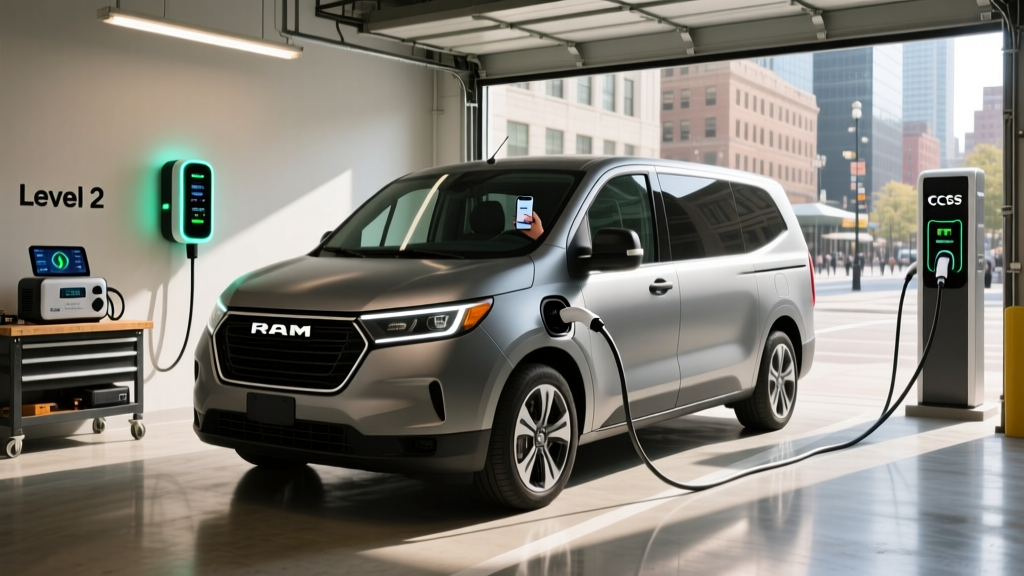
The ProMaster EV uses a CCS1 (Combined Charging System) connector for both Level 2 AC and DC fast charging. It supports up to 150 kW peak DC fast charging and up to 11.5 kW on Level 2 AC. Those numbers dictate your infrastructure decisions, so let's translate them into real-world charging times and costs.
| Battery (usable) | ~110 kWh |
| EPA Est. Range | ~162 miles (cargo van, low roof) |
| Max DC Fast Charge | 150 kW (CCS1) |
| Max Level 2 AC | 11.5 kW |
| Connector | CCS1 (J1772 + DC pins) |
| Base MSRP | ~$58,000 ( Tradesman Cargo Van) |
Sources: Ram Commercial, EPA fueleconomy.gov. Range varies by roof height, wheelbase, and payload.
Charging Levels Explained: How Fast Will Each Add Range?
Understanding the three charging levels is essential before you invest in equipment. The critical distinction: kW (kilowatts) measures power — the rate of energy flow, like water pressure from a hose. kWh (kilowatt-hours) measures energy — the total amount stored in the battery, like gallons in a tank. Charging speed is always in kW; battery size is always in kWh.
| Level | Voltage / Amps | Power (kW) | Miles of Range Added per Hour | 0–100% Time (110 kWh) |
|---|---|---|---|---|
| Level 1 (120V household) | 120V / 12A | ~1.4 kW | ~3–4 mi/hr | ~78+ hours |
| Level 2 (240V home/depot) | 240V / 48A | ~11.5 kW | ~28–32 mi/hr | ~9.5–10 hours |
| DC Fast Charging | 400V+ DC | Up to 150 kW peak | ~180+ mi/hr (at peak) | 10–80% in ~45 min |
Level 1 is a non-starter for daily operations. Adding 3–4 miles per hour to a 110 kWh battery means you'd need multiple days to fully charge from empty. It's only useful as an emergency top-off or for vehicles that drive fewer than 30 miles per day and can plug in for 10+ hours.
Level 2 is the operational backbone for most ProMaster EV owners. At 11.5 kW, the onboard charger can fully replenish the battery in roughly 10 hours — perfect for overnight depot charging or a dedicated home circuit. Fleet operators typically install multiple Level 2 stations at their base.
DC Fast Charging at up to 150 kW is your road-trip and mid-shift solution. Ram estimates a 10–80% charge in approximately 45 minutes. However, charging curves taper significantly above 80% — don't plan on 150 kW sustained for the entire session. Peak rates typically hold between 10–50% state of charge, then gradually decline.
Home and Depot Charger Installation: Electrical Requirements and Costs
Installing a Level 2 charger for the ProMaster EV requires a 240-volt dedicated circuit. Because the van's onboard charger accepts up to 11.5 kW, you'll want a hardwired station rated for at least 48 amps on a 60-amp breaker (the National Electrical Code requires the breaker to be rated at 125% of the continuous load).
What Electrical Upgrades Might You Need?
Most modern homes and commercial buildings have 200-amp electrical panels, which can typically support one or two 60-amp EV circuits. However, older properties with 100-amp service may require a panel upgrade — a significant added cost. A licensed electrician will perform a load calculation to determine if your existing panel has sufficient capacity.
Common upgrade scenarios:
- No upgrade needed: 200A panel with spare capacity — straightforward circuit addition
- Minor upgrade: Adding a sub-panel ($500–$1,500) to distribute load
- Full panel upgrade: Replacing a 100A panel with 200A service ($2,000–$4,500)
- Commercial service upgrade: For fleet depots adding multiple chargers, utility service upgrades can run $5,000–$20,000+
| Component | Low Estimate | High Estimate |
|---|---|---|
| Level 2 charger (48A, hardwired) | $500 | $900 |
| Electrician labor (2–6 hours) | $400 | $1,800 |
| Electrical permit | $50 | $250 |
| Conduit, wiring, misc. materials | $100 | $500 |
| Panel upgrade (if needed) | $0 | $4,500 |
| Total (no panel upgrade) | $1,050 | $3,450 |
| Total (with panel upgrade) | $3,050 | $7,950 |
For fleet depot installations with multiple chargers, contact your utility company early. Many utilities offer commercial EV charging incentives, demand-management programs, or make-ready infrastructure support that can offset thousands in upgrade costs. Check DOE EV infrastructure programs for state-level resources.
Safety and Code Requirements
Any Level 2 installation must comply with NEC Article 625 (Electric Vehicle Charging System Equipment). Key requirements include:
- Dedicated circuit: The charger must have its own breaker — no shared circuits with other appliances
- GFCI protection: Required for outdoor installations and many indoor jurisdictions (2020 NEC and later)
- Outdoor rating: If mounted outside, the station must carry a NEMA 4 or NEMA 4X weather-resistance rating
- Cable management: For commercial installations, retractors or cable management systems prevent trip hazards and cord damage
- Permitting: Nearly all jurisdictions require an electrical permit and post-installation inspection — do not skip this step, as unpermitted work can void insurance coverage
Connector Compatibility: CCS1, NACS, and Adapter Options
The 2025 Ram ProMaster EV ships with a CCS1 (Combined Charging System Type 1) port. This is the standard connector used by most non-Tesla EVs in North America and works natively with Electrify America, EVgo, ChargePoint, and most other public DC fast-charging networks.
| Connector | Native Support? | Adapter Needed? | Notes |
|---|---|---|---|
| CCS1 | Yes — native | No | Standard DC fast charging and Level 2 AC (J1772 upper portion) |
| NACS (Tesla) | No | Yes — CCS1-to-NACS adapter (~$200–$250) | Required to use Tesla Superchargers; verify adapter is rated for 150 kW DC |
| CHAdeMO | No | Not practical | CHAdeMO is being phased out; no reliable adapter exists for CCS vehicles |
| J1772 (Level 2 only) | Yes — native (upper CCS port) | No | All Level 2 public and home stations with J1772 plugs work directly |
Why consider a NACS adapter? Tesla's Supercharger network is the largest and most reliable DC fast-charging network in North America, with over 6,000 stations and 30,000+ stalls. As of 2025, Tesla has opened many Superchargers to non-Tesla CCS vehicles via its Magic Dock connector or through adapter access. A CCS1-to-NACS adapter from a reputable manufacturer (such as Lectron or A2Z) costs $200–$250 and unlocks thousands of additional fast-charging locations — valuable for fleet vehicles on longer routes.
Before purchasing any adapter, confirm it is rated for the ProMaster EV's maximum charge rate (150 kW DC). Some adapters are limited to 50 kW or are rated only for Level 2 AC use.
Charging Cost Per Mile: ProMaster EV vs. Gas ProMaster
The economics of operating an electric commercial van hinge on fuel savings. Here's how the ProMaster EV compares to its gasoline counterpart across common charging scenarios.
| Scenario | Rate | ProMaster EV Cost/Mile | Gas ProMaster Cost/Mile |
|---|---|---|---|
| Home charging (off-peak) | $0.10/kWh | $0.036 | $0.17 (at $3.40/gal, 20 MPG) |
| Home charging (standard) | $0.16/kWh | $0.058 | $0.17 |
| Public Level 2 | $0.30/kWh | $0.109 | $0.17 |
| DC Fast Charging (public) | $0.48/kWh | $0.175 | $0.17 |
Key takeaway: The ProMaster EV delivers dramatic cost savings when charged at home or at a depot on off-peak utility rates — roughly $0.04–$0.06 per mile versus $0.17 for gas. For a fleet vehicle covering 25,000 miles per year, that's a fuel savings of $2,750–$3,250 annually. Over five years, those savings can offset a significant portion of the EV's higher purchase price.
However, frequent reliance on public DC fast charging erodes the advantage. At $0.48/kWh, the per-mile cost is roughly equivalent to gasoline. This is why depot or home Level 2 charging is essential to the business case.
Recommended Level 2 Chargers for the ProMaster EV
Since the ProMaster EV's onboard charger maxes out at 11.5 kW (48 amps at 240V), you need a station that can deliver at least that. Here are three proven options across different budgets and use cases.
ChargePoint Home Flex
- Power Output: Up to 12 kW (50A) — adjustable down
- Connector: J1772 (CCS1 compatible)
- Cable Length: 23 feet
- Smart Features: Wi-Fi, app scheduling, Alexa, energy tracking
- Price: ~$550–$650
- Best For: Home and small-fleet installations with smart scheduling needs
Grizzl-E Smart
- Power Output: Up to 11.5 kW (48A)
- Connector: J1772 (CCS1 compatible)
- Cable Length: 24 feet
- Smart Features: OCPP-compatible, app control, load sharing for multi-charger setups
- Price: ~$450–$550
- Best For: Fleet depots needing load-balanced multi-charger installs; built in Canada for cold weather
Emporia Vue + EV Charger
- Power Output: Up to 11.5 kW (48A)
- Connector: J1772 (CCS1 compatible)
- Cable Length: 24 feet
- Smart Features: Whole-home energy monitoring integration, solar-aware scheduling, app control
- Price: ~$400–$500 (charger); $100+ for Vue panel monitor
- Best For: Properties with solar panels or those wanting detailed energy-use analytics
For commercial fleet depots, consider networked chargers from ChargePoint (CT4000 series), Blink (HQ100), or EVBox that support RFID access, usage billing, and OCPP fleet management software. These typically cost $3,000–$7,000 per dual-port station before installation.
DC Fast Charging: Public Networks and 10–80% Charge Times
When the ProMaster EV needs a quick top-up mid-route, DC fast charging is the solution. At a 150 kW station, the van can add roughly 100 miles of range in about 25–30 minutes, with a 10–80% session taking approximately 45 minutes.
Here's what to expect at different DC fast-charger power levels:
- 50 kW station: 10–80% in ~2 hours — very slow for a 110 kWh battery; avoid if faster options exist
- 100 kW station: 10–80% in ~65 minutes — acceptable for a lunch break stop
- 150 kW station: 10–80% in ~45 minutes — the van's maximum; ideal target
- 350 kW station: 10–80% in ~45 minutes — the van can't use more than 150 kW, so no speed advantage over a 150 kW unit
Charging curve reality: The ProMaster EV will not sustain 150 kW for the entire session. Like all EVs, charge rate peaks at a low state of charge (typically 10–30%) and tapers as the battery fills. Expect peak rates between 10–50% SoC, with a gradual decline to ~80–100 kW in the 50–70% range, and further tapering above 70%. This is normal battery management behavior designed to protect cell longevity.
Major public DC fast-charging networks compatible with the ProMaster EV's CCS1 connector include:
- Electrify America: 150–350 kW stations nationwide; CCS1 native
- EVgo: Growing network of 100–350 kW stations; CCS1 native
- ChargePoint: Mixed DC fast network; CCS1 native
- Tesla Supercharger (with adapter): Requires CCS1-to-NACS adapter; verify station availability for non-Tesla vehicles via the Tesla app
Frequently Asked Questions
How much does it cost to install a home charger for the ProMaster EV?
Expect $1,050–$3,450 for a standard Level 2 installation (48A hardwired station, electrician labor, permit, and materials) if your electrical panel has sufficient capacity. If a panel upgrade from 100A to 200A is needed, add $2,000–$4,500. Commercial fleet installations with multiple chargers and utility service upgrades can exceed $10,000 per site.
Can I charge the ProMaster EV on a regular 120V outlet?
Technically yes, but practically no. Level 1 charging at 120V delivers about 1.4 kW, adding only 3–4 miles of range per hour. Fully charging the 110 kWh battery would take over 78 hours. Level 1 is only viable as an emergency trickle charge.
Does the ProMaster EV work with Tesla Superchargers?
Not natively. The ProMaster EV uses a CCS1 connector, while Tesla Superchargers use NACS. You can purchase a CCS1-to-NACS adapter ($200–$250) to access Tesla's network, but verify that the specific Supercharger station supports non-Tesla vehicles and that the adapter is rated for 150 kW DC.
How long does the ProMaster EV battery last?
Ram provides a battery warranty of 8 years or 100,000 miles (whichever comes first), covering defects and capacity loss below a specified threshold (typically 70% of original capacity). With proper charging habits — avoiding frequent DC fast charging and not regularly storing the van at 100% SoC — the battery should retain usable capacity well beyond the warranty period. LFP or NMC chemistry specifics will be confirmed by Ram; monitor the official Ram Commercial site for updates.
Is the ProMaster EV eligible for the $7,500 federal tax credit?
Eligibility for the §30D Clean Vehicle Credit depends on several factors: the van's MSRP must not exceed $80,000 (vans qualify under the SUV/truck cap), the buyer must meet income limits ($300K joint / $150K single), and the battery must meet critical-mineral and component sourcing requirements that tighten annually. Business buyers may alternatively qualify for the §45W Commercial Clean Vehicle Credit. Always verify current-year eligibility on IRS.gov and consult a tax professional.
What's the best charging strategy for a fleet of ProMaster EVs?
Depot Level 2 charging overnight is the most cost-effective approach. Install hardwired 48A stations on dedicated 60A circuits, use load-management software to distribute available power across multiple chargers, and schedule charging during off-peak utility hours (typically 10 PM – 6 AM). Reserve DC fast charging for mid-shift top-ups or unexpected route extensions. Contact your utility about commercial EV rate plans and make-ready infrastructure programs.