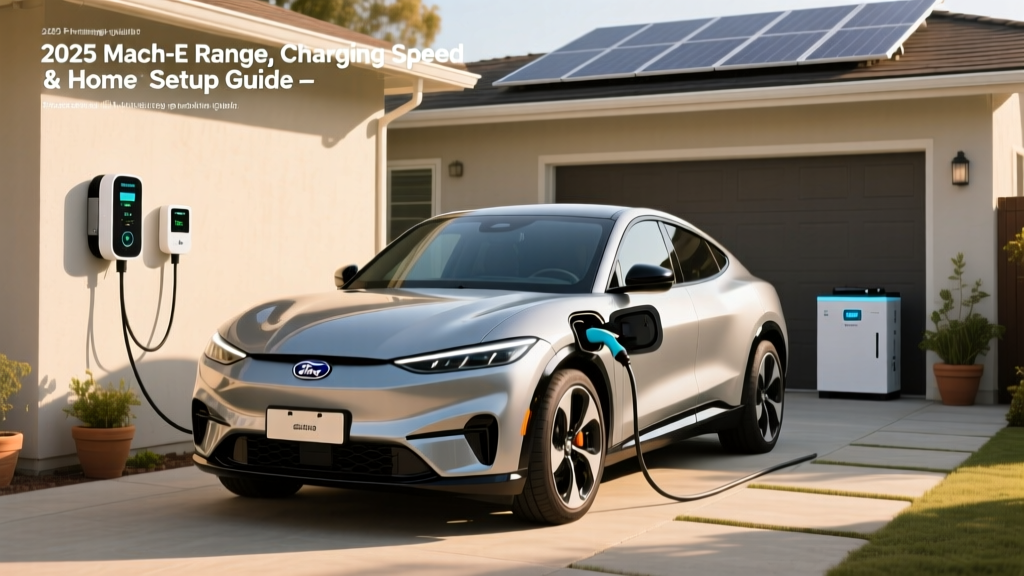
The 2025 Ford Mustang Mach-E is a compelling electric SUV, but extracting maximum utility from it depends entirely on your charging setup. Whether you own the Select trim with the Standard Range battery or the GT with the Extended Range pack, understanding how to replenish its 70 kWh to 91 kWh battery efficiently is the difference between loving EV ownership and feeling tethered to public stations.
This guide covers the 2025 Mach-E range realities, the exact charging speeds you can expect at each level, what it costs to install a home charger, and how to choose the right equipment.
2025 Mach-E Range: EPA vs. Real World
Before discussing electrons, we need to establish how far those electrons take you. The EPA range sticker is a laboratory estimate; real-world driving introduces variables like highway speeds, cold weather, and elevation.
- Select RWD (Standard Range, 70 kWh usable): EPA 250 miles. Expect ~210-225 miles highway (70 mph), ~175-190 miles in freezing weather.
- Premium RWD (Extended Range, 91 kWh usable): EPA 320 miles. Expect ~270-290 miles highway, ~225-245 miles in freezing weather.
- GT AWD (Extended Range, 91 kWh usable): EPA 280 miles. Expect ~235-255 miles highway, ~195-215 miles in freezing weather.
Source: EPA fueleconomy.gov
Cold weather reduces range because the battery must spend energy heating itself and the cabin. The Mach-E's heat pump (standard on most trims) mitigates this somewhat, but 30°F and below still exacts a 15-30% toll. Highway driving at 75+ mph also consumes disproportionately more energy than city driving due to aerodynamic drag.
Charging Levels: Speeds and Range Added Per Hour
Charging speed is measured in kilowatts (kW), which is power — the rate of energy flow. The battery capacity is measured in kilowatt-hours (kWh), which is energy — the total fuel in the tank. Never confuse the two.
| Level | Voltage | Max Power (kW) | Miles of Range Added Per Hour | Best Use Case |
|---|---|---|---|---|
| Level 1 | 120V AC | 1.2 - 1.4 kW | 3 - 5 miles | Overnight top-up, low-mileage drivers |
| Level 2 | 240V AC | 7.2 - 11.5 kW | 20 - 38 miles | Daily home/workplace charging |
| DC Fast Charge | 400V+ DC | 115 - 150 kW (peak) | ~150 - 250 miles in 20 min | Road trips, quick replenishment |
The 2025 Mach-E's onboard charger accepts up to 10.5 kW on Level 2 AC (some earlier model years were limited to 10.5 kW; confirm your specific build). This means even if you install a 48-amp (11.5 kW) charger, the car will only pull about 10.5 kW. For DC fast charging, the Standard Range battery peaks around 115 kW, while the Extended Range battery peaks around 150 kW.
Charging Time: 10-80% and Full Charge Examples
EV charging is not linear. The battery charges fastest between roughly 10% and 50% State of Charge (SoC), then tapers significantly above 80% to protect battery longevity. This is why manufacturers quote 10-80% times rather than 0-100%.
- Standard Range (70 kWh) at 150 kW DCFC: 10-80% in approximately 38-42 minutes. Peak rate sustains to ~55% SoC, then tapers.
- Extended Range (91 kWh) at 150 kW DCFC: 10-80% in approximately 35-40 minutes. Larger battery absorbs peak rate longer.
- Extended Range at 10.5 kW Level 2: 10-80% in approximately 6 hours. Ideal for overnight.
- Standard Range at 10.5 kW Level 2: 10-80% in approximately 4.5 hours.
- Any battery at 1.4 kW Level 1: 10-80% in 35-50+ hours. Only viable for emergency or very low daily mileage.
Pro tip: Use the FordPass app to precondition the battery while navigating to a DC fast charger. This warms the battery to optimal temperature and can shave 5-10 minutes off your charge session, especially in cold weather.
Home Charger Installation: Costs, Electrical Requirements, and Upgrades
Installing a Level 2 home charger is the single biggest ownership upgrade you can make. It transforms your Mach-E from a car you must plan around to one that's always full each morning.
Electrical Requirements
A Level 2 charger requires a dedicated 240V circuit. The amperage depends on your charger:
- 32-amp charger (7.7 kW): Requires a 40-amp breaker (NEC requires circuits to be rated 125% of continuous load).
- 40-amp charger (9.6 kW): Requires a 50-amp breaker.
- 48-amp charger (11.5 kW): Requires a 60-amp breaker.
Since the Mach-E caps at 10.5 kW, a 48-amp charger is the practical maximum. A 40-amp charger (9.6 kW) is often the sweet spot for cost and performance.
Panel Upgrade Considerations
Many homes built before 2000 have 100-amp or 150-amp electrical panels. Adding a 50-amp or 60-amp EV circuit may push you near or over your panel's capacity, especially if you already run electric dryer, oven, and HVAC. An electrician will perform a load calculation to determine if you need a panel upgrade.
Panel upgrades (to 200A service) typically cost $1,500 - $3,500 depending on local labor rates and whether the utility needs to upgrade the service drop. This is the single biggest variable in home charging cost.
| Component | Cost Range | Notes |
|---|---|---|
| Level 2 Charger (Equipment) | $350 - $750 | Varies by brand, power, smart features |
| Electrician Labor (standard install) | $400 - $1,200 | Depends on run length from panel to garage |
| Permit & Inspection | $50 - $300 | Required in most jurisdictions |
| Panel Upgrade (if needed) | $1,500 - $3,500 | Not always required |
| Total (no panel upgrade) | $800 - $2,250 | Typical scenario |
| Total (with panel upgrade) | $2,300 - $5,750 | Older homes with limited capacity |
Safety and Code Requirements
- Dedicated circuit: The charger must be on its own breaker — no sharing with other outlets or appliances.
- GFCI protection: NEC 2020 and later require GFCI breakers for EV circuits in garages and all outdoor installations.
- Outdoor rating: If your charger is mounted outside, it must carry a NEMA 4 or NEMA 4X rating for weather resistance.
- Hardwired vs. plug: Hardwired units (no plug) are common for 48-amp chargers and eliminate the failure point of a receptacle. Plug-in units (NEMA 14-50) offer portability but require a quality receptacle (Hubbell or Bryant brand recommended — cheap ones can overheat).
Always hire a licensed electrician. DIY electrical work on 240V circuits is dangerous and may void your homeowner's insurance in the event of a fire.
Connector Compatibility: NACS, CCS, and Adapter Realities
The 2025 Mach-E uses the CCS1 (Combined Charging System) connector for both AC Level 2 and DC fast charging. However, the charging landscape is shifting rapidly toward the NACS (North American Charging Standard, originally Tesla's connector).
| Connector | Used By | Mach-E Compatibility |
|---|---|---|
| CCS1 | Ford, GM, VW, Hyundai, most non-Tesla | Native — built into the car |
| NACS | Tesla, and all major brands starting 2025-2026 | Requires Ford-provided NACS adapter (for Tesla Superchargers) |
| CHAdeMO | Nissan Leaf (legacy) | Not compatible — network is effectively discontinued |
| J1772 (AC only) | All EVs for Level 1/2 | Native — the top portion of your CCS port |
What this means for 2025 Mach-E owners: Ford has provided a NACS adapter that allows CCS-equipped Mach-E vehicles to charge at Tesla Supercharger V3 stations (up to 150 kW). Confirm with your dealer that your specific VIN received the adapter, or purchase one from Ford's accessory store. You'll also need to activate Tesla Supercharger access through the FordPass app.
For public Electrify America, EVgo, and ChargePoint DCFC stations, your native CCS1 plug works directly. For Level 2 public charging, the J1772 connector (the AC portion) is universal.
Cost to Charge: Per Mile vs. Gasoline
The Mach-E's efficiency is measured in MPGe (miles per gallon equivalent) and kWh per 100 miles. The 2025 Mach-E RWD Extended Range achieves approximately 37 kWh/100mi (or ~91 MPGe combined) per EPA data. Let's translate that to real dollars.
| Scenario | Rate ($/kWh) | Cost per 100 Miles | Cost per Mile |
|---|---|---|---|
| Home (off-peak utility rate) | $0.12 | $4.44 | $0.044 |
| Home (average US rate) | $0.17 | $6.29 | $0.063 |
| Public Level 2 (ChargePoint, etc.) | $0.30 | $11.10 | $0.111 |
| DC Fast Charging (Electrify America) | $0.48 | $17.76 | $0.178 |
| Gasoline equivalent (25 MPG at $3.40/gal) | — | $13.60 | $0.136 |
The takeaway: Home charging at off-peak rates is dramatically cheaper than gas — about $0.04-$0.06 per mile. Public DC fast charging, however, can exceed the cost of gasoline. The economics of EV ownership strongly favor home charging. If you cannot charge at home, a PHEV or hybrid may be a more cost-effective choice.
Equipment Recommendations: Best Home Chargers for the Mach-E
Since the Mach-E caps at 10.5 kW AC charging, a 48-amp (11.5 kW) charger is the optimal match. Here are proven units:
ChargePoint Home Flex
- Power: Up to 12 kW (50 amps), configurable down to 16A for smaller circuits
- Connector: J1772 (plugs into Mach-E's AC port)
- Cable length: 23 feet
- Smart features: Wi-Fi, app scheduling, Alexa, load sharing
- Price: ~$550-$650
- Best for: Flexibility — can be dialed to match any circuit size
Emporia Level 2 EV Charger
- Power: Up to 11.5 kW (48 amps)
- Connector: J1772
- Cable length: 24 feet
- Smart features: Wi-Fi, app, energy monitoring, solar integration
- Price: ~$350-$400
- Best for: Budget-conscious buyers who want smart features
Ford Charge Station Pro
- Power: Up to 11.5 kW (48 amps)
- Connector: J1772 (with CCS compatibility)
- Cable length: 25 feet
- Smart features: FordPass integration, scheduled charging, Intelligent Backup Power (with F-150 Lightning only)
- Price: ~$700-$800
- Best for: Mach-E owners who want native Ford app integration
Grizzl-E Smart
- Power: Up to 10 kW (40 amps)
- Connector: J1772
- Cable length: 24 feet
- Smart features: Wi-Fi, OCPP, adjustable amperage
- Price: ~$450-$550
- Best for: Extreme cold climates (-40°F rated), durable build
Frequently Asked Questions
How much does it cost to install a home EV charger for my 2025 Mach-E?
Expect $800-$2,250 for a standard installation (equipment, electrician, permit) if your electrical panel has sufficient capacity. If you need a panel upgrade to 200A service, add $1,500-$3,500. Get three quotes from licensed electricians and ensure the quote includes permit and inspection.
How fast will each charging level add range to the Mach-E?
Level 1 (120V) adds 3-5 miles per hour. Level 2 (240V at 10.5 kW) adds about 32-38 miles per hour. DC fast charging at 150 kW can add roughly 150-200 miles in 20 minutes, though the rate tapers significantly above 80% SoC.
Which connector is compatible with my 2025 Mach-E?
Your Mach-E has a native CCS1 port. For Level 2 AC charging, use any J1772 connector. For DC fast charging, use CCS1 at Electrify America, EVgo, and similar networks. To use Tesla Superchargers, you need Ford's NACS adapter (confirm availability with your dealer).
How much does charging the Mach-E cost per mile compared to gas?
At home on an average electricity rate ($0.17/kWh), charging costs about $0.06 per mile. A comparable gas SUV at 25 MPG with $3.40/gallon fuel costs $0.14 per mile. Home charging saves roughly 55-65% per mile. Public DC fast charging ($0.40-$0.50/kWh) can cost more than gas.
What electrical upgrades might I need for a Level 2 charger?
You need a dedicated 240V circuit (40A or 50A breaker depending on charger amperage). If your home's electrical panel is 100A or 150A and already near capacity, you may need a panel upgrade to 200A. An electrician will perform a load calculation to determine this. Homes with 200A panels rarely need an upgrade.
Should I charge my Mach-E to 100% every night?
No. Ford recommends setting a charge limit of 80-90% for daily driving to preserve long-term battery health. Charge to 100% only before long road trips. The Mach-E's battery management system includes a buffer (the difference between gross and usable kWh) that provides some protection, but consistent 100% charges accelerate degradation over years of ownership.
Does the 2025 Mach-E qualify for the federal EV tax credit?
The 2025 Mach-E may qualify for up to $7,500 under IRS §30D rules, but eligibility depends on your income (AGI caps: $150K single, $300K joint), the vehicle's MSRP (must be under $80K for SUVs), and battery component/critical mineral sourcing requirements that tighten annually. As of 2025, the Mach-E Extended Range models assembled in North America have qualified for partial or full credit — verify your specific build on the IRS eligible vehicle list and consult a tax professional. The credit can now be transferred to the dealer at point of sale as an instant discount.