2024 Toyota bZ4X Range: What the EPA Sticker Doesn't Tell You
If you're researching the 2024 Toyota bZ4X range, you've likely seen the EPA estimate of 252 miles for the front-wheel-drive (FWD) XLE trim and 228 miles for the all-wheel-drive (AWD) variant. Those numbers are the starting point — not the finish line. Real-world range depends heavily on driving style, ambient temperature, terrain, and whether you use the heat pump (standard on AWD trims, optional on FWD).
- FWD XLE: EPA 252 mi — expect ~210–230 mi on highway trips at 70 mph, ~170–195 mi in freezing weather
- AWD XLE/Limited: EPA 228 mi — expect ~190–210 mi highway, ~155–175 mi in freezing weather
The bZ4X uses a 71.4 kWh (usable) lithium-ion battery with NMC chemistry. Cold weather reduces lithium-ion efficiency and increases cabin heating demand, cutting range 15–30%. Highway driving at sustained speeds above 65 mph also increases aerodynamic drag, reducing efficiency by 10–20% compared to the EPA's combined cycle.
For context, the bZ4X's range trails competitors like the Hyundai Ioniq 5 (EPA 303 mi) and Tesla Model Y (EPA 310 mi), but it remains competitive for daily commuting and moderate road trips when paired with reliable home charging.
Charging Levels Explained: How Fast Can You Add Range?
Understanding charging speed requires distinguishing between kW (kilowatts), which measures power (the rate of energy flow), and kWh (kilowatt-hours), which measures energy (the total capacity stored in the battery). Think of kW as the flow rate of a hose and kWh as the size of the bucket.
| Level | Voltage/Amps | Power (kW) | Miles Added/Hour | Use Case |
|---|---|---|---|---|
| Level 1 | 120V / 12A | 1.4 kW | 3–5 mi/hr | Overnight trickle, emergency top-up |
| Level 2 | 240V / 32–48A | 7.7–11.5 kW | 25–40 mi/hr | Daily home charging, workplace |
| DC Fast | 400–800V DC | 50–250 kW | 150–600 mi/hr | Road trips, public stations |
The 2024 Toyota bZ4X accepts up to 6.6 kW on Level 2 (240V, 27.5A) and peaks at 150 kW on DC fast charging for FWD models, or 100 kW for AWD models. At peak DC speed, the FWD bZ4X can charge from 10–80% in approximately 30 minutes, though real-world times vary based on battery temperature and station capability.
Home Charging Installation: Costs, Electrical Requirements, and Gotchas
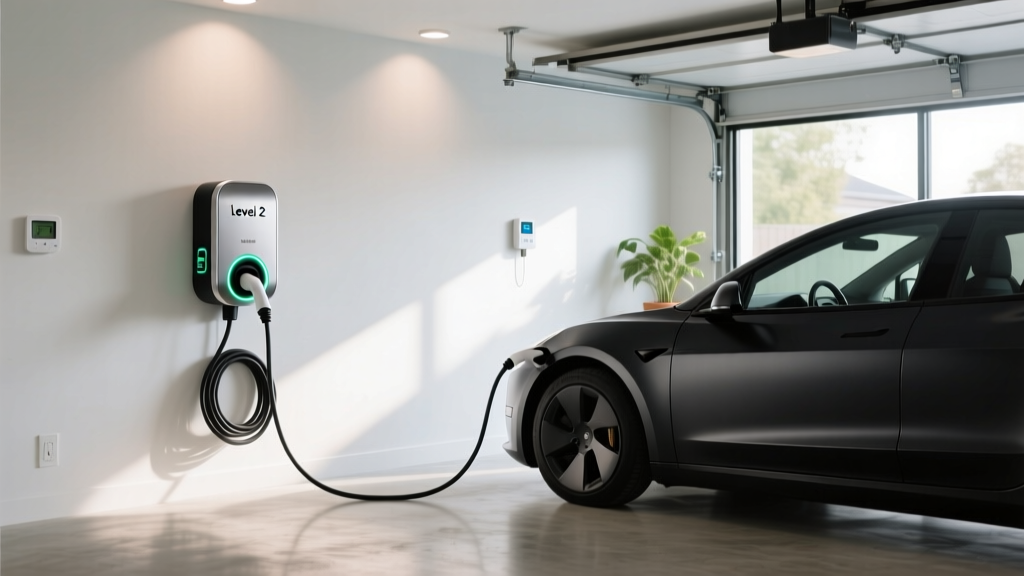
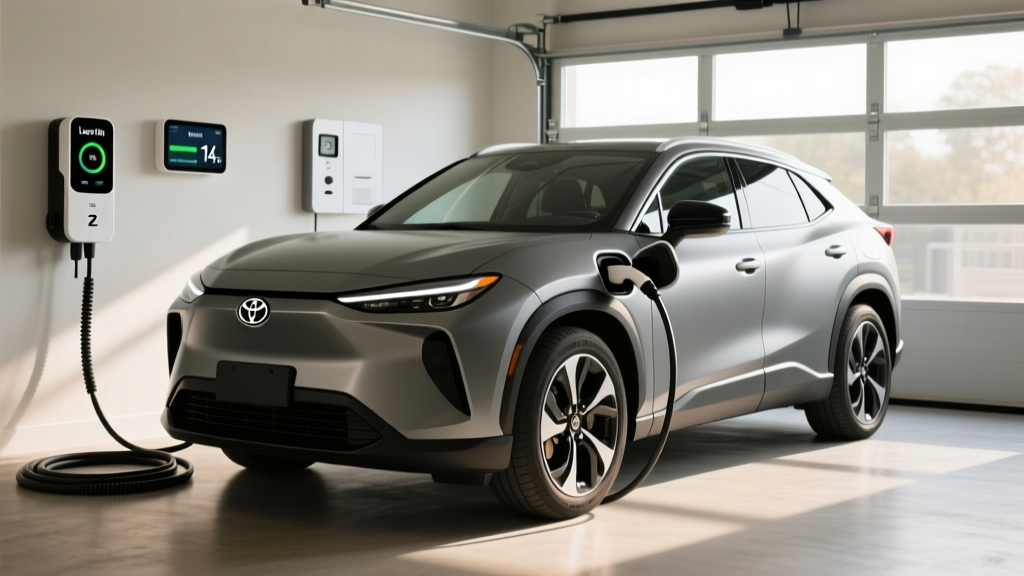
Installing a Level 2 home charger is the single most impactful upgrade for EV ownership. For the bZ4X, a 240V Level 2 station will fully recharge the 71.4 kWh battery in roughly 10–11 hours — ideal for overnight replenishment.
Electrical Requirements
- Circuit: Dedicated 40A or 50A, 240V circuit (NEMA 14-50 outlet or hardwired)
- Wire gauge: 6 AWG copper for 50A circuits, 8 AWG for 40A
- Panel capacity: Most homes need at least 100A service; 200A is preferred for simultaneous EV charging and heavy appliance use
- Permit: Required in most jurisdictions; ensures compliance with NEC (National Electrical Code) Article 625
Installation Cost Breakdown
| Component | Cost Range | Notes |
|---|---|---|
| Level 2 Charger (Equipment) | $350–$700 | Smart chargers with Wi-Fi/app control cost more |
| Electrician Labor | $500–$1,500 | Varies by region, complexity, and run length |
| Permit Fees | $50–$200 | Local jurisdiction; some utilities waive or rebate |
| Panel Upgrade (if needed) | $1,500–$3,500 | Required if existing panel lacks capacity or space |
| Total (no panel upgrade) | $900–$2,400 | Average: ~$1,500 |
| Total (with panel upgrade) | $2,400–$5,900 | Older homes (pre-1990) often need upgrades |
Panel upgrade reality check: If your home was built before 1990 or has a 100A service panel, you may need a 200A upgrade to safely support a 40A EV circuit alongside HVAC, electric range, and dryer loads. A licensed electrician can perform a load calculation (NEC Article 220) to determine if an upgrade is necessary.
Connector Compatibility: NACS, CCS1, and the bZ4X
The 2024 Toyota bZ4X uses the CCS1 (Combined Charging System) connector for both Level 2 (J1772 portion) and DC fast charging (CCS combo). However, the EV landscape is shifting: Tesla's NACS (North American Charging Standard) is becoming the de facto standard, with major automakers — including Toyota — committing to NACS adoption starting in 2025.
| Connector | Level 2 (AC) | DC Fast | bZ4X Compatibility |
|---|---|---|---|
| J1772 | ✓ Standard | — | Native (Level 2 only) |
| CCS1 | ✓ (J1772 + DC pins) | ✓ | Native (Level 2 + DC) |
| NACS (Tesla) | ✓ | ✓ | Requires adapter (available 2025+) |
| CHAdeMO | ✓ (J1772) | ✓ | Not supported (obsolete in US) |
Adapter note: Toyota has announced that 2025+ bZ4X models will ship with NACS ports. For 2024 bZ4X owners, a CCS-to-NACS adapter (expected late 2024/early 2025) will enable access to Tesla Supercharger stations. Until then, rely on Electrify America, EVgo, and ChargePoint DC networks for fast charging.
Cost to Charge: Home vs. Public vs. Gas
Charging costs vary dramatically based on electricity rates, time-of-use (TOU) plans, and whether you charge at home or on public DC networks. Here's a breakdown for the 2024 Toyota bZ4X (71.4 kWh battery, 252 mi EPA range for FWD):
| Scenario | $/kWh | Cost for Full Charge (71.4 kWh) | Cost Per Mile |
|---|---|---|---|
| Home (off-peak TOU) | $0.12 | $8.57 | $0.034 |
| Home (standard rate) | $0.18 | $12.85 | $0.051 |
| Public Level 2 | $0.25–$0.35 | $17.85–$25.00 | $0.071–$0.099 |
| DC Fast (Electrify America) | $0.43–$0.56 | $30.70–$40.00 | $0.122–$0.159 |
| Gas Vehicle (30 MPG, $3.50/gal) | — | — | $0.117 |
Key takeaway: Home charging on an off-peak TOU plan delivers the lowest cost per mile (~$0.034), roughly one-third the cost of a comparable gas vehicle. Public DC fast charging, however, can exceed gas costs per mile — use it sparingly for road trips, not daily top-ups.
Recommended Home Chargers for the Toyota bZ4X
Given the bZ4X's 6.6 kW Level 2 acceptance rate, you don't need a 48A charger — a 32A or 40A unit will max out the vehicle's onboard charger. Here are three reliable options:
ChargePoint Home Flex (32A–50A adjustable)
- Power: Up to 12 kW (48A), adjustable to 32A for bZ4X
- Connector: J1772 (CCS1 compatible)
- Cable length: 23 ft
- Smart features: Wi-Fi, app scheduling, TOU optimization, Alexa integration
- Price: ~$550
Emporia Level 2 Smart Charger (40A)
- Power: 9.6 kW (40A)
- Connector: J1772
- Cable length: 24 ft
- Smart features: Wi-Fi, app control, solar integration, energy monitoring
- Price: ~$400
Grizzl-E Smart (40A)
- Power: 9.6 kW (40A)
- Connector: J1772
- Cable length: 24 ft
- Smart features: Wi-Fi, app, OCPP compatibility, outdoor-rated (NEMA 4)
- Price: ~$500
Pro tip: Install a 50A circuit and a 48A-capable charger even if your current EV only accepts 6.6 kW. This future-proofs your setup for your next EV, which may support 11.5 kW or higher Level 2 charging.
Safety, Code Compliance, and Installation Best Practices
EV charging involves sustained high-current loads — safety and code compliance are non-negotiable.
- Dedicated circuit: NEC Article 625 requires a dedicated branch circuit for EVSE (Electric Vehicle Supply Equipment). Do not share the circuit with other appliances.
- GFCI protection: Required for outdoor installations and garages (NEC 2020+). Use a GFCI breaker or a charger with built-in GFCI.
- Outdoor rating: If installing outdoors, use a NEMA 4-rated (weatherproof) charger and enclosure.
- Cable management: Avoid tripping hazards; use a cable holster or retractable reel.
- Load calculation: A licensed electrician must perform a NEC Article 220 load calculation to ensure your panel can handle the EV circuit without overloading.
Frequently Asked Questions
How much does it cost to install a home EV charger for the Toyota bZ4X?
Expect $900–$2,400 for a standard Level 2 installation (equipment + electrician + permit) if your electrical panel has sufficient capacity. If a panel upgrade is needed (common in older homes), total costs can reach $2,400–$5,900.
How fast will each charging level add range to the bZ4X?
Level 1 (120V) adds 3–5 miles per hour. Level 2 (240V, 32A) adds ~25 miles per hour. DC fast charging (150 kW peak for FWD) can add 150+ miles in 30 minutes, though the charge curve tapers above 80% SoC.
Which connector is compatible with the 2024 Toyota bZ4X?
The 2024 bZ4X uses CCS1 (J1772 for Level 2, CCS combo for DC fast). A CCS-to-NACS adapter (expected 2025) will enable Tesla Supercharger access.
How much does charging cost per mile vs. gas?
Home charging on off-peak rates costs ~$0.034 per mile for the bZ4X FWD, compared to ~$0.117 per mile for a 30 MPG gas vehicle at $3.50/gallon. Public DC fast charging can exceed gas costs per mile.
What electrical upgrades might I need for a home charger?
If your home has a 100A panel or lacks two adjacent breaker slots, you may need a panel upgrade to 200A ($1,500–$3,500). A licensed electrician can perform a load calculation to determine requirements.
Does the bZ4X qualify for the federal EV tax credit?
The 2024 bZ4X may qualify for up to $7,500 under IRS §30D, but eligibility depends on MSRP caps ($55,000 for SUVs), buyer income limits ($150K single / $300K joint), and battery sourcing requirements. Check IRS guidelines and consult a tax professional.
Final Considerations: Is the bZ4X Right for Your Charging Setup?
The 2024 Toyota bZ4X's 252-mile EPA range (FWD) and 6.6 kW Level 2 charging are adequate for most commuters with home charging access. However, if you frequently drive 200+ miles in a single day or lack home charging, consider competitors with longer range (Ioniq 5, Model Y) or faster DC charging (Ioniq 5's 240 kW peak).
For bZ4X owners, a 32A or 40A Level 2 home charger on a dedicated 240V circuit is the optimal setup. Pair it with a time-of-use electricity plan to minimize charging costs, and use DC fast charging sparingly to preserve long-term battery health.
Sources: EPA Fuel Economy (2024 Toyota bZ4X), Toyota bZ4X Official Specs, IRS §30D Clean Vehicle Credit