The 2023 Tesla Model 3 remains one of the most efficient electric sedans on the road, but your real-world mileage depends heavily on how and where you charge. Whether you own the Standard Range RWD (EPA 272 miles) or the Long Range AWD (EPA 358 miles), understanding your charging ecosystem is the key to eliminating range anxiety and minimizing cost per mile.
This guide breaks down exactly how fast each charging level replenishes the Model 3's battery, what a home Level 2 installation actually costs in 2026, and how the North American Charging Standard (NACS) has reshaped public charging access for Tesla owners.
Charging Levels Explained: kW, kWh, and Miles Per Hour
Before plugging in, it's critical to understand the difference between kW (kilowatts) and kWh (kilowatt-hours). Kilowatts measure power — the rate at which electricity flows into your battery, like water pressure from a hose. Kilowatt-hours measure energy — the total capacity stored in your battery, like the size of the tank. The 2023 Model 3 Long Range carries roughly 75 kWh of usable battery capacity (NMC chemistry); the RWD base model uses approximately 57.5 kWh (LFP chemistry).
| Charging Level | Voltage / Power | Typical kW Output | Miles of Range Added Per Hour | Best Use Case |
|---|---|---|---|---|
| Level 1 | 120V / 1.4 kW | 1.2–1.4 kW | 3–5 miles | Overnight emergency top-off |
| Level 2 (Home) | 240V / 7.7–11.5 kW | 7.7–11.5 kW | 30–44 miles | Daily home charging |
| DC Fast Charging | 400V+ / 50–250 kW | 50–250 kW (peak) | 200–1,000+ miles (equivalent rate) | Road trips, rapid replenishment |
Real-world charging times for the 2023 Model 3 Long Range (75 kWh battery):
- Level 1 (120V): 0–100% in roughly 55–65 hours — impractical for regular use
- Level 2 (240V, 48A / 11.5 kW): 10–80% in approximately 5–6 hours
- Tesla Supercharger V3 (250 kW peak): 10–80% in roughly 25–30 minutes (sustained rate tapers significantly above 60% SoC)
- 50 kW DC Fast Charger: 10–80% in approximately 70–80 minutes
Home Level 2 Installation: Costs, Requirements, and Gotchas
Installing a Level 2 home charger is the single biggest quality-of-life upgrade for any Model 3 owner. You'll wake up every morning with a full battery, and your cost per mile drops dramatically compared to public charging.
Electrical Requirements
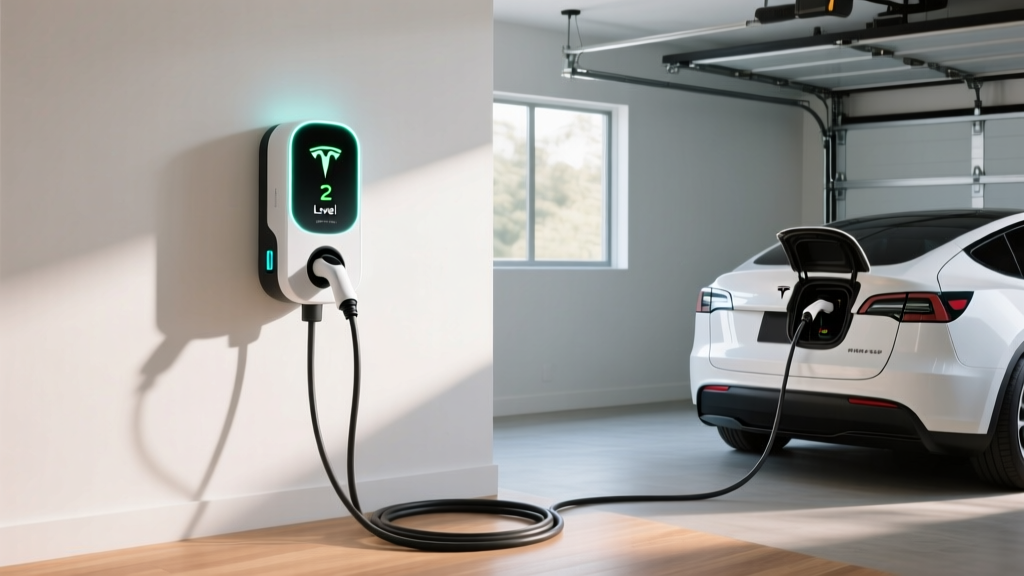
The Tesla Wall Connector or any quality Level 2 charger requires a 240-volt dedicated circuit. For the Model 3's 11.5 kW maximum AC charge rate, you need a 60-amp breaker with 48 amps of continuous draw. Many homes can accommodate this on their existing electrical panel, but older homes with 100-amp service may require a panel upgrade to 200 amps.
Critical considerations:
- Dedicated circuit: Your EV charger must have its own breaker — no sharing with dryers or ranges
- Wire gauge: 6 AWG copper for a 60A circuit; your electrician will confirm
- GFCI protection: NEC 2020+ requires GFCI breakers for EV outlets (adds $50–$150 to breaker cost)
- Outdoor rating: If installing outside, the charger must carry a NEMA 4 or IP65 weather rating
- Permit: Most jurisdictions require an electrical permit ($50–$200) and a post-install inspection
Installation Cost Breakdown
| Cost Component | Typical Range | Notes |
|---|---|---|
| Level 2 Charger Equipment | $350–$700 | Tesla Wall Connector ~$475; third-party smart chargers up to $700 |
| Electrician Labor | $500–$2,000 | Depends on run length, conduit, wall material |
| Electrical Permit | $50–$200 | Varies by municipality |
| Panel Upgrade (if needed) | $1,500–$4,000 | 100A → 200A service upgrade; older homes only |
| Total (no panel upgrade) | $900–$2,900 | Most typical installations fall in $1,200–$1,800 |
| Total (with panel upgrade) | $2,400–$6,900 | Significant but adds home resale value |
Pro tip: Get at least three quotes from licensed electricians. Ask specifically whether your panel has capacity for a 60A double-pole breaker. Some electricians can perform a "load calculation" to confirm without requiring a panel upgrade.
Connector Compatibility: NACS, CCS, and the Adapter Landscape
The 2023 Tesla Model 3 ships with the proprietary Tesla connector (now formally designated as NACS — North American Charging Standard). This gives you native access to Tesla's Supercharger network — the most reliable DC fast-charging network in North America with over 6,000 stations.
However, with Tesla opening Superchargers to non-Tesla EVs and other manufacturers adopting NACS for 2025+ models, the connector landscape has shifted. Here's what you need to know:
| Connector Type | 2023 Model 3 Native? | Where You'll Find It | Adapter Needed? |
|---|---|---|---|
| NACS (Tesla) | Yes — built in | Tesla Superchargers, Tesla Destination Chargers | None |
| CCS1 | No | Electrify America, EVgo, ChargePoint DC stations | Tesla CCS Adapter (~$175 from Tesla) |
| CHAdeMO | No | Legacy Nissan Leaf stations (phasing out) | Third-party adapter ($300+; rarely worth it) |
| J1772 (Level 2) | No | Public Level 2 stations, non-Tesla home chargers | Tesla Mobile Connector J1772 adapter (included with car) |
Key takeaway: The Tesla CCS adapter is a worthwhile $175 investment for road trips through areas where Supercharger coverage is sparse. It unlocks Electrify America's 350 kW stations and other CCS networks, though the Model 3's peak charge rate will cap at approximately 170–250 kW depending on battery temperature and state of charge.
Cost to Charge: Home vs. Public vs. Gas Comparison
One of the most compelling arguments for the Model 3 is the fuel-cost advantage. Here's how the numbers break down in 2026:
| Charging Scenario | Cost per kWh | Cost to Add 200 Miles* | Cost per Mile |
|---|---|---|---|
| Home (national avg. electricity) | $0.16/kWh | $8.96 | $0.045 |
| Home (off-peak time-of-use rate) | $0.09/kWh | $5.04 | $0.025 |
| Tesla Supercharger (avg.) | $0.32/kWh | $17.92 | $0.090 |
| Electrify America / Public DC | $0.38/kWh | $21.28 | $0.106 |
| Gas equivalent (30 MPG, $3.40/gal) | $3.40/gal | $22.67 | $0.113 |
*Based on the 2023 Model 3 Long Range efficiency of approximately 4.48 miles/kWh (124 MPGe combined per fueleconomy.gov)
Annual savings calculation: If you drive 12,000 miles per year and charge primarily at home on an off-peak rate, your annual "fuel" cost is approximately $300. The equivalent gas car at 30 MPG and $3.40/gallon costs $1,360. That's a $1,060 annual savings — enough to recoup a home charger installation in roughly two years.
Even if you rely exclusively on Superchargers, your annual cost is approximately $1,080 — still $280 less than gasoline.
Recommended Home Charging Equipment for the Model 3
Not all Level 2 chargers are created equal. Here are our top picks for 2023 Tesla Model 3 owners:
Tesla Wall Connector (Best Overall)
- Power Output: Up to 11.5 kW (48A)
- Connector: NACS (native Tesla)
- Cable Length: 24 feet
- Smart Features: Wi-Fi updates, power sharing between two units, load management
- Price: ~$475
- Why: Seamless Tesla integration, fastest home charge for Model 3, cleanest aesthetic
ChargePoint Home Flex (Best Third-Party)
- Power Output: Up to 12 kW (50A, configurable)
- Connector: J1772 (use included Tesla adapter) or NACS pigtail version
- Cable Length: 23 feet
- Smart Features: App scheduling, energy tracking, Alexa integration
- Price: ~$550–$650
- Why: Works with any EV (future-proof if you add a non-Tesla), excellent app
Tesla Mobile Connector (Budget Pick)
- Power Output: Up to 7.7 kW (32A on 240V NEMA 14-50 outlet)
- Connector: NACS with swappable adapter heads
- Cable Length: 20 feet
- Smart Features: None (dumb charger)
- Price: ~$200 (plus ~$50 for NEMA 14-50 adapter head)
- Why: Lowest-cost entry; portable for travel; requires only a 240V outlet install
Important note on the Mobile Connector: While the $200 price tag is attractive, the 7.7 kW max output means a 10–80% charge takes approximately 7–8 hours on the Long Range model — noticeably slower than the Wall Connector. For daily commuters who deplete more than 60% of their battery between charges, the Wall Connector's faster rate matters.
Public Charging: Supercharger Network and Beyond
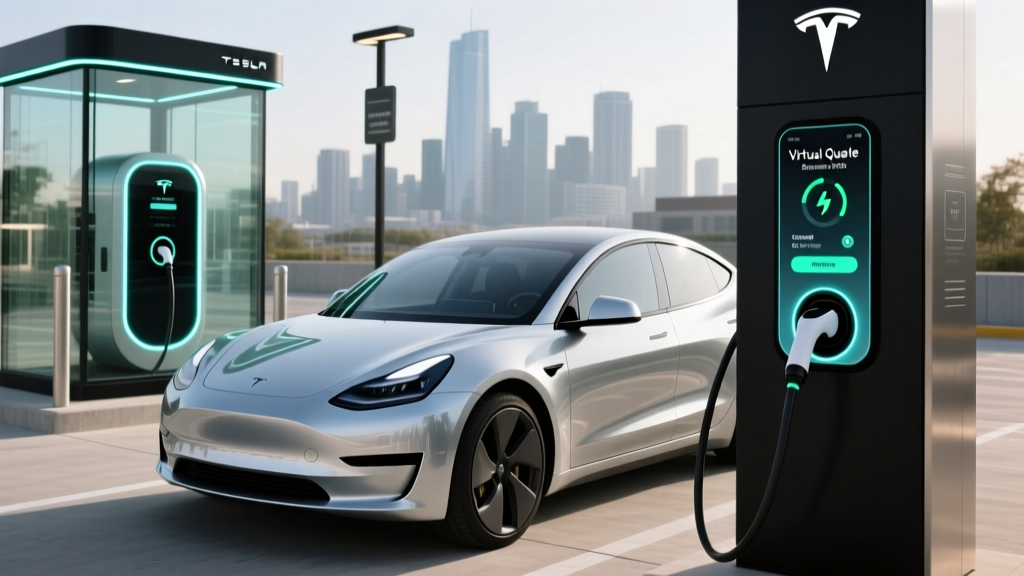
Tesla's Supercharger network remains the gold standard for reliability. As of 2026, Tesla operates over 6,500 Supercharger stalls in North America, with V3 stations delivering up to 250 kW and newer V4 stations supporting up to 350 kW (though the 2023 Model 3's onboard architecture caps at approximately 250 kW peak).
Charge curve reality check: The Model 3 Long Range will peak near 250 kW only when the battery is preconditioned (via onboard navigation to a Supercharger) and the state of charge is below 30%. Above 50% SoC, the charge rate tapers to approximately 100–120 kW. Above 80%, it drops further to 40–60 kW. This is why manufacturers quote "10–80%" times — the last 20% can take as long as the first 80%.
Charging on non-Tesla networks: With the Tesla CCS adapter, you can access Electrify America, EVgo, and ChargePoint DC fast chargers. Reliability on these networks has improved significantly since 2024, but Tesla Superchargers still maintain a 95%+ uptime advantage. Use the PlugShare app to check station status and user reviews before relying on a non-Tesla charger for a road trip.
Destination charging: Many hotels, restaurants, and shopping centers offer Level 2 Tesla Destination Chargers (typically 7.7–11.5 kW). These are ideal for multi-hour stops — you can add 40–90 miles of range during a dinner or overnight stay, often for free or at a nominal fee.
Federal Tax Credit and Incentives for Home Charging
The IRS Residential Clean Energy Credit (Section 25D) covers 30% of the cost of home EV charging equipment and installation, up to $1,000. This applies to both the charger hardware and electrician labor.
Eligibility requirements:
- Equipment must be installed at your primary residence
- The charger must be new (not previously claimed)
- Installation must be completed by December 31, 2032 (under current law)
- No income cap for this credit (unlike the vehicle purchase credit under §30D)
Additionally, many states and utilities offer their own rebates. Check your local utility — some offer $200–$500 rebates for Level 2 charger installation, and some provide free or discounted time-of-use electricity plans that make overnight charging even cheaper.
How much does it cost to install a home EV charger for a 2023 Tesla Model 3?
A typical Level 2 home charger installation costs between $1,200 and $1,800, including the Tesla Wall Connector ($475), electrician labor, and permit. If your home needs a panel upgrade from 100A to 200A service, add $1,500–$4,000. The 30% federal tax credit (up to $1,000) can offset a portion of this cost.
How fast will each charging level add range to my Model 3?
Level 1 (120V) adds 3–5 miles per hour — too slow for regular use. Level 2 (240V, 11.5 kW) adds approximately 44 miles per hour, fully replenishing a Long Range model overnight. DC fast charging at a Tesla Supercharger V3 can add up to 175 miles in 15 minutes under ideal conditions (preconditioned battery, low state of charge).
Which charger connector is compatible with the 2023 Tesla Model 3?
The 2023 Model 3 uses the NACS (Tesla) connector natively, giving direct access to Superchargers and Destination Chargers. For CCS1 public DC fast chargers (Electrify America, EVgo), you'll need the Tesla CCS Adapter ($175). For public Level 2 stations with J1772 connectors, use the adapter included with the Tesla Mobile Connector.
How much does charging the Model 3 cost per mile compared to gas?
Charging at home on a national average electricity rate ($0.16/kWh) costs approximately $0.045 per mile. On an off-peak rate ($0.09/kWh), it drops to $0.025/mile. A comparable gas car at 30 MPG with $3.40/gallon fuel costs $0.113 per mile. Even Supercharging at $0.32/kWh ($0.09/mile) is cheaper than gasoline.
What electrical upgrades might I need for a home charger?
You need a dedicated 240V circuit with a 60-amp breaker for maximum Level 2 speed. If your electrical panel is already near capacity or is a 100-amp service, you may need a panel upgrade to 200 amps ($1,500–$4,000). An electrician will perform a load calculation to determine if your existing panel can handle the additional draw without an upgrade.
Does the 2023 Model 3 LFP battery (RWD model) charge differently?
Yes. The RWD model uses an LFP (lithium iron phosphate) battery, which Tesla recommends charging to 100% regularly — unlike the Long Range's NMC battery, which is best kept between 20–80% for longevity. The LFP battery also has a slightly lower peak DC fast-charge rate (approximately 170 kW vs. 250 kW) and charges more slowly in cold weather without preconditioning.
Is it safe to charge in the rain or with an outdoor charger?
Yes. All properly rated EV chargers (NEMA 4 or IP65 rated) are designed for outdoor use in rain, snow, and dust. The connector and vehicle inlet are designed to be weather-sealed when mated. Never use an extension cord or a charger with visible cable damage, and ensure your installation includes a GFCI breaker as required by the National Electrical Code.
For official EPA range and efficiency data, visit fueleconomy.gov. For federal tax credit rules, consult the IRS Residential Clean Energy Credit page. Always verify your home's electrical capacity with a licensed electrician before purchasing equipment.