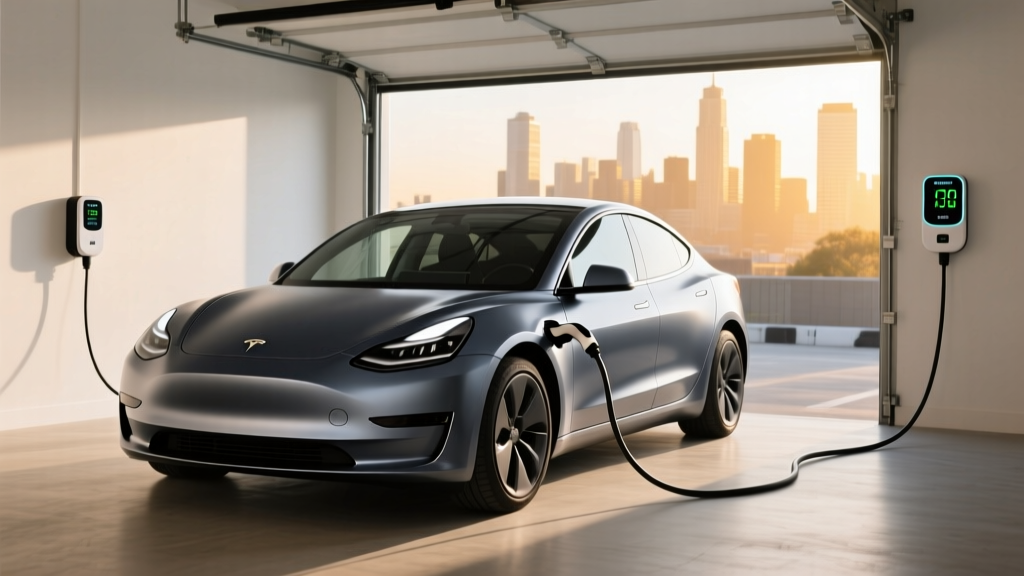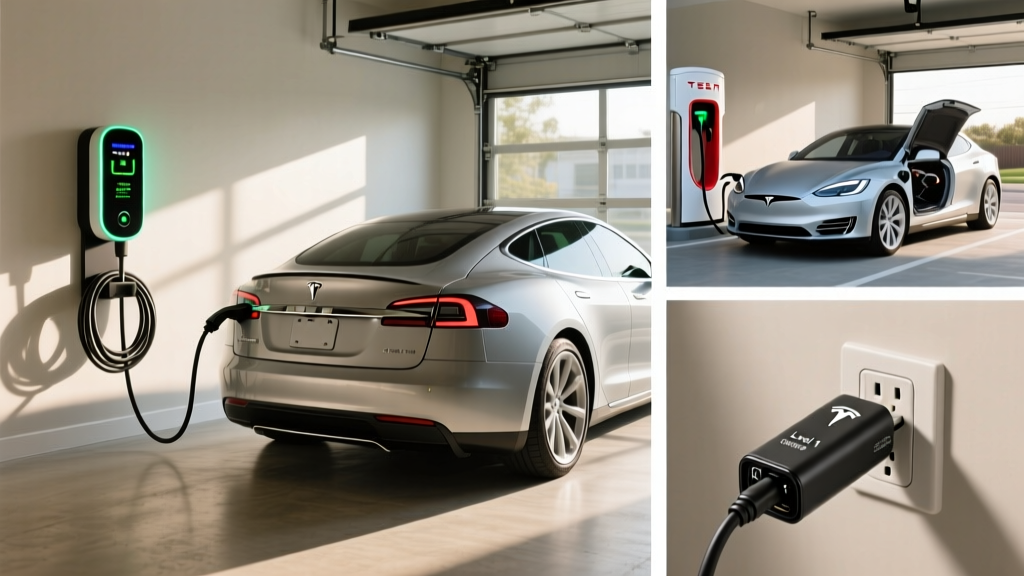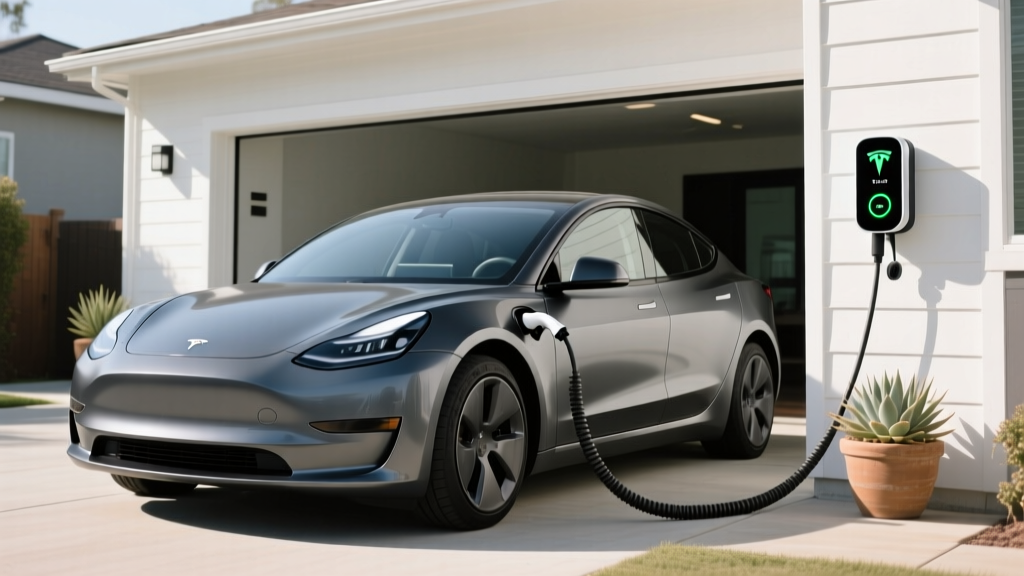
If you own or are considering a 2023 Tesla Model 3 Long Range AWD, understanding your charging options is the single biggest factor in daily satisfaction. The EPA rates this sedan at 358 miles of range from its 75 kWh usable battery (NMC chemistry), with a combined 132 MPGe per fueleconomy.gov. But real-world range, charging speed, and cost depend heavily on how and where you plug in.
This guide covers every charging scenario for the 2023 Model 3 Long Range AWD — from a standard 120V outlet to a 250 kW Supercharger — with exact numbers for install costs, charge times, electricity rates, and the NACS connector ecosystem.
EPA sticker: 358 miles. Expect 290–320 miles on the highway at 70 mph, and 250–280 miles in freezing weather. The Long Range AWD's dual motors and heat pump help, but cold and speed still reduce range 15–30%.
Charging Levels Explained: Speeds in kW and Miles Per Hour
Before comparing chargers, the critical distinction: kW (kilowatts) measures power — the rate of energy delivery. kWh (kilowatt-hours) measures energy — the total capacity of your battery, like gallons in a tank. The 2023 Model 3 Long Range AWD holds about 75 kWh of usable energy. How fast you refill those kWh depends on the charging level.
| Level | Voltage | Max Power (kW) | Miles Added/Hour | Best For |
|---|---|---|---|---|
| Level 1 (120V) | 120V AC | ~1.4 kW | ~3–5 mi/hr | Emergency top-ups, overnight trickle |
| Level 2 (240V) | 240V AC | Up to 11.5 kW | ~30–44 mi/hr | Daily home charging, workplace |
| DC Fast (Supercharger) | 400V+ DC | Up to 250 kW | ~200+ mi in 15 min | Road trips, rapid refill |
The 2023 Model 3 Long Range AWD's onboard charger accepts up to 11.5 kW on Level 2 (48 amps), meaning a full 48A home charger can add roughly 44 miles of range per hour. On DC fast charging, the vehicle peaks at 250 kW at V3 Superchargers, achieving a 10–80% charge in approximately 25–30 minutes under ideal conditions (battery preconditioned, warm ambient temperature).
Real-world charging curves taper significantly above 80% state of charge. Charging from 80–100% at a DC fast charger can take nearly as long as 10–80%. For road trips, plan to charge to 80% and move on.
Home Charger Installation: Electrical Requirements and Costs
Most Model 3 Long Range owners install a Level 2 home charger. The 2023 Model 3's onboard charger supports up to 48 amps, so you'll want a 60-amp dedicated circuit (electrical code requires circuits rated 125% of the continuous load — 48A × 1.25 = 60A).
Key electrical requirements:
- Voltage: 240V (NEMA 14-50 outlet or hardwired)
- Amperage: 48A charger on a 60A breaker
- Panel capacity: Minimum 100A service panel; 200A preferred for homes with other high-draw appliances
- Permit: Required in virtually all US jurisdictions for new 240V circuits
- GFCI protection: Required by NEC 2020+ for EV receptacles; hardwired chargers typically include built-in ground-fault protection
What Electrical Upgrades Might I Need?
If your home has a 100-amp electrical panel that's already near capacity (common in homes built before 1990 with added HVAC, electric dryers, or ranges), you may need a panel upgrade to 200 amps. This is the single biggest cost variable in home charging. A load calculation by a licensed electrician will determine if your existing panel can handle a 60A EV circuit.
Some homes may benefit from a load-management device (like the Emporia Smart Load Management system) that dynamically shares capacity between the EV charger and other appliances, potentially avoiding a panel upgrade entirely.
| Component | Simple Install (Near Panel) | Complex Install (Panel Upgrade + Long Run) |
|---|---|---|
| Level 2 Charger (Equipment) | $400–$700 | $400–$700 |
| Electrician Labor (240V circuit) | $600–$1,200 | $1,500–$3,000 |
| Electrical Panel Upgrade | $0 (not needed) | $1,500–$3,500 |
| Permit & Inspection | $100–$250 | $150–$400 |
| Conduit/Wire (50+ ft run) | $100–$300 | $300–$800 |
| Total Estimated Cost | $1,200–$2,450 | $3,850–$8,400 |
The IRS Residential Clean Energy Credit (25C) covers 30% of home charger equipment and installation costs, up to $1,000 for chargers placed in service through 2032. This applies to both the charger hardware and the electrical work. Consult a tax professional to confirm eligibility.
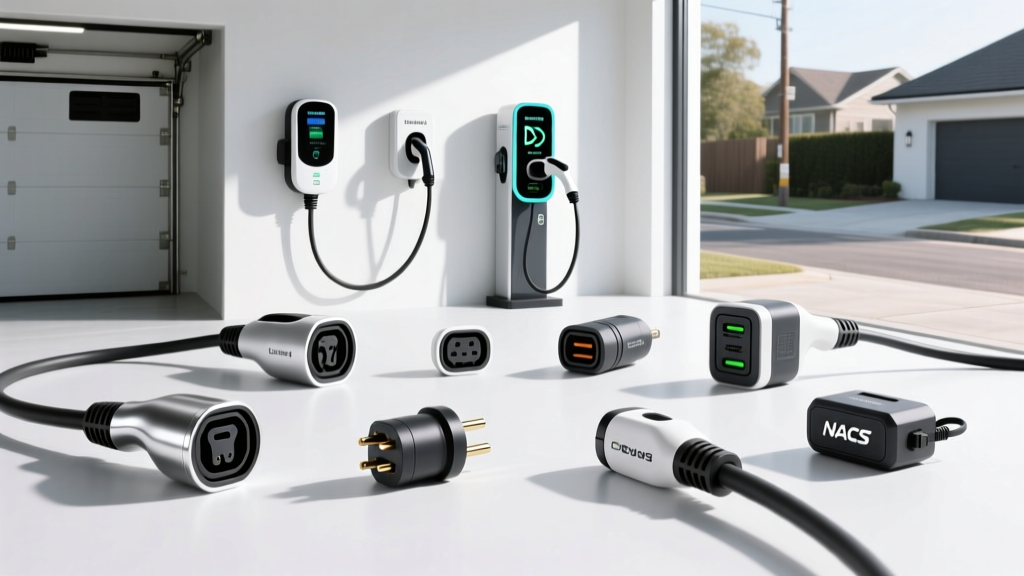
Connector Compatibility: NACS, CCS, and Adapters
The 2023 Tesla Model 3 Long Range AWD comes equipped with the North American Charging Standard (NACS) connector — Tesla's proprietary plug, which is now being adopted industry-wide. This means direct compatibility with the entire Tesla Supercharger network (17,000+ stalls in North America) without any adapter.
| Connector Type | Compatibility | Adapter Needed? | Network Examples |
|---|---|---|---|
| NACS (Tesla) | Native — direct plug | None | Tesla Superchargers, Tesla Destination |
| CCS1 | Via adapter | Tesla CCS Adapter (~$250) | Electrify America, EVgo, ChargePoint DC |
| CHAdeMO | Not supported | N/A | Legacy Nissan Leaf network (declining) |
| J1772 (Level 2) | Via included adapter | Tesla J1772 Adapter (included) | Public Level 2, workplace, hotels |
Tesla includes a J1772 adapter with every Model 3, allowing you to use non-Tesla Level 2 chargers. For DC fast charging on non-Tesla networks, purchase the Tesla CCS1 adapter. While the Supercharger network is the most reliable in the US, having the CCS adapter provides backup access to Electrify America and other networks — useful in areas where Supercharger coverage has gaps.
Charging Cost Per Mile: Home vs. Public vs. Gas
The 2023 Model 3 Long Range AWD achieves approximately 26 kWh per 100 miles (combined EPA). Your cost per mile depends entirely on your electricity rate.
| Scenario | Rate | Cost per 100 Miles | Cost per Mile |
|---|---|---|---|
| Home (off-peak utility rate) | $0.10/kWh | $2.60 | $0.026 |
| Home (national avg. residential) | $0.16/kWh | $4.16 | $0.042 |
| Public Level 2 (ChargePoint/EVgo) | $0.25–$0.40/kWh | $6.50–$10.40 | $0.065–$0.104 |
| Tesla Supercharger (avg. US) | $0.28–$0.36/kWh | $7.28–$9.36 | $0.073–$0.094 |
| Gasoline car (28 MPG avg, $3.40/gal) | — | $12.14 | $0.121 |
At national average residential electricity rates, the Model 3 Long Range AWD costs roughly $0.04 per mile to fuel at home — about one-third the cost of a 28 MPG gas car at $3.40/gallon. Even at Supercharger rates, the EV costs less per mile than gasoline. Over 15,000 miles per year, home charging saves approximately $1,200–$1,400 annually compared to gas.
Maximize savings: Many utilities offer time-of-use (TOU) plans with off-peak rates as low as $0.06–$0.10/kWh overnight. Schedule your Model 3 to charge between midnight and 6 AM using the Tesla app's Scheduled Charging feature.
Recommended Home Chargers for the Model 3 Long Range AWD
Since the Model 3's onboard charger maxes out at 11.5 kW (48A), any quality 48A Level 2 charger will deliver maximum home charging speed. Here are proven options:
Tesla Wall Connector (Gen 3)
- Power Output: 11.5 kW (48A)
- Connector: NACS (native Tesla plug)
- Cable Length: 24 feet
- Smart Features: Wi-Fi, OTA updates, Power Sharing (load-balance multiple units), access control
- Price: ~$475
- Best For: Tesla-only households; seamless app integration
ChargePoint Home Flex
- Power Output: Up to 12 kW (50A, adjustable down to 16A–50A)
- Connector: J1772 (use included Tesla adapter) or NACS version available
- Cable Length: 23 feet
- Smart Features: Wi-Fi, ChargePoint app scheduling, Alexa integration, flexible amperage
- Price: ~$550–$650
- Best For: Multi-EV households (Tesla + non-Tesla)
Emporia Vue Smart EV Charger
- Power Output: 11.5 kW (48A)
- Connector: J1772 (NACS version available)
- Cable Length: 24 feet
- Smart Features: Solar integration, load management, real-time energy monitoring
- Price: ~$400
- Best For: Budget-conscious buyers, solar homes, panel-capacity-limited installs
All three chargers are NEMA 4 rated for outdoor installation and include ground-fault protection. Hardwiring is recommended over a NEMA 14-50 receptacle for reliability and to meet NEC code requirements in many jurisdictions.
DC Fast Charging Times and the Charge Curve Reality
The 2023 Model 3 Long Range AWD can accept up to 250 kW peak at a V3 Tesla Supercharger, but that peak rate only holds between roughly 10–30% state of charge. The charge curve tapers progressively:
- 10–30% SoC: ~200–250 kW (fastest segment)
- 30–50% SoC: ~150–180 kW
- 50–80% SoC: ~75–110 kW
- 80–100% SoC: ~25–50 kW (trickle)
Under ideal conditions (battery preconditioned via navigation to a Supercharger), expect:
- 10–80%: ~25–30 minutes at a V3 Supercharger (250 kW stall)
- 10–80%: ~40–50 minutes at a V2 Supercharger (150 kW stall)
- 10–80%: ~45–60 minutes at a 150 kW Electrify America CCS stall (with adapter)
Preconditioning matters. Navigate to your Supercharger destination in the Tesla app or in-car navigation before arriving. The car will warm the battery to optimal charging temperature, which can shave 5–10 minutes off your charge session — especially critical in cold weather.
Safety and Code Considerations for Home Charging
Home EV charger installations must comply with the National Electrical Code (NEC) Article 625. Key requirements:
- Dedicated circuit: Your EV charger must be on its own dedicated breaker — not shared with other appliances
- GFCI protection: Required for all EV receptacles (NEMA 14-50 outlets) installed after NEC 2020 adoption in your jurisdiction. Hardwired chargers include internal GFCI
- Outdoor rating: If installed outdoors, the charger must carry a NEMA 3R or NEMA 4 rating. All three chargers recommended above meet this standard
- Cable management: Use a wall-mounted holster or retractable cable reel to prevent trip hazards and cable damage
- Permit and inspection: Required in virtually all municipalities — your electrician should pull the permit before work begins
Never use extension cords with EV chargers. Never plug a Level 2 charger into a standard 120V outlet. And always have a licensed, EV-experienced electrician perform the installation — this is not a DIY project.
2023 Tesla Model 3 Long Range AWD: Key Specs at a Glance
| Specification | Value |
|---|---|
| EPA Range | 358 miles (real-world: ~290–320 mi highway) |
| Battery (Usable) | ~75 kWh, NMC chemistry |
| Max Level 2 Charge Rate | 11.5 kW (48A) |
| Max DC Fast Charge Rate | 250 kW (NACS, V3 Supercharger) |
| 10–80% DC Fast Charge | ~25–30 minutes (V3, preconditioned) |
| Efficiency | 132 MPGe combined / 26 kWh per 100 mi |
| 0–60 mph | 4.2 seconds |
| Horsepower | 346 hp (dual motor AWD) |
| Battery Warranty | 8 years / 120,000 miles (70% capacity retention) |
| Original MSRP (2023) | $47,740 (before incentives) |
Frequently Asked Questions
How much does it cost to install a home EV charger for my 2023 Model 3?
A straightforward Level 2 install (panel near garage, no upgrade needed) runs $1,200–$2,450 including the charger, electrician labor, wire, and permit. If your home needs a 200A panel upgrade, expect $3,850–$8,400 total. The IRS 25C credit covers 30% up to $1,000 of charger and installation costs.
How fast will each charging level add range to the Model 3 Long Range AWD?
Level 1 (120V): ~3–5 miles per hour. Level 2 (240V, 48A): ~44 miles per hour. DC Fast (250 kW Supercharger): up to 175 miles in 15 minutes during peak charge rate.
Which chargers and connectors are compatible with the 2023 Model 3 Long Range AWD?
NACS (native, no adapter) for Tesla Superchargers and Destination chargers. J1772 for non-Tesla Level 2 chargers (adapter included). CCS1 for Electrify America and other DC networks (adapter sold separately, ~$250). CHAdeMO is not supported.
How much does charging the Model 3 Long Range cost per mile compared to gas?
At the national average residential electricity rate of $0.16/kWh, home charging costs about $0.042 per mile. A comparable gas car at 28 MPG and $3.40/gallon costs $0.121 per mile. Home charging saves roughly $0.08 per mile, or $1,200+ per year at 15,000 miles.
What electrical upgrades might my home need for a Level 2 charger?
The 2023 Model 3's 48A onboard charger requires a 60A dedicated 240V circuit. If your home's electrical panel is already near capacity (common with 100A panels in older homes), you may need a panel upgrade to 200 amps ($1,500–$3,500) or a load-management device to share existing capacity. A licensed electrician can perform a load calculation to determine what's required.
Can I charge my 2023 Model 3 Long Range on non-Tesla chargers?
Yes. Use the included J1772 adapter for non-Tesla Level 2 chargers (hotels, workplaces, public lots). For non-Tesla DC fast chargers like Electrify America, purchase the optional Tesla CCS1 adapter. However, the Tesla Supercharger network remains the most reliable and widely available DC fast-charging network in the US.
Does cold weather affect charging speed?
Yes — significantly. A cold battery (below 50°F) cannot accept peak charge rates. Always navigate to your Supercharger in the Tesla app or car nav to trigger battery preconditioning. Without preconditioning, a cold battery may peak at only 50–100 kW instead of 250 kW, adding 10–20 minutes to a 10–80% charge session.