Quick Verdict: What 2023 Model Y Long Range Owners Need to Know
If you own or are buying a 2023 Tesla Model Y Long Range, you're working with one of the most efficient electric SUVs on the road. Its 75 kWh usable battery (NMC chemistry), EPA-rated 330 miles of range, and native NACS (North American Charging Standard) connector give you access to the largest fast-charging network in the U.S. without adapters. But maximizing that advantage means understanding exactly what happens when you plug in — at home, at a Supercharger, or at a third-party DC station.
This guide breaks down every charging scenario for the 2023 Model Y Long Range with exact numbers: kW charge rates, 10–80% times, home installation costs, electrical panel considerations, and per-mile charging costs compared to gasoline. No marketing fluff — just the data you need to set up your charging and budget accurately.
EPA estimate: 330 miles. In real-world mixed driving, expect 280–310 miles. Sustained highway speeds (75+ mph) drop that to ~260–280 miles. In freezing temperatures with cabin heat, plan for 220–250 miles. Source: fueleconomy.gov.
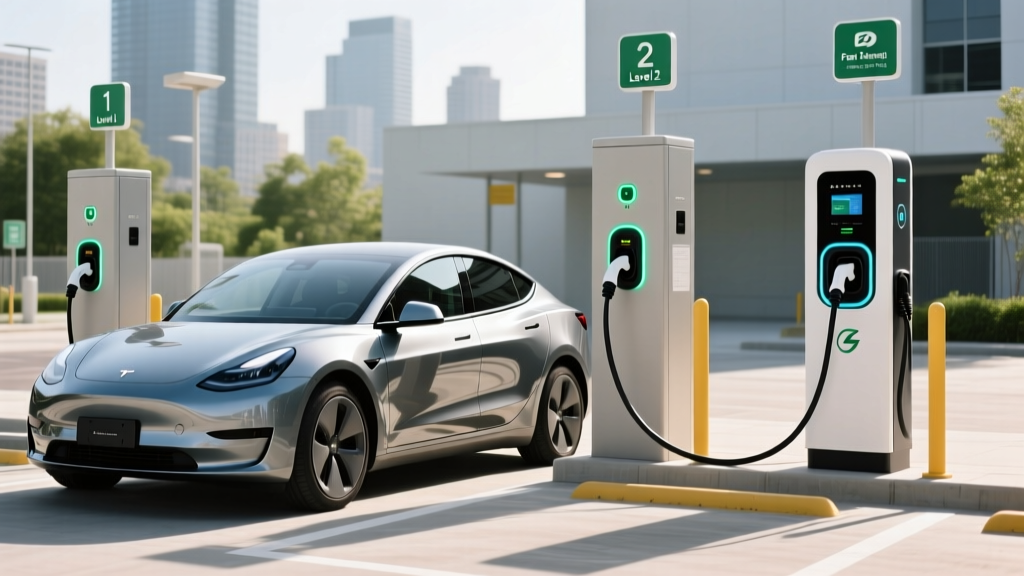
Charging Levels Explained: How Fast Will Each Level Add Range?
EV charging happens at three distinct levels. The critical distinction: kW (kilowatts) measures power — the rate of energy delivery, like water pressure from a hose. kWh (kilowatt-hours) measures energy — the total amount stored in your battery, like gallons in a tank. Your 2023 Model Y Long Range has roughly 75 kWh of usable battery capacity.
| Level | Voltage | Power (kW) | Miles Added per Hour | Best Use Case |
|---|---|---|---|---|
| Level 1 | 120V AC | ~1.4 kW | ~3–5 mi/hr | Emergency top-ups, overnight trickle |
| Level 2 (Home/Public AC) | 240V AC | 7.2–11.5 kW | ~25–44 mi/hr | Daily home charging, workplace, destination |
| DC Fast Charging | 400V+ DC | Up to 250 kW peak | ~150–200+ mi in 15 min | Road trips, rapid replenishment |
Level 1: The Emergency Fallback
Using the Tesla Mobile Connector with the standard 120V NEMA 5-15 adapter, you'll add roughly 3–5 miles of range per hour. A full 10–80% charge (about 52.5 kWh) would take over 37 hours — impractical for daily use, but sufficient if you drive under 30 miles per day and have no other option.
Level 2: Where Most Model Y Charging Happens
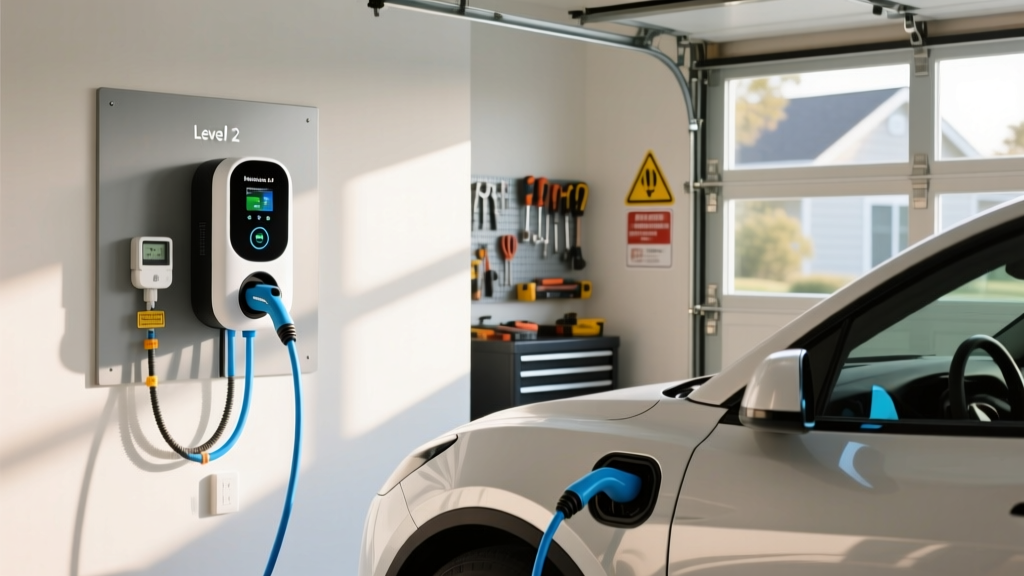
The 2023 Model Y Long Range has an 11.5 kW onboard charger, meaning it can accept up to 48 amps from a 240V Level 2 source. At that rate, you add roughly 44 miles of range per hour. A 10–80% charge takes approximately 5–5.5 hours. Most home installations use a 60-amp circuit (delivering 48A continuous), which perfectly matches this vehicle's capability.
DC Fast Charging: Road Trip Speed
At a Tesla V3 Supercharger (250 kW peak), the Model Y Long Range can add up to ~200 miles in about 15 minutes under ideal conditions — battery preconditioned, low state of charge. Peak rate is not sustained: the charge curve tapers significantly above 50–60% SoC, and drops sharply past 80%. A realistic 10–80% session at a V3 Supercharger takes roughly 25–30 minutes.
Home Charger Installation: Electrical Requirements, Costs & Panel Upgrades
Installing a dedicated Level 2 home charger is the single most impactful upgrade for daily EV ownership. Here's what's involved for a 2023 Model Y Long Range setup.
Electrical Requirements
To deliver the full 11.5 kW the Model Y can accept, you need:
- Circuit: 60-amp dedicated breaker (NEC requires circuits rated at 125% of continuous load, so 48A continuous = 60A breaker)
- Wire: 6 AWG copper (or 4 AWG aluminum) THHN in conduit, or 6/2 NM-B for short indoor runs
- Outlet or hardwired: NEMA 14-60 receptacle (if using Tesla Wall Connector with a plug) or hardwired connection (preferred for outdoor installs and higher reliability)
- Panel capacity: Your main service panel must have room for a 60A double-pole breaker and sufficient load capacity
Do You Need a Panel Upgrade?
If your home has a 100-amp main service panel — common in homes built before the 1990s — adding a 60A EV circuit may exceed your panel's capacity, especially if you already run electric range, dryer, and HVAC. A licensed electrician will perform a NEC Article 220 load calculation to determine if your panel can handle the addition.
Homes with 200-amp service (standard in most post-2000 construction) typically accommodate a 60A EV circuit without upgrade. If an upgrade to 200A is needed, expect $1,500–$3,500 for the panel swap, depending on your utility and local labor rates.
Permits and Inspections
Most jurisdictions require an electrical permit for a new 240V circuit. Permit costs typically run $50–$200. The work must pass inspection before the circuit is energized. Never skip this step — unpermitted electrical work can void home insurance claims.
| Component | Cost Range | Notes |
|---|---|---|
| EVSE Equipment (Tesla Wall Connector) | $400–$475 | Gen 3, 48A, 24-ft cable, Wi-Fi enabled |
| Electrician Labor (standard install) | $600–$1,500 | Varies by run length, conduit, wall type |
| Materials (wire, conduit, breaker) | $150–$400 | Longer runs from panel = higher cost |
| Permit & Inspection | $50–$200 | Varies by municipality |
| Total (no panel upgrade) | $1,200–$2,575 | Most homes with 200A service |
| Panel Upgrade (if needed) | $1,500–$3,500 | 100A → 200A service upgrade |
| Total (with panel upgrade) | $2,700–$6,075 | Older homes with 100A panels |
Federal incentive note: The §30C Alternative Fuel Vehicle Refueling Property Credit covers 30% of home charger equipment and installation costs, up to $1,000, for installations in eligible census tracts. Check the IRS §30C page for eligibility — this credit has specific geographic and income requirements that vary by tax year.
Connector Compatibility: NACS, CCS, and What You Need to Know
The 2023 Model Y Long Range uses the NACS (North American Charging Standard) connector — Tesla's proprietary plug, which was opened as an industry standard in late 2022 and has since been adopted by Ford, GM, Rivian, Volvo, and most major automakers for 2025+ models.
| Connector Type | Compatibility | Adapter Needed? | Notes |
|---|---|---|---|
| NACS (Tesla) | Native | No | Direct access to Tesla Superchargers & Destination Chargers |
| CCS1 | With adapter | Yes — Tesla CCS Adapter (~$175–$250) | Required for Electrify America, EVgo, and most non-Tesla DC networks |
| CHAdeMO | With adapter | Yes — Tesla CHAdeMO Adapter (~$400) | Largely legacy; fewer stations being built |
| J1772 (Level 2 public) | With adapter | Yes — J1772-to-NACS (included with vehicle) | For public Level 2 stations (ChargePoint, Blink, etc.) |
Practical recommendation: The J1772 adapter ships with every Model Y. For road trips outside the Supercharger network, purchase the Tesla CCS Adapter — it unlocks Electrify America's 350 kW stations (though the Model Y will peak around 250 kW regardless). The CHAdeMO adapter is rarely necessary in 2026 and can be skipped unless you regularly travel in areas with only CHAdeMO infrastructure.
Cost to Charge: Per-Mile Cost vs. Gasoline
One of the strongest ownership arguments for the 2023 Model Y Long Range is fuel cost savings — but the actual savings depend heavily on where and when you charge. The Model Y Long Range AWD achieves an EPA-rated 116 MPGe combined, consuming roughly 29 kWh per 100 miles.
| Scenario | Rate ($/kWh) | Cost per 100 Miles | Cost per Mile | Annual Cost (12,000 mi) |
|---|---|---|---|---|
| Home — Off-Peak TOU | $0.09 | $2.61 | $0.026 | $313 |
| Home — Standard Rate | $0.16 | $4.64 | $0.046 | $557 |
| Public Level 2 (ChargePoint) | $0.25–$0.39 | $7.25–$11.31 | $0.07–$0.11 | $870–$1,357 |
| Tesla Supercharger (V3) | $0.28–$0.36 | $8.12–$10.44 | $0.08–$0.10 | $974–$1,253 |
| Electrify America (DC) | $0.36–$0.48 | $10.44–$13.92 | $0.10–$0.14 | $1,253–$1,670 |
| Gasoline SUV (25 MPG avg, $3.40/gal) | — | $13.60 | $0.136 | $1,632 |
The takeaway: Charging at home on an off-peak time-of-use plan delivers the lowest cost — roughly $313 per year for 12,000 miles, or about 80% less than a comparable gas SUV. Even at standard residential rates, you save significantly. Public DC fast charging narrows the gap, and frequent exclusive reliance on Electrify America or similar premium-priced networks can approach gas costs. Home charging access is the economic linchpin of EV ownership.
Best Home Chargers for the 2023 Model Y Long Range
Because the Model Y can accept up to 11.5 kW (48A), pairing it with a charger that delivers less means leaving charging speed on the table. Here are three recommended options, all NACS-native or compatible.
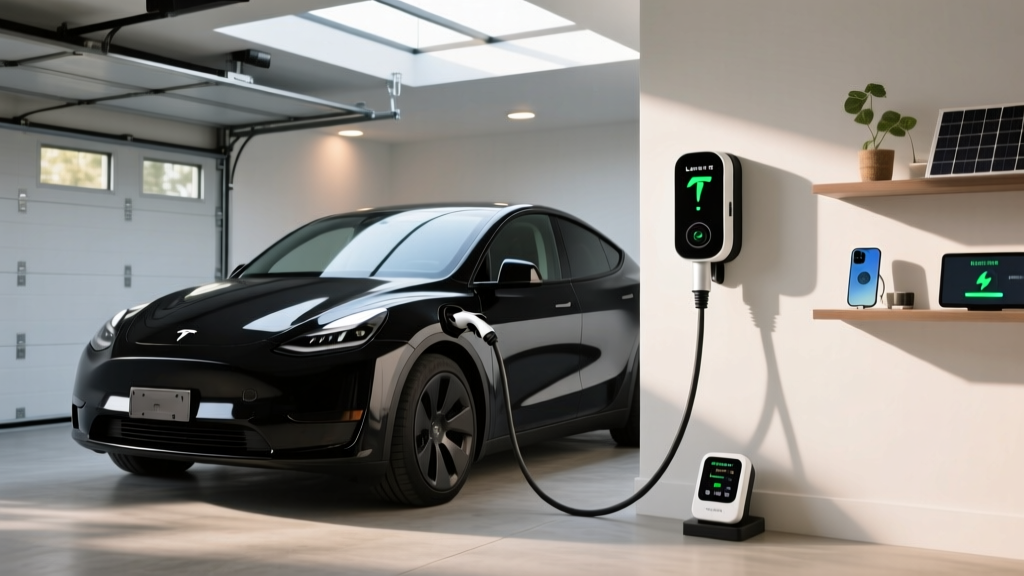
1. Tesla Wall Connector (Gen 3) — Best Overall
- Power Output: Up to 11.5 kW (48A) on a 60A circuit
- Connector: NACS native
- Cable Length: 24 feet
- Smart Features: Wi-Fi connectivity, over-the-air firmware updates, load sharing (pair two units on one circuit), power sharing, access control
- Price: ~$475
- Why it wins: Matches the Model Y's max onboard charge rate exactly. NACS-native means no adapter. Tesla's ecosystem integration (scheduled charging, preconditioning) is seamless.
2. ChargePoint Home Flex — Best for Multi-Vehicle Households
- Power Output: Up to 12 kW (50A) on a 60A circuit, adjustable down to 16A
- Connector: NACS (2025+ model) or J1772 (with adapter)
- Cable Length: 23 feet
- Smart Features: Wi-Fi, app scheduling, energy tracking, Alexa/Google integration, flexible amperage settings
- Price: ~$550–$650
- Why it works: Adjustable amperage lets you match your circuit capacity without swapping hardware. Excellent app. Good choice if you also own a non-Tesla EV.
3. Emporia Vue EV Charger — Best Budget Smart Charger
- Power Output: Up to 11.5 kW (48A) on a 60A circuit
- Connector: NACS (2025+ model) or J1772 (with adapter)
- Cable Length: 24 feet
- Smart Features: Wi-Fi, energy monitoring with whole-home integration (paired with Emporia Vue panel monitor), scheduling, solar-aware charging
- Price: ~$350–$400
- Why it works: Lowest-cost option that still delivers full 48A. Solar integration is valuable for homes with rooftop PV. Less polished app than Tesla or ChargePoint.
Safety and Code Considerations for Home Charging
EV charging draws sustained high current for hours — more like a welding machine than a typical household appliance. Proper installation is non-negotiable.
- Dedicated circuit: Your Level 2 charger must be on its own dedicated double-pole breaker. Never share the circuit with other appliances.
- GFCI protection: NEC 2020 (Article 625.54) requires GFCI protection for all EV receptacles rated 150V to ground or less and 60A or less. Hardwired installations are exempt from the GFCI receptacle requirement, which is one reason many electricians prefer hardwired setups.
- Outdoor rating: If installing outdoors, ensure the EVSE is rated NEMA 4 (weather-resistant). The Tesla Wall Connector is NEMA 4 rated. The receptacle (if used) must be in an in-use weatherproof cover.
- Wire sizing: Undersized wire causes overheating and fire risk. Always follow NEC Table 310.16 for ampacity ratings. A qualified electrician will handle this — do not DIY a 240V/60A circuit unless you are licensed.
- Surge protection: Consider a whole-home surge protector (Type 2 SPD) at your panel, especially in areas with frequent lightning. EV chargers contain sensitive electronics that can be damaged by voltage spikes.
Always hire a licensed electrician and pull a permit. Refer to NHTSA's EV safety resources for broader safety context on electric vehicle ownership.
DC Fast Charging in Practice: Charge Curve and Road Trip Strategy
The 2023 Model Y Long Range peaks at 250 kW on a V3 Supercharger, but that peak rate only holds briefly at a low state of charge (typically 10–20% SoC). Here's a realistic charge curve breakdown:
- 10–30% SoC: ~200–250 kW (peak performance)
- 30–50% SoC: ~150–180 kW (first taper)
- 50–80% SoC: ~70–100 kW (significant taper)
- 80–100% SoC: ~20–40 kW (trickle — avoid charging past 80% on road trips)
Road trip strategy: Precondition the battery by entering a Supercharger as your navigation destination — the car will warm the battery en route, which dramatically improves charge speed in cold weather. Charge from 10–80% (about 25–30 minutes) and move on rather than waiting for a full charge. The last 20% can take as long as the first 70%.
Cold weather note: Below 32°F, DC fast charging speeds can be 30–50% slower without preconditioning. Always navigate to the charger to trigger thermal management. Range drops 20–30% in freezing conditions — plan stops accordingly.
Ownership Economics: Battery Warranty and Long-Term Costs
The 2023 Model Y Long Range carries Tesla's standard battery and drive unit warranty: 8 years or 120,000 miles (whichever comes first), with a minimum 70% capacity retention guarantee. Real-world degradation data from Tesla's fleet suggests most Model Y batteries retain 90%+ capacity at 100,000 miles.
For daily charging, Tesla recommends setting the charge limit to 80% for NMC batteries (which is what the Long Range uses) to maximize long-term health. Reserve 100% charges for road trips. This is different from LFP-equipped Model Y RWD variants, which Tesla recommends charging to 100% regularly.
Frequently Asked Questions
How much does it cost to install a home EV charger for a 2023 Model Y Long Range?
Expect $1,200–$2,575 for a standard installation with a 200-amp panel (Tesla Wall Connector + electrician + materials + permit). If your home needs a panel upgrade from 100A to 200A service, add $1,500–$3,500, bringing the total to $2,700–$6,075. The §30C federal credit may offset 30% of costs up to $1,000 if you're in an eligible census tract.
How fast will each charging level add range to my Model Y?
Level 1 (120V): ~3–5 miles per hour. Level 2 (240V, 48A): ~44 miles per hour — a 10–80% charge in about 5–5.5 hours. DC fast charging (V3 Supercharger): up to ~200 miles in 15 minutes, or a 10–80% charge in roughly 25–30 minutes with a preconditioned battery.
Which connector and charger is compatible with my 2023 Model Y Long Range?
The 2023 Model Y uses NACS natively. It plugs directly into all Tesla Superchargers and Destination Chargers without an adapter. For CCS-based public DC networks (Electrify America, EVgo), you'll need the Tesla CCS Adapter (~$175–$250). The included J1772 adapter covers public Level 2 stations.
How much does charging cost per mile compared to gasoline?
At home on off-peak electricity ($0.09/kWh), the Model Y Long Range costs about $0.026 per mile — roughly 80% cheaper than a 25 MPG gas SUV at $3.40/gallon ($0.136/mile). Even at standard residential rates ($0.16/kWh), you pay $0.046/mile. Public DC fast charging at $0.28–$0.48/kWh costs $0.08–$0.14/mile, narrowing the savings gap.
What electrical upgrades might I need for a home charger?
The most common upgrade is a panel capacity increase from 100A to 200A service, needed in older homes where the existing panel can't handle a 60A EV circuit alongside other major appliances. Your electrician will perform a NEC load calculation to determine this. Other potential upgrades include adding a sub-panel closer to the garage (to reduce wire run costs) or upgrading the utility service drop if your home's incoming supply is insufficient.
Should I charge my Model Y Long Range to 100% every day?
No. The Long Range uses an NMC battery, which degrades faster when held at high states of charge. Set your daily charge limit to 80% and only charge to 100% when you need full range for a road trip. This practice significantly extends long-term battery health.