The 2022 Tesla Model 3 Standard Range (officially the Rear-Wheel Drive trim) remains one of the most efficient electric sedans on the used market. With a ~57.5 kWh usable LFP (lithium iron phosphate) battery and EPA-rated 272 miles of range, it delivers outstanding miles per kWh — but only if you charge it correctly. This guide covers every charging scenario for this specific model: home installation requirements, public network compatibility, real-world charging times, and what you'll actually spend per mile.
Battery: ~57.5 kWh usable, LFP chemistry
EPA Range: 272 miles (real-world highway: ~230–250 mi; cold weather: ~200–220 mi)
Max DC Fast Charge: 170 kW peak
10–80% DC Fast Charge: ~25 minutes
Level 2 Max Acceptance: 11.5 kW (48A)
Connector: NACS (Tesla proprietary)
Efficiency: 132 MPGe combined (25 kWh/100 mi)
Charging Levels Explained: How Fast Will Each Add Range?
Understanding the three charging levels is essential before choosing equipment. The critical distinction: kW (kilowatts) measures power — how fast energy flows into the car. kWh (kilowatt-hours) measures energy — the total capacity of the battery. Think of kW as the width of a hose and kWh as the size of the bucket.
| Level | Voltage / Amperage | Power (kW) | Miles of Range Per Hour | 0–100% Time (57.5 kWh) |
|---|---|---|---|---|
| Level 1 (120V outlet) | 120V / 12A | ~1.4 kW | 3–5 mi/hr | ~41+ hours |
| Level 2 (240V home/public) | 240V / 48A | 11.5 kW | 37–44 mi/hr | ~5–6 hours |
| DC Fast Charging | 400V+ architecture | Up to 170 kW peak | ~1,000+ mi/hr (peak) | 10–80% in ~25 min |
Real-world charging curve note: The 170 kW peak rate on DC fast charging only holds roughly between 10–30% State of Charge (SoC). Above 50%, the rate tapers significantly — expect ~60–80 kW at 60% SoC and ~25 kW above 85%. This is why manufacturers quote 10–80% times rather than 0–100%. Charging from 80–100% on a DC fast charger can take nearly as long as the 10–80% portion. For daily driving, staying in the 20–80% window maximizes both speed and long-term battery health, though Tesla recommends periodically charging LFP batteries to 100% for accurate state-of-charge calibration.
Home Charger Installation: Electrical Requirements and Costs
For the 2022 Model 3 RWD, a Level 2 home charger is the practical baseline. Level 1 (standard 120V outlet) adds only ~4 miles of range per hour — adequate only if your daily driving is under 20 miles and you can charge for 10+ hours overnight. Most owners need Level 2 to replenish a meaningful portion of the battery in a single overnight session.
The Model 3's onboard charger accepts up to 11.5 kW (48 amps). To deliver this, you need a 240V circuit rated for 60 amps (electrical code requires circuits to be rated at 125% of the continuous load, so a 48A charger needs a 60A breaker). A 50A circuit with a 40A charger is also common and delivers ~9.6 kW — still enough to fully charge the 57.5 kWh battery overnight in about 6 hours.
What Electrical Upgrades Might You Need?
Your home's electrical panel determines installation complexity and cost. Key factors:
- Panel capacity: Most modern homes have 200A service. Adding a 60A EV circuit is typically fine if you have spare slots and headroom. Older homes with 100A service may require a panel upgrade ($1,500–$3,500) or a load-management device that throttles the charger when other high-draw appliances run.
- Available breaker slots: A 240V circuit requires two adjacent slots. Full panels may need a sub-panel addition.
- Run distance: The farther the charger is from the panel, the more expensive the wiring (longer conduit, heavier-gauge copper for voltage drop over distance).
- Permit requirements: Nearly all jurisdictions require an electrical permit for a new 240V circuit. The permit ensures the installation meets NEC (National Electrical Code) standards and is inspected for safety.
• Dedicated circuit: Your EV charger must have its own breaker — never share with other appliances.
• GFCI protection: NEC 2020+ requires GFCI breakers for EV receptacles in garages (hardwired units are exempt in many jurisdictions).
• Outdoor rating: If installing outside, the unit must carry a NEMA 4 or NEMA 4X rating for weather resistance.
• Hardwired vs. plug: Hardwired installations avoid the NEC GFCI requirement for receptacles and allow higher amperage (48A+). NEMA 14-50 receptacles are limited to 50A circuits (40A continuous).
How Much Does It Cost to Install a Home EV Charger?
| Component | Simple Install (near panel, garage) | Complex Install (long run, outdoor) |
|---|---|---|
| Level 2 charger unit (40–48A) | $400–$700 | $400–$700 |
| Electrician labor (2–8 hours) | $300–$600 | $800–$2,000 |
| Materials (wire, conduit, breaker) | $100–$250 | $300–$800 |
| Electrical permit | $50–$150 | $50–$200 |
| Panel upgrade (if needed) | $0 | $1,500–$3,500 |
| Total Range | $850–$1,700 | $3,050–$7,200 |
Most homeowners with a 200A panel and a garage-mounted charger near the panel fall in the $1,000–$1,500 total range. Always get at least two quotes from licensed electricians and confirm they pull a permit — unpermitted work can void home insurance claims and create resale issues.
Connector Compatibility: NACS, CCS, and Adapters
The 2022 Tesla Model 3 uses the NACS (North American Charging Standard) connector — Tesla's proprietary plug that became the de facto industry standard starting in 2023. This means native access to the entire Tesla Supercharger network (17,000+ stalls in North America) without any adapter.
| Connector Type | Compatibility | Adapter Needed? | Network Examples |
|---|---|---|---|
| NACS (Tesla) | ✅ Native | No | Tesla Superchargers, Tesla Destination |
| CCS1 (Combo) | ⚠️ With adapter | Yes — Tesla CCS Adapter (~$175–$250) | Electrify America, EVgo, ChargePoint DC |
| CHAdeMO | ⚠️ With adapter (legacy) | Yes — third-party adapter (~$300–$450) | Legacy stations (being phased out) |
| J1772 (Level 2 public) | ⚠️ With adapter | Yes — included with vehicle (J1772-to-Tesla) | Public Level 2 stations, hotels, workplaces |
Practical advice: The Tesla Supercharger network remains the most reliable public DC fast-charging network in the U.S., with consistent uptime and plug-and-charge billing. The CCS adapter is worth purchasing if you travel to areas with limited Supercharger coverage or want access to Electrify America stations along certain highway corridors. Tesla includes a J1772 adapter with the vehicle for public Level 2 charging.
Cost to Charge: Per-Mile Economics vs. Gas
The 2022 Model 3 RWD consumes approximately 25 kWh per 100 miles (EPA combined). Your cost per mile depends entirely on where and when you charge.
| Scenario | Rate ($/kWh) | Cost per 100 Miles | Cost per Mile |
|---|---|---|---|
| Home (off-peak utility rate) | $0.08–$0.12 | $2.00–$3.00 | $0.02–$0.03 |
| Home (standard residential rate) | $0.14–$0.18 | $3.50–$4.50 | $0.035–$0.045 |
| Tesla Supercharger (average) | $0.28–$0.36 | $7.00–$9.00 | $0.07–$0.09 |
| Electrify America / CCS DC fast | $0.35–$0.48 | $8.75–$12.00 | $0.09–$0.12 |
| Gas car comparison (30 MPG, $3.40/gal) | — | $11.33 | $0.113 |
At home off-peak rates, the Model 3 RWD costs roughly $0.025 per mile to fuel — about one-quarter the cost of a 30 MPG gas car at $3.40/gallon. Over 15,000 miles per year, that's $375 in home electricity versus $1,700 in gasoline — a $1,325 annual savings. Even exclusive Supercharger use ($0.08/mi) undercuts gasoline by ~30%.
However, if your only option is frequent DC fast charging at $0.40+/kWh, the cost advantage narrows considerably. Home charging access is the single biggest factor in EV ownership economics.
Recommended Home Charging Equipment for the Model 3
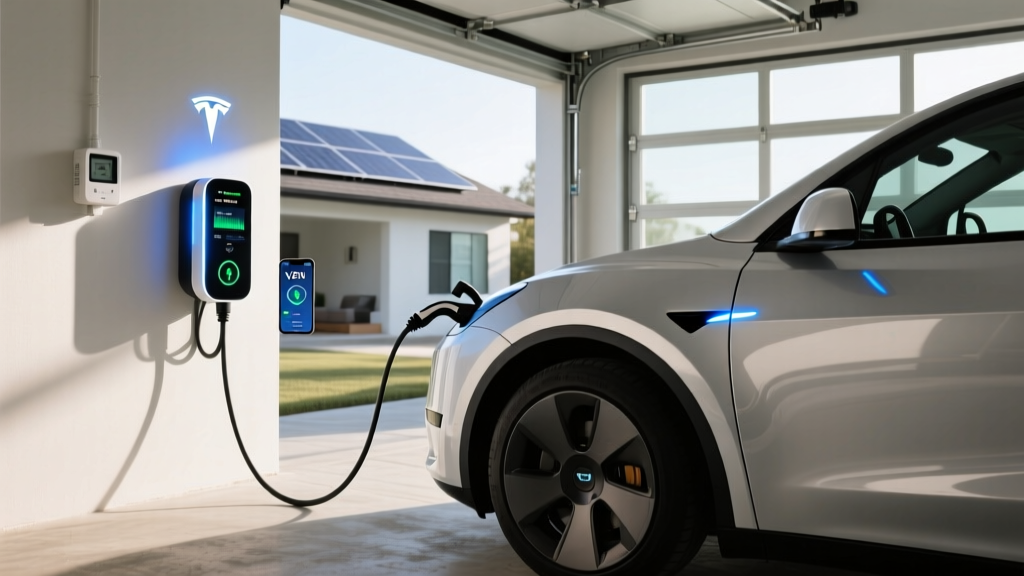
These chargers pair well with the Model 3's 11.5 kW onboard charger and NACS connector. All are Wi-Fi-enabled for scheduling, monitoring, and utility demand-response programs.
Power: Up to 11.5 kW (48A)
Connector: NACS (native)
Cable: 24 ft
Smart features: Wi-Fi, OTA updates, load sharing with second unit, access control
Price: ~$475
Best for: Tesla-only households. Seamless integration, cleanest install, no adapter needed.
Power: Up to 12 kW (50A, adjustable down to 16A)
Connector: NACS or J1772 (select at purchase)
Cable: 23 ft
Smart features: Wi-Fi, app scheduling, Alexa integration, utility demand-response ready
Price: ~$649
Best for: Multi-EV households (mixed brands). Flexible amperage fits older panels.
Power: Up to 11.5 kW (48A)
Connector: J1772 (use included Tesla adapter) or NACS version
Cable: 24 ft
Smart features: Wi-Fi, energy monitoring, solar integration, time-of-use scheduling
Price: ~$399
Best for: Budget-conscious buyers with solar panels. Energy monitoring tracks exact charging costs.
Hardwired vs. plug-in: The Tesla Wall Connector and ChargePoint Home Flex are available in both configurations. Hardwired units support the full 48A and avoid the NEC GFCI breaker requirement for 240V receptacles. NEMA 14-50 plug-in versions offer portability (take the charger when you move) but are limited to 40A continuous draw on a 50A circuit.
Public Charging Tips for the 2022 Model 3 RWD
The Tesla Supercharger network provides the most seamless public charging experience — no adapters, no app juggling, and automatic billing. The 2022 Model 3 RWD peaks at 170 kW on V3 Superchargers, adding roughly 150 miles in 15 minutes under ideal conditions (battery preconditioned, low SoC start).
Preconditioning matters: When you navigate to a Supercharger using the car's built-in navigation, the battery thermal management system begins heating or cooling the pack to optimal charging temperature. This can reduce 10–80% charge time by 5–10 minutes in cold weather. Always navigate to the charger rather than driving there from memory.
For non-Tesla DC fast chargers (Electrify America, EVgo), you'll need the Tesla CCS adapter. Charge speeds on these networks may be limited by the adapter's throughput and the station's own power delivery. Expect 100–150 kW on most CCS stations with the adapter, compared to the full 170 kW on native Superchargers.
Destination charging (Level 2 at hotels, restaurants, shopping centers) typically delivers 7–11.5 kW via Tesla Wall Connectors. This is ideal for overnight stays — a hotel with a Wall Connector can fully replenish the 57.5 kWh battery in 5–8 hours.
Frequently Asked Questions
Can I charge the 2022 Model 3 Standard Range on a regular 120V outlet?
Yes, using the Tesla Mobile Connector with the 120V adapter (included with the car). Expect ~3–5 miles of range per hour, or about 40–50 miles overnight (10 hours). This works for low-mileage drivers or as emergency backup, but Level 2 is strongly recommended as your primary charging method.
Should I charge the LFP battery to 100%?
Tesla recommends charging LFP batteries to 100% at least once per week for accurate state-of-charge calibration. Unlike NMC chemistries, LFP degrades minimally at high SoC, so daily 100% charging is acceptable. However, for DC fast charging on road trips, charging to 80% and moving on is faster due to the steep taper above 80%.
How much does a Tesla Supercharger session cost for this model?
A 10–80% session (~40 kWh added) at $0.32/kWh averages about $12.80 and takes roughly 25 minutes. That provides about 175–190 miles of real-world range. Pricing varies by location, time of day (some stations have peak/off-peak rates), and whether you have a Tesla subscription plan.
Does the 2022 Model 3 qualify for any tax credits as a used EV purchase?
If you're buying this model used from a dealer, it may qualify for the IRS §25E used EV credit — up to $4,000 or 30% of the sale price (whichever is less). Eligibility requires: sale price ≤$25,000, buyer income ≤$75K single / $150K joint, purchased from a licensed dealer, and the vehicle must be at least 2 model years old (2022 models qualify in 2024+). Rules are subject to change — verify current eligibility on irs.gov or consult a tax professional.
What happens if my home electrical panel can't support a Level 2 charger?
Options include: (1) a panel upgrade from 100A to 200A service ($1,500–$3,500), (2) a smart load-management device like the Emporia smart breaker or Tesla Wall Connector's built-in load sharing, which dynamically reduces charger amperage when other appliances draw heavily, or (3) installing a lower-amperage circuit (20A or 30A) that still delivers 16–24 miles of range per hour — adequate for many commuters.
Sources: EPA Fuel Economy — 2022 Tesla Model 3 RWD, Tesla Home Charging Installation Guide, IRS §25E Used Clean Vehicle Credit.