If you own or are considering a 2022 Audi e-tron GT, understanding how to charge it efficiently is just as important as knowing how far it can go. The e-tron GT's 800-volt architecture enables some of the fastest DC charging in the luxury EV segment, but extracting real-world value from that capability requires the right home equipment, a clear picture of public-network compatibility, and an honest look at costs. This guide covers everything from the 2022 Audi e-tron GT range expectations to the electrical upgrades your garage might need.
2022 Audi e-tron GT Range: EPA vs. Real World
The 2022 Audi e-tron GT (Premium Plus trim) carries an 84 kWh usable battery pack (93.4 kWh gross, NMC chemistry). The EPA rates it at 238 miles of combined range. The higher-performance RS e-tron GT, with its 590-hp dual-motor setup, drops slightly to 232 miles EPA.
EPA estimates assume a mix of city and moderate-speed driving at ~70°F. In practice:
• Highway (75 mph, summer): expect ~200–215 miles
• Highway (75 mph, winter, 30°F): expect ~160–180 miles (cold reduces battery efficiency and increases cabin heating load)
• City/commute (summer): 230–245 miles is achievable with regenerative braking
The e-tron GT's heat pump (standard on US models) mitigates some cold-weather loss, but plan road trips around ~180-mile segments in freezing conditions to maintain a safety buffer.
| Spec | e-tron GT Premium Plus | RS e-tron GT |
|---|---|---|
| EPA Range | 238 mi | 232 mi |
| Battery (usable/gross) | 84 / 93.4 kWh (NMC) | 84 / 93.4 kWh (NMC) |
| Peak DC Charge Rate | 270 kW | 270 kW |
| 10–80% DC Fast Charge | ~22 min | ~22 min |
| Level 2 AC Charge (onboard) | 9.6 kW (standard) / 19.2 kW (optional) | 9.6 kW (standard) / 19.2 kW (optional) |
| 0–60 mph | 3.9 sec | 3.1 sec |
| Horsepower | 469 hp (522 hp w/launch) | 590 hp (637 hp w/launch) |
| MPGe (combined) | 82 MPGe | 79 MPGe |
| Battery Warranty | 8 yr / 100,000 mi | 8 yr / 100,000 mi |
Source: EPA fueleconomy.gov
Charging Levels Explained: kW, Speed, and What Each Adds
Before selecting equipment, it's critical to understand the difference between kW (kilowatts — the rate of power delivery, like water pressure) and kWh (kilowatt-hours — the total energy stored, like gallons in a tank). Your e-tron GT's battery holds 84 kWh of usable energy. A charger delivering 9.6 kW would theoretically fill that battery from empty in roughly 8.75 hours (84 ÷ 9.6), though real-world charging involves tapering near full capacity.
| Level | Voltage / Power | e-tron GT Range Added/Hour | Best Use Case |
|---|---|---|---|
| Level 1 | 120V / 1.4 kW | ~3–4 mi/hr | Emergency / overnight trickle (adds ~35 mi in 10 hrs) |
| Level 2 (standard onboard) | 240V / 9.6 kW (40A circuit) | ~25–28 mi/hr | Daily home charging — full charge in ~9 hrs |
| Level 2 (optional 19.2 kW onboard) | 240V / 19.2 kW (80A circuit) | ~50–55 mi/hr | Fast home top-ups — full charge in ~4.5 hrs |
| DC Fast Charge | Up to 270 kW peak | ~180 mi in 22 min (10–80%) | Road trips, highway corridors |
The e-tron GT's 800V architecture is its charging superpower. While many EVs peak at 150–175 kW on DC fast chargers, the GT can sustain over 200 kW through a large portion of the 10–80% window when the battery is preconditioned. However, the charge curve tapers significantly above 80% — going from 80% to 100% on DC fast charging can take an additional 25–30 minutes. For battery longevity, limit DC fast charging to road trips and keep daily charging on Level 2.
Home Charger Installation: Electrical Requirements and Cost Breakdown
Most e-tron GT owners will install a Level 2 home charger on a dedicated 240V circuit. Here's what your electrician will assess:
Standard 9.6 kW setup (40A circuit, NEMA 14-50 outlet or hardwired 48A charger): This is the most common residential configuration. It requires a 50-amp breaker (the charger draws a continuous 40A, and NEC code requires the breaker to be rated at 125% of continuous load). A NEMA 14-50 outlet gives you flexibility to unplug and take the charger with you; hardwiring is preferred for 48A+ chargers because high-amperage outlets can overheat over time.
Optional 19.2 kW setup (80A circuit, hardwired): If your e-tron GT has the optional 19.2 kW onboard charger, you'll need a 100-amp breaker and 80A continuous circuit. This typically requires 2 AWG copper wire or 1/0 aluminum, and many older homes' electrical panels cannot accommodate this without an upgrade.
| Item | Typical Cost Range | Notes |
|---|---|---|
| Level 2 charger (hardware) | $400–$750 | Smart Wi-Fi chargers (ChargePoint, Wallbox, Emporia) |
| Electrician labor (standard install) | $500–$1,500 | Varies by run length, conduit, and local rates |
| Permit and inspection | $100–$350 | Required in most jurisdictions for new 240V circuits |
| Electrical panel upgrade (if needed) | $1,500–$4,000 | 100A → 200A service; common in pre-2000 homes |
| Total (no panel upgrade) | $1,000–$2,600 | Most homeowners fall in this range |
| Total (with panel upgrade) | $2,500–$6,600 | Older homes with 100A service |
Panel Upgrade Gotcha: If your home has a 100-amp main panel and you're already running central AC, an electric dryer, and an electric oven, adding a 40A EV circuit may push your calculated load past code limits. A licensed electrician will perform a NEC Article 220 load calculation. In some cases, a "smart" panel or load-management device (like the Emporia Smart Panel or Span Drive) can avoid a full upgrade by dynamically shedding non-essential loads.
What Electrical Upgrades Might I Need?
Beyond the panel itself, consider these common scenarios:
- Subpanel installation ($400–$800): If your main panel is full but you have sufficient service capacity, a subpanel near the garage can provide dedicated EV circuit space.
- Conduit and wire run length: Runs over 50 feet from the panel to the garage require thicker wire to prevent voltage drop, adding $200–$500 in materials.
- GFCI breaker requirement: The 2020 NEC (adopted by most states by 2026) requires GFCI protection for 240V EV outlets. GFCI breakers for 50A circuits cost $80–$150, and some chargers have caused nuisance trips with certain GFCI breaker brands — hardwiring avoids this issue entirely.
- Outdoor-rated equipment: If your charger mounts outside, ensure it carries a NEMA 4 (weatherproof) rating. The ChargePoint Home Flex and Wallbox Pulsar Plus both meet this standard.
Connector Compatibility: CCS1, NACS, and the e-tron GT
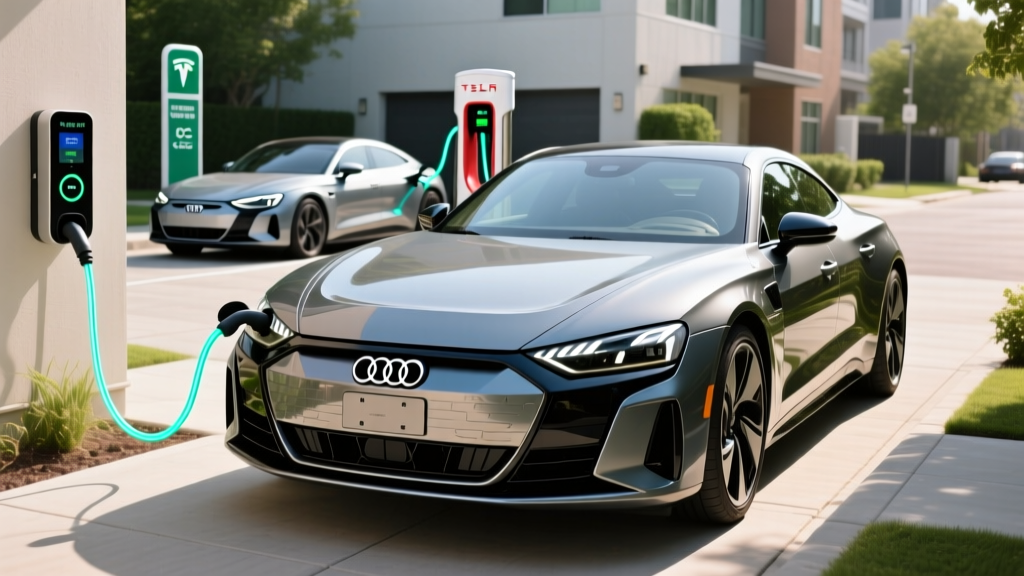
The 2022 Audi e-tron GT uses the CCS1 (Combined Charging System) connector for both Level 2 AC and DC fast charging in North America. This is the standard shared by most non-Tesla EVs sold through 2024.
| Connector | Used By | e-tron GT Native? | Adapter Available? |
|---|---|---|---|
| CCS1 | Audi, BMW, VW, Hyundai, Ford, GM (pre-2025) | ✅ Yes — native | N/A |
| NACS (Tesla) | Tesla; most brands transitioning 2025+ | ❌ No | ✅ Yes — CCS-to-NACS adapters ($180–$300) from Lectron, A2Z, and Tesla |
| CHAdeMO | Nissan Leaf (legacy) | ❌ No | ❌ No reliable adapter exists |
| J1772 (AC only) | All EVs (AC portion of CCS1) | ✅ Yes — via CCS inlet | N/A |
Which Connector/Charger Is Compatible with My e-tron GT?
For home Level 2 charging, any J1772-connector charger works — the CCS1 inlet on your e-tron GT accepts the J1772 plug for AC charging. You do not need a special CCS charger at home; the DC pins simply aren't used during Level 2 sessions.
For public DC fast charging, your e-tron GT plugs natively into Electrify America, EVgo, and most ChargePoint DC stations. To access Tesla Superchargers (which now welcome non-Tesla CCS vehicles at select locations via the NACS Open network), you'll need a CCS1-to-NACS adapter. As of 2026, Audi has not issued a factory NACS adapter for the 2022 model year, so aftermarket adapters from Lectron or Tesla's official CCS adapter are the primary options.
Cost to Charge: Home vs. Public vs. Gas Comparison
One of the strongest arguments for the e-tron GT is fuel-cost savings — but the magnitude depends entirely on where you charge. Here's a breakdown using the e-tron GT's efficiency of approximately 2.5 miles/kWh (or ~40 kWh per 100 miles), based on EPA data.
| Scenario | Rate | Cost per 100 Miles | Cost per Mile |
|---|---|---|---|
| Home (off-peak utility rate) | $0.13/kWh | $5.20 | $0.052 |
| Home (national avg. residential) | $0.17/kWh | $6.80 | $0.068 |
| Public Level 2 (network pricing) | $0.30/kWh | $12.00 | $0.12 |
| DC Fast Charge (Electrify America) | $0.48/kWh | $19.20 | $0.192 |
| Gas sedan (28 MPG, $3.50/gal) | $3.50/gallon | $12.50 | $0.125 |
The takeaway: Charging at home on off-peak rates makes the e-tron GT roughly 60% cheaper per mile than a comparable gas sedan (think Audi A6 or BMW 5 Series). Even at average residential rates, you save 45–50%. However, exclusive reliance on DC fast charging at public rates can actually exceed gas costs — another reason a home Level 2 setup is essential for e-tron GT ownership economics.
How much does charging cost per mile vs gas? For a driver covering 12,000 miles/year, home charging at $0.13/kWh costs roughly $624 annually. A gas equivalent at 28 MPG and $3.50/gallon costs $1,500 — a yearly savings of ~$876. Over five years, that's $4,380 in fuel savings, which substantially offsets the home charger installation cost.
Best Level 2 Chargers for the Audi e-tron GT
Given the e-tron GT's 9.6 kW standard onboard charger (with an optional 19.2 kW unit), here are the top home chargers that match its capabilities. All recommendations below use the J1772 connector, which is natively compatible with the GT's CCS1 inlet for AC charging.
• Power: Up to 12 kW (50A) — adjustable via dip switches
• Connector: J1772 (23-ft cable)
• Smart features: Wi-Fi, app scheduling, Alexa, energy reports
• NEMA 4 outdoor rated
• Price: ~$550
• Verdict: Best all-around smart charger; matches the 9.6 kW onboard perfectly at 40A
• Power: Up to 11.5 kW (48A)
• Connector: J1772 (25-ft cable)
• Smart features: Wi-Fi + Bluetooth, app, solar integration, Power Sharing
• NEMA 4 outdoor rated
• Price: ~$500
• Verdict: Compact design, excellent app; great for tight garages
• Power: Up to 11.5 kW (48A)
• Connector: J1772 (24-ft cable)
• Smart features: Wi-Fi, integrates with Emporia Vue energy monitor, solar-aware scheduling
• NEMA 4 outdoor rated
• Price: ~$400
• Verdict: Best budget smart charger; ideal if you already use Emporia home energy monitoring
• Power: Up to 9.6 kW (40A) with included adapter
• Connector: J1772 (comes with vehicle)
• Smart features: Basic LED status, no Wi-Fi
• Portable (comes in a carry case)
• Price: Included with vehicle; replacement ~$600
• Verdict: Adequate but basic; most owners upgrade to a wall-mounted smart unit for daily use
If your e-tron GT has the optional 19.2 kW onboard charger: You'll need a charger capable of 80A output, such as the Grizzl-E Smart (80A, ~$650) or the FLO Home X80 (80A, ~$900). These require hardwired installation on a 100A breaker — confirm your panel capacity before committing.
DC Fast Charging on the Road: Preconditioning and Charge Curve Reality
The e-tron GT's headline 270 kW peak DC charge rate is only achievable under specific conditions:
- Battery preconditioning: Use the e-tron GT's built-in navigation to route to a DC fast charger. The car will automatically warm or cool the battery to the optimal temperature (~30–35°C) during the drive. Without preconditioning, peak rates may drop to 150–180 kW, especially in cold weather.
- State of charge: The 270 kW peak occurs between roughly 10–40% SoC. From 40–60%, the rate tapers to ~200 kW; from 60–80%, it drops to ~130–150 kW. Above 80%, expect under 50 kW.
- Charger capability: You need a 350 kW-capable station (Electrify America's newest stalls, some EVgo 350 kW units) to see the full rate. A 150 kW station will cap you at 150 kW regardless.
Real-world 10–80% charge time: With proper preconditioning at a 350 kW station, expect 22–24 minutes. Without preconditioning at a 150 kW station, expect 32–38 minutes. Plan accordingly for road trips — the e-tron GT's navigation-integrated charging planner (via the MMI system) handles this automatically when you enter a destination with a charging stop.
Safety, Code, and Best Practices
Installing a Level 2 charger involves working with high-voltage circuits that can cause arc flash, fire, or electrocution if done improperly. Always hire a licensed electrician and pull a permit. Key safety requirements include:
- Dedicated circuit: Your EV charger must be on its own breaker — never share a circuit with other appliances. A 40A continuous load on a shared circuit is a fire hazard.
- GFCI protection: NEC 2020/2023 (625.54) requires GFCI protection for all EV outlets rated 150V to ground or less and up to 60A. Hardwired chargers are exempt from the outlet-GFCI requirement, which is why many electricians recommend hardwiring for 48A+ installations.
- Outdoor rating: If mounting outdoors, the charger must be rated NEMA 4 (dust and water ingress). Verify the junction box and conduit fittings are also rated for wet locations.
- Cable management: A 25-foot charging cable weighs 8–12 pounds and can be a tripping hazard. Use a wall-mounted cable organizer or retractable reel, and never run cables across walkways.
- Utility notification: Some utilities require notification before adding a Level 2 charger, and many offer time-of-use (TOU) rate plans that cut your charging cost by 30–50% if you charge during off-peak hours (typically 10 PM–6 AM).
Frequently Asked Questions
How much does it cost to install a home EV charger for my 2022 Audi e-tron GT?
Expect $1,000–$2,600 for a standard 40A/9.6 kW Level 2 installation (charger + electrician + permit) if your electrical panel has sufficient capacity. Homes needing a panel upgrade from 100A to 200A service should budget $2,500–$6,600 total. Always get at least three quotes from licensed electricians and confirm they include permit costs.
How fast will each charging level add range to the e-tron GT?
Level 1 (120V) adds roughly 3–4 miles per hour — too slow for daily use. Level 2 at 9.6 kW adds about 25–28 miles per hour, fully recharging the 84 kWh battery overnight in ~9 hours. DC fast charging at peak 270 kW adds approximately 180 miles of range in 22 minutes (10–80% SoC).
Can I charge my e-tron GT at Tesla Superchargers?
Not natively. The 2022 e-tron GT uses a CCS1 connector, while Tesla Superchargers use NACS. However, Tesla has opened select Supercharger stations to non-Tesla CCS vehicles, and you can use a CCS-to-NACS adapter ($180–$300) at NACS-equipped stations that support the "Open Supercharger" protocol. Check the Tesla app for station compatibility before relying on this for a road trip.
Should I set a charge limit on my e-tron GT for daily driving?
Yes. For daily use, Audi recommends setting the charge limit to 80% via the MMI or myAudi app. This reduces stress on the NMC battery and slows long-term degradation. Set it to 100% only when you need maximum range for a road trip. The e-tron GT's battery management system includes a top and bottom buffer, but habitual 100% charges still accelerate capacity loss over years.
Does the 2022 e-tron GT qualify for any federal tax credits for home charging?
The federal Alternative Fuel Vehicle Refueling Property Credit (IRS Form 8911) was reinstated for 2023–2032 and covers 30% of home charger hardware and installation costs, up to $1,000. However, eligibility requires that your home be located in a qualifying census tract (low-income or non-urban). Check the IRS census tract lookup tool and consult a tax professional to confirm eligibility for your specific address.
What's the real-world range of the 2022 Audi e-tron GT in winter?
Expect 160–180 miles at highway speeds in temperatures around 30°F. The e-tron GT's standard heat pump helps, but cold reduces lithium-ion battery efficiency and increases energy demand for cabin heating, seat heaters, and battery thermal management. Preconditioning the cabin and battery while still plugged in (via the myAudi app) recovers some of this loss by using grid power instead of battery energy.