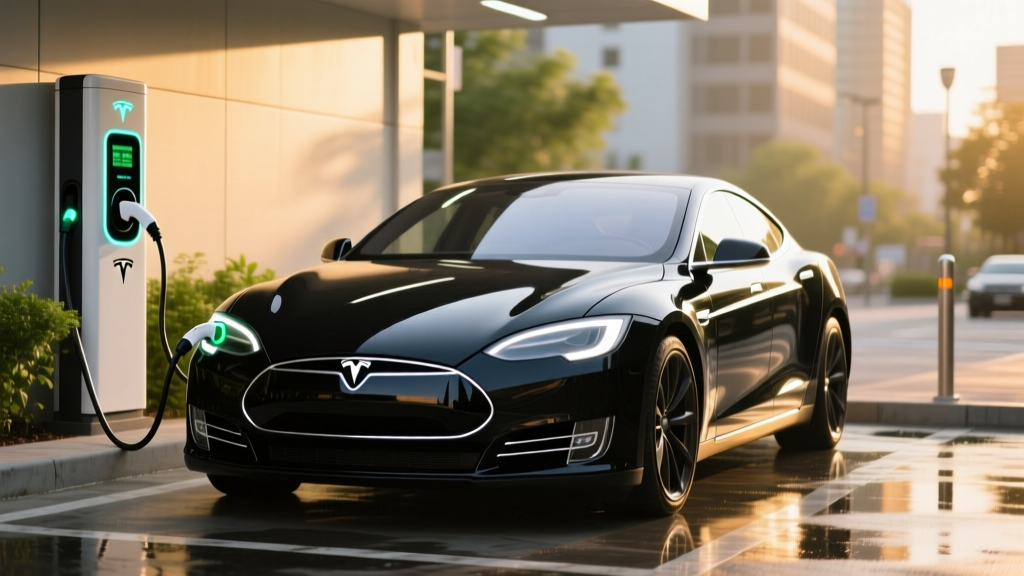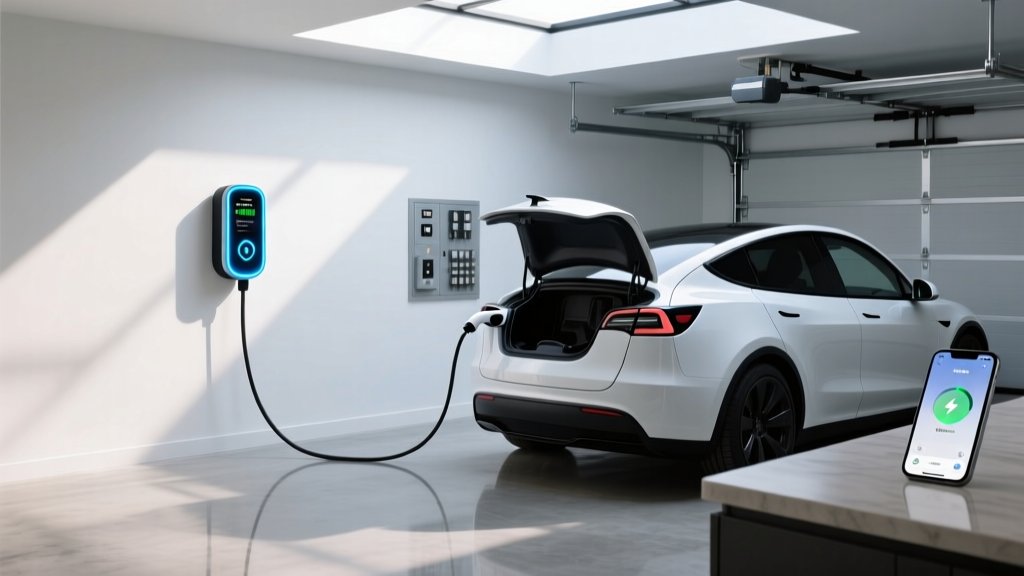
If you own or are shopping for a used 2021 Tesla Model Y Long Range, understanding exactly how it charges — at home, on road trips, and in daily driving — is the difference between effortless EV ownership and frustrating guesswork. The 2021 Model Y Long Range pairs an EPA-rated 326 miles of range with a usable battery capacity of roughly 75 kWh (NMC chemistry), and it supports peak DC fast charging up to 250 kW on V3 Superchargers. But those headline numbers only tell part of the story.
This guide breaks down every charging scenario you'll encounter with the 2021 Model Y Long Range: the real-world speeds, the home installation costs, the connector ecosystem, and the per-mile economics compared to gasoline. All figures reflect the 2026 ownership landscape, including Tesla's NACS connector dominance and the current public charging network.
Understanding the 2021 Model Y Long Range Battery and Charging Specs
Before plugging in anywhere, here's the hardware you're working with. The 2021 Model Y Long Range uses a dual-motor all-wheel-drive powertrain producing 384 horsepower and achieves a 0–60 mph time of 4.8 seconds. Its EPA-rated efficiency is 122 MPGe combined (27 kWh/100 mi). The battery pack is a nickel-manganese-cobalt (NMC) lithium-ion unit with approximately 75 kWh of usable capacity and an 8-year/120,000-mile warranty covering defects and capacity loss below 70%.
| Specification | Value |
|---|---|
| EPA Range | 326 miles (real-world highway: ~270–290 mi; cold weather: ~240–260 mi) |
| Battery Capacity (usable) | ~75 kWh (NMC chemistry) |
| Onboard Charger (Level 2) | 11.5 kW (48A at 240V) |
| Peak DC Fast Charge | 250 kW (CCS protocol via NACS connector) |
| DC Fast Charge 10–80% | ~25–30 minutes (with preconditioning) |
| Connector | NACS (native Tesla); CCS1 adapter available |
| Battery Warranty | 8 years / 120,000 miles (≥70% retention) |
Real-World Range Reality Check: The EPA's 326-mile figure assumes mixed driving. On sustained 75 mph highway runs in moderate temperatures, expect 270–290 miles. In sub-freezing winter conditions, that drops to 240–260 miles due to cabin heating demand and reduced battery efficiency. Always plan road trips around 80% of the EPA figure to maintain a comfortable buffer.
Charging Levels Explained: Speeds, Power, and Miles Per Hour
The most common mistake new EV owners make is confusing kW (kilowatts — the rate of power flow, like water pressure from a hose) with kWh (kilowatt-hours — the total energy stored or delivered, like gallons in a bucket). Your 2021 Model Y Long Range has a ~75 kWh battery. A 7 kW charger delivers 7 kW of power, meaning it would take roughly 10.7 hours to fill that battery from empty to full (75 ÷ 7 = 10.7).
| Level | Voltage / Amperage | Power (kW) | Miles of Range Added Per Hour | Best For |
|---|---|---|---|---|
| Level 1 (120V outlet) | 120V / 12A | ~1.4 kW | ~3–4 mi/hr | Emergency / trickle top-off |
| Level 2 (240V home) | 240V / 48A | 11.5 kW | ~34–38 mi/hr | Daily home charging |
| DC Fast Charge | 400V+ / variable | Up to 250 kW peak | Up to ~1,000 mi/hr (peak) | Road trips / rapid top-ups |
Level 1 is effectively useless for daily use on the Model Y. At 3–4 miles of range per hour, a full charge from 10% would take over 50 hours. It's only practical as an emergency trickle if you're stranded without Level 2 access.
Level 2 is where the 2021 Model Y Long Range lives day-to-day. The onboard charger accepts up to 11.5 kW (48 amps at 240 volts). Plugging into a 48A Level 2 station overnight adds roughly 340+ miles of range in about 10 hours — more than enough to refill the battery completely while you sleep. Most owners install a 60-amp circuit (which delivers 48A continuous under the National Electrical Code's 80% rule for continuous loads).
DC Fast Charging bypasses the onboard charger entirely, sending high-voltage DC current directly into the battery. On a Tesla V3 Supercharger (250 kW peak), the Model Y Long Range can add up to ~162 miles of range in 15 minutes under ideal conditions. However, peak charge rate is not sustained. The charging curve tapers significantly above 60% state of charge (SoC), which is why the industry-standard measurement is 10–80% time: approximately 25–30 minutes when the battery is preconditioned.
Home Charger Installation: Electrical Requirements, Costs, and Gotchas
Installing a Level 2 home charger for your 2021 Model Y Long Range is the single highest-impact upgrade you can make for daily convenience. Here's what's involved electrically and financially.
Electrical Requirements
To achieve the Model Y's maximum 11.5 kW Level 2 rate, you need a 240-volt, 60-amp dedicated circuit with a NEMA 14-60 outlet or a hardwired connection. The 80% continuous-load rule means a 60A breaker supports 48A of sustained draw. If your electrical panel lacks capacity for an additional 60A circuit, you may need a panel upgrade — a significant added cost.
Key safety and code requirements include:
- Dedicated circuit: The EV charger must have its own breaker — no sharing with dryers, ranges, or HVAC.
- GFCI protection: The 2020 NEC and later require GFCI (Ground Fault Circuit Interrupter) protection for outdoor EV outlets. Hardwired units may also require GFCI breakers in some jurisdictions.
- Outdoor rating: If installing outside, use a NEMA 4-rated enclosure and a charger rated for outdoor use (IP55 or higher).
- Permit: Most municipalities require an electrical permit and inspection for new 240V circuits. Budget $50–$250 for the permit depending on your locality.
Installation Cost Breakdown
| Component | Low-End | Typical | High-End |
|---|---|---|---|
| Level 2 Charger Equipment | $350 | $550 | $750 |
| Electrician Labor (new 60A circuit, ~20–40 ft run) | $500 | $1,000 | $2,000 |
| Electrical Permit | $50 | $125 | $250 |
| Panel Upgrade (200A → 200A replacement or upgrade, if needed) | $0 | $0 | $2,500–$4,000 |
| Total (no panel upgrade) | $900 | $1,675 | $3,000 |
| Total (with panel upgrade) | $3,400 | $4,175 | $7,000 |
The wide range in electrician labor reflects real-world variability: a short wire run from a panel in an attached garage costs far less than a 60-foot conduit run to a detached garage. Older homes with 100A panels almost always need a panel upgrade to support a 60A EV circuit alongside existing loads. Always get at least two quotes from licensed electricians and confirm they have EV charger installation experience.
Federal incentive note: The Residential Clean Energy Credit (IRC §25D) previously covered 30% of home charger equipment and installation costs up to $1,000. As of 2026, verify current availability and eligibility with a tax professional, as incentive programs and caps change.
Connector Compatibility: NACS, CCS1, and Adapters
The 2021 Model Y Long Range uses Tesla's proprietary connector, which was formally adopted as the North American Charging Standard (NACS) in late 2022. By 2026, NACS has become the dominant connector across most new EVs sold in North America, and the vast majority of public DC fast-charging networks now offer NACS plugs natively.
| Connector | Network / Use | Compatibility |
|---|---|---|
| NACS (native Tesla) | Tesla Supercharger, Electrify America, EVgo, ChargePoint (newer stations) | Native — no adapter needed |
| CCS1 | Legacy Electrify America, older ChargePoint and EVgo stations | Requires Tesla CCS1 adapter (~$175–$250) |
| CHAdeMO | Nissan Leaf ecosystem (declining) | Not compatible — no adapter available |
| J1772 (Level 2 public) | Public Level 2 stations (parking garages, workplaces) | Requires J1772-to-NACS adapter (included with vehicle or ~$95 aftermarket) |
For daily Level 2 charging, you'll encounter J1772 connectors at public stations. Tesla includes a J1772 adapter with new vehicles; for a used 2021 Model Y, confirm the adapter is included or purchase one aftermarket. For DC fast charging on road trips, the Tesla Supercharger network remains the most reliable and widespread option, with NACS plugs native to the vehicle.
Cost to Charge: Per-Mile Economics vs. Gasoline
One of the strongest ownership arguments for the 2021 Model Y Long Range is the per-mile energy cost. Let's run the numbers using the vehicle's EPA efficiency of 27 kWh/100 miles across common charging scenarios.
| Scenario | Rate | Cost per 100 Miles | Cost per Mile |
|---|---|---|---|
| Home charging (off-peak utility rate) | $0.12/kWh | $3.24 | $0.032 |
| Home charging (average US residential) | $0.17/kWh | $4.59 | $0.046 |
| Public Level 2 (network pricing) | $0.25/kWh | $6.75 | $0.068 |
| DC Fast Charge (Supercharger / public) | $0.35/kWh | $9.45 | $0.095 |
| Comparable gas SUV (25 MPG combined) | $3.50/gallon | $14.00 | $0.140 |
| Comparable gas SUV (25 MPG, $4.00/gal) | $4.00/gallon | $16.00 | $0.160 |
At home on an off-peak utility rate, the Model Y Long Range costs roughly 3.2 cents per mile — less than a quarter of the cost of fueling a comparable gasoline SUV at $3.50/gallon. Even at public DC fast-charging rates of $0.35/kWh, you're still paying roughly $0.095/mile, which undercuts gasoline. The key economic takeaway: home charging is where the savings compound. If you rely exclusively on public DC fast charging, your per-mile cost rises to about two-thirds of gasoline — still cheaper, but the margin narrows significantly.
For a driver covering 12,000 miles per year with 80% home charging at $0.14/kWh average and 20% DC fast charging at $0.35/kWh, the annual electricity cost is approximately $622. The equivalent gasoline SUV at 25 MPG and $3.50/gallon would cost $1,680 — an annual fuel savings of over $1,050.
Recommended Home Chargers for the 2021 Model Y Long Range
The 2021 Model Y's 11.5 kW onboard charger means you should pair it with a charger that delivers at least 48 amps to capture the full charging rate. Here are three proven options at different price points:
Tesla Wall Connector (Gen 3)
- Power Output: 11.5 kW (48A at 240V)
- Connector: NACS native — no adapter needed
- Cable Length: 24 feet
- Smart Features: Wi-Fi, over-the-air updates, load sharing (pair two units on one circuit), access control
- Price: ~$475
- Best For: Tesla-only households wanting the cleanest integration
ChargePoint Home Flex
- Power Output: Up to 12 kW (50A at 240V); adjustable down to 16A
- Connector: J1772 (NACS adapter required) or NACS version available
- Cable Length: 23 feet
- Smart Features: Wi-Fi, app-based scheduling, Alexa integration, flexible amperage for panel-limited homes
- Price: ~$599–$699
- Best For: Multi-EV households or homes with limited panel capacity (can dial down to 32A or 24A)
Emporia Level 2 EV Charger
- Power Output: 11.5 kW (48A at 240V)
- Connector: J1772 (NACS adapter required)
- Cable Length: 24 feet
- Smart Features: Wi-Fi, energy monitoring, solar integration, app scheduling
- Price: ~$349–$399
- Best For: Budget-conscious buyers who want smart features without the premium price
For the 2021 Model Y Long Range, the Tesla Wall Connector is the default recommendation — native NACS, no adapter clutter, and it maxes out the vehicle's 11.5 kW onboard charger. If you plan to add a non-Tesla EV in the future or need adjustable amperage for panel limitations, the ChargePoint Home Flex is the most versatile alternative.
DC Fast Charging and Road Trip Realities
On road trips, the 2021 Model Y Long Range has access to Tesla's Supercharger network — the most reliable and widespread DC fast-charging infrastructure in North America as of 2026. Here's what to expect in practice:
- V3 Supercharger (250 kW peak): 10–80% in approximately 25–30 minutes with battery preconditioning. Peak rate of ~250 kW is only sustained from roughly 10–30% SoC; the curve tapers to ~100 kW by 60% and ~40 kW by 80%.
- V2 Supercharger (150 kW peak): 10–80% in approximately 35–40 minutes. Still common at older locations.
- Non-Tesla DC fast chargers (CCS1 with adapter): Speeds vary by station. Electrify America 350 kW stations will be limited by the Model Y's ~250 kW peak acceptance rate. Expect 10–80% in roughly 28–35 minutes.
Preconditioning is critical. When you navigate to a Supercharger in the Tesla navigation system, the car automatically warms the battery to optimal charging temperature during your drive. Arriving without preconditioning — for example, at a non-Tesla charger or in cold weather without navigation routing — can slow your 10–80% time by 10–15 minutes. Always route through the car's nav system to trigger preconditioning.
Charging curve taper above 80%: Lithium-ion batteries resist accepting high current at high states of charge to prevent degradation. Charging from 80–100% on a DC fast charger can take nearly as long as 10–80%. On road trips, plan to charge to 80% and drive on — it's faster overall than waiting for a full charge.
Frequently Asked Questions
How much does it cost to install a home EV charger for a 2021 Model Y Long Range?
A typical Level 2 home installation with a new 60-amp circuit, Tesla Wall Connector, and permit costs between $1,200 and $2,500 if your electrical panel has sufficient capacity. If a panel upgrade is required (common in homes with 100A service), add $2,500–$4,000, bringing the total to $3,700–$6,500.
How fast will each charging level add range to the Model Y Long Range?
Level 1 (120V) adds approximately 3–4 miles per hour — impractical for daily use. Level 2 (240V, 48A) adds 34–38 miles per hour and can fully recharge the battery overnight. DC fast charging at a V3 Supercharger adds up to ~162 miles in 15 minutes at peak rate, with a 10–80% session taking 25–30 minutes.
Which connector and charger is compatible with my 2021 Model Y Long Range?
The 2021 Model Y uses the NACS connector natively. It plugs directly into all Tesla Superchargers and an expanding number of third-party DC fast chargers. For older CCS1 stations, you'll need a Tesla CCS1 adapter. For public Level 2 stations with J1772 connectors, you'll need a J1772-to-NACS adapter. CHAdeMO is not compatible.
How much does charging cost per mile compared to gasoline?
At the US average residential electricity rate of ~$0.17/kWh, the 2021 Model Y Long Range costs about $0.046 per mile to charge at home. A comparable gasoline SUV at 25 MPG and $3.50/gallon costs $0.14 per mile. That's a 67% per-mile fuel savings when charging at home. Even public DC fast charging at $0.35/kWh ($0.095/mile) is cheaper than gasoline.
What electrical upgrades might I need for a home Level 2 charger?
You need a dedicated 240V, 60-amp circuit. If your home has a 200-amp electrical panel with available capacity, the installation is straightforward. Homes with 100-amp panels or panels near capacity will likely need a panel upgrade to 200 amps ($2,500–$4,000). Some utilities offer time-of-use rate plans that make off-peak charging significantly cheaper — check with your provider before installation.
Should I charge to 100% every day?
For daily driving, Tesla recommends setting the charge limit to 80–90% to reduce long-term battery degradation on NMC chemistry. Reserve 100% charges for road trips where you need the full 326-mile EPA range. The battery management system handles balancing and thermal regulation automatically — you just set the limit in the app or on the touchscreen.
Does cold weather affect charging speed?
Yes, significantly. In sub-freezing temperatures, an un-preconditioned battery may accept DC fast charging at only 30–50 kW initially, ramping up as the battery warms. Always navigate to a Supercharger using the car's built-in navigation to trigger automatic battery preconditioning — this alone can save 10–15 minutes on a cold-weather charging stop. Cold weather also reduces range by 15–25% due to cabin heating demand and reduced battery efficiency.