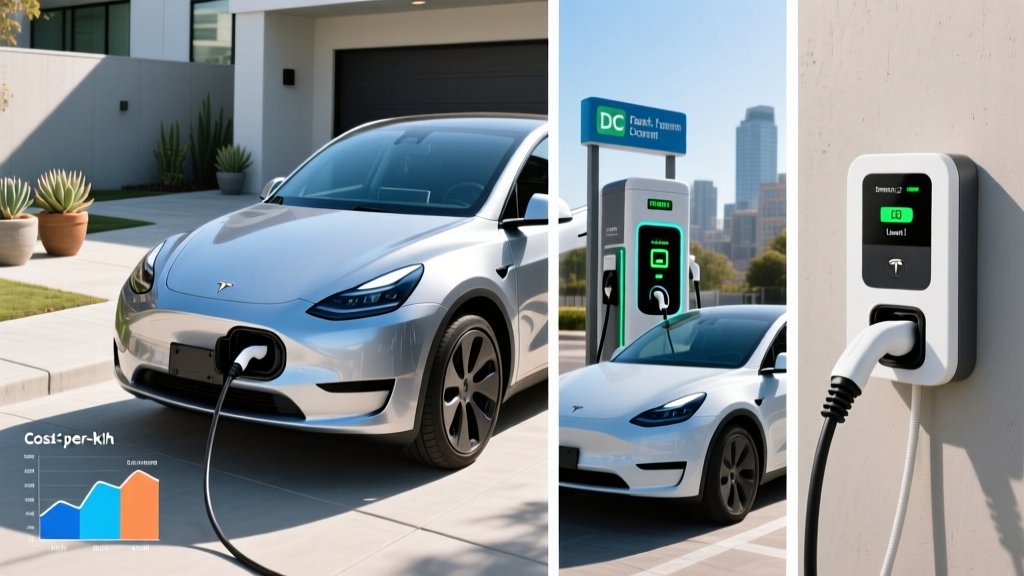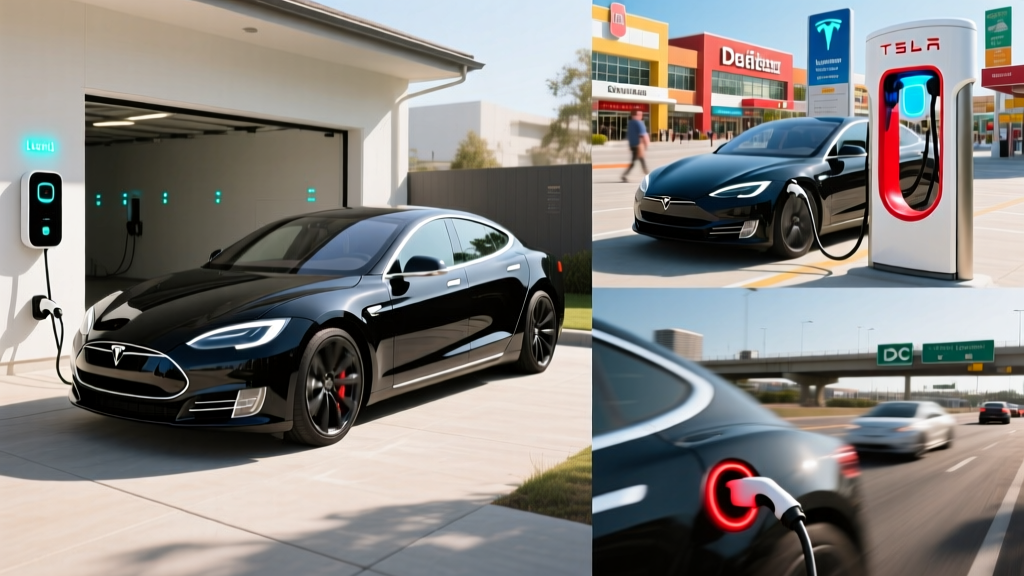
The 2020 Tesla Model S Long Range Plus holds a special place in EV history. It was the first production vehicle to break the EPA's 400-mile range barrier, earning an official 402-mile EPA estimate thanks to a 100 kWh (usable) battery pack, weight-saving measures, and improved powertrain efficiency. If you own one today or are picking one up on the used market, understanding exactly how to charge it — at home, on road trips, and at public stations — is essential to maximizing that legendary range and keeping the battery healthy for years to come.
This guide covers every charging scenario the 2020 Model S Long Range Plus will encounter, with exact kW figures, realistic charge times, home installation costs, and what you'll actually spend per mile compared to a gasoline car.
Know Your Battery: 100 kWh and What That Means
Before plugging in, it's worth clarifying the most important distinction in EV ownership: kW (kilowatts) measures power — how fast energy flows into the car — while kWh (kilowatt-hours) measures energy — how much the battery holds. The 2020 Model S Long Range Plus has a roughly 100 kWh battery pack (approximately 95–100 kWh usable, depending on buffer management). Think of kWh as the size of the fuel tank and kW as the diameter of the hose filling it.
This pack uses NMC (nickel manganese cobalt) lithium-ion chemistry, which offers high energy density — the reason this car achieves 402 miles — but benefits from daily charge limits around 80–90% for longevity, with 100% reserved for road trips. Tesla's battery management system handles most of this automatically, but understanding the basics helps you make smarter charging decisions.
Charging Levels Explained: Level 1, Level 2, and DC Fast
Every EV charges at one of three levels. Here's what each delivers to the 2020 Model S Long Range Plus, based on its onboard charger capacity and battery size.
| Level | Voltage | Max Power (kW) | Miles of Range Added Per Hour | Best Use Case |
|---|---|---|---|---|
| Level 1 (120V) | 120V AC | ~1.4 kW | ~3–4 miles/hr | Emergency/trickle; overnight top-off |
| Level 2 (240V) | 240V AC | 11.5 kW (48A) | ~30–34 miles/hr | Daily home charging; overnight full charge |
| DC Fast Charging | 400V DC | ~150 kW peak | ~200+ miles in 30 min | Road trips; rapid top-ups |
Level 1: The Emergency Backup
Every Model S ships with a Mobile Connector that includes a 120V NEMA 5-15 adapter. Plugging into a standard household outlet delivers roughly 1.4 kW — about 3 to 4 miles of range per hour. Fully charging a depleted 100 kWh battery this way would take over 70 hours. It's viable only for overnight top-offs if you drive fewer than 40 miles daily, or as an emergency option when no Level 2 or DC charger is available.
Level 2: Your Daily Workhorse
The 2020 Model S Long Range Plus has an onboard AC charger rated at 11.5 kW (48 amps). This means even if your home charger is capable of 19.2 kW (80A), the car will only accept 11.5 kW. At this rate, you'll add roughly 30–34 miles of range per hour, and a full 10–80% charge takes approximately 6.5–7 hours — ideal for overnight charging.
DC Fast Charging: Road-Trip Speed
The 2020 Model S Long Range Plus supports DC fast charging at up to roughly 150 kW peak on V2 Superchargers (Tesla's 400V architecture limits it compared to newer vehicles on V3/V4 stations). On a V3 Supercharger (capable of 250 kW), this car will still peak around 150 kW and taper as the battery fills. Expect a 10–80% charge in approximately 35–40 minutes. The charge curve is not linear: you'll see peak speeds between 10–50% SoC, then a gradual taper from 50–80%, and a sharp slowdown above 80% to protect the cells.
Home Charger Installation: Costs, Electrical Requirements, and Upgrades
Installing a Level 2 home charger is the single most impactful upgrade for EV ownership. For the 2020 Model S Long Range Plus, you'll want a 240V circuit capable of delivering at least 48 amps to match the car's 11.5 kW onboard charger.
Electrical Requirements
- Circuit: 60-amp dedicated breaker (provides 48 amps continuous, per the 80% NEC rule for continuous loads)
- Voltage: 240V single-phase
- Wiring: 6 AWG copper (or 4 AWG aluminum) for a 60A circuit
- Outlet vs. hardwired: A NEMA 14-60 receptacle offers portability; hardwired installations are often preferred for outdoor setups and may be required by some local codes for circuits above 40A
What Will It Cost?
Installation costs vary enormously depending on your home's electrical panel, the distance from the panel to the charger location, and local permit fees. Here's a realistic breakdown for 2026:
| Cost Component | Simple Install (panel nearby) | Complex Install (long run or panel upgrade) |
|---|---|---|
| Level 2 Charger Equipment | $400–$650 | $400–$650 |
| Electrician Labor | $500–$1,200 | $1,500–$3,500 |
| Permit & Inspection | $100–$300 | $150–$500 |
| Electrical Panel Upgrade (if needed) | $0 | $1,500–$3,000 |
| Total Estimated Range | $1,000–$2,150 | $3,550–$7,650 |
Panel upgrade gotcha: Many homes built before 2000 have 100-amp electrical panels. Adding a 60A EV circuit may push total load beyond the panel's capacity, requiring an upgrade to 200 amps. This is the single biggest cost variable. Have an electrician perform a load calculation before committing to a charger install. According to the National Electrical Contractors Association, a panel upgrade typically runs $1,500–$3,000 but varies by region and utility requirements.
Safety and Code Considerations
- Dedicated circuit: Your EV charger must have its own dedicated breaker — never share a circuit with other appliances
- GFCI protection: NEC 2020 and later require GFCI protection for outdoor receptacles used for EV charging; hardwired units may have GFCI built in
- Outdoor rating: If installing outdoors, ensure the charger is rated NEMA 4 (weatherproof). Most quality Level 2 chargers carry this rating
- Permit required: Nearly all jurisdictions require a permit and inspection for EV charger installation. Skipping this can void home insurance coverage in the event of an electrical fire
Connector Compatibility: NACS, Adapters, and Public Charging Access
The 2020 Tesla Model S Long Range Plus was built with Tesla's proprietary connector, which in 2022 was formalized as the North American Charging Standard (NACS). This gives you native access to the entire Tesla Supercharger network — still the most reliable and extensive DC fast-charging network in North America, with over 6,000 stations and 30,000+ connectors as of early 2026.
| Connector Type | Native on 2020 Model S? | Adapter Needed? | Network Access |
|---|---|---|---|
| NACS (Tesla) | Yes — native | No | Tesla Superchargers, Destination Chargers |
| CCS1 | No | Yes — Tesla CCS Adapter (~$175–$250) | Electrify America, EVgo, ChargePoint, Ionity |
| CHAdeMO | No | Yes — third-party adapter (rare, ~$300+) | Limited legacy stations; being phased out |
| J1772 (Level 2 public) | No | Yes — included J1772 adapter (ships with car) | Public Level 2 at malls, workplaces, hotels |
Practical recommendation: Buy the official Tesla CCS adapter if you plan to use non-Tesla DC fast chargers. The CHAdeMO network is shrinking rapidly and is not worth investing in for a Tesla owner. The J1772 adapter for Level 2 public charging is included with the vehicle — keep it in the trunk.
Equipment Recommendations: Best Home Chargers for the 2020 Model S
Since the Model S Long Range Plus accepts up to 11.5 kW (48A), you'll want a charger rated for at least 48 amps to take full advantage. Here are top picks for 2026:
Tesla Wall Connector (Gen 3)
- Power Output: Up to 11.5 kW (48A) on a 60A circuit
- Connector: NACS (native Tesla — no adapter needed)
- Cable Length: 24 feet
- Smart Features: Wi-Fi connectivity, over-the-air updates, load sharing with multiple Wall Connectors, access control
- Price: ~$475
- Best For: Tesla-only households seeking seamless integration
ChargePoint Home Flex
- Power Output: Up to 12 kW (50A) on a 60A circuit; configurable down to lower amperages
- Connector: NACS (as of 2025 refresh) or J1772 (use Tesla adapter)
- Cable Length: 23 feet
- Smart Features: App-based scheduling, energy tracking, Alexa integration, flexible amperage settings for older panels
- Price: ~$550–$650
- Best For: Multi-EV households or homes needing adjustable amperage
Emporia Level 2 EV Charger
- Power Output: Up to 11.5 kW (48A)
- Connector: J1772 (use included Tesla adapter) or NACS version available
- Cable Length: 24 feet
- Smart Features: Energy monitoring, solar integration, scheduling via app, one of the most affordable smart chargers
- Price: ~$350–$400
- Best For: Budget-conscious buyers who want smart features and energy monitoring
For the 2020 Model S Long Range Plus, the Tesla Wall Connector is the most straightforward choice: native NACS plug, no adapter fumbling, and guaranteed compatibility. If you own or plan to own non-Tesla EVs, the ChargePoint Home Flex offers more versatility.
Cost to Charge: Home vs. Public vs. Gas
One of the strongest ownership arguments for the Model S Long Range Plus is fuel cost savings. Here's how charging costs break down across scenarios, using the 100 kWh battery as a reference.
| Charging Scenario | Cost per kWh | Cost for 10–80% (70 kWh) | Cost per Mile (est.) |
|---|---|---|---|
| Home — Off-Peak TOU Rate | $0.08–$0.12 | $5.60–$8.40 | $0.02–$0.03 |
| Home — Standard Rate | $0.14–$0.18 | $9.80–$12.60 | $0.03–$0.04 |
| Public Level 2 (ChargePoint, etc.) | $0.25–$0.40 | $17.50–$28.00 | $0.05–$0.08 |
| DC Fast — Tesla Supercharger V3 | $0.28–$0.40 | $19.60–$28.00 | $0.06–$0.08 |
| DC Fast — Electrify America | $0.35–$0.52 | $24.50–$36.40 | $0.07–$0.10 |
| Comparison: Gasoline sedan at 28 MPG, $3.40/gal = $0.12/mile | |||
The bottom line: Charging at home on an off-peak time-of-use (TOU) plan is roughly one-quarter the cost per mile of gasoline. Even DC fast charging on road trips is competitive with or cheaper than gas on a per-mile basis. Over 15,000 miles of annual driving, a home-charged Model S Long Range Plus can save $1,200–$1,600 per year compared to a gasoline sedan averaging 28 MPG.
To maximize savings, contact your utility about EV-specific TOU rates. Many utilities offer plans where electricity drops to $0.06–$0.10/kWh between midnight and 6 AM — the ideal charging window. The U.S. Department of Energy's fueleconomy.gov provides state-by-state electricity rate data and EV efficiency comparisons.
Charging Time Examples: What to Expect With the 100 kWh Pack
Here are realistic charge times for the 2020 Model S Long Range Plus across common scenarios. These assume starting at approximately 10% state of charge:
- Level 1 (120V, 1.4 kW): 10–80% in approximately 50 hours — impractical for full charges; use only for overnight trickle
- Level 2 (240V, 11.5 kW): 10–80% in approximately 6.5 hours — a full overnight session fills the battery comfortably
- DC Fast — Tesla V2 Supercharger (150 kW): 10–80% in approximately 40 minutes
- DC Fast — Tesla V3 Supercharger (250 kW station, ~150 kW vehicle peak): 10–80% in approximately 35 minutes — the car's 400V architecture limits gains from V3 infrastructure
- DC Fast — CCS station via adapter (350 kW station, ~150 kW vehicle peak): 10–80% in approximately 35–40 minutes, depending on station load and battery temperature
Preconditioning matters: If you navigate to a Supercharger using the car's built-in navigation, the Model S will automatically precondition the battery — warming it to optimal temperature for faster charge acceptance. In cold weather, preconditioning can shave 10–15 minutes off a fast-charging session. Always navigate to your charger rather than just driving there.
Tips for Maximizing Battery Health on the 2020 Model S
The NMC battery in this vehicle will last longest with a few simple habits:
- Set daily charge limit to 80–90%. Only charge to 100% when you need the full range for a trip. The car's settings menu lets you adjust this easily.
- Avoid frequent DC fast charging if possible. Occasional Supercharging on road trips is fine, but daily DC fast charging accelerates degradation. Home Level 2 is the healthiest diet for your battery.
- Don't let the car sit at 100% or near 0% for extended periods. If you're leaving for a week, set the charge limit to 50% and leave it plugged in.
- Use scheduled charging to finish charging right before you leave — this minimizes time spent at high state of charge.
Tesla's battery warranty on the 2020 Model S covers 8 years or 150,000 miles (whichever comes first) with a minimum 70% capacity retention threshold. According to Tesla's 2024 Impact Report, Model S/X batteries degrade approximately 10–12% after 200,000 miles on average. For a used 2020 example, check the battery's State of Health (SoH) through the service menu or a third-party diagnostic tool before purchasing.
Frequently Asked Questions
How much does it cost to install a home EV charger for a 2020 Tesla Model S?
Expect $1,000–$2,150 for a straightforward install with a nearby electrical panel. If your panel needs upgrading from 100A to 200A, total costs can reach $3,500–$7,650. The Tesla Wall Connector itself costs around $475, with electrician labor and permits making up the remainder. Always get a load calculation from a licensed electrician first.
How fast will each charging level add range to the Model S Long Range Plus?
Level 1 (120V) adds about 3–4 miles per hour. Level 2 (240V at 48A) adds roughly 30–34 miles per hour. DC fast charging at a Supercharger can add over 200 miles in about 30 minutes, though speeds taper significantly above 80% state of charge.
Which connectors and chargers are compatible with my 2020 Model S?
The 2020 Model S uses Tesla's proprietary connector (now called NACS) natively. It plugs directly into all Tesla Superchargers and Destination Chargers. For CCS public fast chargers (Electrify America, EVgo), you'll need the Tesla CCS adapter ($175–$250). A J1772 adapter for public Level 2 charging is included with the car.
How much does charging cost per mile vs. gasoline?
Charging at home on off-peak electricity ($0.08–$0.12/kWh) costs approximately $0.02–$0.03 per mile. A comparable gasoline sedan at 28 MPG with gas at $3.40/gallon costs about $0.12 per mile. Even public DC fast charging ($0.28–$0.40/kWh) at $0.06–$0.10 per mile remains competitive with gasoline.
What electrical upgrades might I need for a Level 2 home charger?
You'll need a dedicated 60-amp, 240V circuit. The most common upgrade is an electrical panel expansion from 100A to 200A service, which costs $1,500–$3,000. Homes with modern 200A panels typically need only the new circuit and breaker. A licensed electrician must perform a load calculation to determine if your panel can handle the additional draw.
Can I use a non-Tesla DC fast charger with the 2020 Model S Long Range Plus?
Yes, with the Tesla CCS adapter. As of 2026, Tesla has also opened its Supercharger network to other brands, but your Model S already has native Supercharger access. The CCS adapter unlocks Electrify America, EVgo, and other networks as a backup option, especially useful in areas where Supercharger coverage is sparse.
Does the 2020 Model S Long Range Plus qualify for any federal tax credits?
The IRS §30D federal tax credit applies only to new vehicle purchases, so a used 2020 Model S does not qualify for the new-vehicle credit. However, it may qualify for the Used Clean Vehicle Credit (up to $4,000 or 30% of sale price, whichever is less) if purchased from a dealer for under $25,000, subject to buyer income caps ($75,000 single / $150,000 joint). Consult a tax professional for eligibility specifics.
For official efficiency and range data, refer to the EPA's fueleconomy.gov listing for the 2020 Tesla Model S Long Range Plus. For detailed safety ratings, check NHTSA.gov.