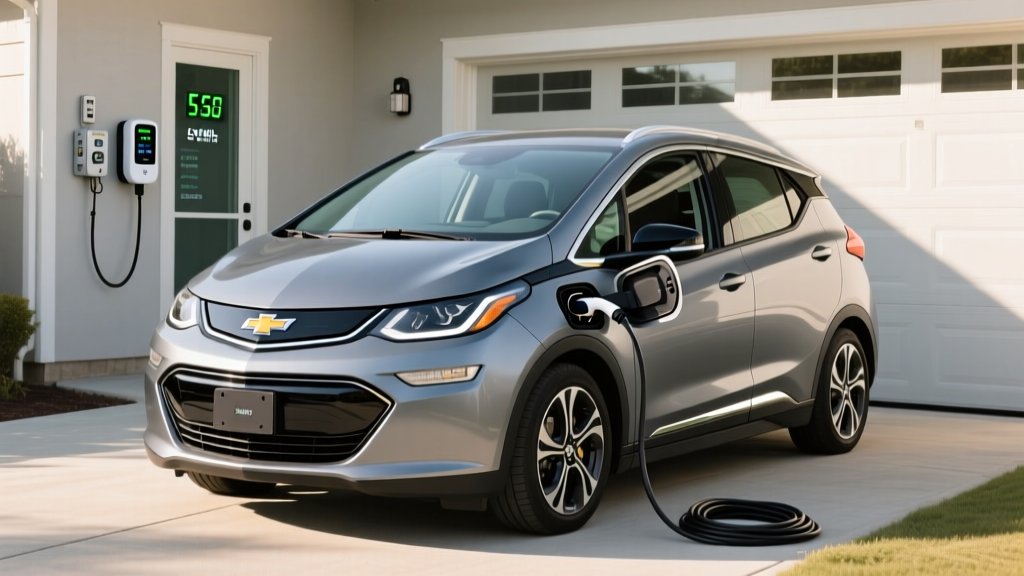
If you own a 2019 Chevrolet Bolt EV—or you're shopping the used market for one—you already know its headline stat: an EPA-estimated 238 miles of range from a 60 kWh lithium-ion (NMC) battery pack. That figure held up well in its day, and even in 2026, it remains practical for daily commuting and moderate road trips. But the real question Bolt owners ask isn't just about the sticker range—it's about how to charge efficiently at home, what installation actually costs, and how fast each charging level replenishes those 238 miles.
This guide is built specifically around the 2019 Chevy Bolt's charging architecture and battery specifications. We'll cover every charging tier, connector compatibility (including the CCS1-to-NACS adapter reality), real installation costs down to the permit, and exactly what you'll pay per mile compared to gas. Let's get into the numbers.
2019 Chevy Bolt EV: Battery, Range, and Charging Architecture
Before choosing equipment, you need to understand what the Bolt can actually accept. The 2019 Bolt EV uses a 60 kWh usable battery pack (NMC chemistry) paired with an onboard charger rated at 7.2 kW for Level 2 AC charging. On DC fast chargers, it peaks at approximately 55 kW using the CCS1 connector—a rate that was competitive in 2019 but is modest by 2026 standards.
| EPA Range | 238 miles |
| Battery Capacity | 60 kWh usable (NMC) |
| Level 2 Onboard Charger | 7.2 kW (240V / 30A) |
| DC Fast Charge Peak | ~55 kW (CCS1) |
| 10–80% DC Fast Charge | ~55–60 minutes |
| EPA Efficiency | 119 MPGe combined / 28 kWh/100mi |
| Connector | CCS1 (J1772 + DC pins) |
| Battery Warranty (Original) | 8 years / 100,000 miles |
Charging Levels Explained: Speeds in kW and Miles Per Hour
A common source of confusion for new EV owners is the difference between kW (kilowatts) and kWh (kilowatt-hours). Here's the distinction: kW measures power—the rate at which electricity flows into your car. kWh measures energy—the total capacity of your battery. Think of kW as the width of a hose and kWh as the size of the bucket. A wider hose (higher kW) fills the bucket (kWh) faster.
The 2019 Bolt's 60 kWh battery needs to be filled at different rates depending on your charging setup. Here's what each level delivers:
| Level | Voltage / Amperage | Power (kW) | Miles of Range Added Per Hour | Full 0–100% Time (60 kWh) |
|---|---|---|---|---|
| Level 1 (120V) | 120V / 12A | ~1.4 kW | ~4 miles/hr | ~42 hours |
| Level 2 (240V) | 240V / 30A | 7.2 kW | ~24 miles/hr | ~8.5 hours |
| DC Fast (CCS1) | 400V DC | ~55 kW peak | ~160 miles/hr (at peak) | ~55–60 min (10–80%) |
For daily ownership, Level 2 is the sweet spot. Plugging in overnight for 8 hours at 7.2 kW adds roughly 190 miles—more than enough to replenish a typical day's driving. Level 1 is only viable as a trickle-charge supplement if you drive fewer than 30 miles daily and have 12+ hours to charge. DC fast charging is best reserved for road trips; using it exclusively accelerates battery degradation over time.
According to fueleconomy.gov, the Bolt EV's 28 kWh/100mi efficiency rating means you're consuming 0.28 kWh per mile driven—a useful figure for calculating costs below.
How Much Does It Cost to Install a Home EV Charger?
This is the question every Bolt owner or prospective buyer needs answered before purchasing a Level 2 charger. The honest answer: it depends heavily on your home's electrical panel and the distance from the panel to your parking spot. Here's a realistic breakdown for a 240V / 40A circuit installation (the most common home EV setup in 2026):
| Component | Low End | High End | Notes |
|---|---|---|---|
| Level 2 Charger (Equipment) | $350 | $700 | Smart Wi-Fi chargers, 32A–40A, 25ft cable |
| Electrician Labor | $500 | $1,500 | Depends on run length, conduit, wall type |
| Electrical Permit | $50 | $200 | Varies by municipality |
| Panel Upgrade (if needed) | $1,500 | $3,500 | 100A → 200A service upgrade |
| Total (No Panel Upgrade) | $900 | $2,400 | Most homes with 200A panels |
| Total (With Panel Upgrade) | $2,400 | $5,900 | Older homes with 100A service |
The panel-upgrade gotcha: Homes built before the 1990s often have 100-amp electrical service. Adding a 40A dedicated EV circuit to a panel already near capacity requires a service upgrade to 200A. This is the single biggest variable in installation cost. Before buying a charger, have a licensed electrician evaluate your panel's available amperage. Some homeowners can use a smart load-management device (like the Emporia VUE with EV charger integration) to avoid a panel upgrade by dynamically throttling charge rate when other appliances draw power.
Many states and utilities offer rebates for home charger installation—check the Alternative Fuels Data Center for current incentive programs in your area.
Connector Compatibility: CCS1, NACS, and the Adapter Question
The 2019 Chevy Bolt EV uses the CCS1 (Combined Charging System) connector, which combines the J1772 AC plug with two DC fast-charge pins below it. In 2026, the EV industry has largely shifted toward the NACS (North American Charging Standard, formerly Tesla's proprietary connector), but CCS1 infrastructure remains widely available at Electrify America, EVgo, and ChargePoint stations.
| Connector | Used By | 2019 Bolt Compatible? | Adapter Needed? |
|---|---|---|---|
| CCS1 | Chevy, Ford (pre-2025), VW, BMW, Hyundai/Kia (pre-2025) | Yes — native | No |
| NACS (Tesla) | Tesla (all), Ford (2025+), GM (2025+), Rivian | With adapter | Yes — CCS1-to-NACS adapter (~$200–$300) |
| CHAdeMO | Nissan Leaf, Mitsubishi (legacy) | No | N/A — different standard entirely |
| J1772 (AC only) | All EVs (Level 1 & 2 AC charging) | Yes — native | No |
What this means for Bolt owners in 2026: GM has transitioned to NACS on new vehicles starting with the 2025 model year. For your 2019 Bolt, you can continue using CCS1 stations natively. However, if you want access to Tesla Supercharger stations (which now offer NACS adapters for non-Tesla EVs via the "Magic Dock" at select locations), you'll need a CCS1-to-NACS adapter. General Motors has offered adapters to Bolt owners through dealer channels—check with your local Chevy dealer or the myChevrolet app for availability and pricing.
For home Level 2 charging, virtually all residential chargers use the J1772 connector, which plugs directly into your Bolt. No adapter needed for home charging.
Recommended Level 2 Chargers for the 2019 Bolt EV
Since the Bolt's onboard charger maxes out at 7.2 kW (32A at 240V), you don't technically need a 48A charger. However, installing a 40A-rated charger on a 50A circuit future-proofs your setup for a next EV. Here are three proven options in 2026:
ChargePoint Home Flex
- Power Output: Up to 12 kW (50A) — Bolt will draw 7.2 kW
- Connector: J1772 (NACS version also available)
- Cable Length: 23 feet
- Smart Features: Wi-Fi, app scheduling, Alexa integration, energy tracking
- Price: ~$550
- Best For: App-driven scheduling and utility rate optimization
Emporia Level 2 EV Charger
- Power Output: Up to 11.5 kW (48A)
- Connector: J1772
- Cable Length: 24 feet
- Smart Features: Wi-Fi, solar integration, load management with Emporia VUE panel monitor
- Price: ~$400
- Best For: Budget-conscious buyers and solar-home owners who want to avoid panel upgrades
Grizzl-E Smart
- Power Output: Up to 10 kW (40A)
- Connector: J1772
- Cable Length: 24 feet
- Smart Features: Wi-Fi, OCPP-compatible, adjustable amperage (16A–40A via DIP switch)
- Price: ~$450
- Best For: Outdoor installations (IP67 rated, -40°C to +50°C operating range)
Any of these chargers will fully replenish the Bolt's 60 kWh battery overnight in roughly 8.5 hours. If you're installing on a 40A circuit, set the charger to 32A output to match the Bolt's onboard charger limit and stay within the NEC 80% continuous-load rule.
Cost to Charge: Per-Mile Cost vs. Gas
One of the strongest arguments for the Bolt EV is its low operating cost. Let's compare real charging costs against a gas equivalent using the Bolt's 28 kWh/100mi consumption rate.
| Charging Scenario | Rate ($/kWh) | Cost Per Mile | Cost for 238-Mile Full "Tank" |
|---|---|---|---|
| Home Off-Peak (utility time-of-use) | $0.08 | $0.022 | $5.38 |
| Home Standard Rate (national avg.) | $0.16 | $0.045 | $10.70 |
| Public Level 2 (ChargePoint, etc.) | $0.25 | $0.070 | $16.66 |
| DC Fast Charging (Electrify America) | $0.48 | $0.134 | $31.98 |
| Gas Car (30 MPG @ $3.40/gal) | $3.40/gal | $0.113 | $26.97 |
The math is clear: home charging on any rate plan beats gas per mile. Even DC fast charging is roughly comparable to gas on a per-mile basis, though it should be used sparingly for battery health. The key to maximizing savings is enrolling in your utility's time-of-use (TOU) plan and scheduling charges during off-peak hours (typically 10 PM – 6 AM). A smart charger with scheduling features makes this automatic.
Over 15,000 miles of annual driving, a Bolt owner charging primarily at home on a standard rate saves roughly $1,020 per year compared to a 30 MPG gas car at $3.40/gallon. On off-peak rates, savings exceed $1,350 annually.
Electrical Safety, Code, and Installation Best Practices
EV charging is a high-draw, continuous electrical load—the National Electrical Code (NEC) treats it seriously. Here's what your installation must address:
- Dedicated Circuit: Your Level 2 charger requires its own dedicated circuit. A 40A charger needs a 50A breaker (NEC requires circuits be rated at 125% of continuous load). Never share this circuit with other appliances.
- GFCI Protection: The 2020 NEC (and subsequent updates adopted by most jurisdictions by 2026) requires GFCI protection for EV charging outlets. Hardwired chargers with built-in GFCI protection satisfy this requirement without a separate breaker. Hardwiring also eliminates the need for a NEMA 14-50 receptacle and avoids the GFCI nuisance-trip issues some owners experience with receptacle-based setups.
- Outdoor Rating: If your charger is installed outdoors (garage-exterior wall, carport, or driveway pedestal), ensure the unit carries at least an IP65 rating (IP67 preferred). All three chargers recommended above meet outdoor-use standards.
- Wire Gauge: A 50A circuit requires 6 AWG copper wire for runs up to 50 feet. Longer runs may require 4 AWG to prevent voltage drop. Your electrician will calculate this based on distance.
- Permit and Inspection: Most jurisdictions require a permit for EV charger installation. The inspection ensures proper grounding, correct breaker sizing, and code compliance. Skipping the permit can void your homeowner's insurance coverage for electrical fires.
DC Fast Charging on the Road: What Bolt Owners Should Know
The 2019 Bolt's ~55 kW peak DC fast-charge rate is its most significant limitation for road-trip use in 2026. While newer EVs charge at 150–350 kW, the Bolt's charge curve peaks at 55 kW only below 50% state of charge (SoC), then tapers significantly:
- 10%–50% SoC: ~50–55 kW sustained — adds roughly 80 miles in 20 minutes
- 50%–80% SoC: ~35–40 kW — adds roughly 55 miles in 20 minutes
- 80%–100% SoC: Drops below 20 kW — plan extra time or skip the top-up
This tapering charge curve is why we always quote 10–80% times rather than full charges. Charging past 80% on DC fast chargers is both slow and stressful on the NMC battery. For road trips, plan stops at 15–20% remaining SoC and charge to 80%—this keeps total stop time around 45–55 minutes.
Use apps like PlugShare or A Better Routeplanner to map CCS1-compatible DC fast chargers along your route. With a CCS1-to-NACS adapter, you also gain access to select Tesla Supercharger stations equipped with Magic Dock, expanding your road-trip options considerably.
Frequently Asked Questions
How much does it cost to install a home EV charger for my 2019 Chevy Bolt?
Expect $900–$2,400 if your home already has a 200A electrical panel. If you need a panel upgrade from 100A to 200A service, total costs range from $2,400 to $5,900. This includes the charger ($350–$700), electrician labor ($500–$1,500), and permit ($50–$200).
How fast will each charging level add range to my Bolt?
Level 1 (120V) adds about 4 miles per hour—only practical for overnight trickle-charging under 30 miles. Level 2 (240V at 32A) adds roughly 24 miles per hour, fully replenishing the 60 kWh battery in about 8.5 hours. DC fast charging peaks at ~160 miles per hour of charging, but only below 50% SoC; expect a 10–80% session to take 55–60 minutes.
Which connector and charger is compatible with my 2019 Bolt EV?
Your Bolt uses CCS1 for DC fast charging and J1772 for AC Level 1 and Level 2 charging. Any J1772 home charger will work natively. For Tesla Supercharger access, you'll need a CCS1-to-NACS adapter (approximately $200–$300). CHAdeMO chargers are not compatible.
How much does charging cost per mile vs. gas?
At the national average home electricity rate of $0.16/kWh, the Bolt costs about $0.045 per mile to charge—roughly 60% less than a 30 MPG gas car at $3.40/gallon ($0.113/mile). On off-peak utility rates ($0.08/kWh), you're looking at just $0.022 per mile.
What electrical upgrades might I need for a Level 2 charger?
You'll need a dedicated 50A circuit with 6 AWG copper wire and a 240V outlet (NEMA 14-50) or hardwired connection. If your home has a 100A electrical panel that's already near capacity, a service upgrade to 200A will be necessary—this adds $1,500–$3,500 to your installation cost. A smart load-management device may let you avoid the panel upgrade by dynamically limiting charge rate.
Does frequent DC fast charging damage the Bolt's battery?
Exclusively using DC fast charging accelerates NMC battery degradation over time. GM's battery management system includes thermal management to mitigate this, but best practice is to rely on Level 2 for daily charging and reserve DC fast charging for road trips. The Bolt's original battery warranty covers 8 years/100,000 miles against defects and excessive capacity loss (typically defined as falling below 60% of original capacity).
Sources: Range and efficiency data from fueleconomy.gov. Tax credit and incentive information from IRS.gov. Charging infrastructure data from the Alternative Fuels Data Center. Always verify current incentive eligibility with a tax professional.