Understanding the 2018 Nissan Leaf SV Range and Why Charging Setup Matters
The 2018 Nissan Leaf SV marked the debut of the second-generation Leaf, bringing a significantly larger battery and more practical range to Nissan's mainstream electric hatchback. If you own one or are shopping for one on the used market, understanding how to charge it efficiently at home and on the road is essential to getting the most from the vehicle.
The 2018 Leaf SV comes equipped with a 40 kWh lithium-ion battery pack (NMC chemistry), delivering an EPA-estimated 151 miles of range. In real-world driving, expect closer to 120–140 miles on the highway at 70 mph, and potentially 100–115 miles in cold weather (below 32°F) due to battery chemistry limitations and cabin heating demands. The onboard charger accepts up to 6.6 kW on Level 2, and the DC fast-charging port uses the CHAdeMO connector standard — a critical detail that affects your public charging options in 2026.
Real-World Highway (70 mph): ~120–140 miles
Real-World Cold Weather (below 32°F): ~100–115 miles
Efficiency: 112 MPGe combined / 30 kWh per 100 miles
Source: fueleconomy.gov
Because the Leaf's range is moderate by today's standards, having a reliable, fast home charging setup isn't a luxury — it's a necessity. Let's walk through every charging level, what each costs, and exactly what you'll need to install at home.
Charging Levels Explained: How Fast Will Each Add Range to Your Leaf?
EV charging is measured in kW (kilowatts), which represents the rate of power delivery — think of it like water flow rate from a hose. The battery capacity is measured in kWh (kilowatt-hours), which represents the total energy stored — the size of the tank. A higher kW charge rate fills the 40 kWh battery faster.
| Charging Level | Voltage | Power (kW) | Miles Added Per Hour | 0–100% Time (40 kWh) |
|---|---|---|---|---|
| Level 1 (Standard Outlet) | 120V | 1.2–1.4 kW | ~4–5 mi/hr | ~30–35 hours |
| Level 2 (Home/Public AC) | 240V | Up to 6.6 kW (Leaf limit) | ~22–25 mi/hr | ~6–7 hours |
| DC Fast Charging (CHAdeMO) | 400V+ | Up to 50 kW | ~150+ mi/hr (peak) | 10–80% in ~40 min |
Level 1 uses a standard 120V household outlet and the portable cord that came with the Leaf. At roughly 4–5 miles of range per hour, a full charge takes well over a day. This works only as a trickle-charge supplement or emergency option.
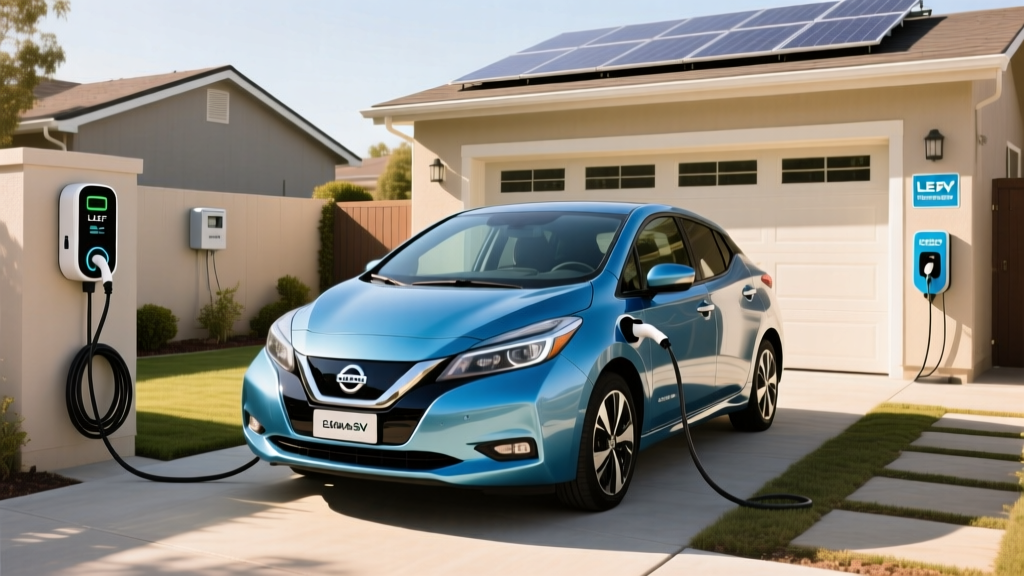
Level 2 is the practical daily charging solution. The 2018 Leaf SV's onboard charger is rated at 6.6 kW, meaning even if you install a 48-amp (11.5 kW) home charger, the car will only draw 6.6 kW. A full charge from empty takes about 6–7 hours — perfect for overnight replenishment. Level 2 charging also enables battery preconditioning through the Leaf's climate control timer, warming the battery for better efficiency and range on cold mornings.
DC Fast Charging uses the CHAdeMO connector on your Leaf. The 2018 model peaks at approximately 50 kW, adding roughly 80% charge in about 40 minutes. However, be aware of the well-documented "Rapidgate" issue: the 2018 Leaf lacks active battery thermal management (it uses passive air cooling), so consecutive DC fast charges in warm weather will trigger aggressive charge-rate throttling to protect the battery. Second and third fast charges in a single day may slow to 20–30 kW or less.
Home Charger Installation: Electrical Requirements, Costs, and Panel Considerations
Installing a Level 2 home charger is the single highest-impact upgrade for any Leaf owner. Here's what's involved electrically and financially.
Electrical Requirements
For a Level 2 charger that will max out the Leaf's 6.6 kW onboard charger, you need a 240V circuit rated at 30 amps or higher. The National Electrical Code (NEC) requires that continuous loads (like EV charging) use no more than 80% of a circuit's rated capacity, so:
- A 30-amp circuit supports up to 24 amps continuous (5.8 kW) — close to the Leaf's limit
- A 40-amp circuit supports up to 32 amps continuous (7.7 kW) — ideal headroom
- A 50-amp circuit supports up to 40 amps continuous (9.6 kW) — future-proof for your next EV
The circuit requires a dedicated double-pole breaker in your electrical panel, appropriate-gauge wiring (10 AWG for 30A, 8 AWG for 40A, 6 AWG for 50A), and a properly rated receptacle (NEMA 14-50 is the most common and versatile) or a hardwired connection.
Do You Need a Panel Upgrade?
This is where costs can jump significantly. Your home's electrical panel must have enough spare capacity to add a 30–50 amp circuit. A licensed electrician will perform a load calculation based on your existing appliances, HVAC, and panel rating.
- 100-amp panel: Likely insufficient if you have electric heating, an electric oven, and a dryer. A panel upgrade to 200 amps may be required — adding $1,500–$3,500+ to the project.
- 150-amp panel: May work if gas appliances are present and the load calculation clears, but could be tight.
- 200-amp panel: Usually sufficient for a 40-amp EV circuit without upgrade.
Homes built before 1990 frequently have 100-amp service. Budget accordingly and get the load calculation done before committing to equipment.
Installation Cost Breakdown
| Cost Component | Typical Range | Notes |
|---|---|---|
| Level 2 Charger (Equipment) | $300–$700 | Varies by brand, power, smart features |
| Electrician Labor | $500–$2,000 | Depends on run length, wall type, conduit |
| Electrical Permit | $50–$250 | Required by most jurisdictions |
| Panel Upgrade (if needed) | $1,500–$3,500 | 100A → 200A service upgrade |
| Total (no panel upgrade) | $850–$2,950 | Most common scenario for modern homes |
| Total (with panel upgrade) | $2,350–$6,450 | Common for older homes |
The Alternative Fuel Vehicle Refueling Property Credit (IRS Form 8911) may cover up to 30% of home charger equipment and installation costs, capped at $1,000, but only if you live in an eligible census tract. Check current IRS rules at irs.gov, as eligibility is location-dependent and subject to change.
CHAdeMO, CCS, and NACS: Connector Compatibility for the 2018 Leaf
The connector landscape has shifted dramatically since the 2018 Leaf was built. Here's where your Leaf stands in 2026:
| Connector Standard | Used By | Compatible with 2018 Leaf? | Notes |
|---|---|---|---|
| CHAdeMO | Nissan Leaf, Mitsubishi Outlander PHEV | ✅ Yes (native) | Your Leaf's DC fast-charge port |
| CCS1 | Most non-Tesla EVs (Ford, GM, Hyundai, VW) | ❌ No | No reliable CHAdeMO-to-CCS adapter exists |
| NACS (Tesla) | Tesla, Ford, GM, Rivian, and most 2025+ EVs | ❌ No | No adapter available for Leaf |
| J1772 | All EVs (Level 2 AC standard) | ✅ Yes (native) | Your Leaf's Level 2 port |
The 2018 Leaf uses CHAdeMO for DC fast charging and J1772 for Level 2 AC charging. This is an important reality in 2026: the North American charging industry has overwhelmingly adopted NACS (Tesla's connector standard), and CHAdeMO infrastructure is shrinking. While Electrify America and some regional networks still maintain CHAdeMO connectors, many newer stations do not include them.
Practical impact: Plan road trips carefully using apps like PlugShare or A Better Routeplanner to filter for CHAdeMO-equipped stations. For daily driving and home charging, the J1772 Level 2 port works universally and poses no compatibility issue.
Cost to Charge: Home vs. Public vs. Gas — What Does Each Mile Cost?
One of the strongest ownership arguments for the Leaf is low fueling cost. The 2018 Leaf SV consumes approximately 30 kWh per 100 miles (or 0.30 kWh per mile) according to EPA data. Let's translate that into dollars.
| Charging Scenario | $/kWh | Cost Per 100 Miles | Cost Per Mile |
|---|---|---|---|
| Home (off-peak utility rate) | $0.08–$0.12 | $2.40–$3.60 | $0.024–$0.036 |
| Home (average US rate) | $0.16 | $4.80 | $0.048 |
| Public Level 2 (network pricing) | $0.25–$0.49 | $7.50–$14.70 | $0.075–$0.147 |
| DC Fast Charging (CHAdeMO station) | $0.35–$0.55 | $10.50–$16.50 | $0.105–$0.165 |
| Gasoline Car (30 MPG, $3.40/gal) | — | $11.33 | $0.113 |
The takeaway: Charging at home on off-peak rates costs roughly 3–4 cents per mile, which is about one-quarter to one-third the cost of gasoline. Even public DC fast charging is cost-competitive with gas in most markets. However, premium-priced public chargers in urban areas can exceed gas costs per mile, which reinforces why home charging is the economic sweet spot for Leaf ownership.
To maximize savings, check if your utility offers a time-of-use (TOU) rate plan with discounted overnight rates. Many utilities offer EV-specific plans that drop rates to $0.06–$0.09/kWh between 11 PM and 6 AM.
Best Level 2 Chargers for the 2018 Nissan Leaf SV
Since the Leaf's onboard charger maxes out at 6.6 kW, you don't technically need a 48-amp charger. But installing a higher-capacity unit future-proofs your setup for your next EV. Here are proven options that pair well with the Leaf today and whatever you drive next:
Emporia Vue Level 2 Charger
- Power Output: 48 amps (11.5 kW at 240V)
- Connector: J1772 (NACS version also available)
- Cable Length: 24 feet
- Smart Features: Wi-Fi, app scheduling, solar integration, energy monitoring
- Price: ~$400
- Why for Leaf: Budget-friendly, smart scheduling aligns with TOU rates, more than enough power for the Leaf's 6.6 kW limit
ChargePoint Home Flex
- Power Output: Configurable 16–50 amps (up to 12 kW)
- Connector: J1772 (NACS adapter available)
- Cable Length: 23 feet
- Smart Features: Wi-Fi, app control, Alexa integration, flexible amperage settings
- Price: ~$550–$700
- Why for Leaf: Adjustable amperage lets you match your circuit exactly; strong app and scheduling features
Grizzl-E Smart
- Power Output: 40 amps (9.6 kW at 240V)
- Connector: J1772
- Cable Length: 24 feet
- Smart Features: Wi-Fi, OCPP protocol, app scheduling
- Price: ~$500
- Why for Leaf: Built in Canada for extreme cold, rugged outdoor-rated enclosure, excellent for unheated garages or outdoor installs
All three chargers are UL-listed (or equivalent), which is required for code compliance and may be required for utility rebate eligibility. Avoid uncertified chargers from unknown brands — they pose fire and insurance risks.
Safety, Code Compliance, and Installation Best Practices
A Level 2 EV charger is a high-draw, continuous-load appliance. Proper installation isn't optional — it protects your home and ensures insurance coverage in the event of an electrical fault.
- Dedicated circuit: The charger must have its own dedicated breaker — never share a circuit with other appliances.
- GFCI protection: NEC 2020 and later requires GFCI (Ground Fault Circuit Interrupter) protection for outdoor receptacles used for EV charging. Many modern chargers have built-in GFCI; if yours doesn't, a GFCI breaker is required for outdoor installs.
- Outdoor rating: If installing outdoors, the charger must carry a NEMA 4 or NEMA 4X rating for weather resistance. All three chargers recommended above meet this standard.
- Permit and inspection: Most jurisdictions require an electrical permit and a post-installation inspection. Skipping this step can void home insurance coverage and cause problems at resale.
- Wire gauge and conduit: Your electrician will size wire and conduit based on circuit amperage and run length. Longer runs (over 50 feet) may require upsized wire to prevent voltage drop.
- Hardwired vs. plug-in: Hardwired installations eliminate the receptacle as a failure point and are preferred for outdoor or high-use setups. Plug-in (NEMA 14-50) offers portability but requires a quality industrial-grade receptacle — avoid cheap residential-grade outlets.
Frequently Asked Questions
How much does it cost to install a home EV charger for the 2018 Nissan Leaf?
Expect $850–$2,950 for a standard installation (equipment, electrician, and permit) if your electrical panel has sufficient capacity. If your home needs a panel upgrade from 100A to 200A service, add $1,500–$3,500, bringing the total to $2,350–$6,450. Get at least two quotes from licensed electricians and ask for a load calculation upfront.
How fast will each charging level add range to the Leaf SV?
Level 1 (120V) adds roughly 4–5 miles per hour. Level 2 (240V) adds approximately 22–25 miles per hour, filling the 40 kWh battery overnight in about 6–7 hours. DC fast charging on CHAdeMO can add up to 100+ miles in 30 minutes, but charge speed tapers significantly above 80% State of Charge and may throttle on repeat charges due to the Leaf's passive thermal management.
Which connector and charger is compatible with the 2018 Nissan Leaf?
The 2018 Leaf uses J1772 for Level 2 AC charging and CHAdeMO for DC fast charging. Any J1772 Level 2 home charger will work. For DC fast charging, you must find stations equipped with CHAdeMO connectors — increasingly rare as the industry shifts to NACS and CCS1. No adapter exists to convert the Leaf's CHAdeMO port to CCS or NACS.
How much does charging the Leaf cost per mile compared to gas?
At home on average US electricity rates (~$0.16/kWh), the Leaf costs about $0.048 per mile to fuel. On off-peak utility rates, that drops to $0.024–$0.036 per mile. A comparable 30 MPG gas car at $3.40 per gallon costs roughly $0.113 per mile. Home charging saves 60–75% per mile versus gasoline.
What electrical upgrades might I need for a Level 2 charger?
You'll need a dedicated 240V circuit (30–50 amps) with a double-pole breaker. Homes with 100-amp electrical panels often need a panel upgrade to 200-amp service to safely accommodate the additional load, especially if you have other electric appliances. A licensed electrician will perform a load calculation to determine whether an upgrade is necessary.
Does the 2018 Leaf SV qualify for any tax credits in 2026?
The 2018 Leaf SV is no longer eligible for the federal §30D new EV tax credit (that applies only to new vehicle purchases). However, if you're buying one used, the Used Clean Vehicle Credit (up to $4,000 or 30% of sale price, whichever is less) may apply if the sale price is $25,000 or less, you meet income limits ($75,000 single / $150,000 joint), and you purchase from a licensed dealer. Verify current rules at irs.gov.