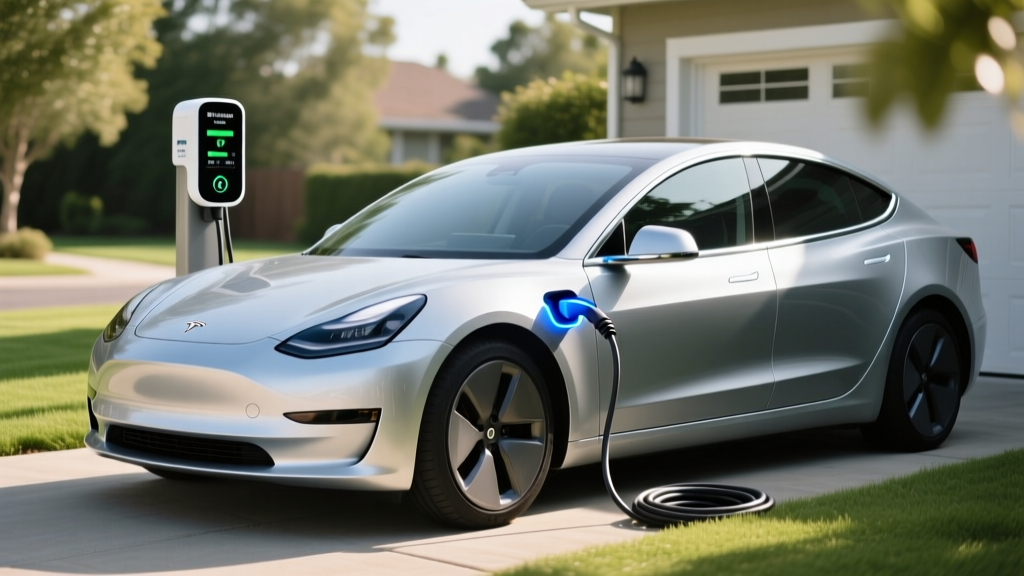
The 2018 Tesla Model 3 Long Range remains one of the most popular used EVs on the road in 2026, and for good reason. With an EPA-rated 310 miles of range and access to the Supercharger network, it's a practical daily driver and road-trip companion. But if you've just picked one up — or you're considering one — understanding exactly how to charge it efficiently at home and on the road is essential. This guide covers every charging scenario, real costs, equipment recommendations, and the electrical upgrades you might face.
Battery: ~75 kWh usable (NMC chemistry) | EPA Range: 310 miles | Max DC Fast Charge: ~170 kW (V2 Supercharger) / ~250 kW (V3 Supercharger, added via OTA) | Level 2 Max Acceptance: 11.5 kW (48A) | Connector: NACS (Tesla proprietary, native)
Charging Levels Explained: How Fast Will Each Level Add Range?
Before plugging in anywhere, you need to understand the three charging tiers available to your 2018 Model 3 Long Range. The critical distinction is between kW (kilowatts — the rate of power delivery, like water pressure) and kWh (kilowatt-hours — the total energy stored in your battery, like the size of the tank). Your battery holds roughly 75 kWh; the charger's kW rating determines how quickly those kWh flow in.
| Level | Voltage | Max Power (kW) | Miles of Range Added Per Hour | Best Use Case |
|---|---|---|---|---|
| Level 1 (120V household outlet) | 120V | ~1.4 kW | ~4-5 miles/hr | Overnight trickle, emergencies |
| Level 2 (240V home/public) | 240V | Up to 11.5 kW | ~37-44 miles/hr | Daily home charging, workplace |
| DC Fast Charging (Supercharger/CCS) | 400V+ | Up to 250 kW (V3) | ~1,000+ miles/hr (peak) | Road trips, quick top-ups |
Real-world context: Level 1 is essentially useless for daily driving unless your commute is under 20 miles round-trip. A full 0-100% charge on Level 1 would take roughly 54 hours. Level 2 at 48 amps (11.5 kW) is the sweet spot for home charging — a depleted battery reaches full in about 7-8 hours, which is ideal for overnight sessions. DC fast charging is for road trips; you'll rarely use it daily because frequent high-power charging accelerates battery degradation over time.
Home Level 2 Installation: Electrical Requirements, Costs & Panel Upgrades
Installing a Level 2 charger at home is the single most impactful upgrade for EV ownership. For the 2018 Model 3 Long Range, you'll want a 240V circuit capable of delivering at least 48 amps to max out the car's onboard charger (11.5 kW). Here's what that involves electrically and financially.
Electrical Requirements
- Circuit: Dedicated 60-amp breaker (EV chargers are continuous loads, so the circuit must be rated 125% above the charger's max draw — a 48A charger requires a 60A circuit)
- Wire: 6 AWG copper (THHN in conduit) or 4 AWG aluminum for runs over 50 feet
- Outlet vs. hardwired: NEMA 14-50 outlet offers flexibility (you can unplug the charger and take it when you move); hardwired units avoid the ~$80 outlet cost and eliminate one potential failure point
- Panel capacity: Your main service panel must have enough spare capacity. A 200-amp panel in a typical home can usually accommodate a 60A EV circuit. Older 100-amp panels almost certainly cannot.
Installation Cost Breakdown
| Component | Cost Range | Notes |
|---|---|---|
| Level 2 charger (equipment) | $350 - $750 | Tesla Wall Connector, ChargePoint, Emporia |
| Electrician labor | $600 - $2,500 | Depends on run length, wall type, conduit needs |
| Electrical permit | $50 - $250 | Varies by municipality; required in most jurisdictions |
| Panel upgrade (if needed) | $1,500 - $4,000 | Required if panel is 100A or has insufficient breaker spaces |
| NEMA 14-50 outlet (optional) | $80 - $150 | If choosing plug-in over hardwired |
| Total (no panel upgrade) | $1,000 - $3,500 | Most common scenario for modern homes |
| Total (with panel upgrade) | $2,500 - $7,500 | Older homes with 100A service |
Safety & Code Considerations
- Dedicated circuit: The EV charger must be on its own dedicated breaker — never shared with other appliances
- GFCI protection: NEC 2020+ requires GFCI protection for outdoor receptacles; many modern chargers have built-in ground fault detection
- Outdoor rating: If your charger mounts outside, ensure it carries a NEMA 4 or IP65 rating for weather resistance
- Permit and inspection: Skipping the permit may save $100-$250 upfront but can void homeowner's insurance coverage for electrical fires and cause problems at resale
DC Fast Charging: Supercharger Speeds & the Charging Curve Reality
The 2018 Model 3 Long Range was originally rated for up to ~170 kW on Tesla's V2 Superchargers. A subsequent over-the-air software update enabled compatibility with V3 Superchargers at up to 250 kW peak. But peak power is only part of the story — the charging curve matters far more for real trip planning.
Here's what actually happens at a V3 Supercharger (250 kW max):
- 10-30% SoC: Peak ~250 kW, adding roughly 15-17 miles per minute
- 30-50% SoC: Tapers to ~150-180 kW
- 50-80% SoC: Further taper to ~75-110 kW
- 80-100% SoC: Dramatically slows to ~25-40 kW (charging above 80% on DC fast chargers is rarely worth the time)
• 10-80% on V3 Supercharger (250 kW peak): ~25-30 minutes
• 10-80% on V2 Supercharger (150 kW peak): ~35-40 minutes
• 10-80% on Electrify America/CCS (with adapter, ~150 kW): ~35-45 minutes
• 0-100% on Level 2 (11.5 kW / 48A): ~7-8 hours
• Precondition the battery by navigating to a Supercharger in the car's nav — this warms the pack and can shave 5-10 minutes off your charge session.
According to fueleconomy.gov, DC fast charging efficiency also depends on ambient temperature. In cold weather (below 32°F), expect 10-80% charge times to increase by 15-25% due to the battery management system limiting charge rate to protect the cells until they warm up.
Connector Compatibility: NACS, CCS & Adapters
Your 2018 Model 3 Long Range came from the factory with Tesla's proprietary connector, now officially designated NACS (North American Charging Standard). In 2026, NACS has become the dominant connector in North America, adopted by Ford, GM, Rivian, Volvo, and most other manufacturers. This is excellent news for Tesla owners — the Supercharger network is now the largest and most reliable DC fast-charging network in the country.
| Connector | Native Support? | Adapter Needed? | Where You'll Find It |
|---|---|---|---|
| NACS (Tesla) | Yes — native | None | Tesla Superchargers, Tesla Destination Chargers, newer public stations |
| CCS1 | No | Tesla CCS Adapter (~$175) | Electrify America, EVgo, ChargePoint DC stations |
| CHAdeMO | No | Third-party adapter (~$300-$400, rare) | Legacy Nissan Leaf stations — largely phased out |
| J1772 (Level 2 public) | No | Tesla J1772 Adapter (included with car) | Public Level 2 stations, workplaces, hotels |
Practical advice: The Tesla CCS adapter is worth buying even if you rarely use non-Tesla chargers. It opens up Electrify America and EVgo stations as backup options in areas where Supercharger coverage has gaps. The J1772 adapter that came with your car handles all public Level 2 stations — keep it in the trunk at all times. CHAdeMO is essentially dead in North America as of 2026; don't invest in that adapter.
Cost to Charge: Per-Mile Breakdown vs. Gasoline
One of the strongest ownership arguments for the 2018 Model 3 Long Range is fuel cost savings. But the actual savings depend heavily on where and when you charge. Here's a data-driven breakdown using the Model 3 LR's efficiency of approximately 26 kWh/100 miles (130 MPGe combined per fueleconomy.gov).
| Charging Scenario | Cost per kWh | Cost per 100 Miles | Cost per Mile |
|---|---|---|---|
| Home (off-peak utility rate) | $0.08 - $0.12 | $2.08 - $3.12 | $0.02 - $0.03 |
| Home (average US rate, 2026) | $0.16 | $4.16 | $0.04 |
| Home (peak TOU rate, e.g., California) | $0.30 - $0.45 | $7.80 - $11.70 | $0.08 - $0.12 |
| Tesla Supercharger (average 2026) | $0.28 - $0.36 | $7.28 - $9.36 | $0.07 - $0.09 |
| Electrify America / public DC | $0.35 - $0.52 | $9.10 - $13.52 | $0.09 - $0.14 |
| Comparison: Gas vehicle at 28 MPG combined, $3.40/gal — $12.14/100 mi — $0.12/mi | |||
Key takeaway: If you charge at home on off-peak rates (the most common scenario for owners with Level 2), you'll spend roughly $600-$950 per year on electricity for 15,000 miles of driving. A comparable gas car at 28 MPG would cost $1,820 per year. That's $900-$1,200 in annual fuel savings. However, if you rely exclusively on public DC fast charging, your costs approach or even exceed gasoline — a critical consideration for apartment dwellers without home charging access.
Best Level 2 Chargers for the 2018 Model 3 Long Range
Since your Model 3 accepts up to 48 amps (11.5 kW), you want a charger that can deliver at least that. Here are three proven options that pair well with this vehicle:
Power: Up to 11.5 kW (48A)
Connector: NACS (native — no adapter needed)
Cable length: 24 feet
Smart features: Wi-Fi, OTA updates, load sharing with second unit, Tesla app integration
Price: ~$475
Best for: Tesla-only households; simplest, most integrated experience
Power: Up to 11.5 kW (48A)
Connector: J1772 (use Tesla's included J1772 adapter) or NACS version available
Cable length: 24 feet
Smart features: Wi-Fi, energy monitoring via Emporia app, solar integration, scheduling
Price: ~$399
Best for: Multi-EV households, solar panel owners, budget-conscious buyers
Power: Up to 12 kW (50A) — configurable via DIP switches
Connector: J1772 (use Tesla adapter) or NACS version
Cable length: 23 feet
Smart features: Wi-Fi, Alexa integration, ChargePoint app with scheduling and cost tracking
Price: ~$699
Best for: Smart-home enthusiasts, those wanting detailed cost/energy tracking
Our recommendation for the 2018 Model 3 Long Range: The Tesla Wall Connector is the default choice. It requires no adapter, communicates directly with the car, and the 24-foot cable gives flexibility in garage placement. If you plan to add a non-Tesla EV to your household, the ChargePoint Home Flex with the NACS connector option gives you universal compatibility at a higher price.
Public Charging Tips & Battery Longevity
The 2018 Model 3 Long Range uses NMC (nickel manganese cobalt) battery chemistry, which is energy-dense but more sensitive to high state-of-charge stress than LFP (lithium iron phosphate) packs. This has practical implications for how you charge:
- Daily charging limit: Set to 80% for daily use. Only charge to 100% when you need the full range for a trip. The car's Battery Management System (BMS) includes a top and bottom buffer, but keeping the pack between 20-80% significantly slows long-term degradation.
- DC fast charging frequency: Occasional Supercharging (a few times a month) won't meaningfully impact battery health. Daily DC fast charging, however, can accelerate degradation by 1-2% per year compared to Level 2 only. If you must rely on public charging daily, prioritize Level 2 public stations over DC fast.
- Preconditioning: Always navigate to a Supercharger using the car's built-in navigation before arriving. This activates battery preconditioning — warming the pack to optimal charging temperature — which can improve charge speed by 20-30% in cool weather.
- Cold weather range loss: Expect 15-30% range reduction in sustained below-freezing temperatures. The 310-mile EPA rating assumes moderate conditions; in January in Minnesota, plan for roughly 220-260 miles of real range.
Frequently Asked Questions
How much does it cost to install a home EV charger for a 2018 Model 3 Long Range?
Expect $1,000-$3,500 for a standard installation with a 60A dedicated circuit and a quality Level 2 charger (no panel upgrade needed). If your home has a 100-amp panel that needs upgrading to 200A, add $1,500-$4,000. The federal §25D Residential Clean Energy Credit may cover 30% of equipment and installation costs — verify current-year eligibility on IRS.gov.
Can I charge my 2018 Model 3 on a regular 120V outlet?
Yes, but it's painfully slow — roughly 4-5 miles of range per hour. That's about 48 miles overnight (12 hours). It works as a stopgap or for very low-mileage drivers, but anyone driving more than 20 miles daily needs a Level 2 installation.
Which charger connector does the 2018 Model 3 Long Range use?
The native connector is NACS (Tesla's proprietary plug, now the North American Charging Standard). No adapter is needed at Tesla Superchargers or Destination Chargers. For CCS stations (Electrify America, EVgo), you'll need Tesla's CCS adapter (~$175). For public Level 2 J1772 stations, use the J1772 adapter that came with the car.
How fast does the 2018 Model 3 Long Range charge on a Supercharger?
On a V3 Supercharger (250 kW peak), expect 10-80% in approximately 25-30 minutes. On a V2 Supercharger (150 kW), the same 10-80% session takes about 35-40 minutes. Cold weather and high battery age can add 5-10 minutes to these times.
Is it bad to Supercharge my 2018 Model 3 Long Range frequently?
Occasional Supercharging (2-4 times per month) has minimal impact on long-term battery health. Daily DC fast charging can accelerate NMC battery degradation by roughly 1-2% additional capacity loss per year compared to exclusive Level 2 charging. For daily charging, a home Level 2 setup at 11.5 kW is the best approach for longevity.
What electrical upgrades might I need for a home charger?
The most common upgrade is a panel replacement from 100A to 200A service ($1,500-$4,000). You may also need a new conduit run from the panel to the garage (add $300-$800 for long runs through finished walls). Some municipalities require a dedicated sub-panel for EV charging. Always get a licensed electrician's load calculation before committing to a charger purchase.