If you own or are buying a used 2017 Tesla Model 3 Long Range, understanding its charging behavior is critical to getting the most out of its 75 kWh battery pack. This was the original Long Range variant that launched with an EPA-estimated 310 miles of range and a peak DC fast-charging rate around 145 kW — respectable for its era but meaningfully different from today's 250 kW+ architectures. Below, we break down every charging scenario you'll encounter: home Level 2 installation, public DC fast charging, connector compatibility (including NACS/CCS adapters in 2026), real cost-per-mile figures, and the electrical upgrades your home might need.
2017 Tesla Model 3 Long Range: Key Charging Specs at a Glance
Before we get into installation and costs, here are the hard numbers that define how this car charges. Note: kW (kilowatts) measures charging power — how fast energy flows. kWh (kilowatt-hours) measures battery capacity — how much energy the pack holds. These are not interchangeable.
| Specification | Value |
|---|---|
| Battery capacity (usable) | ~75 kWh (NMC chemistry) |
| EPA range (original sticker) | 310 miles |
| Real-world range (2026, aged battery) | ~240–275 miles (depending on degradation, weather, driving style) |
| Max DC fast-charge rate | ~145 kW peak (V2 Supercharger compatible) |
| 10–80% DC fast charge time | ~35–40 minutes |
| Level 2 onboard charger | 11.5 kW max (48A) |
| Level 1 (120V) charging | ~1.4 kW (~3–4 miles/hour) |
| Connector (native) | NACS (Tesla proprietary — now the North American Charging Standard) |
| EPA efficiency | 130 MPGe combined (26 kWh/100 mi) |
| Battery warranty (original) | 8 years / 120,000 miles (70% capacity retention threshold) |
How Fast Will Each Charging Level Add Range?
Charging speed depends on three factors: the power source (kW), your Model 3's onboard acceptance rate, and the battery's state of charge. Here's what to expect at each level with the 2017 Model 3 Long Range's 75 kWh pack.
| Level | Voltage / Amps | Power (kW) | Miles of Range per Hour | Full Charge Time (10–100%) |
|---|---|---|---|---|
| Level 1 (standard outlet) | 120V / 12A | ~1.4 kW | 3–4 mi/hr | ~50+ hours |
| Level 2 (home wall connector) | 240V / 48A | 11.5 kW | 30–37 mi/hr | ~7–8 hours |
| Level 2 (public 40A station) | 240V / 40A | 9.6 kW | 25–30 mi/hr | ~8–9 hours |
| DC Fast (Tesla V2 Supercharger) | 400V DC | ~145 kW peak | ~350+ mi/hr (at peak) | 10–80% in ~35–40 min |
| DC Fast (Tesla V3 Supercharger) | 400V DC | ~145 kW (car-limited) | ~350+ mi/hr (at peak) | 10–80% in ~35–40 min |
Critical charging-curve note: The 145 kW peak only holds between roughly 10–30% state of charge. Above 50%, the rate tapers significantly — often dropping below 60 kW past 70% SoC. This is why the 10–80% time is 35–40 minutes even though peak math might suggest faster. The car's battery management system (BMS) throttles current to protect cell longevity. Always plan road-trip stops around the 10–80% window; charging from 80–100% on DC fast can add another 30+ minutes for minimal range gain.
Home Level 2 Installation: Electrical Requirements & Costs
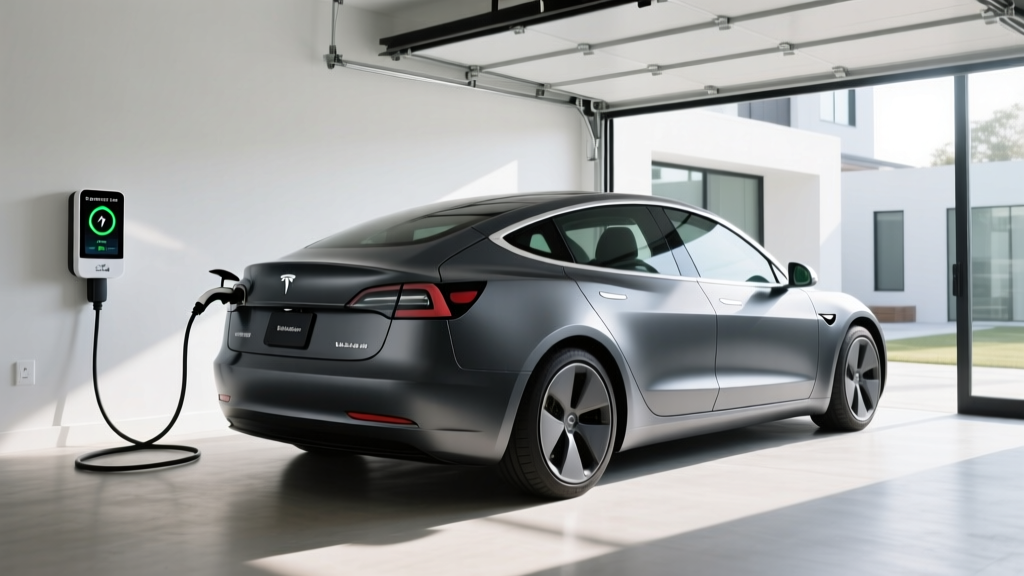
For daily driving, a home Level 2 charger is the single best investment for any 2017 Model 3 LR owner. It eliminates public-charging dependency and takes advantage of off-peak electricity rates. Here's what the installation actually involves.
Electrical Requirements
- Circuit: Dedicated 60-amp breaker (to deliver 48A continuous, per NEC 80% rule for continuous loads)
- Wire: 6 AWG copper (or 4 AWG aluminum) run from panel to charger location
- Voltage: 240V split-phase (standard US residential)
- Panel capacity: Your main panel must have 2 available slots and sufficient amperage headroom (a 200A panel is typical; a 100A panel may require an upgrade)
- Permit: Required in virtually all US jurisdictions — typically $50–$200
Panel Upgrade: The Hidden Cost
Many homes built before 2000 have 100-amp or 150-amp main panels. Adding a 60-amp EV circuit may push total load beyond safe capacity, triggering a panel upgrade to 200 amps. This is the single biggest variable in installation cost and is often overlooked in online estimates. A licensed electrician will perform a load calculation (NEC Article 220) to determine if your panel can handle the addition.
| Component | Cost Range | Notes |
|---|---|---|
| Level 2 charger equipment | $400–$700 | Tesla Wall Connector, ChargePoint Home Flex, etc. |
| Electrician labor (standard install) | $600–$1,500 | Assumes panel within 50 ft of charger location, no conduit complications |
| Permit & inspection | $50–$250 | Varies by municipality |
| Electrical materials (wire, conduit, breaker) | $150–$400 | Depends on run length and local code |
| Standard install total | $1,200–$2,850 | Most homes with 200A panel |
| Panel upgrade (100A → 200A) | $1,500–$4,000+ | Required if existing panel lacks capacity; adds significant cost |
| Total with panel upgrade | $2,700–$6,850+ | Older homes worst-case scenario |
Get at least two quotes from licensed electricians. Ask specifically for a load calculation in writing. The National Electrical Code (NEC) governs these requirements, and your local jurisdiction enforces them.
Connector Compatibility: NACS, CCS, and Adapters in 2026
The 2017 Model 3 Long Range was built with Tesla's proprietary connector, which was formally adopted as the North American Charging Standard (NACS) in late 2022. This is actually excellent news for 2026 ownership: NACS is now the dominant connector in North America, and Tesla's Supercharger network remains the most reliable DC fast-charging infrastructure available.
| Connector Type | Native Support? | Adapter Needed? | Availability in 2026 |
|---|---|---|---|
| NACS (Tesla) | Yes — native | None | Tesla Superchargers, Destination Chargers, most new public stations |
| CCS1 | No | Tesla CCS Adapter (~$175–$250) | Electrify America, EVgo, some ChargePoint DC stations |
| CHAdeMO | No | Aftermarket adapter (rare, expensive) | Largely deprecated in North America by 2026 |
| J1772 (Level 2 public) | No | Tesla J1772 adapter (included with car) | Hotels, workplaces, public Level 2 stations |
Practical advice: Your Model 3 should have come with a J1772-to-Tesla adapter and a Mobile Connector. If buying used, verify these are included — replacements cost $50–$100. The CCS adapter is worth purchasing if you frequently travel in areas where Electrify America or EVgo stations outnumber Superchargers. However, note that the 2017 Model 3's 145 kW peak charge rate means you won't benefit from CCS stations' 350 kW capability — the car limits intake regardless of station output.
Cost to Charge: Home vs. Public vs. Gas Comparison
This is where the 2017 Model 3 Long Range makes a compelling economic case, especially for home charging. Let's break down real cost-per-mile scenarios using the car's EPA efficiency of 26 kWh per 100 miles (or 0.26 kWh/mile).
| Scenario | Rate | Cost per Mile | Annual Cost (12,000 mi) |
|---|---|---|---|
| Home charging (off-peak utility rate) | $0.12/kWh | $0.031 | $374 |
| Home charging (average US rate) | $0.17/kWh | $0.044 | $530 |
| Home charging (high-cost state, e.g. CA) | $0.30/kWh | $0.078 | $936 |
| Public Level 2 (network pricing) | $0.25–$0.49/kWh | $0.065–$0.127 | $780–$1,528 |
| DC fast charging (Supercharger, avg) | $0.28–$0.40/kWh | $0.073–$0.104 | $874–$1,248 |
| DC fast charging (Electrify America) | $0.40–$0.56/kWh | $0.104–$0.146 | $1,248–$1,747 |
| Gas vehicle (25 MPG, $3.50/gal) | $3.50/gallon | $0.140 | $1,680 |
| Gas vehicle (25 MPG, $4.00/gal) | $4.00/gallon | $0.160 | $1,920 |
Even at California's high electricity rates, home charging the Model 3 LR costs roughly half what a 25 MPG gas car costs to fuel. The savings are dramatic with off-peak utility rates — under $400/year for 12,000 miles of driving. However, if you rely exclusively on DC fast charging at premium public rates, the cost advantage narrows considerably, approaching gas-car territory in the worst case.
Pro tip: Many utilities offer time-of-use (TOU) plans with rates as low as $0.06–$0.10/kWh during overnight hours (typically 10 PM–6 AM). Scheduling your Model 3 to charge during these windows — easily done through the car's built-in charge scheduling or the Tesla app — maximizes savings.
Recommended Home Chargers for the 2017 Model 3 LR
The Model 3 LR's onboard charger accepts up to 11.5 kW (48A at 240V). To use that full capacity, you need a charger rated for at least 48A on a 60A circuit. Here are the top options in 2026.
Tesla Wall Connector (Gen 3)
Power: Up to 11.5 kW (48A)
Connector: NACS native — no adapter needed
Cable length: 24 feet
Smart features: Wi-Fi, OTA updates, load sharing with multiple units, Tesla app integration
Price: ~$475
Verdict: Best overall choice for a Tesla. Native NACS means no adapter fumbling. Load-sharing lets you install two units on a single 60A circuit if you add a second EV.
ChargePoint Home Flex
Power: Up to 12 kW (50A, configurable to match circuit)
Connector: J1772 (use Tesla's included adapter) or NACS version available
Cable length: 23 feet
Smart features: Wi-Fi, Alexa integration, detailed energy tracking, flexible amperage settings
Price: ~$650–$700
Verdict: Best if you own or plan to own a non-Tesla EV alongside the Model 3. Amperage is adjustable from 16A to 50A to match your circuit.
Emporia Vue Level 2 Charger
Power: Up to 11.5 kW (48A)
Connector: J1772 (adapter needed for Tesla)
Cable length: 24 feet
Smart features: Energy monitoring, solar integration, scheduling, works with Emporia home energy monitor
Price: ~$400
Verdict: Budget pick with surprisingly good smart features. Ideal if you have solar panels and want to charge on excess production.
For a pure Tesla household, the Tesla Wall Connector is the clear winner: native NACS, competitive price, and seamless integration with the Tesla app. If you anticipate owning a CCS-equipped vehicle in the future, the ChargePoint Home Flex (NACS version) gives you flexibility.
Safety, Code Compliance & Best Practices
EV charging involves sustained high-current draw — the most demanding continuous load in a typical home. Cutting corners here creates fire risk.
- Dedicated circuit: Your Level 2 charger must be on its own dedicated breaker — never shared with other appliances. NEC Article 625 governs EV charging equipment.
- GFCI protection: The 2020 NEC and later require GFCI protection for outdoor receptacles used for EV charging. Many jurisdictions now require GFCI breakers even for hardwired indoor installations. Your electrician will know local requirements.
- Outdoor rating: If installing outdoors (driveway, carport), ensure the charger is rated NEMA 4 (weatherproof). The Tesla Wall Connector and ChargePoint Home Flex both carry NEMA 4 ratings.
- Cable management: Avoid running charging cables across walkways or driveways where they create trip hazards or can be driven over. Use a cable holster or retractable mount.
- No extension cords: Never use an extension cord with an EV charger, including the Mobile Connector. The sustained current draw can overheat undersized cords.
- Hardwired vs. plug: Hardwired installations (no plug) are generally preferred for 48A+ chargers. A NEMA 14-50 receptacle is acceptable up to 40A continuous (50A breaker), but many inspectors now scrutinize 14-50 installations for EV use. Hardwired eliminates receptacle overheating concerns.
Frequently Asked Questions
How much does it cost to install a home EV charger for a 2017 Tesla Model 3?
A standard Level 2 installation (Tesla Wall Connector on a 60A circuit) typically costs $1,200–$2,850 including equipment, labor, materials, and permits — assuming your home has a 200-amp panel with available capacity. If a panel upgrade is needed, total cost can reach $2,700–$6,850+. Always get a load calculation from a licensed electrician before committing.
How fast will each charging level add range to my Model 3 Long Range?
Level 1 (120V standard outlet): approximately 3–4 miles per hour. Level 2 (240V, 48A): approximately 30–37 miles per hour — enough to fully replenish overnight. DC fast charging at a Tesla Supercharger: up to 350+ miles per hour at peak, but tapering significantly above 50% SoC. A 10–80% DC fast charge takes roughly 35–40 minutes.
Which connector and charger are compatible with my 2017 Model 3 Long Range?
Your car uses the NACS (Tesla) connector natively. This connects directly to all Tesla Superchargers and Destination Chargers without an adapter. For J1772 public Level 2 stations, use the Tesla J1772 adapter (typically included with the car). For CCS1 stations like Electrify America, you'll need a Tesla CCS adapter ($175–$250). CHAdeMO is largely obsolete in North America by 2026.
How much does charging cost per mile compared to gas?
With home charging at the US average rate of ~$0.17/kWh, the 2017 Model 3 LR costs about $0.044/mile to fuel — roughly one-quarter the cost of a 25 MPG gas car at $3.50/gallon ($0.14/mile). Annual fuel savings for 12,000 miles of driving: approximately $1,150. Even at California's higher rates ($0.30/kWh), you'd still save ~$740/year vs. gas. Exclusive reliance on premium DC fast charging narrows the gap but still typically undercuts gas.
What electrical upgrades might I need for a home charger?
The most common upgrade is a panel replacement if your existing panel lacks amperage headroom (100A panels often can't support a new 60A circuit). Older homes may also need: a service drop upgrade from the utility (free in some areas), new conduit runs if the panel is far from the garage, or a sub-panel installation. Homes with Federal Pacific or Zinsco panels will require a full replacement regardless of capacity. Get a professional load calculation before purchasing equipment.
Can I use the Tesla Mobile Connector as my primary home charger?
You can, but it's not ideal. The Mobile Connector on a 240V NEMA 14-50 outlet delivers up to 32A (7.7 kW), adding about 20–25 miles per hour — adequate for moderate daily driving but slower than a Wall Connector at 48A. For high-mileage drivers or those who frequently deplete the battery, the Wall Connector's 48A output is meaningfully faster and hardwired installations are safer for sustained use.
Does the 2017 Model 3 Long Range battery degrade? What should I expect?
Yes. Data from fleet studies and owner reports show typical NMC battery degradation of 8–15% over 7–9 years of use. For a 2017 Model 3 LR originally rated at 310 miles EPA, expect roughly 260–285 miles at 100% charge in 2026 under mild conditions. Tesla's battery warranty covers degradation below 70% capacity within 8 years/120,000 miles — meaning most 2017 examples are at or near the end of their warranty coverage period. To minimize further degradation, charge to 80–90% for daily use and avoid frequent DC fast charging above 90%.