The 2017 Nissan Leaf was the last model year of the first-generation Leaf, and it arrived with a meaningful battery upgrade: a 30 kWh pack (up from the prior 24 kWh), pushing the EPA-estimated range to 107 miles. If you own one today or are considering a used purchase, understanding how to charge it efficiently — and what real-world range actually looks like — is essential to getting the most from the car.
This guide covers the 2017 Leaf's range realities, every charging option available to it, what a home Level 2 installation actually costs, and the CHAdeMO connector situation you need to know about in 2026.
2017 Nissan Leaf: Real Range vs. the EPA Sticker
The EPA rates the 2017 Leaf (30 kWh battery) at 107 miles of combined range. That number was competitive in 2017, but it requires context for real-world driving.
Real-World Highway (65-75 mph): ~80-90 miles
Cold Weather (below 32°F): ~65-80 miles
Mild Weather City: ~110-120 miles
The Leaf's lack of active liquid battery thermal management means both extreme heat and cold significantly affect range and long-term battery health.
The 30 kWh pack in the 2017 Leaf uses NMC (nickel manganese cobalt) chemistry. Unlike later Leafs and many competitors, this generation relies on passive air cooling for the battery. In sustained highway driving or repeated DC fast-charging sessions, the pack heats up, which slows charging speeds and accelerates degradation. Owners in hot climates like Arizona or Texas should expect more capacity loss over time than those in moderate regions.
| Specification | Value |
|---|---|
| Battery Capacity | 30 kWh (NMC) |
| EPA Range | 107 miles |
| EPA Efficiency | 112 MPGe (30 kWh/100 mi) |
| Max DC Fast Charge | ~50 kW (CHAdeMO) |
| Level 2 Onboard Charger | 6.6 kW (J1772) |
| 0-60 mph | ~10.0 seconds |
| Horsepower | 107 hp |
| Original MSRP | $30,680 (S) – $36,200 (SL) |
| Battery Warranty (original) | 8 yr / 100,000 mi (capacity loss below 9 bars on gauge) |
Source: fueleconomy.gov
Charging Levels Explained: Speeds in kW and Miles Per Hour
A critical distinction for any EV owner: kW (kilowatts) measures the rate of power delivery — how fast energy flows into the battery. kWh (kilowatt-hours) measures the total energy stored — the battery's capacity. Think of kW as the width of a hose and kWh as the size of the bucket.
Here's how each charging level performs with the 2017 Leaf's 30 kWh battery:
| Level | Power (kW) | Miles of Range/Hour | Full Charge Time (0-100%) | Connector |
|---|---|---|---|---|
| Level 1 (120V) | 1.2-1.4 kW | ~4-5 mi/hr | ~24-28 hours | Standard outlet (J1772 plug) |
| Level 2 (240V) | 6.6 kW (max) | ~22-25 mi/hr | ~5 hours | J1772 |
| DC Fast Charge | ~50 kW peak | ~150+ mi/hr (to 80%) | ~30 min (0-80%) | CHAdeMO |
Important charging-curve note: The Leaf's DC fast charging peaks near 50 kW only when the battery state of charge (SoC) is low (roughly 10-30%) and the pack is at an optimal temperature. As SoC climbs past 60-70%, the charge rate tapers significantly. Above 80%, speeds can drop below 15 kW. This is normal battery management — lithium-ion cells accept charge more slowly as they fill to prevent overheating and lithium plating.
The CHAdeMO Connector Problem in 2026
The 2017 Leaf uses the CHAdeMO connector for DC fast charging and the J1772 connector for Level 1 and Level 2 AC charging. This matters more now than ever.
| Connector | Leaf Support | Network Availability (2026) | Adapter Available? |
|---|---|---|---|
| J1772 (Level 2 AC) | Native | Universal — all public L2 stations | N/A (native) |
| NACS (Tesla/J3400) | No | Dominant — Tesla Superchargers + most new stations | No CHAdeMO-to-NACS adapter exists for DC |
| CCS1 (Combined Charging System) | No | Widely available (Electrify America, EVgo) | No CHAdeMO-to-CCS adapter exists for DC |
| CHAdeMO | Native | Declining — Electrify America removed CHAdeMO; some EVgo and independent stations remain | N/A (native) |
This is the hardest truth about owning a 2017 Leaf in 2026: CHAdeMO DC fast-charging infrastructure is shrinking. Electrify America never supported CHAdeMO. Most new DC installations are NACS (the Tesla/J3400 standard now adopted by nearly every automaker) or CCS1. Your best DC fast-charging options are EVgo stations (which still maintain some CHAdeMO connectors in many markets) and older ChargePoint or independent CHAdeMO stations. Use apps like PlugShare to verify CHAdeMO availability before planning a road trip.
For Level 2 AC charging, the J1772 connector on the Leaf remains fully compatible with virtually every public Level 2 station and home charger in North America. If you have a NACS-only home charger (like a Tesla Wall Connector), you'll need a J1772-to-NACS adapter (~$100-$150) to use it with the Leaf.
Home Level 2 Charger Installation: Requirements, Costs & Panel Upgrades
A Level 2 home charger is the single most impactful upgrade for daily EV ownership. For the 2017 Leaf with its 6.6 kW onboard charger, you want a Level 2 station that can deliver at least 32 amps (7.7 kW) to ensure you're getting the Leaf's full 6.6 kW charge rate with headroom.
Electrical Requirements
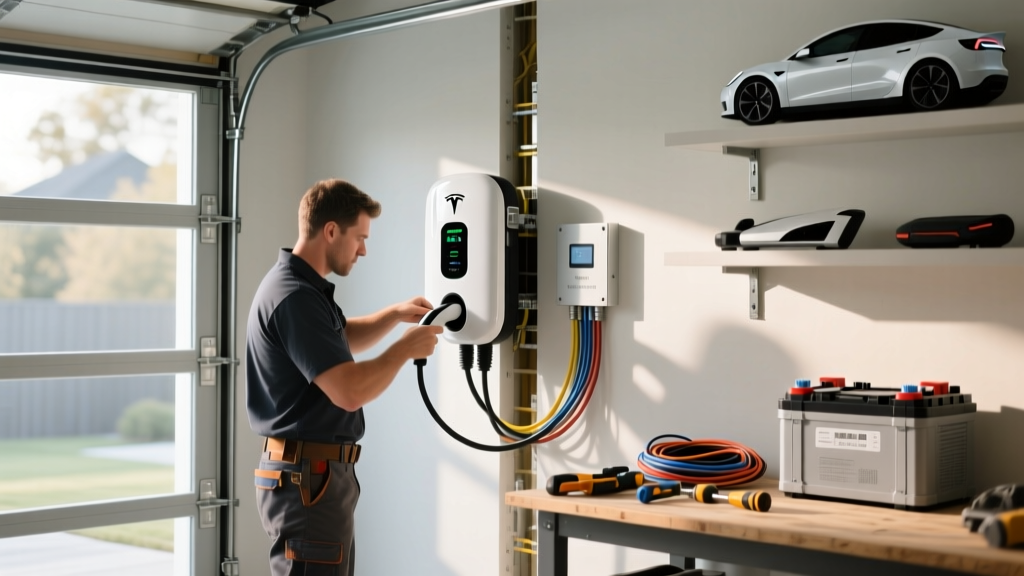
- Circuit: Dedicated 40-amp, 240V circuit (for a 32A charger) or 50-amp circuit (for a 40A/48A charger)
- Breaker: The circuit breaker must be rated at 125% of the continuous load — a 32A charger requires a 40A breaker; a 40A charger requires a 50A breaker
- Wire: 6 AWG copper (for 40A) or 4 AWG copper (for 50A) in most jurisdictions
- Outlet vs. hardwired: A NEMA 14-50 outlet offers portability; hardwired installations are often cheaper and avoid the NEC requirement for GFCI breakers on receptacles (which can cause nuisance tripping with some EV chargers)
- Permit: Most jurisdictions require an electrical permit ($50-$200) and a final inspection
Will You Need a Panel Upgrade?
This is the question that can double or triple your installation cost. The 2017 Leaf's 6.6 kW draw represents about 28 amps at 240V. If your home has a 100-amp electrical panel that's already near capacity (common in older homes), adding a 40A dedicated circuit may exceed the panel's rated capacity. A licensed electrician will perform a load calculation per NEC Article 220 to determine whether your panel can handle the additional draw.
If you need a panel upgrade from 100A to 200A, expect to pay $1,500-$3,500 additional. Homes built after 2000 typically have 200A panels and rarely need upgrades for a single EV charger.
| Component | Simple Install (near panel) | Complex Install (long run/conduit) |
|---|---|---|
| Level 2 Charger (32-48A) | $350-$650 | $350-$650 |
| Electrician labor + materials | $300-$600 | $800-$2,000 |
| Electrical permit | $50-$150 | $50-$200 |
| Panel upgrade (if needed) | $0 | $1,500-$3,500 |
| Total | $700-$1,400 | $2,700-$6,350 |
Note: The federal Residential Clean Energy Credit (IRC §25C) may cover up to 30% of charger equipment and installation costs (up to $1,000) for equipment placed in service. Consult a tax professional for eligibility. Some utilities also offer rebates of $200-$500 for smart charger installations.
Recommended Level 2 Chargers for the 2017 Leaf
Since the Leaf's onboard charger caps at 6.6 kW, you don't need a 48A charger — but buying a more capable unit gives you flexibility for a future EV. Here are three proven options:
Emporia Level 2 EV Charger — Best Value
- Power Output: 48A max (11.5 kW at 240V)
- Connector: J1772 (native for Leaf); NACS adapter available
- Cable Length: 24 feet
- Smart Features: Wi-Fi, app scheduling, energy monitoring, solar integration
- Price: ~$399
- Why for the Leaf: The Leaf will draw its max 6.6 kW (28A). The Emporia's scheduling features let you charge during off-peak utility rates, saving money.
ChargePoint Home Flex — Most Flexible
- Power Output: Configurable 16A-50A (up to 12 kW)
- Connector: J1772 (native); NACS version also available
- Cable Length: 23 feet
- Smart Features: Wi-Fi, app with detailed session data, Alexa integration, amperage adjustable to match your circuit
- Price: ~$549
- Why for the Leaf: You can set it to 32A on a 40A circuit — perfect for the Leaf's 6.6 kW max, with the option to increase amperage for a future vehicle.
Tesla Wall Connector — Best if You Also Own a Tesla
- Power Output: 48A max (11.5 kW at 240V)
- Connector: NACS (requires J1772-to-NACS adapter for Leaf, ~$100-$150)
- Cable Length: 24 feet
- Smart Features: Wi-Fi, over-the-air updates, power sharing between two units
- Price: ~$450 (+ adapter cost)
- Why for the Leaf: Only makes sense if you have a Tesla in the household. The adapter adds cost but lets both vehicles share one charger.
Charging Cost Per Mile: Leaf vs. Gasoline Car
One of the strongest arguments for the 2017 Leaf is operating cost. At 30 kWh per 100 miles (its EPA-rated consumption), here's what charging actually costs in different scenarios:
| Scenario | Rate | Cost Per Mile (Leaf) | Cost Per Mile (30 MPG @ $3.40/gal) |
|---|---|---|---|
| Home Off-Peak (utility rate) | $0.09/kWh | $0.027/mi | $0.113/mi |
| Home Average (national) | $0.17/kWh | $0.051/mi | $0.113/mi |
| Public Level 2 (ChargePoint/EVgo) | $0.25-$0.40/kWh | $0.075-$0.12/mi | $0.113/mi |
| DC Fast Charge (public) | $0.35-$0.55/kWh | $0.105-$0.165/mi | $0.113/mi |
At home on off-peak rates, the Leaf costs roughly one-quarter what a 30 MPG gas car costs per mile. Even on public DC fast charging at premium rates, the Leaf can be cost-competitive with gasoline — though relying exclusively on public DC fast charging erodes the cost advantage and, for the Leaf's passively-cooled battery, accelerates degradation.
For a driver covering 12,000 miles per year with home charging at the national average rate ($0.17/kWh), annual fuel cost is approximately $612 for the Leaf versus $1,360 for a 30 MPG gas car — a savings of about $748 per year.
Battery Degradation and Longevity for the 2017 Leaf
The 2017 Leaf's passive battery thermal management is its most significant long-term limitation. Data from Leaf owners tracked on platforms like MyNissanLeaf and Battery Age show that 30 kWh packs in hot climates can lose 15-25% of original capacity within 5-7 years. In moderate climates, 10-15% loss over the same period is more typical.
Nissan's original battery warranty covered capacity loss below 9 bars (out of 12) on the dashboard capacity gauge within 8 years or 100,000 miles. By 2026, most 2017 Leafs are past the time limit of this warranty. If you're buying used, check the capacity bar display on the dash — a car showing 10 or fewer bars has experienced measurable degradation.
A replacement 30 kWh battery pack from Nissan costs approximately $6,500-$8,500 installed (pricing varies by dealer). Third-party refurbishment shops offer pack rebuilds for $3,500-$5,500 in some markets. Given the vehicle's used market value of roughly $8,000-$13,000 depending on condition and mileage, a battery replacement is a significant economic decision relative to the car's value.
Safety and Electrical Code Considerations
Whether you're installing a Level 2 charger in a garage or outdoors, these code and safety requirements apply:
- Dedicated circuit: NEC requires EV chargers to be on a dedicated circuit — it cannot share with other outlets or appliances.
- GFCI protection: The 2020 NEC (and later) requires GFCI protection for receptacles used for EV charging. Hardwired installations are exempt from this requirement, which is why many electricians recommend hardwiring to avoid nuisance tripping.
- Outdoor rating: If installing outdoors, the charger must carry a NEMA 4 or NEMA 4X rating for weather resistance. All three chargers recommended above are outdoor-rated.
- Cable management: Use a wall-mounted cable organizer to prevent tripping hazards and connector damage. Never run charging cables across walkways or driveways where vehicles can drive over them.
- Ventilation: The Leaf's battery doesn't off-gas during normal charging, so garage installation doesn't require special ventilation beyond standard garage code.
Frequently Asked Questions
How much does it cost to install a home EV charger for a 2017 Nissan Leaf?
For a straightforward installation with an adequate electrical panel, expect $700-$1,400 total (charger + electrician + permit). If your home needs a panel upgrade or a long conduit run, costs can reach $2,700-$6,350. Get at least two quotes from licensed electricians who have EV charger installation experience.
How fast will each charging level add range to my Leaf?
Level 1 (120V household outlet) adds about 4-5 miles of range per hour — adequate only for overnight topping up if you drive less than 40 miles daily. Level 2 (240V home charger) adds about 22-25 miles per hour and fully recharges the 30 kWh battery in roughly 5 hours. DC fast charging at a CHAdeMO station can take the battery from 10% to 80% in about 30 minutes at peak speeds near 50 kW.
Which connector and charger is compatible with my 2017 Leaf?
The 2017 Leaf uses J1772 for AC charging (Level 1 and Level 2) and CHAdeMO for DC fast charging. Any J1772 Level 2 home charger or public station works natively. For DC fast charging, you must find a station with a CHAdeMO connector — check PlugShare or your preferred charging app to filter for CHAdeMO availability. There are no reliable adapters to convert the Leaf's CHAdeMO port to CCS or NACS for DC charging.
How much does charging the Leaf cost per mile compared to gasoline?
Charging at home at the national average electricity rate ($0.17/kWh), the Leaf costs about $0.051 per mile. A comparable 30 MPG gas car at $3.40/gallon costs $0.113 per mile. Home charging saves roughly $0.06 per mile, or about $720 per year at 12,000 miles annually. Off-peak utility rates can push the Leaf's cost below $0.03 per mile.
What electrical upgrades might I need for a Level 2 charger?
The most common upgrade is a panel capacity increase from 100A to 200A ($1,500-$3,500) if your existing panel is near capacity. Other potential needs include: adding a new 240V circuit with appropriate-gauge wiring, installing a NEMA 14-50 outlet or hardwired junction box, and obtaining an electrical permit. Homes built after 2000 with 200A panels usually need only the new circuit and outlet/hardwire.
Can I use a Tesla Supercharger with my 2017 Leaf?
No. Tesla Superchargers use the NACS connector and do not support CHAdeMO. There is no commercially available adapter that allows a CHAdeMO-equipped vehicle to use a NACS or CCS DC fast charger. Your DC fast-charging options are limited to stations that still maintain CHAdeMO connectors, primarily on the EVgo network and some independent operators.
Is the 2017 Leaf a good used EV purchase in 2026?
It depends on your needs. The 107-mile EPA range (likely 80-95 miles real-world in a used example with some degradation) suits city commuting and short errands well, especially if you can charge at home. The low purchase price ($8,000-$13,000 used) and low operating costs are genuine advantages. The limitations — declining CHAdeMO infrastructure, passive battery cooling, and short range — make it unsuitable as a primary vehicle for long-distance driving or for buyers without reliable home charging access.